The Loss of Spiritual Power Explains the Appeal to Civil Power.
By Geo. B. Wheeler
From “Baptist Principles of Religious Liberty,” by Geo. B. Wheeler.
IN the “Hallowed Day” before referred to, it is said:—
“We see the sad spectacle of the great moral and religious activities of the Church dropped down into the rut of the ordinary routine of mere business affairs, while her beautiful and glorious life is shorn of its spiritual power.”—Page 20.
A paper read before the New York Baptist Pastors’ Conference, Feb. 4, 1895, says:—
“The writer feels that this is a pleasure-loving age, when too many of our churches have degenerated into religious clubs, to gratify the esthetic tastes of the wealthy; when refined Christians excuse themselves from disagreeable civic and other duties; when pig sty tenements are rented to the poor at twenty per cent. on value, buildings rented for saloons and brothels, and even license petitions signed by nominal Christians; when the faces of the poor are ground by sweat house proprietors and by iniquitous combinations and trusts in which those who claim to be Christians are interested.”
One of the last articles written by the late Dr. A. J. Gordon, entitled “Drifts Among Baptists,” in the Watchman, Feb. 14, 1895. says:—
“It is no secret that the liturgical tendency has appeared in some of our Baptist congregations. It has manifested itself indeed in a very mild form—in the chanting of responses, in the use of occasional collects, and in the recitation of the Lord’s Prayer and of the Apostle’s Creed. This we have met in a few churches, while in many we have encountered a musical service so elaborate and long-drawn-out as to drive the sermon into very narrow quarters. Then quite generally our churches have fallen into line in observing sacred days—Christmas, Good Friday, and Easter. Far be it from us269to restrict the liberty in such matters. Yet the practical observation must be made, that ritualism, like eczema in the human body, is generally the symptom of a low state of the blood. As a rule, when the Church becomes secularized, it becomes ritualized, while it is equally true that great revivals pouring through the Church, have almost always burst the liturgical bands and restored it to the freedom of the Spirit.”
Rev. Walter Evans, in an article in the Arena, October, 1895, says:—
“The church of the apostles and martyrs, few in numbers, unorganized, poor, despised and persecuted because it was pure, was invincible. But the church of victorious Constantine—the church of royal patronage, intoxicated with worldly success, lulled in the lap of luxury, first slept in security, and then (all but) died in iniquity. So it is ever. Shall history repeat itself? We hope not. We pray not. But no careful observer of men, and events as reflected in the secular and religious press, can fail to see that the relative power of the church over the masses for public and personal righteousness in this nation, has most signally and sadly failed to keep pace with the increase in the number of communicants in the churches. There has been indeed an increase of numbers in the church, but relatively a decline in moral influence and spiritual power. The church has waxed; religion has waned; Christians have multiplied: but the significance of the term has become indefinitely vague; quantity has been attained, but quality lost.”
“Send your petitions to the throne of God, and not to the Congress of the United States.”
In a remonstrance and petition against allowing the State to judge in matters of conscience, sent to the Connecticut legislature in 1791, it is said:—
“And we long to see religion left entirely in the hands of Christ, to be governed alone by his laws, that the grand controversy may be decided, whether religion is such an adjective that it cannot stand of itself, or so important that it will support itself upon its own merits, and all who trust in it.”
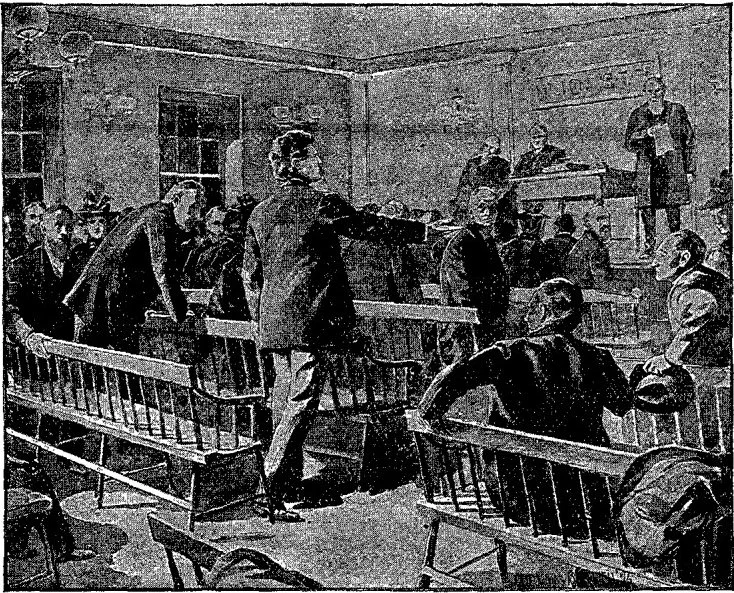
O that Baptists would heed the pleadings of a Russian boy, addressed in 1892 to a prayer-meeting in the First Baptist Church of Chicago, following a call of the leader of the meeting for signatures to a petition to Congress for a Sunday law closing the World’s Fair on Sunday! Following is the boy’s appeal:—
“I am from Russia, the land of intolerance; the land of a union of Church and State. I have seen the scars on the wrists of the missionaries whom you sent to my country—scars made by chains placed on them by Russia’s union of Church and State. I joined the Baptist Church in Russia because it trusted in God, not in the State. And now I come to America and enter my beloved Baptist Church, and hear you petitioning Congress for a law to bind chains on the wrists of your fellowmen. I appeal to you in the name of God, Send your petitions to the throne of God, and not to the Congress of the United States.”
The statement so often made that Christianity in this country cannot be maintained unless its chief bulwark—the Sabbath—be supported by the civil law, is a terrible reflection on the power of Him who declared that he would be with his disciples till the end of the world, and who said, “All power is given unto me in heaven and in earth.” It is equivalent to saying that in this country where Christians are protected in every way in the promulgation and practice of their religion (with the single exception of seventh-day observers), their religion is so devoid of vital, inherent power, that without the direct support of the human arm of civil power, regard for its precepts will perish from the hearts of men.
What the Church needs to-day is not civil power, but divine power; a revival of primitive, apostolic, Holy-Spirit religion. The writer appeals to Baptists in the language of the Russian boy, “Send your petitions to the throne of God, and not to the Congress of the United States.”