May 28, the following bill was introduced in the Senate by Mr. Kyle, by request, was read twice and referred to the Committee on the District of Columbia:—
A BILL
To regulate labor and business on Sunday in the District of Columbia.
Be it enacted by the Senate and House of Representatives of the United States of America in Congress assembled, That the heads of Government Departments or bureaus, the courts of justice, and the board of trustees of common schools in Washington shall not, except as hereinafter provided, require subordinate officers or employés to perform work on or during Sunday: Provided however, That nothing herein contained shall apply to the Executive Department, the Capitol, the Naval Yard, the Weather Bureau, the Metropolitan Police, or the employés about the courts, the police stations, the jail, or the District buildings.
Sec. 2. That it shall not be lawful for any person to keep open on Sunday any place of business for the transaction of business in which money is received, except restaurants, apothecaries, physicians, bakers, undertakers, vendors of milk, vendors of ice, vendors of fruit or other perishable merchandise, vendors of soda water, ice cream, or refreshments other than intoxicants, publishers and vendors of newspapers, telegraph and telephone operators, street-car, rail-road, steamboat, herdic, and omnibus companies, hotels and boarding-house keepers, and salaried preachers, janitors, livery-stable keepers, and other persons whose business contributes to the comfort or instruction of the public and is not of such a nature as to disturb public assemblies or the peace or good order of the community.
Sec. 3. That public assemblies of any kind held on Sunday shall be conducted in a quiet and orderly manner, so as not to interfere with the peace of residents in their neighborhood.
Sec. 4. That no church bells shall be rung before eight o'clock antemeridian, or after seven o'clock postmeridian; and no bell shall be rung more than two minutes at a time or oftener than every half hour.
Sec. 5. That the Congressional Library, National Museum, Smithsonian Institution, Monument, and Capitol shall be kept open on Sundays, from nine o'clock in the forenoon to four o'clock in the afternoon, for the accommodation of the public.
Sec. 6. That the penalty for the willful violation of any of the provisions of this Act shall be a fine not exceeding twenty dollars or imprisonment not exceeding ten days, at the discretion of the court; but it shall be a sufficient defense to a prosecution for labor on Sunday that the defendant usually keeps another day of the week as a day of rest.
Sec. 7. That all acts and parts of acts inconsistent with this Act are hereby repealed.
This bill is a curious illustration of the universality of the idea that there must be some legislation concerning Sunday. It reminds one of the story of the boys in a sinking boat. They could neither pray nor sing, so one of them, remarking that “something religious has got to be done,” proceeded to take up a collection!
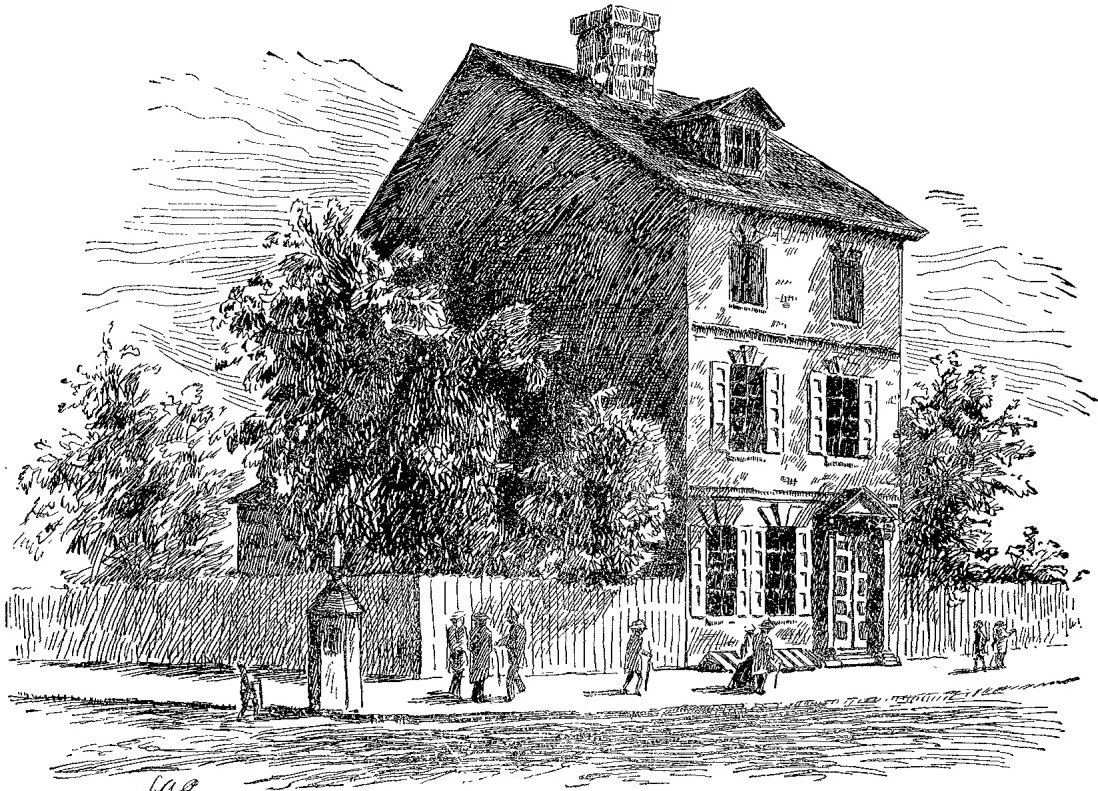
House at 702 Market Street, Philadelphia, in Which the Declaration of Independence Was Written.
• An unwholesome sentiment demands something religious of the government, and so divers Sunday bills are proposed. This, the latest one introduced, would be about as harmless as any such “law” could be, so far as interfering with anybody is concerned; but it violates the principle just as much as though it were an ironclad National Reform measure.