Elijah P. Lovejoy,

3%

Pacific Press Publishing Company · New York · Jun 24, 1897

FromThe American Sentinel, Vol. 12, No. 25.

Read the full edition

Elijah P. Lovejoy,

A MARTYR TO THE CAUSE OF LIBERTY.
BY R. M. KILGORE.
SIXTY years ago this noble man closed his brief, heroic life in the battle for civil and religious liberty, at Alton, Ill. The fair name of that free State was tarnished by, and her soil was the first to drink, the blood of one who stood bravely in defense of the God-given right of all men to “life, liberty, and the pursuit of happiness.” The bondage and slavery of three million men and women at that time were more than his sense of justice could endure. He saw in that, his, and the freedom of every other man, involved; he could not keep silent, and at the age of thirty-two, he announced to the world his position, in these words:—
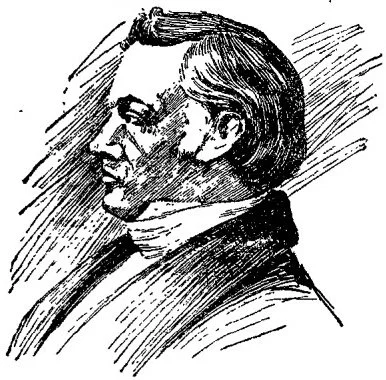
ELIJAH P. LOVEJOY.
ELIJAH P. LOVEJOY.
“I have sworn eternal opposition to slavery, and by the blessing of God, I will never go back.”
He was a Presbyterian minister, but was called to the editorship of the St. Louis Observer, the first number of which was dated November 22, 1833. His views on the slavery question were not to be tolerated in Missouri, and prominent citizens of St. Louis objected to the discussion of the subject in the columns of his paper, and “warned Mr. Lovejoy that his views were dangerous, and would lead to violence.” The editor replied with an appeal “To my fellow-citizens,” repeating his views as to slavery, and calling attention to the clause of the constitution of Missouri declaring that “the free communication of thoughts and opinions is one of the inalienable rights of man, and that every person may freely speak, write and print on any subject—being responsible for the abuse of that liberty.” The deliberate determination is announced in one of the closing paragraphs of the appeal:—
“I do, therefore, as an American citizen and Christian patriot, and in the name of liberty, law and religion, solemnly protest against all these attempts, howsoever and by whomsoever made, to frown down the liberty of the press and forbid the free expression of opinion. Under a deep sense of my obligations to my country, the church and my God, I declare it to be my fixed purpose to submit to no such dictation. And I am prepared to abide by the consequences. I have appealed to the constitution and laws of my country; if they fail to protect me, I appeal to God, and with him I cheerfully rest my cause.”
The St. Louis Globe Democrat, of June 4, 1897, gives the following graphic account of the scenes that followed, and Mr. Lovejoy’s replies to the attacks made against the principles he so fondly cherished. They were dearer to him than life.
The Democrat says:—
“The opposition of the people grew stronger as the editor continued his attacks on slavery, and the owners of the paper finally decided to move it to Alton, that being in a free State, and the people of the town apparently having no objection to the transfer. Before this was done, however, persons entered the Observer office, broke up some of the furniture and material, and threw the remains into the river. The press was not seriously damaged, and it was shipped to Alton, where it was immediately destroyed by persons unknown, and thrown into the river. A public meeting was held by the citizens of Alton, and this act denounced, although the Assembly declared itself not in sympathy with Mr. Lovejoy’s views. A new press was procured, and the publication of the Observer was resumed Sept. 8, 1836, and continued without interruption, but not without opposition, until August, 1837. On July 11, 1837, at a public meeting, resolutions were adopted condemning the course of the Observer, and a committee appointed to present them to Lovejoy. His reply was dignified and dispassionate, but manifested an unalterable purpose:—
‘As long as I am an American citizen, and as long as American blood runs in these veins, I shall hold myself at liberty to speak, to write, to publish whatever I please on any subject—being amenable to the laws of my country for the same.’”
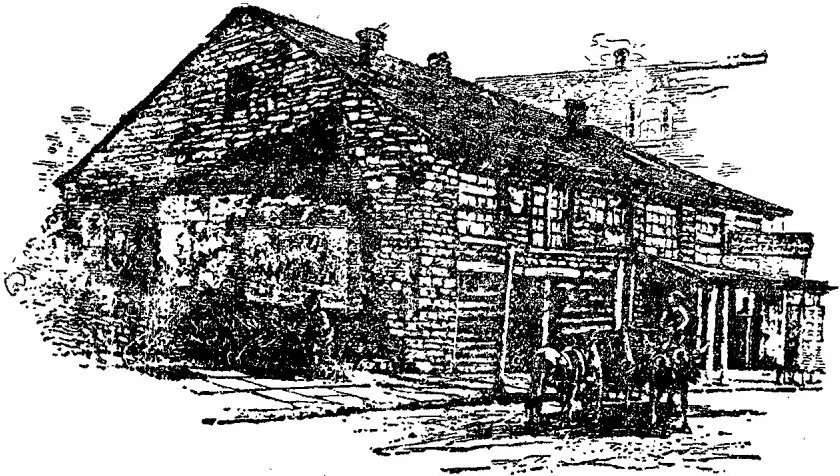
LOVEJOY'S PRINTING OFFICE AT ALTON, ILL.
“The office of the Observer was broken into by a mob on the night of August 21, and the press and printing material completely destroyed. A month later a third press was received and placed in a warehouse on Second Street. The same night it was taken out, broken up and thrown into the river. Undismayed, Lovejoy ordered a fourth press. Before its arrival excitement rose to fever heat, and on November 3 a public indignation meeting was held. Strong condemnatory resolutions were presented by a committee appointed to prepare them. Lovejoy was present, and was allowed to speak in his own behalf.
“Mr. Lovejoy said:—
‘I feel, Mr. Chairman, that this is the most solemn moment of my life. I feel, I trust, in some measure the responsibilities which at this hour I sustain to those, my fellow-citizens, to the church of which I am a minister, to my country, and to God. And let me beg of you, before I proceed further, to construe nothing I shall say as being disrespectful to this assembly. I have no such feeling; far from it. And if I do not act or speak according to their wishes at all times, it is because I cannot conscientiously do it.
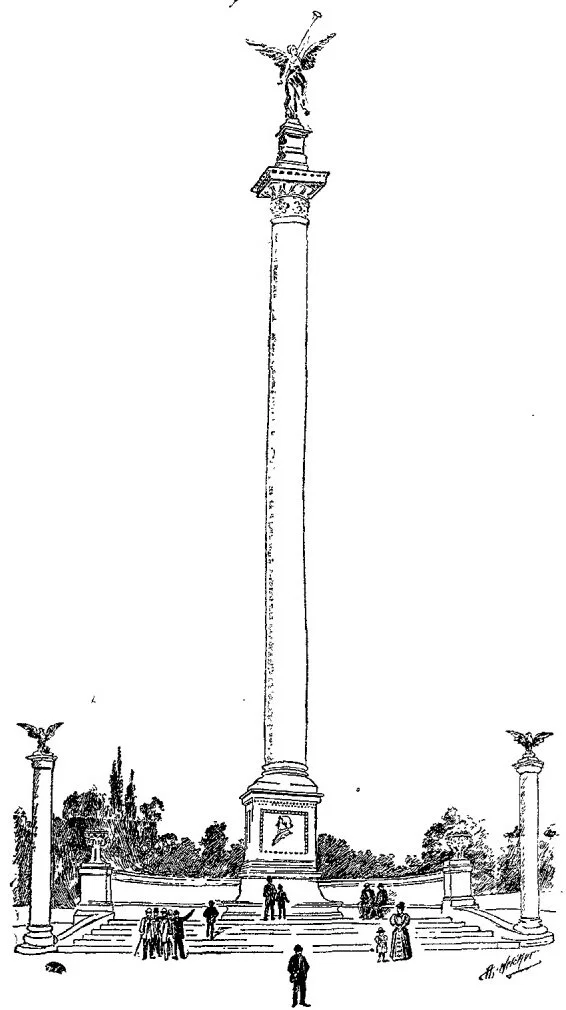
THE LOVEJOY MONUMENT AT ALTON, ILL.
(Recently completed and about to be dedicated. Height 90 feet.)
THE LOVEJOY MONUMENT AT ALTON, ILL. (Recently completed and about to be dedicated. Height 90 feet.)
‘It is proper I should state the whole matter, as I understand it, before this audience. I do not stand here to argue the questions as presented by the report of the committee. My only wonder is that the honorable gentleman, the chairman of that committee, for whose character I entertain great respect, though I have not the pleasure of his personal acquaintance—my only wonder is how that gentleman could have brought himself to submit such a report.
‘Mr. Chairman, I do not admit that it is the business of this assembly to decide whether I shall or shall not publish a newspaper in this city. The gentlemen have, as the lawyers say, made a wrong issue. I have the right to do it. I know that I have the right freely to speak and publish my sentiments, subject only to the laws of the land for the abuse of that right. This right was given me by my Maker, and is solemnly guaranteed to me by the Constitution of these United States and of this State. What I wish to know of you is whether you will protect me in the exercise of this right, or whether, as heretofore, I am to be subjected to personal indignity and outrage. These resolutions, and the measures proposed by them, are spoken of as a compromise—a compromise between two parties. Mr. Chairman, this is not so. There is but one party here. It is simply a question whether the law shall be enforced, or whether the mob shall be allowed, as they now do, to continue to trample it under their feet, by violating with impunity the rights of an innocent individual.
‘Mr. Chairman, what have I to compromise? If freely to forgive those who have so greatly injured me, if to pray for their temporal and eternal happiness, if still to wish for the prosperity of your city and State, notwithstanding all the indignities I have suffered in it; if this be the compromise intended, then do I willingly make it. My rights have been shamefully, wickedly outraged; this I know, and feel, and can never forget. But I can and do freely forgive those who have done it.
‘But if by a compromise is meant that I should cease from doing that which duty requires of me, I cannot make it. And the reason is, that I fear God more than I fear man. Think not that I would lightly go contrary to public sentiment around me. The good opinion of my fellowmen is dear to me, and I would sacrifice anything but principle to obtain their good wishes; but when they ask me to surrender this, they ask for more than I can—more than I dare give.
‘Reference is made to the fact that I offered a few days since to give up the editorship of the Observer into other hands. This is true. I did so because it was thought or said by some that perhaps the paper would be better patronized in other hands. They declined accepting my offer, however, and since then we have heard from the friends and supporters of the paper in all parts of the State. There was but one sentiment among them; and this was that the paper could be sustained in no other hands than mine.
‘It is also a very different question whether I shall voluntarily, or at the request of friends, yield up my post; or whether I shall forsake it at the demand of a mob. The former I am at all times ready to do, when circumstances occur to require it, as I will never put my personal wishes or interests in competition with the cause of that Master whose minister I am. But the latter, be assured, I never will do. God, in his providence—so say all my brethren, and so I think—has devolved upon me the responsibility of maintaining my ground here; and, Mr. Chairman, I am determined to do it. A voice comes to me from Maine, from Massachusetts, from Connecticut, from New York, from Pennsylvania; yea, from Kentucky, from Mississippi, from Missouri, calling upon me in the name of all that is dear in heaven or earth, to stand fast, and by the help of God I will stand. I know I am but one and you are many. My strength would avail but little against you all. You can crush me if you will; but I shall die at my post, for I cannot and will not forsake it.
‘Why should I flee from Alton? Is not this a free State? When assailed by a mob at St. Louis, I came hither, as the home of freedom and of the laws. The mob has pursued me here, and why should I retreat again? Where can I be safe if not here? Have not I a right to claim the protection of the laws? What more can I have in any other place? Sir, the very act of retreating will embolden the mob to follow me wherever I go. No, sir; there is no way to escape the mob but to abandon the path of duty, and that, God helping me, I will never do.
‘It has been said here that my hand is against every man, and every man’s hand against me. The last part of the declaration is too painfully true. I do indeed find almost every hand lifted against me; but against whom in this place has my hand been raised? I appeal to every individual present. Whom of you have I injured? Whose character have I traduced? Whose family have I molested? Whose business have I meddled with? if any, let him rise here and testify against me. No one answers.
‘And do not your resolutions say that you find nothing against my private character? And does anyone believe that if there was anything to be found it would not be found and brought forth? If in anything I have offended against the law, I am not so popular in this community that it would be difficult to convict me. You have courts and judges and juries; they find nothing against me. And now you come together for the purpose of driving me out, a confessedly innocent man, for no cause but that he dares to think and speak as his conscience and his God dictate. Will conduct like this stand the scrutiny of your country? Of posterity? Above all, of the judgment day? For, remember, the Judge of that day is no respecter of persons. Pause, I beseech you, and reflect. The present excitement will soon be over; the voice of conscience will at last be heard. And in some season of honest thought, even in this world, as you review the scenes of this hour, you will be compelled to say, ‘He was right; he was right!’
‘But you have been exhorted to be lenient and compassionate: and in driving me away to affix no unnecessary disgrace upon me. Sir, I reject all such compassion. You cannot disgrace me. Scandal and falsehood and calumny have already done their worst. My shoulders have borne the burden till it sits easy upon them. You may hang me up as the mob hung up the individuals at Vicksburg; you may burn me at the stake as they did McIntosh at St. Louis; or you may tar and feather me, or throw me into the Mississippi, as you have often threatened to do; but you cannot disgrace me. I and I alone can disgrace myself; and the deepest of all disgrace would be, at a time like this, to deny my Master by forsaking his cause. He died for me; and I were most unworthy to bear his name should I refuse, if need be, to die for him.
‘Again, you have been told that I have a family who are dependent upon me, and this has been given as a reason why I should be driven off as quietly as possible. It is true, Mr. Chairman, I am a husband and a father, and this it is that adds the bitterest ingredient to the cup of sorrow I am called to drink. I am made to feel the wisdom of the apostle’s advice, ‘It is better not to marry.’ I know, sir, that in this contest I stake not my life only, but that of others also. I do not expect that my wife will ever recover from the shock received at the awful scenes through which she was called to pass at St. Charles. And how was it the other night on my return to my house? I found her driven to the garret through fear of the mob who were prowling around my house? And scarcely had I entered the house ere my windows were broken in by the brickbats of the mob, and she so alarmed that it was impossible for her to sleep or rest that night. I am hunted as a partridge upon the mountains. I am pursued as a felon through your streets, and to the guardian power of the land I look in vain for that protection against violence which even the vilest criminal may claim.
‘Yet, think not that I am unhappy. Think not that I regret the choice I have made. While all around me is violence and tumult, all is peace within. An approving conscience and the rewarding smile of God is a full recompense for all that I forego and all that I endure. Yes, sir, I enjoy a peace which nothing can destroy. I sleep sweetly and undisturbed, except when awakened by the brickbats of the mob.
‘No, sir, I am not unhappy. I have counted the cost and stand prepared freely to offer up my all in the service of God. Yes, sir, I am fully aware of all the sacrifice I make in here pledging myself to continue this contest to the last. Forgive these tears. I had not intended to shed them, and they are not for myself, but others. But I am commanded to forsake father and mother and wife and children for Jesus’ sake, and as his professed disciple I stand prepared to do it. The time for fulfilling this pledge in my case, it seems to me, has come. Sir, I dare not flee away from Alton. Should I attempt it I should feel that the anger of the Lord with his flaming sword was pursuing me wherever I went. It is because I fear God that I am not afraid of all who oppose me in this city. No, sir; the contest has commenced here, and here it must be finished. Before God and you all, I here pledge myself to continue it if need be till death. If I fall my grave shall be made in Alton.’”
That meeting of the citizens called for the purpose of muffling the voice of Liberty, and silencing its brave defender by banishment, having failed, unbridled license was given to the fury of the mob. In less than a week the fourth press was seized and destroyed, the building fired, and Mr. Lovejoy was laid low with five bullets piercing his body. The next day, Nov. 8, 1837, the 35th anniversary of his birth, his body was removed to his residence, and the following day was carried to its burial.
“And to-day,” adds the Globe Democrat, “in this same city of Alton, one of the most imposing monuments ever erected to a private citizen in any country is nearing completion, and in a few days will be dedicated with all the pomp and ceremony with which the great State of Illinois can surround it. The world has moved very rapidly during the last half century!”
Thus do they “build,” again, “the tombs of the prophets, and garnish the sepulchres of the righteous, and say, If we had been in the days of our fathers, we would not have been partakers with them in the blood of the prophets.” Matt. 23. History repeats itself; and let the Spirit now at work prevail in its efforts to stifle conscience, haling good citizens to the prison and chain-gang, because they dare to worship God according to the dictates of conscience, and it will not require another “half century” to demonstrate that “the children of them which killed the prophets” are now living, and stand ready to fill up the measure of their fathers. We shall see.