“Reading the Fourth Commandment in a Drop of Blood by the Aid of the Microscope.”
By J. F. Ballenger
BY ELD. J. F. BALLENGER.
The sixth of the educational series of lectures under the auspices of the local plebiscit campaign committee was delivered in the Dundas Street Methodist Church recently by Dr. Wilbur F. Crafts, of Washington, D. C. His subject was “The Big Four and Forty More” (reforms). Prominent among the “Big Four” was the sabbath reform. In speaking upon this the doctor said:—
“As in the case of temperance, so in that of the sabbath, we believe the need of the hour is to reinforce conscience with science to show in this case that it is not a Christian doctrine only but a certainty of science that the best health and the longest life cannot be attained without sabbath rest.”
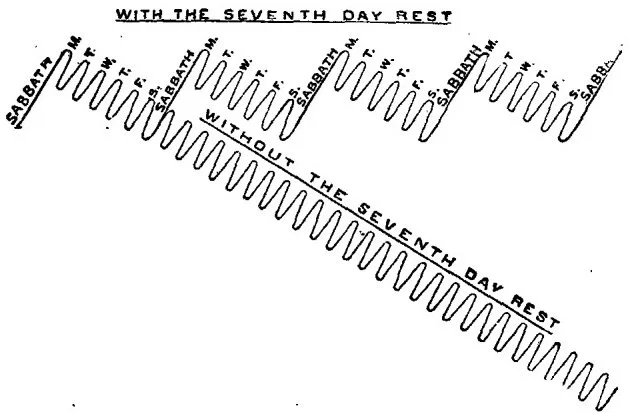
After making the above statements the speaker produced a chart drawn up by Dr. Heagler, with the accompanying diagram,— in which the author claims to have made a new discovery showing the “need of the hour,” that is, how “conscience can be reinforced with science” by the devoting of one day out of the seven to rest.
The speaker said it was hoped that the chart would soon be inserted in the text books of scientific temperance, which are one by one being revised, as they ought to be as familiar and fundamental in every child’s education as the “rule of three,” since this rule of seven is more radically essential to wise living.
Each downward stroke (in the accompanying diagram) represents a day’s work which is not quite equaled by the upward restorative stroke of the night’s rest; so that one is a little weaker every day as the week’s work goes on.
It was further claimed that the laborer in a normal327day’s work, overdraws his oxygen one ounce, and that the normal night’s rest restores only five sixths of it. Losing one sixth of an ounce per day, he is six sixths of an ounce short on Sabbath morning,—a whole ounce short,—a whole day behind—in the same condition physically on Sabbath morning and in the same need of rest as on Monday night. He is therefore called to a whole day’s rest to balance his account with Nature. If he habitually disobeys this divine law of weekly rest, he runs down more and more until he is far from what he ought to be, as is shown by the chart, about which, the speaker said, doctors do not disagree.
Further, that one breathes less oxygen and uses more during ordinary work than when at rest, absorption of mind checking the respiration to the extent of 12,960 cubic inches in eight hours. Oxygen being but another name for vital force, the bearing of the foregoing facts on health and strength is apparent. So that if this reparation is not supplemented by an occasional longer period of rest, the system is subjected to a gradual falling in pitch. So that one may “read the fourth commandment in a drop of blood by the aid of the microscope.”
The reader of the above needs no aid to see the underlying object of this pretended science, or as the Scriptures put it, “science falsely so called.” We are sometimes met with the objection that we cannot keep the same day all around the world, therefore a seventh part of time is all that is required; but the above reasoning makes it impossible to keep a seventh or any other equal portion of time.
Every person in the least acquainted with the chemical properties of the atmosphere knows that the vitalizing property of oxygen is found in different degrees in different localities. In the pine regions of the North, ozone or oxygen gas is found in greater abundance than in the lower and more malarial regions of the South. In fact there is scarcely two degrees of latitude where the air is charged with the same proportion of oxygen. So that a law compelling people to stop work a sufficient length of time to take on the wasted oxygen from a certain number of normal days’ labor would vary according to the amount of oxygen gas found in the different latitudes. In some localities it would be necessary, according to the above diagram, to have a “Civil Sanitary Sabbath” about every third day, while in more healthy regions these periods of rest might be two or three weeks apart.
In China, the people have kept no sabbath for centuries and yet they have not “run down” or run out either; and facts show that they live to as great age as do those who keep Sunday regularly.
Again, there is a large element in society that live sedentary lives. They need no civil Sunday law to compel them to be idle that they may take in a sufficient amount of gas to keep them from “running down.” It would be far better for this class of people if they could get out every Sunday and exercise their muscles by honest toil or innocent amusement.
We quote the following from “Home Hand Book of Domestic Hygiene,” page 239:—
“During forced respiration, when a larger quantity of air is inhaled, the quantity of oxygen lost in the lungs, and the amount of carbonic acid gained are of course greater [italics ours], which is also true of the other changes mentioned. It should be remarked that the amount of carbonic acid gained is a little less than that of the oxygen lost.”
According to the above, the amount of oxygen lost depends upon the degree of respiration, and this depends upon the amount of exercise taken. Hence, a civil Sunday law should specify just how much each one should respire during the week. Or if this could not be done, then the law should gauge the time of rest to suit each individual case. So that those who work in the furnace in hot weather and respire very rapidly might have their sabbaths come at shorter intervals; and the man whose employment is less violent and in a cool place, and hence respires much less, should have a longer interval between his periods of rest.
Once more: A person with weak lungs who is compelled to labor beyond his strength to get a living for himself and his family would certainly require a longer time to recuperate his wasted energies than a robust healthy person whose occupation required but little physical exercise. Surely a law requiring stated periods of rest could not fall in equal proportions upon all classes. Then how foolish and absurd to think of basing a “Civil Sunday Law” upon the amount of oxygen gas required to recuperate our wasted energies. No one but a drowning man would ever catch at such floating straws.
Those who are acquainted with the history of the papal church need no microscope to read in the blood of the saints and martyrs of Jesus Christ the outcome of the first Sunday law enacted by Constantine in A. D. 321, in speaking of which Dr. Neander says: “In this way the church received help from the State for the furtherance of her ends.” And the same results are seen in the Sunday laws of the present time.
Nor does human vision need artificial aid to see in this whole scheme of civil Sunday legislation the dragonic spirit which was to make war upon the remnant of the church, who keep the commandments of God and have the testimony of Jesus Christ. Rev. 12:17.
Let the reader beware. God is not mocked with any such pretended reforms as are proposed by these men who make void the law of God by forcing upon the people the traditions of Rome. Again we say, Beware!