It has been the custom of religious intolerance in all times of which history speaks, to seek to hide itself under the cloak of regard for “the law of the land.” “We have a law, and by our law he ought to die,” said the Jews, when they accused Christ before Pilate; and as religious phariseeism dealt with the Master, so has it dealt with his servants. They have been accused, tried and condemned as violators of “the law.”
he died under the same Pilate; and yet I hope you will not say that either Paul or Christ were such as did deny magistracy, and so sinned against God in slighting the ordinance.
It is maintained—and very truthfully—that a prime requisite of good and stable government is a popular respect for the law. No one will more readily and heartily indorse this proposition than does the Christian—he who, in the midst of the world’s iniquity, maintains allegiance to the government of heaven. He must stand for law—the law of heaven—in the face of the opposition of multitudes who neither respect nor obey it. The Christian will set an example before all, of obedience to the highest authority in the land.
Respect for law can never properly lead to the prosecution of any person for an act performed in obedience to the dictates of conscience; provided of course that the act in question does not constitute an invasion of the rights of other persons.
Injustice Not Law.
It is often the case that “the law” in some section of the country, is—either designedly or accidentally—in conflict with a course of action to which certain ones believe themselves to be morally bound. In such a case it is a mistake to proceed against these persons with physical force simply because they are condemned by the statute. To say that it is not a mistake, is to justify nearly every persecution of Christians which history records. But must not the law be enforced? it may be asked. Yes; law ought to be enforced always and in every place; but injustice ought not to be enforced at any time or place. Injustice is not law, even though it be embodied in a statute.
Law is not created by the fiat of man; for law is justice, and as such was ordained by the Creator. The province of man in legislation is to discover and define the law of justice in those relations between men which involve the maintenance of civil rights. No man, or assembly of men,—not even the legislature—has the right to perpetrate injustice; and no human assembly has the power to manufacture justice. If the statute is against justice, it is by that very fact divested of all rightful authority and power, for justice is the law, and must prevail.
Might Have Escaped by, Promising Obedience.
As we have stated, it was by means of unjust “laws” that most if not all of those persecutions were carried on which stain the record of human history. The victims of those persecutions might in very many instances have escaped the fate which overtook them by simply promising obedience to “the law.” Because they would not do this they were counted obstinate and unreasonable, disturbers of the peace, etc., whose example was seditious and pestilential. The magistrates appeared to deal with them in a manner characterized by much leniency and patience; and after the rejection of all inducements to surrender what was deemed their unreasonable notions, they were regarded as entitled to but scant sympathy.
The purpose of this article can be best served, however, by quoting from the language of one whose experience was that of a hated and persecuted dissenter from the Church of England during his adult life, but whose name is now held in honor by all the Protestant world. We refer to John Bunyan. In his life narrative Bunyan relates his experience as a “criminal” in the hands of the civil authorities, for having preached the gospel to “unlawful” assemblies of the people, and in other ways expressed dissent from certain doctrines of the established Church. After Bunyan had lain seven weeks in Bedford jail, the time of the “quarter sessions” of court having arrived, he was brought before the justices, under the following indictment: “That John Bunyan, of the town of314Bedford, laborer, being a person of such and such conditions, he hath (since such a time) devilishly and perniciously abstained from coming to church to hear divine service, and is a common upholder of several unlawful meetings and conventicles, to the great disturbance and distraction of the good subjects of this kingdom, contrary to the laws of our sovereign lord the king,” etc.
The Sentence Against Bunyan.
He was examined by Justice Keeling, who, after Bunyan had in a manner confessed the charges of the indictment and refused to discontinue his preaching, pronounced this sentence: “You must be had back to prison, and there lie for three months following; and at three months’ end, if you do not submit to go to church to hear divine service, and leave your preaching, you must be banished the realm; and if, after such a day as shall be appointed you to be gone, you shall be found in this realm, &c., or be found to come over again without special license from the king, &c., you must stretch by the neck for it, I tell you plainly.”
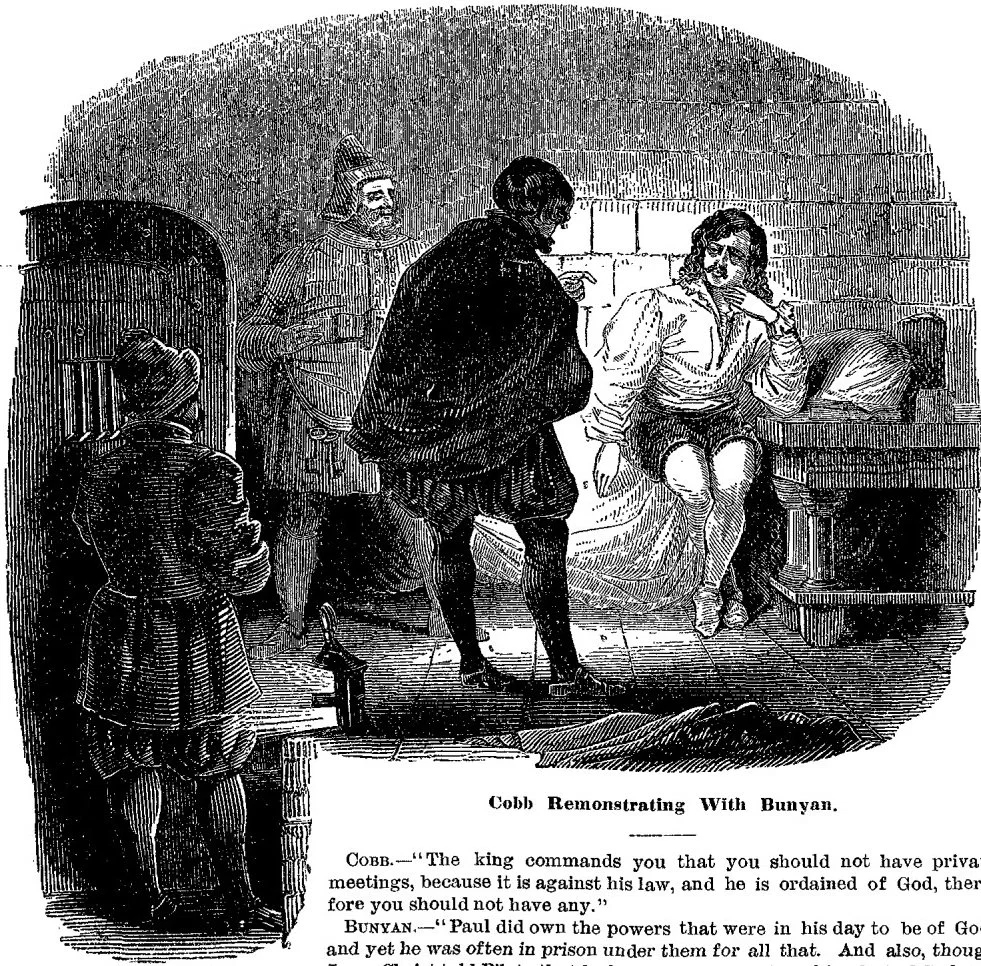
At the end of twelve more weeks the clerk, Mr. Cobb, came to interview Bunyan, in the hope of persuading him to submit to the terms imposed by the court. The substance of this interview, as related by Bunyan, is as follows:—
COBB.—Saith he, I come to tell you, that it is desired, you would submit yourself to the laws of the land, or else at the next session it will go worse with you, even to be sent away out of the nation, or else worse than that.
BUN.—I said, that I did desire to demean myself in the world, both as becometh a man and a Christian.
COBB.—But, saith he, you must submit to the laws of the land, and leave off those meetings which you was wont to have; for the statute law is directly against it; and I am sent to you by the justice to tell you, that they do intend to prosecute the law against you, if you submit not.
BUN.—I said: Sir, I conceive that the law by which I am in prison at this time, doth not reach or condemn, either me or the meetings which I do frequent; that law was made against those that being designed to do evil in their meetings, make the exercise of religion their pretence to cover their wickedness. It doth not forbid the private meetings of those that plainly and simply make it their only end to worship the Lord, and to exhort one another to edification. My end in meeting with others is simply to do as much good as I can, by exhortation and counsel, according to that small measure of light which God hath given me, and not to disturb the peace of the nation.
COBB.—Every one will say the same, said he; you see the late insurrection at London, under what glorious pretences they went, and yet indeed they intended no less than the ruin of the kingdom and commonwealth.
BUN.—That practice of theirs, I abhor, said I; yet it doth not follow, that because they did so, therefore all others will do so. I look upon it as my duty to behave myself under the king’s government, both as becomes a man and a Christian, and if an occasion were offered me, I should willingly manifest my loyalty to my prince, both by word and deed.
COBB.—Well, said he, I do not profess myself to be a man that can dispute; but this I say truly, neighbor Bunyan, I would have you consider this matter seriously, and submit yourself; you may have your liberty to exhort your neighbor in private discourse, so be you do not call together an assembly of people; and truly you may do much good to the Church of Christ, if you would go this way; and this you may do, and the law not abridge you of it. It is your private meetings that the law is against.
BUN.—Sir, said I, if I may do good to one by my discourse, why may I not do good to two? And if to two, why not to four, and so to eight?
COBB.—I, saith he, and to a hundred, I warrant you.
BUN.—Yes, sir, said I, I think I should not be forbid to do as much good as I can.
COBB.—But, saith he, you may but pretend to do good and instead, notwithstanding do harm, by seducing the people; you are therefore denied your meeting so many together, lest you should do harm.
BUN.—And yet, said I, you say the law tolerates me to discourse with my neighbor; surely there is no law tolerates me to seduce any one; therefore if I may by the law discourse with one, surely it is to do him good; and if I by discoursing may do good to one, surely by the same law I may do good to many.
COBB.—The law, saith he, doth expressly forbid your private meetings, therefore they are not to be tolerated.
BUN.—I told him that I would not entertain so much uncharitableness of that parliament in the 35th of Elizabeth, or of the queen herself, as to think they did by that law intend the oppressing of any of God’s ordinances, or the interrupting any in the way of God; but men may, in the wresting of it, turn it against the way of God; but take the law in itself, and it only fighteth against those that drive at mischief in their hearts, and meeting, making religion only their cloak, color, or pretence; for so are the words of the statute, “If any meetings, under color or pretence of religion,” &c.
COBB.—Very good; therefore the king seeing that pretences are usually in and among people, so as to make religion their pretence only; therefore, he and the law before him doth forbid such private meetings, and tolerates only public; you may meet in public.
BUN.— . . . I bless the Lord that my heart is at that point, that if any man can lay anything to my charge, either in doctrine or in practice, in this particular, that can be proved error or heresy, I am willing to disown it, even in the market-place. But if it be truth, then to stand to it to the last drop of my blood. And, Sir, said I, you ought to commend me for so doing. To err, and to be a heretic, are two things; I am no heretic, because I will not stand refractory to defend any one thing that is contrary to the word: prove anything which I hold to be an error, and I will recant it.
COBB.—But good man Bunyan, said he, methinks you need not stand so strictly upon this one thing, as to have meetings of such public assemblies. Cannot you submit, and, notwithstanding do as much good as you can, in a neighborly way, without having such meetings?
BUN.—Truly Sir, said I, I do not desire to commend myself, but to think meanly of myself; yet when I do most despise myself, I cannot help taking notice of that small measure of light which God hath given me, also that the people of the Lord (by their own saying) are edified thereby; besides, when I see that the Lord, through grace, hath in some measure blessed my labor, I dare not but exercise that gift which God hath given me, for the good of the people. And I said further, that I would willingly speak in public if I might.
COBB.—He said, that I might come to the public assemblies and hear. What though you do not preach? you may hear! Do not think yourself so well enlightened, and that you have received a gift so far above others, but that you may hear other men preach, or to that purpose.
BUN.—I told him I was as willing to be taught as to give instruction, and I looked upon it as my duty to do both; for, said I, a man that is a teacher, he himself may learn also from another that teacheth; as the apostle saith, “We may all prophesy one by one, that all may learn.” That is, every man that hath received a gift from God, he may dispense it, that others may be comforted; and when he hath done, he may hear, and learn, and be comforted, himself of others.
COBB.—But, said he, what if you should forbear awhile, and sit still, till you see further, how things will go.
BUN.—Sir, said I, Wickliff saith, that he which leaveth off preaching and hearing of the word of God for fear of excommunication of men, he is already excommunicated of God, and shall in the day of judgment be counted a traitor to Christ.
COBB.—I, saith he, they that do not hear shall be so counted; do you therefore hear.
BUN.—But, Sir, said I, he saith, he that shall leave off either preaching or hearing, &c. That is, if he hath received a gift for education, it is his sin if he doth not lay it out in a way of exhortation and counsel, according to the portion of his gift, as well as to spend his time altogether in hearing others preach.
COBB.—But, said he, how shall we know that you have received a gift?
BUN.—Said I, let any man hear and search, prove the doctrine by the Bible.
COBB.—But will you be willing, said he, that two indifferent persons shall determine the case, and will you stand by their judgment?
BUN.—I said, are they infallible?
COBB.—He said, no.
BUN.—Then said I, it is possible my judgment may be as good as theirs, but yet I will pass by either, and in this matter be judged by the Scriptures; I am sure that is infallible and cannot err.
COBB.—But, said he, who shall be judge between you, for you take the Scripture one way, and they another.
BUN.—I said the Scripture should, and that by comparing one scripture with another, for that will open itself, if it be rightly compared. . . .
COBB.—But are you willing, said he, to stand to the judgment of the church?
BUN.—Yes, Sir, said I, to the approbation of the Church of God (the Church’s judgment is best expressed in Scripture). We had much other discourse which I cannot well remember, about the laws of the nation, and submission to governors: after which I told him that I did look upon myself as bound in conscience to walk according to all righteous laws, and that whether there were a king or not; and if I did anything that was contrary, I did hold it my duty to bear patiently the penalty of the law that was provided against such offenders, with many more words to the like effect. And said moreover, that to cut off all occasion of suspicion from any as touching the harmlessness of my doctrine in private, I would willingly take the pains to give any one the notes of all my sermons; for I do sincerely desire to live quietly in my country, and to submit to the present authority.
COBB.—Well, neighbor Bunyan, said he, but indeed I would wish you seriously to consider these things, between this and the quarter session, and to submit yourself. You may do much good if you continue still in the land; but alas, what benefit will it be to your friends, or what good can you do them, if you should be sent away beyond the seas into Spain, or Constantinople, or some other remote part of the world? Pray be ruled.
JAILOR.—Indeed, Sir, I hope he will be ruled.
BUN.—I shall desire, said I, in all godliness and honesty, to behave myself in the nation, whilst I am in it. And if I must be so dealt withal, as you say, I hope God will help me to bear what they shall lay upon me. I know no evil that I have done in this matter, to be used. I speak in the presence of God.
COBB.—You know, saith he, that the Scripture saith, the powers that be, are ordained of God.
BUN.—I said yes, and that I was to submit to the king as supreme, and also to the governors, as to them who are sent by him.
COBB.—Well then, said he, the king then commands you that you should not have any private meetings, because it is against his law, and he is ordained of God, therefore you should not have any.
BUN.—I told him that Paul did own the powers that were in his day to be of God; and yet he was often in prison under them for all that. And also, though Jesus Christ told Pilate that he had no power against him, but of God, yet he died under the same Pilate; and yet, said I, I hope you will not say that either Paul or Christ were such as did deny magistracy, and so sinned against God in slighting the ordinance. Sir, said I, the law hath provided two ways of obeying: the one to do that which I in my conscience do believe that I am bound to do, actively; and where I cannot obey actively, there am I willing to lie down and to suffer what they shall do unto me. At this he sat still and said no more; which when he had done, I did thank him for his civil and meek discoursing with me; and so we parted.
John Bunyan was a Baptist. To be a Baptist in his day evidently meant more than is realized by many Baptists at the present time. Since his day the Baptists have grown numerous and powerful, and some have forgotten that popular odium and persecution were the lot of Baptists two centuries ago. They have forgotten that “the law of the land” once outlawed their own religious faith and practice; otherwise they would not be so ready to invoke the “law” against conscientious Christians in this day whose religious practice does not conform to the accepted customs and traditions of the people.
Let it be remembered that respect for law means always respect for right and justice; that in no way can this respect be so quickly and surely lost as by allowing the mere fiat of man to clothe itself with that authority which inheres in justice alone; and that regard for justice, as the law, demands that nothing contrary thereto be placed by human hands upon its throne.