THE word “kingdom” signifies a government, or system by which intelligent creatures are ruled over by one who is considered a superior. At least five elements, or component parts, must enter such an organization to render it complete and effective. These are: 1. Certain territory by which to mark the extent of the kingdom. 2. Subjects to occupy the territory and sustain the government. 3. The king or ruler to whom the subjects are amenable. 4. A throne from which the decrees of the government emanate. 5. Laws by which the subjects may be governed, and the unity of the kingdom preserved.
The heavens and the earth, with all things in them, being the product of God’s creative power, it could be truthfully said that, though his throne was prepared in the heavens, “his kingdom ruleth over all.” Ps. 103:19. His may be known as the “kingdom of heaven,” because his throne is located in the heavens, but his kingdom extends to the farthest limits of the universe, because every part of that wide domain is dependent on him for its existence.
One part of his vast domain was entrusted to man, whom he made in his own image, after his own likeness. Given all the noble qualities of the King of heaven, man was commissioned to rule the earth under the direction of the king himself. Gen. 1:26. Through man, as God’s sub-ruler, the whole earth was to render homage to the Creator-King, and so manifest its loyalty to the rule of heaven. But man was only fairly installed in this office before a bold usurper appeared to wrest that power from him, and take to himself the rule of the territory intrusted to man’s dominion.
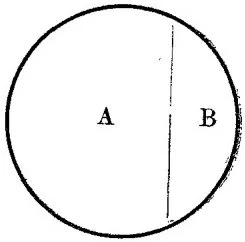
The story of how this was accomplished is familiar to many. Man was induced to disobey one of the precepts of the kingdom of God, and by this declare himself an enemy of heaven’s rule, and a friend of him who would dismember the kingdom. This act severed the earth from the rule of God, and placed it under the sway of Satan, God’s greatest enemy. The situation at this juncture may be well illustrated by the following diagram:—
Let all the space within the circle represent the entire universe, once in harmony, under the sway of God’s rule, thus constituting it the kingdom of heaven. Let that part marked B stand for the earth which Satan wrested from the power of man, into whose possession it had been intrusted, as the representative of the kingdom of heaven. The kingdom being thus dismembered by Satan, it follows that the rule or government of the separated part will thenceforward be distinct from all the rest of the universe, which is still loyal to the rule of heaven, as shown by that part of the diagram marked A.
No kingdom, however small and insignificant, whether it be a dependency or an imperial rule, can fail to disclose in its subjects the character of its ruler and the effect of his government. It is the same with the government of the two great general divisions of the universe. In God’s kingdom, no force is used to compel obedience, but every subject of that government is such voluntarily. God’s representative on the earth—the Lord Jesus—said, “If any man hear my words, and believe not, I judge him not.” John 12:47. It was God’s love for man which caused him to send Christ to die in place of the sinner. John 3:16. He asks no one to obey him except in love. He says, “If a man love me, he will keep my words.” Again, “He that loveth me not keepeth not my sayings.” John 14:23,24. It is thus plainly revealed that love alone is the motive power of God’s rule over his creatures, and that none can obey his rule except through love. This, then, shows that God, the Ruler of the heavenly kingdom, is love. 1 John 4:16.
Not so, however, with the ruler of the disjointed portion of the universe. As he employed force in its usurpation, so force must be the constant rule of his government as long as he maintains it. Since its seizure by Satan, every portion of the earth has, therefore, been ruled by force, more or less absolute, under the name of civil government. Whoever does not outwardly conform to the rule of this system, is immediately made an example of summary vengeance, as a warning to all others who may have thoughts of insubordination. Thus, the fear of punishment, instead of love for the ruler, is made the motive of obedience in the kingdoms of earth.
Men have been so long associated with this sort of38government, that their ideas of heavenly citizenship have become molded after the earthly pattern, which is coercion through punishment. Laws are therefore enacted by which men may be constrained outwardly to conform to certain religious observances to indicate that they are favorable to the reign of God’s kingdom. Of course, those who themselves care nothing for the prosperity of God’s government do not desire to coerce others to follow its requirements, and this accounts for the reason why straightout worldlings have never been found as persecutors of others on account of their religion.
But since Satan has himself revolted from God’s authority, it cannot be that he desires to coerce man into subjection to that kingdom. On the other hand, those who manifest a determination to be loyal to heaven’s requirements, are sure to meet opposition from the arch enemy of righteousness. Then, why does his system of government admit such procedure? It can arise from nothing else than the desire to oblige every one to be, at least outwardly, loyal to the government under which he finds himself. And inasmuch as it seems less harsh to appear to force people to be good rather than bad, certain laws having a religious tinge, but being opposed to God’s requirements, are promulgated, and those who are somewhat religious are drawn to believe the best thing to be done is rigidly to enforce such laws, thus aiding in the work of opposing the kingdom of God, while professing to be loyal to it. This has ever been the system of tactics employed by Satan in his attempts to destroy the reign of God over men.
On the other hand, the King of heaven sent his Son into the disaffected territory to point out to the enslaved ones a kingdom having a better system of government. So, as soon as he had received the public recognition of the Father by the anointing of the Holy Ghost, he began to preach “the gospel of the kingdom of God.” Mark 1:14. Standing upon the enemy’s territory, as indicated by B in the diagram, he pointed to that part of the universe, marked A in the diagram, which was still loyal to heaven, and said, “The kingdom of heaven is like a grain of mustard seed;” “The kingdom of heaven is like unto leaven;” “Like treasure hid in a field;” “Like a merchantman seeking goodly pearls,” etc. Matt. 13: 24, 31, 33, 44, 45, and many other places.
Choosing twelve apostles, he sent them forth also to tell men of this same better kingdom, of which he was the representative, giving them power to heal the sick, to cleanse the lepers, to cast out devils, and even to raise the dead, in order to demonstrate the nature of the kingdom to which they invited men to be loyal, and to show its life-giving power in restoring to soundness those who had become diseased through sin. Matt. 10:7, 8.
It should not seem strange that such teaching, accompanied by such demonstrations, met with such decided and unqualified disapproval from Satan, since the success of Christ’s mission meant the overthrow of his system of government. He would not then, nor will he now, permit the true nature of God’s kingdom to be presented among men, without seeking the destruction of those attempting to do so. The reason for this will be considered in a following paper.