Studies in French History. -13

3%

Pacific Press Publishing Company · New York · Mar 17, 1898

FromThe American Sentinel, Vol. 13, No. 11.

Read the full edition

Studies in French History. -13.

“It seems indeed a relief,” began the professor, when the little audience was again seated, “to find such a character among the kings of France as Louis IX. You will remember that in the last study we learned that he remained at home after his return from the disastrous crusade for about fifteen years. But he felt as if he had not kept the vow which he had made while on his bed of sickness; so he began once more the agitation which led to another crusade.
“You know that after any one had once donned the red cross, it was considered dishonorable unless he went to fight the Turk. So one Christmas the king made each of his courtiers a present of a new robe, as was the custom. This was put on in the dark, on the outside of the church, and when they all went in, behold, every one noticed that his neighbor wore the red cross. Each one was quite inclined to smile at this as a good joke, until he noticed the same mark on his own clothes; then he began to look pretty sober, I tell you.”
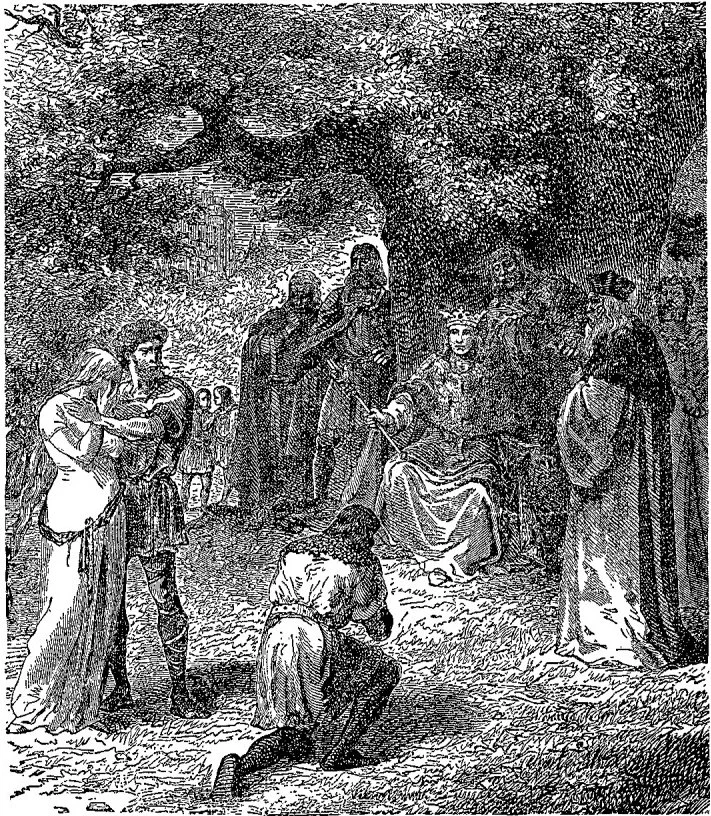
SAINT LOUIS SITTING IN JUDGMENT.
“I should have thought they would!” exclaimed Milly Brown. “It was ever so much nicer to stay at home with their families than to rush off to a far-away country to roast under a foreign sun and be killed by barbarous Turks.”
“Yes; and this second of his crusades was still more disastrous than the first. He did not go at once to Palestine, but sailed for Tunis, Africa, where he was taken very ill from the dreadful effects of the climate and died.”
“Aunt Eunice said she believed Saint Louis died in a bed of ashes, but she had forgotten the circumstances,” said Julia March.
“She was correct. When he died in Tunis, he ordered his servants to strew ashes on the floor, so that he might breathe his last while lying among them.”
“I wonder what he did that for,” said Maggie Palmeter, with a smile. “I should have thought a bed of feathers would have been ever so much softer and nicer.”
“I think Julia March can tell you why he did it. She is quite a student of the oldest, best written and most exact history in the world.”
“I presume you mean the Bible,” said Julia, blushing; “and I dare say that the reason Saint Louis chose ashes as his dying bed was only to symbolize his sorrow for sin. I remember that it was a very ancient custom for people to sit among the ashes in token of humility and sorrow, and sometimes they sprinkled them on their heads.”
“Yes, it was this sorrow for what was really his inability to keep his vow, though he had done the best he could, which caused him to manifest such great grief; he died with the word ‘Jerusalem’ upon his lips.”
“It was said of him that he was never heard to utter an oath. In fact, he punished the sin of blasphemy very severely.”
“I wonder if he was the French king whom I used to hear father tell about,” said Max Smith. “He used to put profane men on a ladder, with nothing on them but their underclothes, and with the entrails of a hog around their neck, would make two men carry them; sometimes he would have them branded on the face.”
Joe Palmeter’s face had begun to get very red during this recital, and his eyes sparkled like diamonds:—
“It was wrong! I’m sure it was not right. There is not the spirit of liberty of conscience in it. It is not Christ’s way of doing!” he exclaimed, earnestly.
“Why, Professor Carman,” said Florence Ray, “you don’t think it was right to blaspheme, do you?”
“I do not, most certainly. But the question is not whether it is wrong to do the act, but whether it would be right to punish men by law for so doing. I am sure Joseph would not approve of swearing, any more than any of us,” said Professor Carman, smiling,
“Indeed I would not,” said Joseph, grateful that his teacher could see the point he had meant to make, “but I believe in perfect liberty of conscience. I would not wonder if the best thing to do with a profane man would be to educate his conscience.”
“Very good, Joseph. The apostle says that he persuades men to repent, and that is the Master’s way. But King Louis said, in excusing his severity, that he would be willing to have the same thing done to him, and he would gladly bear the reproach, if by so doing he could purge France of so heinous a sin.”
“I believe that the blood of Christ alone can purge from sin,” said Julia March, reverently.
“Yes, that is so. No matter how much Saint Louis suffered on account of the sin of his country, it could not pay the debt or cancel the sin.”
“Then don’t you believe it’s right to legislate about such matters? Seems to me Saint Louis did just right,” said Charlie White, with a very sober face.
“I should think Charlie could see,” said Joe Palmeter, earnestly, “that this would make no end of trouble in the government; infidels and unbelievers wouldn’t stand much show, and I guess we’d have to use all the churches for jails after a little.”
“Well,” replied Charlie, “I’m sure it’s very wrong to blaspheme, and I believe I’ll ask my father to-night what he thinks of Saint Louis’ way of putting a stop to it.”
“That’s right,” said Professor Carman. “This is a subject which will bear much thinking about; for it involves a moral principle.”
“Philip the Bold,” he continued, “succeeded his father, Saint Louis, and brought the body of the misguided king back to France, and also those of his own wife and child, his brother-in-law, and John Tristan, his own brother,—five coffins in all—and a sorrowful procession it was.”
“Next week we will ask Charlie White to tell us what his father thinks of the action of King Louis, regarding the punishment of blasphemers.”
MRS. L. D. AVERY-STUTTLE.