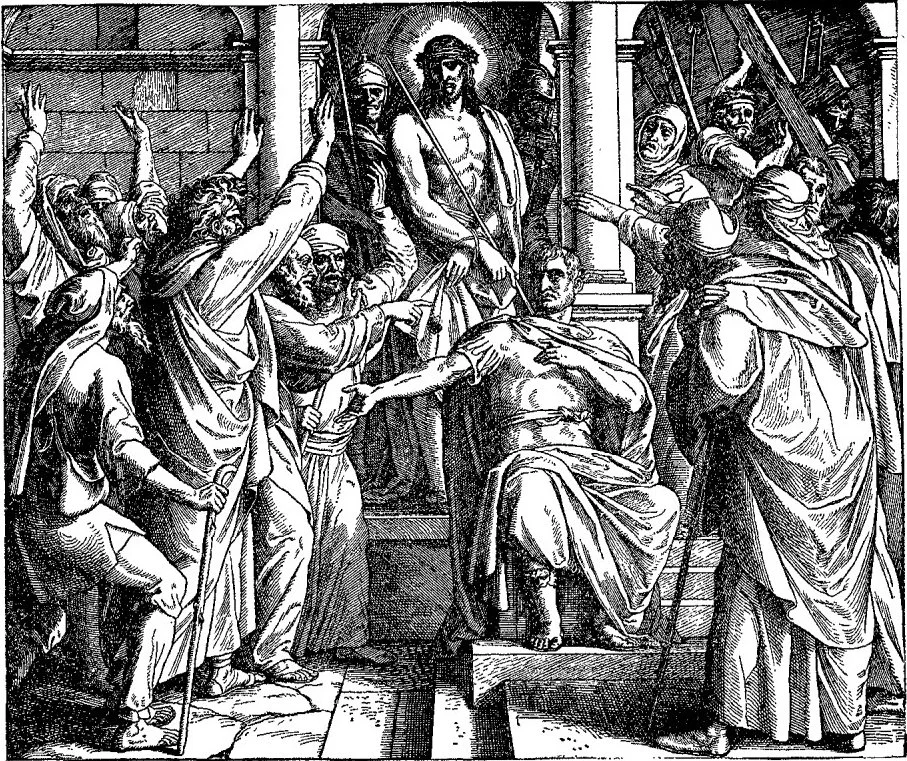
On that fateful day when Pilate had exhausted nearly every resource at hand, in unavailing efforts to save Christ from the power of an angry, infuriated mob, he ventured a last, evasive objection to their demands, in the question: “Shall I crucify your king?” A concert of voices from the chief priests quickly returned the answer: “We have no king but Cæsar.” John 19:15.
Jesus had been dragged by an excited populace before the civil ruler of Judea on charges of a trivial nature, yet they had asked that the sentence of death should be passed upon him. Pilate, suspecting that all was not right in their representation of the case, took the prisoner aside, and questioned him relative to the charges preferred. Finding no cause of condemnation in him, the governor gave a verdict in accordance therewith to the people, who would not receive it. Finding that they could not compass their ends by legal process, the frenzied priests claimed the right, by a religious law of their own, to punish the object of their hatred. Said they: “We have a law, and by our law he ought to die, because he made himself the Son of God.” That is to say, their law regulating religious belief and practice, called for the death of their victim, and therefore the civil power ought not to prevent them from executing its demands.
CHRIST BEFORE PILATE.
This opened a new phase of the controversy to Pilate, and gave him no little anxiety. From what Christ had revealed of himself to the governor when privately examined, he saw that religious malice alone lay at the bottom of the priests’ demand for the blood of Christ. However much he might desire to release the innocent victim of their hatred, he realized that he would not be able to do justice in the matter, without making himself odious in their eyes. Being at that time, too, held under suspicion by the emperor, on account of some irregularity, he feared that, if he offended these fanatical priests, they might accomplish his political overthrow.
Thus timid and undecided, the governor was greatly embarrassed. An earnest appeal, just received from his wife, “Have thou nothing to do with that just man” (Matt. 27:19), coupled with the conviction forced upon his conscience by the private interview with Christ, made him hesitate. He well knew what would have been the right course to take, but his political standing was in the balance. The crafty priesthood fully comprehended the situation, and, taking advantage of the opportunity, quickly exclaimed: “If thou let this man go, thou art not Cæsar’s friend; whoever maketh himself a king speaketh against Cæsar.”
This effort was well-timed on the part of the priests, and had its effect on Pilate. The priests saw this also, and were determined to follow up the advantage thus gained. In reply to the governor’s next appeal for them to consider Christ as their King, they vehemently cried out: “Away with him, crucify him.” Then came the final question from the governor: “Shall I crucify your King?” The answer returned settled the controversy, by deciding Pilate to give Christ into the hands of his accusers. In that the priests covertly insinuated that the governor was not loyal to the emperor. “We have no king but Cæsar,” said they, thus intimating that Pilate had, or was about adopting, another king than Cæsar in the person of Christ.
It seems easy to see from this distance the inconsistency of Pilate’s course, in violating every principle of justice, and his own conscience as well, in yielding to the clamor of the Jewish priests for the life of Christ. Although the Roman civil law assumed control of men’s consciences, yet this judge of the Roman tribunal saw no cause of action against the victim of priestly malice. Notwithstanding this, the mob spirit of the occasion forced the point against the decision of the judge, making him yield to their unjust demands.
Strange as it may seem to some, this was but the legitimate result of religion united with the civil power. By this union, the priests, to whom was committed the administration of religious rites, carried that influence with the civil power that, when a covert threat was made, the civil magistrate gave over to their frenzy, one in6whom “was no sin.” No being could be nobler or purer, yet he was sacrificed to the hatred of fanaticism, for no other consideration than that the one in whose power it was to release or condemn the accused, feared the intrigues of religious leaders, in whose hands was the power of political preferment, or national disgrace.
The power of mischief, maintained by the priesthood of that day, was not peculiar to the spirit of the Jewish religion. Had the priests followed in the way that faith pointed, their disposition would have been merciful, gracious, long-suffering, and abundant in goodness and truth, as was the Source from whence the religion emanated. Ex. 34:4, 5. Where, then, was the difficulty? From whence was their cruel spirit, if not from their religious faith?—It was from the adulteration of their religion with human power, sustained by earthly tribunals. The adoption of this substitute neutralized every element of the refining and ennobling power of God, and left their religion destitute of every heavenly constituent. It thus became subject to the caprice of finite, erring minds, wrought upon by the basest passions of fallen human nature.
It was the same element which is responsible for the spirit of the Dark Ages. Men did not then ruthlessly destroy others, who differed with them religiously, simply because they were Catholics. Protestants of those days acted the same as Catholics when opportunity presented itself. The cruelty then practiced in the name of religion was not the product of Christianity, but the lack of it; not because of Christianity, but in spite of it. The state and the church being united, civil laws were made to maintain the church, of which advantage was taken to coerce the consciences of those who dissented from the dogmas of the church. In other words, men persecuted their fellow men because they were human, and yielded to their own passions of evil, in spite of their profession of goodness.
It would be just the same now, were the state to legislate in behalf of the church, for the reason that human nature has not changed. Give men the power now, and they would use it just the same as others before them have used it, namely, to break down every one who opposed their peculiar ideas of religion. Men grasp for power everywhere,—in religion, as well as in the state. If they cannot secure it in one way, they will in another. The fact that Christ never gave his power in the interest of coercion, and will not grant it now for that purpose, is the reason that ambitious churchmen apply to the state for a power which they may wield as they will.
The power of God is not for man to control in any way, but is designed to influence, guide, and control him. He may not use the power, but the power may, and will use him, if he permits it; otherwise it leaves him alone. If professing Christians would be satisfied with God’s disposition of his power, they could not become arbitrary, and desire to control others in religious matters. It is only when self asserts its desire to control some power in the interest of religion, that he resorts to civil government for it; and when it is secured, he can use it only in a human way, which is far from divine.
The reason for this is plain. When fallen man, who needs God’s power for assistance by the way, and should be subject to it, attempts to take control of that power himself, by which to force others to terms, who are likely to be as near right as himself, he thus essays to rise above, and break away from his Master, and like all servants armed with power, becomes arrogant and cruel. It was at this point where the Jewish priests exclaimed: “We have no king but Cæsar,” and so severed the last link which had united them to the rule of heaven. Will the people of this nation learn lessons of wisdom from the history of the past? J. O. C.