ALCOHOL; ITS HISTORY, AND ITS EFFECTS UPON SOCIETY.
By W. H. Riley
By W. H. Riley, M.D., Superintendent of Colorado Sanitarium, Boulder, Colo.
[All rights reserved.]
Consumption of Alcohol.
(Concluded.)
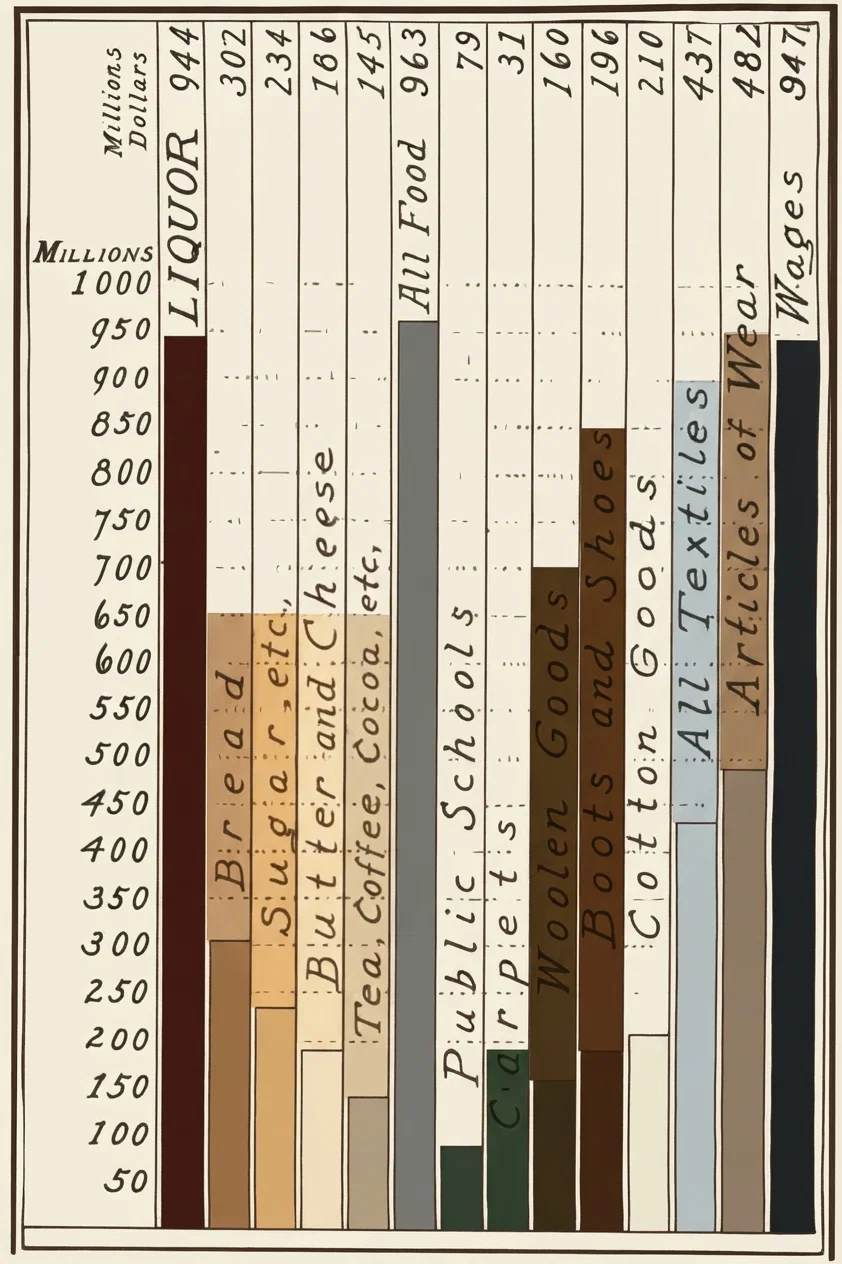
WE here give a diagram of Dr. Hargreaves, comparing expenditures for intoxicating drinks in 1883 with the chief items of expenditure for necessaries of life and wages paid for mechanical and manufacturing industries in 1880.
The following is a diagram for 1895, by Geo. B. Waldron, statistical editor of the Voice.
How We Spend Our Money.
This is in our own country alone; and as alcoholic beverages are known and used throughout the world, the consumption is something prodigious. According to an estimate by Mr. William Hoyle,11of London, there was spent in Great Britain in 1882 the sum of $614,000,000, or $85 per family. He computes the wealth which would have accrued, if the money spent for liquor from 1830 to 1882 had been saved and invested at 5 per cent. interest, at $71,000,000,000. This is twenty times the national debt of Great Britain, forty-seven times more than our own, and four times the amount of the national debts of all Europe and America. For 1896 the national drink bill was $714,000,000.
In France, the land of wines, the consumption of distilled liquors averages 1.24 gallons per capita, as in the United States, while the amount of wine is 23.92 gallons, and the drink habit is increasing. Mr. Rochard, at a meeting of the Acadamie de Médecine in 1887, reported that the consumption of alcohol had doubled in forty years, and that alcoholism had increased enormously. The population of the country seems stationary, and the French army gives evidence of great national physical deterioration. So grave is the situation that the government has appointed a national commission of inquiry with a view to the removal of the national curse.
The German people average 23 gallons of beer per capita. Sweden has consumed as much as 30,000,000 gallons of ardent spirits annually, and the tax on brandy is the principal item in the revenue of Russia. Other nations do not use as much as these more "civilized." Yet if we count the entire world as using twice as much as Great Britain, France, Germany, and the United States, with a combined population of about one-eighth that of the globe, the cost in one year is $7,000,000,000, which sum, in twenty-dollar bills, would reach once around the earth, with enough left to go around again in ten-dollar bills.