Of men's laws one writer has said, "Laws grind the poor, and rich men rule the law." Another has remarked: "The law is a sort of hocus-pocus science, that smiles in your face while it picks your pocket." And so men judge their fellows' attempts to govern. The laws of men at the best are imperfect, and even at their best are often unlawfully or inequitably administered. Notwithstanding this, the poorest law and the worst attempt at government are better than lawlessness and anarchy.
All these imperfections cry out for the one God, the one Law; the perfect Ruler, the perfect Law. Such the Bible reveals God and His law to be. Perfect the law of Jehovah must be if He is the true God. We could not conceive of an infinite God having an imperfect law; for that law in the nature of the case must be the reflection of His own mind. Justice demands that He make it plain to those whom He will call to account.
In the beginning that law was planted in the very nature of man. He was given a conscience in accord with that law; and conscience still, perverted as it is, holds in its better mood some standard higher than itself, to which the ever-present Spirit of the living God is calling. By that unwritten law, and the conscience of that law, God will judge the unenlightened heathen. It is not the amount of light which saves men, it is the reception and following of the light with all the heart. A single ray of solar light followed to its source leads to the great central sun. A single truth of God received and followed will lead to all truth. "For the eyes of Jehovah run to and fro thruout the whole earth to show Himself strong in the behalf of them whose heart is perfect toward Him." 2 Chron. 16:9. On the other hand one ray of light rejected dooms to destruction the soul which may have been flooded with light. When one turns from the one living truth, he turns from the Author of truth.
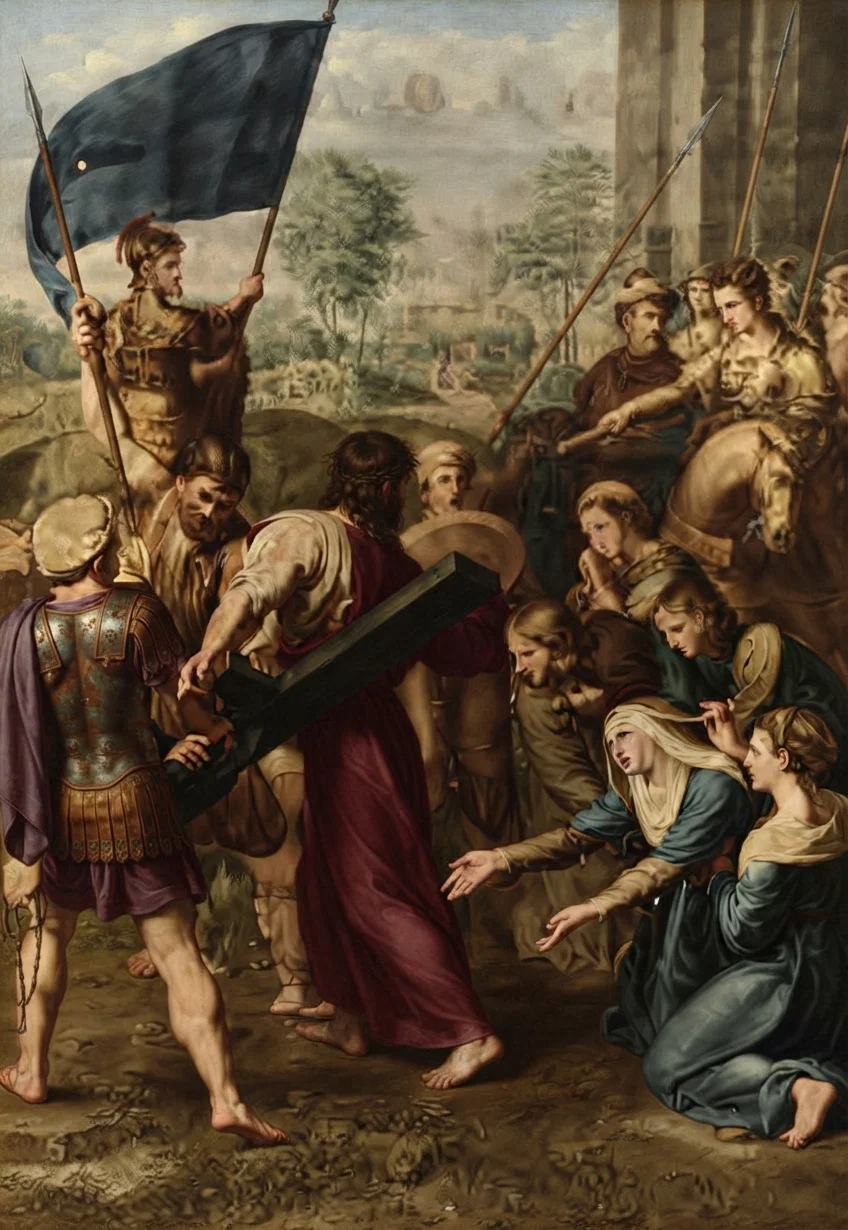
From Raphael's Christ Bearing the Cross. "He was wounded for our transgressions; He was bruised for our iniquities." God's law was so holy that it could not be set aside, and it was necessary that the Son of God must die in order to save the sinner, and vindicate the Law.
Necessity of a Written Law.
As man continued in sin, as sinful generation succeeded sinful generation, it is manifest that conscience would become more and more perverted and stifled by tradition and sinful practises. A standard becomes necessary that men might know sin, and God has given the standard. "The [written] law entered, that the offense might abound" (Rom. 5:20); that sin by the commandment might become exceeding sinful" (Rom. 7:14).
Does the Bible Reveal Such a Law?
It does—a law complete and excellent in every part, the admiration and conceded standard of the enlightened good in all ages. That law is as clearly identified as the God who gave it; and as Jehovah is high above all other gods, so is His law infinitely higher than all other laws. And as all the excellence ever attributed to any other god is borrowed from Jehovah, so any excellence there may be in any laws of human devising is borrowed directly or indirectly from the law of God.
In James (2:8-12) we read of "the Royal Law according to the Scripture." "Royal" means "kingly." The "Royal Law" of the apostle is therefore the law of the great King. The recognized Scripture when James wrote his epistle was that of the Old Testament. The Royal Law is therefore a law of the great King which is recorded in the Old Testament.
But the apostle makes it clearer than this. He refers to two precepts of that law as follows: "For He that said, Do not commit adultery, said also, Do not kill. Now if thou dost not commit adultery, but killest, thou art become a transgressor of the law." What law contains these two prohibitions as essential parts of its provisions?—Clearly the Decalogue, found in Ex. 20:1-17, and printed on page nine of this paper.
There are other important considerations set forth by the apostle James. This "Royal Law" is also a "law of liberty," by which men are to be judged; for after the words above quoted, he continues: "So speak ye, and so do, as men that are to be judged by a law of liberty." The law by which men are to be judged is the law of conduct, the standard of life, and must embrace the whole duty of man. And this also is expressly declared in the scripture to which James referred: "Let us hear the conclusion of the whole matter: Fear God, and keep His commandments; for this is the whole duty of man. For God shall bring every work into judgment, with every secret thing, whether it be good, or whether it be evil." Eccl. 12:13, 14. And thus it is again manifest that "the Royal Law" of the New Testament is God's commandments of the Old, the supreme rule of conduct, as it is the standard by which God shall judge all.
James' law of liberty is also the law of the Old Testament; for so reads the scripture: "I will walk at liberty; for I seek Thy precepts." Ps. 119:45. "Great peace have they which love Thy law; and they shall have no stumbling-block." Ps. 119:165.
The Universality of the Law.
The universality of this "Royal Law" is indicated in the fact that its transgression is sin. Those who disobey its precepts commit sin, and are convicted of the law as transgressors. Another apostle bears similar testimony: "Whosoever committeth sin transgresseth also the law; for sin is the transgression of the law." 1 John 3:4. That is God's definition of sin, brief, yet all-comprehensive. To show that the law condemns all sin, we read in the same epistle (5:17): "All unrighteousness is sin;" all unrighteousness, all wrong-doing, is, therefore, the transgression of the Royal Law of God, the Ten Commandments.
These facts are still further confirmed by the great apostle to the Gentiles, in an epistle addressed to a Gentile or mixed church: "Where no law is, there is no transgression;" "by the law is the knowledge of sin."4"For all have sinned, and come short of the glory of God." Rom. 4:15; 3:20, 23. But by what law is the knowledge of sin revealed? —"Nay, I had not known sin, but by the law; for I had not known lust, except the law had said, Thou shalt not covet." Rom. 7:7. How clearly these passages show the universality, the depth, the comprehensiveness, of the Decalogue, the law which defines sin, which condemns all sin, which therefore witnesses to all righteousness, and which will condemn or acquit us at the last day.
The Giving of the Law.
The giving of that law attested its importance. It was given out in the solitudes of the great world, to a pilgrim people, called out to be priests to the whole world, and to proclaim God's glory among all the nations. Ex. 19:5, 6; 1 Chron. 16:24-36. It was only after most careful three days' preparation on the part of the people that God gave His law. Then amid such grandeur as earth had never before witnessed, the Majesty of Heaven came down and spoke the Royal Law from Sinai's blazing peak to the assembled thousands. See Exodus, chapters 19 and 20. Thus Moses describes that sublime scene forty years later: "These words [the Ten Words] Jehovah spake unto all your assembly in the mount out of the midst of the fire, of the cloud, and of the thick darkness, with a great voice: and He added no more." Deut. 5:22. That Infinite Wisdom "added no more" shows clearly that it was in itself complete. It covered the ground. Its prohibitions were complete.
Not only did Jehovah speak the Ten Words with His own voice, but He Himself "wrote them in two tables of stone." God left it not to be written in a book alone by the careless hand of man, but He wrote it in tables of enduring rock; for the "two tables of testimony, tables of stone," were "written with the finger of God." Ex. 31: 18. "The tables were the work of God, and the writing was the writing of God, graven upon the tables." Ex. 32:16. True, Moses broke these first tables, but of the second tables it is said: "He [Jehovah] wrote on the tables, according to the first writing, the Ten Commandments, which Jehovah spake unto you in the mount out of the midst of the fire." Deut. 10:4.
Those tables were placed in one of the most beautiful and costly chests ever constructed. It was about 45 inches long, 27 inches wide, and 27 inches deep, made from acacia wood, overlaid with pure gold without and within, with a marvelous covering, on which were the figures of cherubim, beaten out of pure gold. Ex. 25:10-22; Deut. 10:2, 3. That cover was the "mercy-seat," and that ark became the earthly center of the worship of God's children.
The Decalogue is therefore God's law, full, complete, comprehensive, the epitome of all morality, the reprover of all sin.