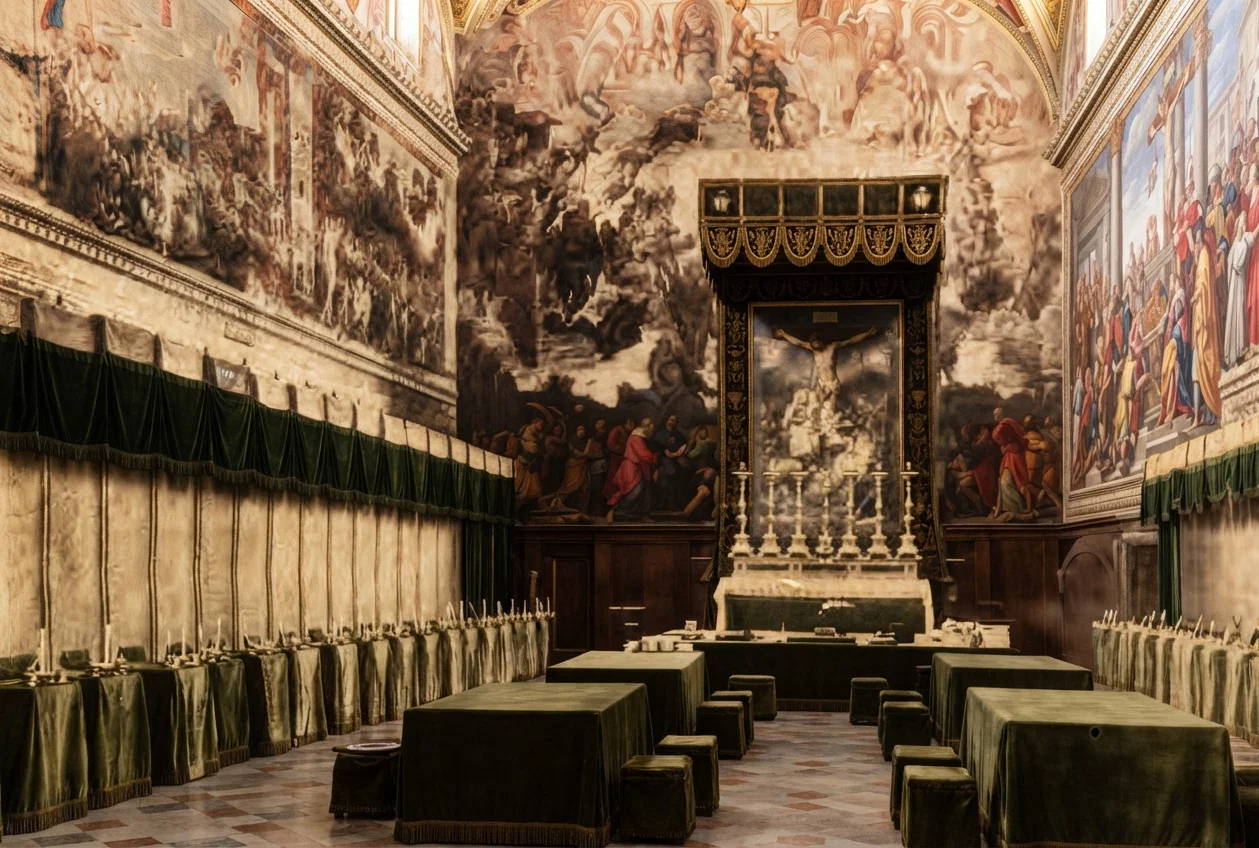
HALL OF THE PAPAL CONCLAVE IN THE VATICAN, WHERE THE CARDINALS ASSEMBLE FOR THE ELECTION OF THE POPES
AMERICAN FEDERATION OF CATHOLIC SOCIETIES
Would Have Use of Mails More Restricted
Meeting in Baltimore—Protests Against Treatment in Mexico
By S. B. HORTON
THE spirit of federation is one of the leading characteristics of this age. We have federations of both capital and labor; we have federations of social organizations; federations of the different Protestant churches; and also a federation of the various orders and societies in the Catholic Church itself.
Federations of political and social bodies we may expect. But when religious bodies combine, their chief object must be to bring to bear on the world the sheer force of their numbers. And in this thing they cease to be a spiritual power in the sense in which God commissioned His church to act. They become instead a force in politics.
The church as an overweening political machine can have but one effect. It must be intolerant of all opposition, and in the end must persecute dissenters.
We have been told for twenty-five years that the world had become too Christian and too civilized for any more war or religious persecution. But the outbreak in Europe ought to dispel the delusion concerning war, and those who had been giving careful heed to the word of God knew all the time that the worst wars the world has ever seen will occur in these last days.
In like manner we should be able to see, from the study of the thirteenth and fourteenth chapters of Revelation and kindred scriptures, that the fiercest religious despotism the world has ever known will occur in the closing days of earth's history.
The religious combinations of this time are significant, and should be watched closely and studied carefully.
THE thirteenth annual convention of the American Federation of Catholic Societies was held in Baltimore, September 27-30, opening with various religious services held at the cathedral and other places, in which Cardinal Gibbons and visiting bishops figured. On Monday evening a public reception was held, at which addresses were given by Governor Goldsborough, of Maryland, Mayor Preston, of Baltimore, Cardinal Gibbons, and others. On Tuesday a parade was conducted, in which it is claimed thirty thousand men participated.
The Catholic Church conditions in Mexico, and the part it was hoped the United States would take in the matter, occupied a very large part of the addresses and resolutions of the convention. In directing attention to the treatment of Catholic priests, nuns, and property in Mexico, Bishop Schrembs, of Toledo, Ohio, said in part:
"In near-by Mexico, thousands and thousands of men and women are being outraged in their most sacred religious convictions. Churches have been closed and desecrated. Priests and bishops have been robbed, tortured, exiled, and in some cases most brutally murdered. The very exercises of religion have been proscribed. . . . Where now are those agencies of public opinion, where is the press of our land, that it does not rise up in its might and raise a protest that can not be silenced until these outrages cease and religious liberty again triumph? The press is silent, silent as the grave in regard to these barbarities and this savagery. Instead it hails the inhuman brutes who are the perpetrators of these atrocities as the saviors of Mexico."
"A few years ago a political genius in one of his great speeches declared: 'You shall not press down this crown of thorns upon the head of labor—you shall not crucify mankind upon a cross of gold.' I had the highest admiration for those sentiments, but I can not help but feel that this political genius has an opportunity to-day to translate his rhetoric into action."
The convention subsequently adopted the following protest, and communicated it to President Wilson through a committee of three, who called at the White House and presented the same to the chief magistrate:
"September 29, 1914.
"Hon. Woodrow Wilson, President of the United States, Washington, D. C.:
"Your Excellency—We herewith respectfully convey to you, through the Rev. Richard Tierney, S. J., and Messrs. John Whalen and H. V. Cunningham, resolutions which were adopted at to-day's session of the thirteenth annual convention of the American Federation of Catholic Societies, and which resolutions read as follows:
"'Section 1. We denounce the outrages perpetrated against bishops, priests, and religious men and women in Mexico. Thousands have been robbed, tortured, exiled, and in many instances brutally murdered—and some of these were American citizens. Religious women, whose lives have been consecrated to the practise of every form of Christian charity, were subjected to what is worse than death, to the brutal lust of an inhuman soldiery."
"'Section 2. We protest against the unexplainable silence of our public press concerning these well-authenticated outrages. This mighty power for the formation of public sentiment and opinion has often made appeals even in the case of individuals, as, for instance, the Russian Jew Beiliss, or Miss Stone, the Protestant missionary, who was held in captivity by Turkish bandits. The Mexican outrages have thus far been scarcely mentioned by the press."
"'Section 3. In the name of sacred religion, which has been ruthlessly attacked; in the name of pure womanhood, which has been shamefully outraged; in the name of humanity, whose fundamental rights have been violated; in the name of Christian civilization, which, being supplanted by a rule of rapine, lust, and murder, we most earnestly appeal to our government at Washington to do its utmost toward stopping this inhuman persecution of just men and women in Mexico."
"'Section 4. By reason of the Monroe Doctrine, the civilized nations of the world look to the United States of America to exercise its great power for the preservation and maintenance of the fundamental rights of mankind on the American continent."
"'We therefore most earnestly urge upon the president of the United States not to recognize in Mexico any government which does not effectively guarantee civil and religious liberty in the true sense of the word."
RESTRICTING THE MAILS
"'Whereas, despite the continued objections of decent men, the privilege of the mails is still extended to obscene and scurrilous papers, injurious to the rights of conscience, as guaranteed by the constitution, and destructive of sound morality;
"'Be it resolved, That the Federation of Catholic Societies protest against such abuse of the mails.'"
"The gentlemen presenting the foregoing expression from the federation have been delegated to commend it to your earnest consideration, and to convey to you the kindest regards of this body.
"We have the honor to remain yours very truly,
"Charles I. Denechaud, President.
"Anthony Matre, Secretary."
On the next day Bishop Currier, of Cuba, and others called to talk over with the president the situation in Mexico. The president is reported as having promised to see that justice and protection would be accorded so far as the influence of the government could make it possible.663It appears that the Constitutionalists, who have succeeded in turning out of office the Huerta regime, do not take kindly to the Roman Catholic Church in Mexico. General Carranza is credited as having said, 'The clergy are among the worst enemies of the Mexican people.'"
General Villa, who led the armies of the Constitutionalists, upon assuming the governorship of Chihuahua is reported to have made this statement: 'We Mexicans have had three hundred years of the Spaniards. They have not changed in character since the conquistadores. They disrupted the Indian empire and enslaved the people. We did not ask them to mingle their blood with ours. Twice we drove them out of Mexico, and allowed them to return with the same rights as Mexicans, and they used these rights to steal away our land, to make the people slaves, and to take up arms against the cause of liberty. They supported Porfirio Diaz. They were perniciously active in politics. It was the Spaniards who framed the plot that put Huerta in the palace. When Madero was murdered, the Spaniards in every state in the republic held banquets of rejoicing. They thrust on us the greatest superstition the world has every known—the Catholic Church. They ought to be killed for that alone. I consider we are being very generous with them.'
A lively interest was manifested in regard to the next place of meeting. It was generally expected that the convention would hold its next annual session in San Francisco; but inasmuch as the Panama Exposition management could not guarantee that Ex-Mayor Ernesto Nathan, of Rome, should not be privileged to represent Italy at the exposition, it was voted to hold the meeting at Toledo, Ohio. Mr. Nathan received very severe castigations for his stand against the papacy several years ago while mayor of the city of Rome.