Translations
For the earth is the Lord’s, and the fullness thereof.
For the earth is the Lord’s, and the fulness thereof.
for the earth is the Lord’s, and the fulness thereof.
For the earth is the Lord's, and its fullness.
Revised Version, American Standard Version
for the earth is the Lord’ s, and the fulness thereof.
for the Lord's [is] the earth, and its fulness;
For the earth [ is] the Lord's and its fulness.
For, unto the Lord, belongeth the earth, and the fullness thereof.
Berean Standard Bible, Majority Standard Bible
for, “ The earth is the Lord’ s, and the fullness thereof.”
for “ the earth is the Lord’ s, and its fullness.”
For the earth is the Lord's and all things in it.
For the earth is the Lords, and all that therein is.
Douay-Rheims (Challoner revision)
The earth is the Lord’s, and the fulness thereof.
Pictures
Cross-references
- Psalms 24:1
The earth is the LORD’s, and the fulness thereof; the world, and they that dwell therein.
Both declare that the earth and its fullness belong to the Lord.
- Psalms 50:12
If I were hungry, I would not tell thee: for the world is mine, and the fulness thereof.
Both affirm that the world and all creation belong to God.
- Exodus 9:29
And Moses said unto him, As soon as I am gone out of the city, I will spread abroad my hands unto the LORD; and the thunder shall cease, neither shall there be any more hail; that thou mayest know how that the earth is the LORD’s.
Both declare that the earth belongs to the Lord.
- Haggai 2:8
The silver is mine, and the gold is mine, saith the LORD of hosts.
Both declare that all wealth belongs to the Lord.
- Psalms 115:16
The heaven, even the heavens, are the LORD’s: but the earth hath he given to the children of men.
Both describe the earth as belonging to God and given to humanity.
Commentary
Each commentary is drawn from primary sources: the writings of Ellen G. White and Adventist pioneers and periodicals. Each commentary is separate. Its own words are not a quotation; follow the references to read the source passages.
Ellen G. White
1 source
The wider context of 1 Corinthians 10:23-33 brings real common sense to diet reform, showing that diet must be studied broadly and deeply rather than narrowed to rigid extremes.MH 319.2 It guards against a shallow or one-sided approach by requiring attention to principle, circumstance, and individual need together.MH 319.2
That breadth forbids criticizing others simply because their practice is not in every detail in harmony with one's own.MH 319.2 No unvarying rule can be made to regulate everyone's habits, and no person should set himself up as the criterion for all.MH 319.2 Not all can eat the same things, for food that is palatable and wholesome to one may be distasteful and even harmful to another.MH 319.2 Some cannot use milk while others thrive on it, some cannot digest peas and beans while others find them wholesome, and coarser grain preparations are good food for some while others cannot use them.MH 319.2
Sources
Pioneers and periodicals
17 sources
The earth and everything that fills it belong to the Lord as His own.RH Feb 23, 1905RH Jun 25, 1901ST Dec 11, 1901 Christ holds that ownership both because He created it and because He bought it back through redemption.RH Aug 1, 1912 Food sold in the market or set before believers may be eaten without asking questions for conscience' sake, since it is not made unfit merely by having been offered to an idol, yet it is not to be eaten when it is expressly pointed out as sacrificed or when eating would be taken as approval of idol worship.ST Oct 19, 1888ST Dec 11, 1901RH Mar 31, 1868 In all such questions the rule is to eat and drink to the glory of God, limiting personal liberty so as to give no occasion of stumbling to others.ST Sep 23, 1889ST Aug 25, 1909ST Sep 4, 1879RH Mar 31, 1868 Because men own nothing of their own but are only stewards of the Lord's property for a lifetime, they must render an account for its use and give back what is above their own need to advance His work and bless the needy.RH Jun 25, 1901ST Jan 11, 1883RH Oct 1, 1861
Ownership and Its Setting
The earth and everything that fills it belong to the Lord as His own, by rightful ownership.RH Feb 23, 1905RH Jun 25, 1901ST Dec 11, 1901ST Sep 4, 1879 Loyal servants of Christ confess that ownership in the controversy over who owns the world.RH Feb 23, 1905 Christ holds that ownership both because He created the earth and because He purchased it through redemption.RH Aug 1, 1912
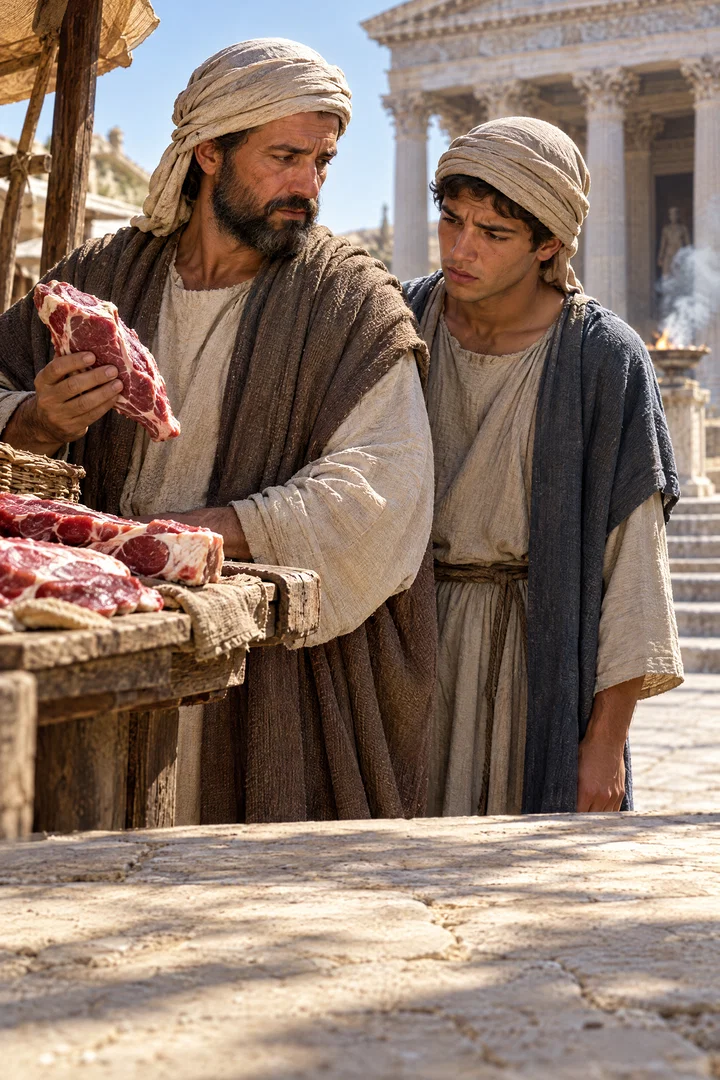
Its immediate setting is the ruling on eating meat offered in sacrifice to idols.ST Oct 19, 1888 Only part of the animal was offered, and the remainder was eaten by the worshiper or sold in the market like other meat.ST Oct 19, 1888 In that ruling such meat is as lawful to eat as any other meat, unless it is expressly pointed out as having been so offered and unless eating it would be understood as giving approval to idol worship.ST Oct 19, 1888
The wider chapter sets forth God's dealings with Israel in the wilderness and in the desert as examples and warnings for believers now.ST Oct 24, 1878RH Apr 29, 1873 Those examples include lessons in health reform, that God cares for the body as an essential part of man.RH Apr 29, 1873 Believers now live in degenerate days with bodies enfeebled by disobedience to physical law, and before He gives the finishing touch of immortality by translation without death they are to do what they can for themselves by labor and obedience instead of expecting Him to do everything for them, which includes caring for the body and doing what can be done for it before translation to immortality.ST Oct 24, 1878RH Apr 29, 1873 As part of that appeal the Old Testament record, especially the accounts of God's dealings with Israel in the last four books of Moses, is pressed as lessons for people living in the last days of probation, to learn spiritual lessons from those records and not merely to know the historical facts.ST Jun 17, 1889 In that connection the religion of Christ is the same in all ages, with the gospel preached to the patriarchs who by faith trusted in the promised seed who would bruise the serpent's head and rejoiced to see the day of Christ.
Liberty, Stewardship, and Courage
Meat sold in the market or set before believers may be eaten without asking questions for conscience' sake, for it remains as lawful as any other meat and is not made unfit, spiritually changed, or defiled merely because it was offered to an idol, since the earth and all that fills it belong to the Lord.ST Oct 19, 1888ST Dec 11, 1901RH Mar 31, 1868ST Jan 31, 1906 Only part of the sacrificial animal was offered, while the remainder was eaten by the worshiper or sold in the market like other meat, so that liberty rests on God's ownership of all food.ST Oct 19, 1888ST Jan 31, 1906 That liberty is to be used with regard for others, avoiding becoming a stumbling block to those of weaker understanding.RH Mar 31, 1868ST Jan 31, 1906
The permission ends where the meat is expressly pointed out as having been offered in sacrifice, and where eating would be understood as giving approval to idol worship.ST Oct 19, 1888 Wholesome and lawful things are not a license for indiscriminate indulgence, for their improper use can become a stumbling block to others; the call is to self-control, to avoid conduct that defiles or merely serves appetite, and to take care not to prejudice others against Christian truth.ST Sep 23, 1889RH Mar 31, 1868 The ruling principle for eating and drinking and for relating to surrounding customs, in questions arising now as then, is to do all to the glory of God.ST Aug 25, 1909RH Mar 31, 1868
Personal freedom must be weighed against its influence on others, giving no occasion of stumbling to Jews, Greeks, or the church of God and showing regard for those of weaker understanding.ST Sep 23, 1889ST Aug 25, 1909ST Sep 4, 1879ST Jan 31, 1906 Human beings own nothing of their own but are only stewards of the Lord's property placed in their care for a lifetime, and they must render an account for the way they use it.ST Jan 11, 1883RH Oct 1, 1861 That ownership grounds the duty and privilege of giving possessions back to God to advance the work of salvation.RH Jun 25, 1901RH Oct 1, 1861
The solemn obligation is to do all in one's power, not merely as much as others do, using everything above what is needed for the necessary things of life to advance truth and righteousness, help the needy, and bless fellow beings.RH Oct 1, 1861 Faithful stewardship therefore requires economy, living within one's means and keeping more to give to the poor, with the rich showing by carefulness that economy is not mean or stingy.ST Jan 11, 1883 It requires casting away idols and unnecessary articles of dress and diet and using earthly means rightly so as to make friends that receive into everlasting habitations.RH Oct 1, 1861
The wilderness experiences stand as examples and warnings that support health reform and care for the body before translation to immortality.ST Oct 24, 1878RH Apr 29, 1873 God cares for the body as an essential part of man, and believers in degenerate days whose bodies are enfeebled by disobedience to physical law must do what they can for themselves by labor and obedience before He gives the finishing touch of immortality by translation without death, instead of expecting Him to do everything for them.ST Oct 24, 1878RH Apr 29, 1873 Because no place on earth lies beyond God's ownership, exile cannot separate a person from Him, which gives courage in banishment.RH May 28, 1857 One whose heart is steadfast can find a home in any land, a truth that comforts those persecuted or driven from home.RH May 28, 1857ST Mar 19, 1885
Sources