1 Kings 3:27
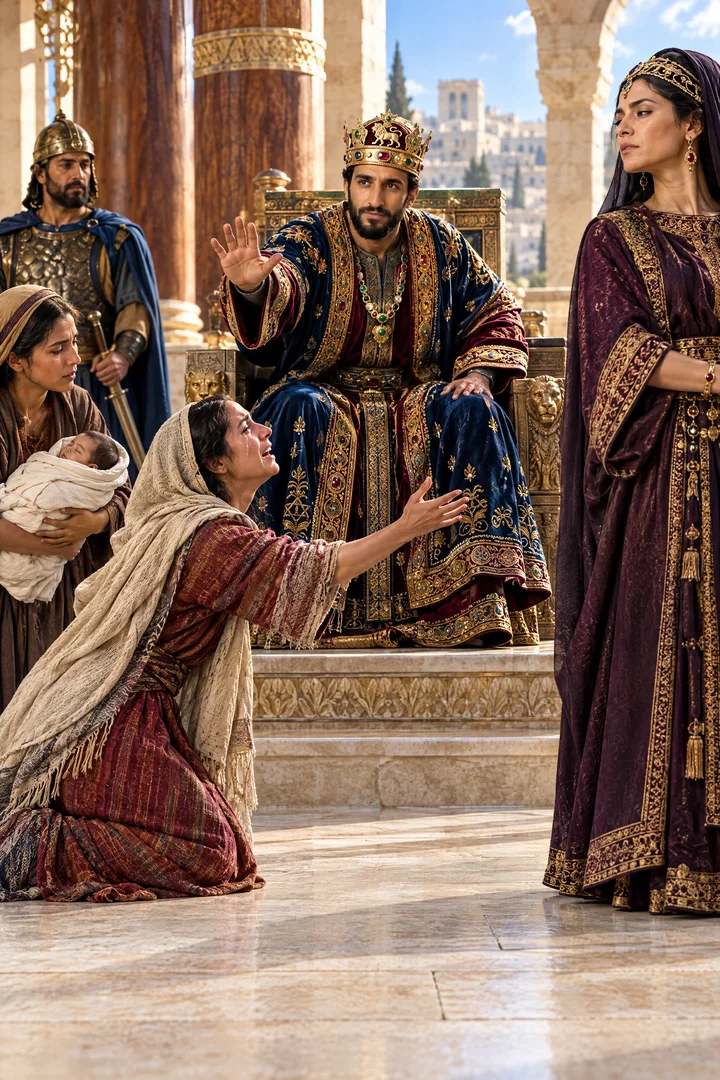
Then the king answered and said, Give her the living child, and in no wise slay it: she is the mother thereof.
Translations
American King James Version, King James Version, KJV Cambridge Paragraph Bible, Revised Version, American Standard Version
Then the king answered and said, Give her the living child, and in no wise slay it: she is the mother thereof.
Then the king answered and said, Give her the living child, and in no wise slay it: she is the mother of it.
And the king answereth and saith, 'Give ye to her the living child, and put it not at all to death; she [is] its mother.'
And the king answered and said, Give this one the living child, and in no wise put it to death: she is its mother.
Then responded the king, and said—Give, her, the living child, ye shall not, kill, it,—she, is its mother.
Berean Standard Bible, Majority Standard Bible
Then the king gave his ruling: “ Give the living baby to the first woman. By no means should you kill him; she is his mother.”
Then the king answered, “ Give the first woman the living child, and definitely do not kill him. She is his mother.”
Then the king made answer and said, Give her the child, and do not put it to death; she is the mother of it.
Then the King answered, and sayde, Giue her the liuing childe, and slay him not: this is his mother.
Douay-Rheims (Challoner revision)
The king answered, and said: Give the living child to this woman, and let it not be killed, for she is the mother thereof.
Pictures
Cross-references
- 1 Kings 3:5-12
In Gibeon the LORD appeared to Solomon in a dream by night: and God said, Ask what I shall give thee.
God grants Solomon the wisdom displayed in the chapter.
Commentary
Each commentary is drawn from primary sources: the writings of Ellen G. White and Adventist pioneers and periodicals. Each commentary is separate. Its own words are not a quotation; follow the references to read the source passages.
Ellen G. White
2 sources
The ruling was a display of wisdom and sympathy belonging to the early part of Solomon's reign.PK 57.2RH Dec 21, 1905 He used that wisdom and sympathy to take the side of a helpless child in danger.PK 57.2RH Dec 21, 1905 He commanded that the living infant be handed over to its mother and by no means be put to death.PK 57.2RH Dec 21, 1905 By that order he acknowledged her maternal claim and identified her as the true mother.PK 57.2RH Dec 21, 1905
That early act of rescuing a living child and restoring it unharmed to its mother stands in direct contrast with his later course.RH Dec 21, 1905 In his apostasy he gave consent to idolatrous worship in which children were presented as living sacrifices.RH Dec 21, 1905
Sources
Pioneers and periodicals
11 sources
The verse stands in 1 Kings 1 to 11, which gives the history of the undivided kingdom under Solomon and corresponds to the history in 2 Chronicles 1 to 9.RH May 11, 1916 It belongs to the account of Solomon, who asked God for wisdom and received it along with earthly blessings.RH Jan 12, 1869 It is part of the difficult case in 1 Kings 3:16-28 that proves his wisdom as king, to be read with the account of his wealth and wisdom in 1 Kings 4:25-34.ST Dec 9, 1897ST Oct 1, 1896 It records his wise decision between the two women, as a manifestation of the wisdom given to him: he gives the living child to its mother and forbids anyone to kill it.ST Apr 21, 1909 He identifies the true mother by her willingness to spare and even give up the living child rather than see him killed or divided, while the other woman accepted that outcome.ST Nov 5, 1885ST Jan 6, 1888
The verse shows Solomon uncertain which woman was the child's rightful mother, illustrating that human beings may fail to recognize what is true.RH Nov 4, 1858 Unlike Solomon, the Lord knows who belongs to him and cannot be confused or forgetful, and no change of time, place, appearance, or circumstance can hide his people from him.RH Nov 4, 1858 The verse shows Solomon using wisdom and sympathy to protect a helpless child and restore the living child to its mother.RH Dec 21, 1905 This early act contrasts with his later consent to idolatrous worship in which children were offered as living sacrifices.RH Dec 21, 1905
The verse illustrates that the true mother would rather surrender the living child than let it be killed, providing a test of who truly values what is alive.RH Jun 9, 1853 The king's decision figures the moral law, which must be preserved whole and not divided or slain, while the ceremonial law is treated as dead and rejected, and the sword of truth and justice tests those who would weaken or abolish the moral law.RH Jun 9, 1853 The verse illustrates the repentant sinner's regard for God's law: like the real mother who pleaded for the child's life, he does not seek the law's abolition but honors and keeps it.RH Apr 16, 1867 The example shows that genuine repentance leads a person to value the law and its life-giving place in obedience to God.RH Apr 16, 1867
Sources