1 Kings 3:26
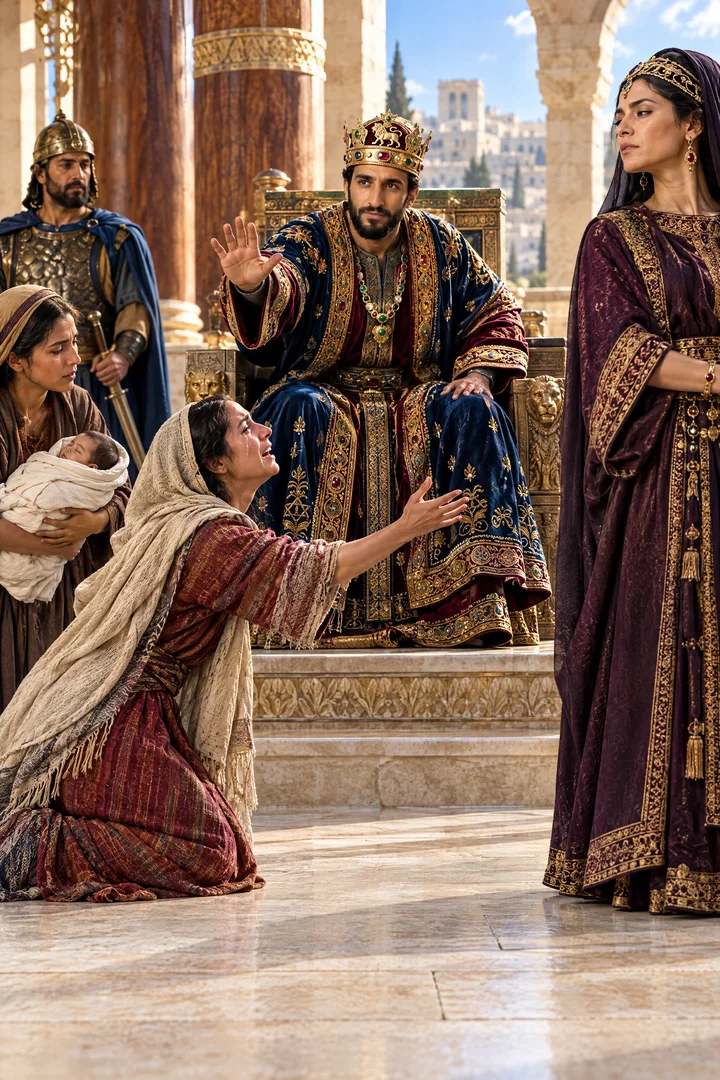
Then spake the woman whose the living child was unto the king, for her bowels yearned upon her son, and she said, O my lord, give her the living child, and in no wise slay it. But the other said, Let it be neither mine nor thine, but divide it.
Translations
Then spoke the woman whose the living child was to the king, for her bowels yearned on her son, and she said, O my lord, give her the living child, and in no wise slay it. But the other said, Let it be neither my nor yours, but divide it.
Then spake the woman whose the living child was unto the king, for her bowels yearned upon her son, and she said, O my lord, give her the living child, and in no wise slay it. But the other said, Let it be neither mine nor thine, but divide it.
Then spake the woman whose the living child was unto the king, for her bowels yerned upon her son, and she said, O my lord, give her the living child, and in no wise slay it. But the other said, Let it be neither mine nor thine, but divide it.
Then spoke the woman whose the living child was to the king, for her bowels yearned upon her son, and she said, O my lord, give her the living child, and in no wise slay it. But the other said, Let it be neither mine nor thine, but divide it.
Then spake the woman whose the living child was unto the king, for her bowels yearned upon her son, and she said, Oh my lord, give her the living child, and in no wise slay it. But the other said, It shall be neither mine nor thine; divide it.
Then spake the woman whose the living child was unto the king, for her heart yearned over her son, and she said, Oh, my lord, give her the living child, and in no wise slay it. But the other said, It shall be neither mine nor thine; divide it.
And the woman whose son [is] the living one saith unto the king (for her bowels yearned over her son), yea, she saith, 'O, my lord, give to her the living child, and put it not at all to death;' and this [one] saith, 'Let it be neither mine or thine — cut [it].'
Then spoke the woman whose was the living child to the king, for her bowels yearned over her son, and she said, Ah, my lord! give her the living child, and in no wise put it to death. But the other said, Let it be neither mine nor thine; divide it.
Then spake the woman, whose was the living child, unto the king—for tender became her compassions over her son—so she said—Pardon, my lord! Give, her, the living child, and do not, kill, it. But the other kept on saying—Neither mine, nor thine, shall it be, divide it.
Berean Standard Bible, Majority Standard Bible
Then the woman whose son was alive spoke to the king because she yearned with compassion for her son. “Please, my lord,” she said, “ give her the living baby. Do not kill him!”But the other woman said, “ He will be neither mine nor yours. Cut him in two!”
Then the woman whose the living child was spoke to the king, for her heart yearned over her son, and she said, “Oh, my lord, give her the living child, and in no way kill him!”But the other said, “ He shall be neither mine nor yours. Divide him.”
Then the mother of the living child came forward, for her heart went out to her son, and she said, O my lord, give her the child; do not on any account put it to death. But the other woman said, It will not be mine or yours; let it be cut in two.
Then spake the woman, whose the liuing child was, vnto the King, for her compassion was kindled toward her sonne, and she sayde, Oh my lorde, giue her the liuing childe, and slay him not: but the other sayde, Let it be neither mine nor thine, but deuide it.
Douay-Rheims (Challoner revision)
But the woman whose child was alive, said to the king, ( for her bowels were moved upon her child,) I beseech thee, my lord, give her the child alive, and do not kill it. But the other said: Let it be neither mine nor thine, but divide it.
Pictures



Cross-references
- 1 Kings 3:9-12
Give therefore thy servant an understanding heart to judge thy people, that I may discern between good and bad: for who is able to judge this thy so great a people?
Solomon’s request for wisdom precedes the judgment that demonstrated it.
Commentary
Each commentary is drawn from primary sources: the writings of Ellen G. White and Adventist pioneers and periodicals. Each commentary is separate. Its own words are not a quotation; follow the references to read the source passages.
Ellen G. White
2 sources
The woman to whom the living child belonged yearned inwardly over her son and pleaded that he be given alive to the other woman rather than slain, and her willingness to give up her own living son rather than see him killed proved the true mother's love.RH Dec 21, 1905 In his early reign Solomon discerned that self-sacrificing love and restored the helpless living babe to its unfortunate mother, displaying his wisdom and sympathetic kindness.PK 57.2RH Dec 21, 1905 That act revealed his self-mastery, moral efficiency, fine sensibilities, and living conscience while he remained loyal to God.PK 57.2
This compassionate judgment stands in stark contrast to his later ruin, when he consented to idolatrous rites in which living children were offered as sacrifices.PK 57.2RH Dec 21, 1905 That fall followed his separation from God through communication with idolaters, when he cast off his allegiance, lost mastery of himself, and fell so low as to allow the erection of such an idol and to countenance the licentious rites of Chemosh and Ashtoreth.PK 57.2
Sources
Pioneers and periodicals
11 sources
The verse belongs to the history of Solomon's reign in the time of the undivided kingdom, covering the same events as 2 Chronicles 1 to 9.ST Dec 9, 1897RH May 11, 1916 It stands just after Solomon asked for wisdom and received wisdom with earthly blessings, and the difficult case proves and displays that wisdom.ST Dec 9, 1897RH Jan 12, 1869 Solomon's shrewd judgment is shown by the opposite answers, for the true mother in yearning compassion begged that her living son be spared even if given to the other woman, while the false claimant was willing for him to be divided and slain, and by this the mother was made known.ST Nov 5, 1885 The two women figure the ceremonial law counted as dead and the moral law still living, so the sword that would divide the child tests those who would divide the moral law, and as the true mother prized her child's life so the converted sinner prizes God's law and seeks to keep it whole rather than to abolish it.RH Jun 9, 1853RH Apr 16, 1867 While Solomon was at first uncertain which woman was rightly his, the Lord knows His own and cannot be deceived by time, place, speech, or appearance, and Solomon's early sympathy that spared the living child stands in contrast to his later consent to idolatrous rites in which children were sacrificed.RH Dec 21, 1905RH Nov 4, 1858
Historical Context and Meaning
The verse belongs to the history of Solomon's reign during the period of the undivided kingdom.ST Dec 9, 1897RH May 11, 1916 That history covers the same events as 2 Chronicles 1 to 9.RH May 11, 1916 It stands in the first part of 1 Kings, where wisdom is a notable feature of the account of his reign.
It comes after Solomon asked for wisdom, when God granted him wisdom together with earthly blessings.RH Jan 12, 1869 It belongs to the difficult case he decided, and that case demonstrated his wisdom.ST Dec 9, 1897 The case demonstrates and illustrates his wisdom.ST Dec 9, 1897
The verse records his wise and shrewd judgment between the two women by their opposite responses.ST Nov 5, 1885 The true mother, whose compassion yearned for her living son, pleaded for him to be spared.ST Nov 5, 1885ST Jan 6, 1888 She would rather give him to the other woman than see him killed or divided.ST Nov 5, 1885ST Apr 21, 1909ST Jan 6, 1888 The false claimant accepted dividing him and his death.ST Nov 5, 1885ST Jan 6, 1888RH Jun 9, 1853 This test exposed which woman was the mother.ST Nov 5, 1885ST Jan 6, 1888
Doctrinal Illustrations and Contrast
The two women stand for two laws, the ceremonial law reckoned as dead and the moral law still living, and the true mother's compassion for the living child makes her unwilling to let it be divided or killed.RH Jun 9, 1853 The threatened sword becomes the test of all who would divide the moral law, distinguishing those who accept only part of it from those who insist that it remain whole.RH Jun 9, 1853 The appeal therefore is to preserve the moral law in all its parts, undivided and alive.RH Jun 9, 1853
Like that mother who valued her child's life and pleaded that it be spared, while the other woman accepted its death, the converted sinner loves God's law and pleads for its continuance.RH Apr 16, 1867 He does not ask for the law to be abolished but values it and keeps it.RH Apr 16, 1867
Solomon at first did not know which woman rightly belonged to him as the living child's mother, and only the true mother's compassion revealed her, while the other accepted the child's death.RH Nov 4, 1858 By contrast the Lord knows His own and cannot be deceived by time, place, speech, or appearance.RH Nov 4, 1858
Solomon's early wisdom and kind sympathy appeared in recognizing the true mother's love, that she would rather give up her living child than let him be killed.RH Dec 21, 1905 That compassionate judgment stands in contrast to his later consent to idolatrous rites in which children were sacrificed.RH Dec 21, 1905
Sources