1 Samuel 13:20
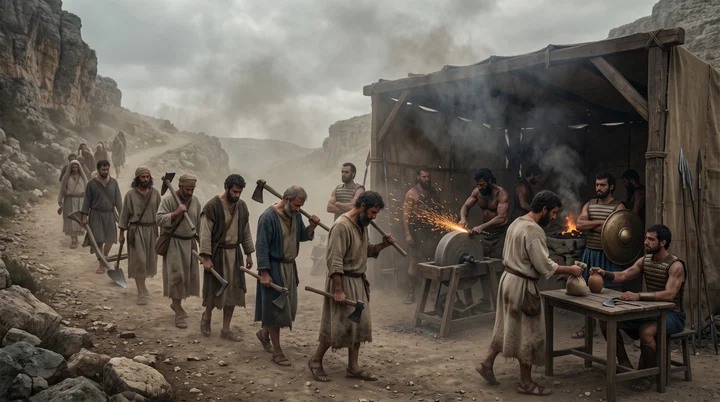
But all the Israelites went down to the Philistines, to sharpen every man his share, and his coulter, and his axe, and his mattock.
Translations
But all the Israelites went down to the Philistines, to sharpen every man his share, and his coulter, and his ax, and his mattock.
But all the Israelites went down to the Philistines, to sharpen every man his share, and his coulter, and his axe, and his mattock.
but all the Israelites went down to the Philistines, to sharpen every man his share, and his coulter, and his axe, and his mattock.
But all the Israelites went down to the Philistines, to sharpen every man his share, and his colter, and his ax, and his mattock.
Revised Version, American Standard Version
but all the Israelites went down to the Philistines, to sharpen every man his share, and his coulter, and his axe, and his mattock;
and all Israel go down to the Philistines, to sharpen each his ploughshare, and his coulter, and his axe, and his mattock;
And all Israel went down to the Philistines, every man to get his ploughshare, and his hoe, and his axe, and his sickle sharpened,
So all Israel went down to the Philistines,—to sharpen every man his share, and his mattock, and his axe, and his sickle.
Berean Standard Bible, Majority Standard Bible
Instead, all the Israelites would go down to the Philistines to sharpen their plowshares, mattocks, axes, and sickles.
but all the Israelites went down to the Philistines, each man to sharpen his own plowshare, mattock, ax, and sickle.
But all the Israelites had to go to the Philistines to get their ploughs and blades and axes and hooks made sharp;
Wherefore all ye Israelites went downe to the Philistims, to sharpen euery man his share, his mattocke, and his axe, and his weeding hooke.
Douay-Rheims (Challoner revision)
So all Israel went down to the Philistines, to sharpen every man his ploughshare, and his spade, and his axe, and his rake.
Pictures

Cross-references
- 1 Samuel 13:8-14
And he tarried seven days, according to the set time that Samuel had appointed: but Samuel came not to Gilgal; and the people were scattered from him.
Saul disobeys during the Philistine crisis, leading to the rejection of his kingship.
Commentary
Each commentary is drawn from primary sources: the writings of Ellen G. White and Adventist pioneers and periodicals. Each commentary is separate. Its own words are not a quotation; follow the references to read the source passages.
Ellen G. White
2 sources
The Israelites were so constrained by the Philistines that all of them had to go down to the Philistines to have their farming tools sharpened.PP 618.2–621.2ST Aug 10, 1882 That dependence exposed Israel's weakness in its crisis with the Philistines.PP 618.2–621.2 It left Saul's small force almost unarmed when facing the Philistine army.ST Aug 10, 1882
Sources
Pioneers and periodicals
5 sources
1 Samuel 13:20 belongs to the history of Israel from Eli to the old age of David, in the part telling the beginning of Saul's reign with Saul's rashness and weakness that brought the Lord's rejection of Saul and his family.ST Mar 31, 1909 It is part of an account of the harsh and severe conditions and oppression the Philistines had imposed on Israel.ST Mar 22, 1883 All the Israelites had to go down to the Philistines, to their garrisons and territory, to have their agricultural and farming tools sharpened, every man his share and his coulter and his axe and his mattock.ST Aug 3, 1882ST Aug 10, 1882ST Mar 22, 1883
The Philistines had forbidden Israel to practice smithing and make implements.ST Aug 3, 1882ST Jul 15, 1889 They kept the smithing trade under their own control even after peace was made.ST Aug 3, 1882 They imposed this ban because they feared the implements could be made into weapons.ST Jul 15, 1889 As a result Israel's tools had become blunt and the people were poorly equipped for war, leaving Saul's small force almost unarmed when it faced the Philistine army, with only Saul and Jonathan having a spear or sword and Israel without weapons of war when Saul became king.ST Aug 3, 1882ST Aug 10, 1882ST Jul 15, 1889 The verse thus recalls the oppression from which David later delivered Israel.ST Mar 22, 1883
Sources