1 Samuel 13:22
So it came to pass in the day of battle, that there was neither sword nor spear found in the hand of any of the people that were with Saul and Jonathan: but with Saul and with Jonathan his son was there found.
Translations
American King James Version, King James Version, KJV Cambridge Paragraph Bible, Webster Bible, Revised Version, American Standard Version
So it came to pass in the day of battle, that there was neither sword nor spear found in the hand of any of the people that were with Saul and Jonathan: but with Saul and with Jonathan his son was there found.
And it hath been, in the day of battle, that there hath not been found sword and spear in the hand of any of the people who [are] with Saul and with Jonathan — and there is found to Saul and to Jonathan his son.
And it came to pass in the day of battle, that there was neither sword nor spear found in the hand of any of the people that were with Saul and Jonathan; but with Saul and with Jonathan his son there was found.
Thus would it come to pass, in the day of battle, that there was found—neither sword nor spear, in the hand of any of the people, that were with Saul and Jonathan, but such were found belonging to Saul and to Jonathan his son.
Berean Standard Bible, Majority Standard Bible
So on the day of battle not a sword or spear could be found in the hands of the troops with Saul and Jonathan; only Saul and his son Jonathan had weapons.
So it came to pass in the day of battle that neither sword nor spear was found in the hand of any of the people who were with Saul and Jonathan; but Saul and Jonathan his son had them.
So on the day of the fight at Michmash, not a sword or a spear was to be seen in the hands of any of the people with Saul and Jonathan: only Saul and his son Jonathan had them.
So whe the day of battell was come, there was neither sworde nor speare founde in the handes of any of the people that were with Saul and with Ionathan: but onely with Saul and Ionathan his sonne was there founde.
Douay-Rheims (Challoner revision)
And when the day of battle was come, there was neither sword nor spear found in the hand of any of the people that were with Saul and Jonathan, except Saul and Jonathan his son.
Pictures
Commentary
Each commentary is drawn from primary sources: the writings of Ellen G. White and Adventist pioneers and periodicals. Each commentary is separate. Its own words are not a quotation; follow the references to read the source passages.
Ellen G. White
4 sources
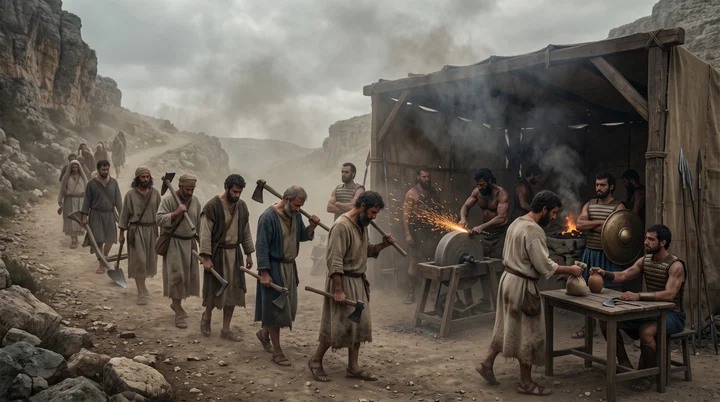
The verse belongs to the time when the Philistines threatened Israel while Saul's army was scattering, and in that crisis Saul's impatience led him to offer a sacrifice contrary to God's command.PP 618.2–621.2 On the day of battle none of the people who were with Saul and Jonathan had a sword or spear in hand, but with Saul and with Jonathan his son weapons were found.Lt 16, 1897, par. 35–36PP 616.2ST Aug 10, 1882 The lack existed because there was no smith found throughout all the land of Israel, for the Philistines had worked diligently to keep the Hebrews from learning to make swords and spears.Lt 16, 1897, par. 35–36PP 616.2 The Hebrews had depended on the Philistines to prepare their instruments of war, and had neglected to equip themselves for conflict.Lt 16, 1897, par. 35–36PP 616.2
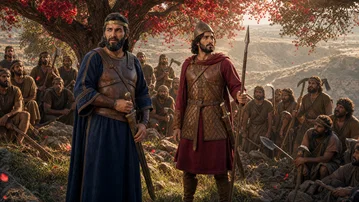
Saul had not done his part as kingly general to prepare Israel for the conflict.Lt 16, 1897, par. 35–36 Israel's force was small, incomplete and disorderly and almost unarmed, in contrast to the immense, large and well-equipped army of the Philistines.Lt 16, 1897, par. 35–36ST Aug 10, 1882 The contrast left Israel's men afraid, with many hiding away for fear and terror.Lt 16, 1897, par. 35–36ST Aug 10, 1882 Because of his presumption Saul was left without any special direction from the Lord and knew not what to do, yet he faced the Philistine host trusting in his own skill and aptitude.Lt 16, 1897, par. 35–36 God allowed the crisis to expose Saul's perversity and to teach the people humility and faith.ST Aug 10, 1882
Sources
Pioneers and periodicals
5 sources
The verse belongs to the account of the choosing of Saul and the beginning of his reign, standing in chapters 13-14 within the larger account in chapters 7-18 of the choosing of Saul as king and the waning of his house with the calling of David.ST Mar 31, 1909ST Apr 15, 1913 That larger account traces Saul's rashness and weakness to the Lord's rejection of Saul and his family and the anointing of David.ST Mar 31, 1909
In the day of battle no sword or spear was found in the hand of any of the people that were with Saul and Jonathan, but only Saul and Jonathan himself had weapons, leaving Israel poorly equipped for battle against the Philistines.ST Aug 3, 1882ST Aug 10, 1882ST Jul 15, 1889 Israel's small force was thus almost unarmed when battle came.ST Aug 3, 1882ST Aug 10, 1882ST Jul 15, 1889 Israel was unarmed because the Philistines had restricted Israelite smithing and prevented them from making weapons, retaining control of the trade.ST Aug 3, 1882ST Jul 15, 1889 Israel's lack of foresight during the years of peace and its oppression also left it unprepared for battle.ST Aug 3, 1882
The verse contrasts Israel's small, almost unarmed force with a large, well-equipped Philistine army, a contrast that left Israel's men afraid.ST Aug 10, 1882 God allowed the crisis to expose Saul's perversity and to teach the people humility and faith.ST Aug 10, 1882 The account shows Saul's rashness, weakness and perversity, which led to the Lord's rejection of Saul and his family and the anointing of David.ST Aug 10, 1882ST Mar 31, 1909 Israel's lack of weapons illustrates how bondage to Satan can be used to block every way of escape and keep people from taking up the means God provides for their defense.ST Jul 15, 1889
Sources