1 Samuel 14:19
And it came to pass, while Saul talked unto the priest, that the noise that was in the host of the Philistines went on and increased: and Saul said unto the priest, Withdraw thine hand.
Translations
And it came to pass, while Saul talked to the priest, that the noise that was in the host of the Philistines went on and increased: and Saul said to the priest, Withdraw your hand.
King James Version, KJV Cambridge Paragraph Bible
And it came to pass, while Saul talked unto the priest, that the noise that was in the host of the Philistines went on and increased: and Saul said unto the priest, Withdraw thine hand.
And it came to pass while Saul talked to the priest, that the noise that was in the host of the Philistines went on, and increased: and Saul said to the priest, Withdraw thy hand.
And it came to pass, while Saul talked unto the priest, that the tumult that was in the camp of the Philistines went on and increased: and Saul said unto the priest, Withdraw thine hand.
And it came to pass, while Saul talked unto the priest, that the tumult that was in the camp of the Philistines went on and increased: and Saul said unto the priest, Withdraw thy hand.
And it cometh to pass, while Saul spake unto the priest, that the noise which [is] in the camp of the Philistines goeth on, going on and becoming great, and Saul saith unto the priest, 'Remove thy hand.'
And it came to pass while Saul talked to the priest, that the noise which was in the camp of the Philistines went on and increased; and Saul said to the priest, Withdraw thy hand.
And it came to pass, as soon as Saul had spoken unto the priest, that, the tumultuous noise that was in the camp of the Philistines, went on and on, increasing. Then said Saul unto the priest,—Withdraw thy hand.
Berean Standard Bible, Majority Standard Bible
While Saul was talking to the priest, the commotion in the Philistine camp continued to increase. So Saul said to the priest, “Withdraw your hand.”
While Saul talked to the priest, the tumult that was in the camp of the Philistines went on and increased; and Saul said to the priest, “Withdraw your hand!”
Now while Saul was talking to the priest, the noise in the tents of the Philistines became louder and louder; and Saul said to the priest, Take back your hand.
And while Saul talked vnto the Priest, the noyse that was in the hoste of the Philistims, spred farther abroade, and encreased: therefore Saul said vnto the Priest, Withdraw thine hand.
Douay-Rheims (Challoner revision)
And while Saul spoke to the priest, there arose a great uproar in the camp of the Philistines: and it increased by degrees, and was heard more clearly. And Saul said to the priest: Draw in thy hand.
Pictures
Cross-references
- 1 Samuel 14:11-12
And both of them discovered themselves unto the garrison of the Philistines: and the Philistines said, Behold, the Hebrews come forth out of the holes where they had hid themselves.
Jonathan takes the Philistines’ challenge as a sign of the LORD’s deliverance.
Commentary
Each commentary is drawn from primary sources: the writings of Ellen G. White and Adventist pioneers and periodicals. Each commentary is separate. Its own words are not a quotation; follow the references to read the source passages.
Ellen G. White
7 sources
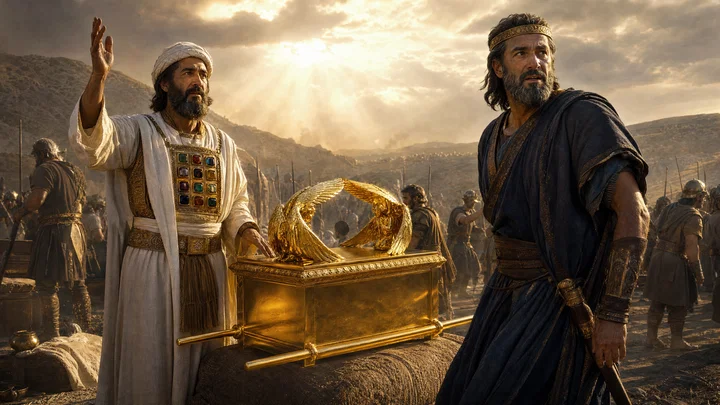
While Saul was still talking with the priest and the priest was inquiring of God, the noise and confusion of battle in the Philistine camp went on and increased, showing that the battle was intensifying.Lt 16, 1897, par. 37–481SP 358.2–359.2SG4 70.1–71.1PP 623.3 Saul had summoned the ark and its priests and meant to ask the Lord whether Israel should attack.ST Aug 10, 1882ST Aug 10, 1882 He did so hoping to restore the people's courage and to strengthen his own royal authority, even though bringing the ark into battle had before preceded Israel's defeat by the Philistines.ST Aug 10, 1882
"Withdraw thine hand" meant that Saul told the priest to stop the inquiry, turning from seeking counsel to acting.Lt 16, 1897, par. 37–481SP 358.2–359.2SG4 70.1–71.1PP 623.3ST Aug 10, 1882 He saw the growing commotion as a signal that the battle was turning and that deliverance was becoming clear, and he seized the opportunity to advance and join the assault.Lt 16, 1897, par. 37–48SG4 70.1–71.1PP 623.3 He did so although he did not know that Jonathan and his armor-bearer had started the attack, while the Lord was already bringing deliverance through Jonathan and through panic among the Philistines.Lt 16, 1897, par. 37–48PP 623.3
In abandoning the delay Saul acted from impatience and from misplaced confidence in royal plans and display rather than from humble trust in God.ST Aug 10, 1882ST Aug 10, 1882 God permitted this crisis to rebuke Saul's perversity and to teach His people humility and faith.PP 623.1–2 For because of Saul's sin in his presumptuous offering the Lord would not give him the honor of vanquishing the Philistines, but chose Jonathan, the king's son, a man who feared the Lord, as the instrument to deliver Israel.PP 623.1–2
Sources
Pioneers and periodicals
9 sources
The verse stands in the history of Israel from Eli to the old age of David recorded in the books of Samuel, in the account of the beginning of Saul's reign before the Lord's rejection of Saul and his family and the anointing of David.ST Mar 31, 1909 The surrounding passage records Jonathan's noted victory over the Philistines going out from Gibeah of Benjamin, the town where Saul dwelt after he was anointed king.ST Oct 27, 1898 Gibeah means high, stands 2,690 feet above the sea, about 200 feet higher than Jerusalem, commands a fine view even beyond the Dead Sea into the mountains of Moab, and lies within an hour's walk from Jerusalem.ST Oct 27, 1898
The immediate context is God's great deliverance of Israel and Jonathan's remarkable victory and triumph under the leadership of Jonathan, the man of valor, with his armor-bearer, in which two men put a trained Philistine army to flight.ST Sep 20, 1883ST Jul 21, 1909ST Oct 4, 1910ST Apr 14, 1909 That triumph was won through faith in the power of God.ST Jul 21, 1909ST Oct 4, 1910ST Apr 14, 1909ST Mar 10, 1909 It shows that God wins battles through the weak through faith in His power, and that victory does not depend on whether the fighters are many or few.ST Jul 21, 1909ST Oct 4, 1910ST Apr 14, 1909ST Mar 10, 1909
The verse shows Saul summoning the ark and its priests to ask the Lord whether Israel should attack, in an attempt to restore the people's courage and strengthen his royal authority, despite knowing that bringing the ark into battle had preceded Israel's defeat by the Philistines.ST Aug 10, 1882 As the noise and confusion in the Philistine host went on and increased, Saul in impatience told the priest to withdraw his hand, abandoning the inquiry and its delay in order to advance against them.ST Aug 10, 1882ST Aug 10, 1882 This showed misplaced confidence in royal plans and display rather than humble trust in God.ST Aug 10, 1882 The act is another instance of Saul's growing rashness and weakness, followed after the deliverance by his rash decree under which he even sentenced Jonathan to death for unknowingly tasting honey.ST Sep 20, 1883ST Mar 31, 1909
Sources