1 Samuel 17:38
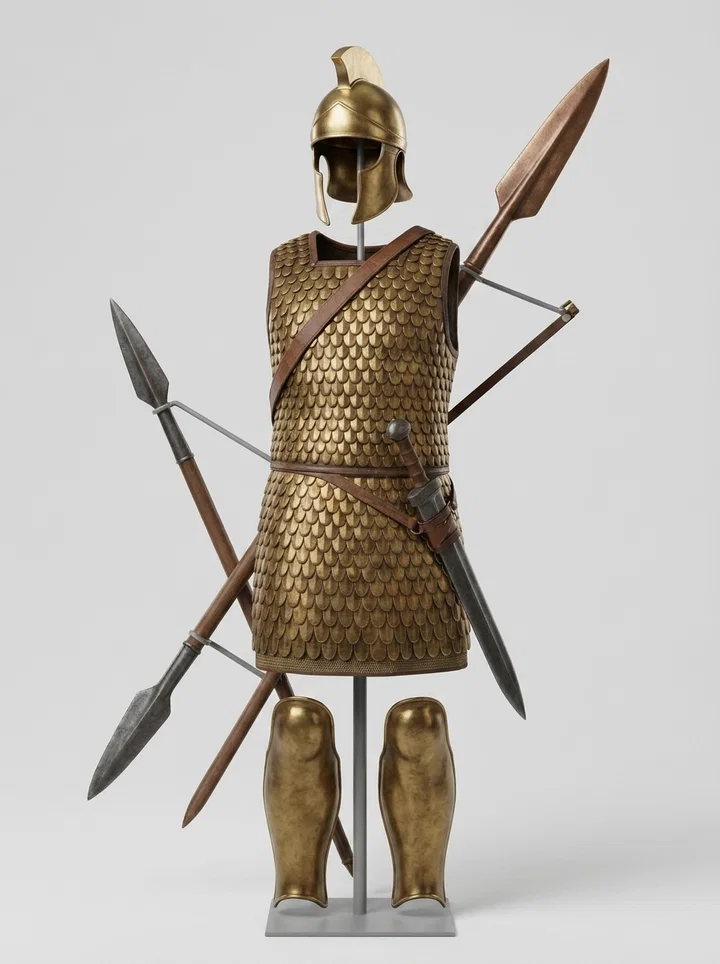
And Saul armed David with his armour, and he put an helmet of brass upon his head; also he armed him with a coat of mail.
Translations
And Saul armed David with his armor, and he put an helmet of brass on his head; also he armed him with a coat of mail.
And Saul armed David with his armour, and he put an helmet of brass upon his head; also he armed him with a coat of mail.
And Saul armed David with his armour, and he put a helmet of brass upon his head; also he armed him with a coat of mail.
And Saul armed David with his armor, and he put a helmet of brass upon his head; also he armed him with a coat of mail.
And Saul clad David with his apparel, and he put an helmet of brass upon his head, and he clad him with a coat of mail.
And Saul clad David with his apparel, and he put a helmet of brass upon his head, and he clad him with a coat of mail.
And Saul clotheth David with his long robe, and hath put a helmet of brass on his head, and doth clothe him with a coat of mail.
And Saul clothed David with his dress, and put a helmet of bronze upon his head, and clothed him with a corselet.
And Saul clad David with his own military coat, and set a helmet of bronze upon his head,—and clad him with a coat of mail.
Berean Standard Bible, Majority Standard Bible
Then Saul clothed David in his own tunic, put a bronze helmet on his head, and dressed him in armor.
Saul dressed David with his clothing. He put a helmet of bronze on his head, and he clad him with a coat of mail.
Then Saul gave David his clothing of war, and put a head-dress of brass on his head and had him clothed with a coat of metal.
And Saul put his rayment vpon Dauid, and put an helmet of brasse vpon his head, and put a brigandine vpon him.
Douay-Rheims (Challoner revision)
And Saul clothed David with his garments, and put a helmet of brass upon his head, and armed him with a coat of mail.
Pictures
Cross-references
- 1 Samuel 17:47
And all this assembly shall know that the LORD saveth not with sword and spear: for the battle is the LORD’s, and he will give you into our hands.
David declares that the battle belongs to the Lord, not to weapons.
- Ephesians 6:11-17
Put on the whole armour of God, that ye may be able to stand against the wiles of the devil.
Spiritual armor contrasts with the armor Saul put on David.
- 1 Samuel 17:5
And he had an helmet of brass upon his head, and he was armed with a coat of mail; and the weight of the coat was five thousand shekels of brass.
Saul arms David with armor like the armor worn by Goliath, his opponent.
- 1 Samuel 17:50-51
So David prevailed over the Philistine with a sling and with a stone, and smote the Philistine, and slew him; but there was no sword in the hand of David.
records slaying and Israel's attack
- 1 Samuel 17:45
Then said David to the Philistine, Thou comest to me with a sword, and with a spear, and with a shield: but I come to thee in the name of the LORD of hosts, the God of the armies of Israel, whom thou hast defied.
David declares he faces Goliath in the Lord’s name.
- 1 Samuel 16:18
Then answered one of the servants, and said, Behold, I have seen a son of Jesse the Beth-lehemite, that is cunning in playing, and a mighty valiant man, and a man of war, and prudent in matters, and a comely person, and the LORD is with him.
David is described as a valiant man and warrior.
Commentary
Each commentary is drawn from primary sources: the writings of Ellen G. White and Adventist pioneers and periodicals. Each commentary is separate. Its own words are not a quotation; follow the references to read the source passages.
Ellen G. White
18 sources
Saul dressed David for his fight with the giant in the king's own battle clothing, with metal covering for head and body and with his sword.PP 646.4–647.11SP 370.1–33T 219.2 The outfit was too large and heavy and untried, so David could not move freely in it and laid it aside for the simple shepherd weapons he had already proved.PP 646.4–647.11SP 370.1–33T 220.1Ms 116, 1898, par. 12–1418MR 4.1–4 In this he showed that victory depends not on human equipment, strength or appearance but on humble trust in God whose help had given past deliverances.1SP 370.1–3GW92 187.1–188.23T 218.2–219.1 Therefore God's workers must not fight in borrowed armor by copying another's methods, plans and mind, but are to keep their own individuality and serve in their own calling with the abilities God has given them.Ms 116, 1898, par. 12–1418MR 4.1–4Lt 46, 1906, par. 5Lt 39a, 1887, par. 1–5Ms 116, 1898, par. 6–9 They are to put on every piece of God's prepared armor from heaven and meet opposition clothed only in Christ's righteousness, with a meek, lowly and loving heart rather than a harsh, dictating spirit of wrath.Ms 103, 1903, par. 9–12Lt 98a, 1897, par. 52–55Lt 169, 1902, par. 2–3Ms 101, 1899, par. 14
David Refuses Saul's Armor
Before the fight with Goliath, Saul clothed David in his own royal armor, putting a brass helmet on his head and a coat of mail on him, together with the king's sword.PP 646.4–647.11SP 370.1–33T 219.23T 220.1GW92 187.1–188.2 The equipping was Saul's own armor placed on David for facing Goliath, and wearing it would have suggested that victory depended on Saul's equipment.3T 219.2GW92 187.1–188.23T 218.2–219.1 The armor was heavy and unfamiliar and too large for David, so he could not move or fight effectively in it.PP 646.4–647.1Ms 116, 1898, par. 12–1418MR 4.1–4Lt 98a, 1897, par. 52–556MR 114.1 Because he had not tested it, he would not wear it but laid the armor aside.PP 646.4–647.11SP 370.1–33T 220.1GW92 187.1–188.23T 218.2–219.1 He went instead with the simple, familiar weapons he had proved, his staff, sling and stones.PP 646.4–647.11SP 370.1–3GW92 187.1–188.23T 218.2–219.1Ms 116, 1898, par. 12–14 With sling and stone he slew the Philistine who defied Israel, defeating Goliath the champion.Ms 116, 1898, par. 12–1418MR 4.1–4 That same victory is recalled later when David sought refuge in Gath, where he is identified as the man who had slain that champion years earlier.PP 656.2
Trust God Not Man
David laid aside the royal armor and chose sling and stones instead, relying on God rather than on military equipment and outward strength.1SP 370.1–3GW92 187.1–188.23T 218.2–219.1 He refused the king's armor because he had not tested it, trusting in God rather than in human weapons or appearances.GW92 187.1–188.23T 218.2–219.1 To have worn it would have suggested that victory depended on Saul's equipment, making it seem that his strength came from human weapons rather than from the Lord.GW92 187.1–188.23T 218.2–219.1 He trusted instead the God whose help had already brought him victories, and went out with the simple, familiar weapons he had proved, relying on the Lord.GW92 187.1–188.23T 218.2–219.1
Like David, ministers and God's servants are not to trust prepared human means and arguments rather than God, nor to boast in themselves.3T 219.2 They are not to rely on equipment or methods they have not proved, but are to rely humbly and trust wholly in God as their strength.3T 219.23T 220.1 When God's cause requires someone to face a defier of Israel, God can carry that person through and give truth the victory.3T 220.1
Those called and prepared for battle in the name of the Lord must not fight in borrowed armor, for David could not put on Saul's armor because it was too large for him.Lt 98a, 1897, par. 52–55 They must have every piece of God's prepared armor from heaven's armory, not Saul's armor but the whole armor of God.Lt 98a, 1897, par. 52–55Ms 101, 1899, par. 14 With that armor they can go forth through Christ and through the Spirit of God and not through themselves to places still in darkness, with hearts full of Christlike tenderness, compassion, and love.Ms 101, 1899, par. 14 For youth this means understanding God's plan for work in every stage of the upward march, knowing for themselves the reasons of the faith and making it their experience, obtaining teaching through work, and feeding on the divine Word until it is brought into the current that circulates through mind, heart, and soul.Lt 98a, 1897, par. 52–55
Serve in Own Calling
A life consecrated to God keeps its own individuality and is developed and beautified in it, grafted into one parent stock with unity in diversity and not sunk into another person's individuality and mold.Ms 116, 1898, par. 12–14 No one is to be forced into another person's pattern, but each is to be left free to serve God with the abilities and capabilities God has given and to work in the way suited to them, since David could not wear Saul's armor but dropped it and took the familiar sling and stone and slew the Philistine who defied Israel.Ms 116, 1898, par. 12–1418MR 4.1–4Lt 46, 1906, par. 5 All characters are to be fashioned not after man's pattern but after the Lord's ideal under the molding of the Holy Spirit, each acting the assigned part with the fragrance of Christ's character.Ms 116, 1898, par. 12–14 None is at liberty to demerit and belittle God's workmanship because fellow workers do not bear his likeness.Ms 116, 1898, par. 12–14
Ministers should not imitate another person's methods or rely on another's prepared work, but should labor in their own harness with the abilities God has given them and seek His guidance for themselves.Lt 39a, 1887, par. 1–5 To consent to wear Saul's armor means to lean upon man and make flesh his arm.Ms 116, 1898, par. 6–9 It means to become the transcript of another man's mind, to let another fashion and shape the mind after his own mind and teach him to voice his sentiments, to refuse to impart instruction unless first learning the mind of some minister or trusted person, and to seek to pattern after any man's character.Ms 116, 1898, par. 6–9 That course makes an utter failure and works detriment and harm.Ms 116, 1898, par. 6–9 Instead each person is to lean upon God, look to God for himself, and breathe out the soul to God, acting in his own capacity according to the ability God has given him and trading with conscientious fidelity upon his own talents.Ms 116, 1898, par. 6–9 Each is to have an individual experience with rejoicing in himself and not in another, and to work in the armor which God has provided while growing up under God's supervision to his own individual measurement.Ms 116, 1898, par. 6–9
Workers for God cannot all labor in the same armor or in the same manner, for Saul's armor stands for one man's plans, ideas, and ways of carrying forward the work.6MR 114.1Lt 49, 1876, par. 13–15 Different workers have different strengths and weaknesses, and the work is best done when they cooperate so that one can supply what another lacks.Lt 49, 1876, par. 13–15 No worker succeeds merely by following exactly another man's order.6MR 114.1 It is therefore wrong for a leader to lift all the burdens himself, to insist that others copy his plans exactly, and to believe that his ideas and ways are the only right way.6MR 114.1
Saul's armor also stands for a war garment of wrath and contention that none of God's servants are to put on.Ms 103, 1903, par. 9–12Lt 169, 1902, par. 2–3 It means a strong spirit that is not meek and contrite, an inherited and cultivated contentious spirit, a strong, dictating attitude expressed in harsh and severe words, contention, criticism, and readiness for battle in council meetings.Ms 103, 1903, par. 9–12Lt 169, 1902, par. 2–3 That armor must not be worn but must be laid aside, disrobed, and stripped off, because vehemence and bringing charges against brethren only wounds the speaker and separates him from God's work.Ms 103, 1903, par. 9–12Lt 169, 1902, par. 2–3 The heart must be broken in tenderness before God and become as a little child.Ms 103, 1903, par. 9–12Lt 169, 1902, par. 2–3 Opposition must then be met clad only in the robe of Christ's righteousness, with a meek, lowly, contrite, humble, and childlike heart, with words subdued by the Spirit of God, with trust in Christ in severe trials, and with work as an example in preparing the way of the Lord and removing stumbling blocks rather than dictating to others.Ms 103, 1903, par. 9–12Lt 169, 1902, par. 2–3
Sources
Pioneers and periodicals
32 sources
Saul clothed David in his own armor for the fight in the vale of Elah, putting a brass helmet on his head and a coat of mail on him over fitting clothing beneath.ST Mar 4, 1886ST Dec 20, 1910ST Dec 12, 1895 David put it aside because it was untried and unproved to him, unfitted to him, unaccustomed, and heavy and cumbersome so he could not go in it.ST Mar 4, 1886ST Dec 20, 1910ST Aug 26, 1889 He went out instead with his shepherd's staff and sling and smooth stones, trusting in the Lord rather than in numbers, size, or human power, and slew the champion of Gath.ST Mar 4, 1886ST Dec 20, 1910ST Dec 12, 1895ST Aug 26, 1889ST Jan 1, 1885 Giants are not overcome by human champions with armor, weapons, and display, but by simple means used in living faith that joins human weakness to God's power.ST Aug 26, 1889ST Jan 1, 1885ST Oct 4, 1883ST Aug 26, 1889RH Apr 28, 1874 Saul's armor stands for the weapons of the state, civil law and compulsion, and worldly methods and assistance, which the church in obedience to God does not need but leaves aside for the Book of God and the Spirit who wrote it, while each worker must do his distinct work with means suited to him and not borrowed from another.ST Jun 7, 1905ST Sep 22, 1890RH Nov 7, 1907
Armor Offered and Refused
Saul clothed David in his own armor before the meeting with Goliath in the vale of Elah, putting a brass helmet on his head and a coat of mail on him.ST Mar 4, 1886ST Dec 20, 1910ST Dec 12, 1895ST Sep 22, 1890RH Nov 7, 1907 The clothing beneath was proper clothing fitted for the helmet and coat of mail, rather than the armor being put directly over his light shepherd's clothes.ST Nov 21, 1895
David could not go in the armor because it was untried and unproved to him and he had not tested it.ST Mar 4, 1886ST Dec 20, 1910 He was unaccustomed to the sword and unused to such equipment, so he put it aside.ST Mar 4, 1886ST Dec 20, 1910ST Aug 26, 1889 The armor was good in itself but it did not fit David and did not suit him, and being heavy and cumbersome it would encumber rather than help him.ST Jul 16, 1885RH Dec 17, 1901 Knowing he could not fight encumbered in that way, he discarded it though the failure of the king's provision left him facing sneers, stares, and the hazard of disgraceful failure.ST Jul 16, 1885RH Dec 17, 1901
He went out instead with his ordinary shepherd's staff and sling, taking a handful of smooth stones.ST Mar 4, 1886ST Dec 20, 1910ST Aug 26, 1889ST Mar 14, 1906 With sling and stone he slew the mighty Philistine champion.ST Mar 14, 1906ST Oct 4, 1883RH Apr 28, 1874 The death of the leader slain before them became the signal for a united attack of the army of Israel, and the enemy fled in confusion.ST Mar 14, 1906
He had been trained in humble circumstances guarding his father's sheep for greater challenges ahead.RH Mar 10, 1903 There, in facing the lion and the bear, was formed his habit of obeying God that prepared him for Goliath and brought success.
After slaying Goliath and taking a leading part in the battle, David was kept by Saul with him at his court at Gibeah, where he behaved wisely and played before Saul as before.ST Nov 28, 1895 There he gained the friendship of the people, and there the friendship between David and Jonathan was sealed.ST Nov 28, 1895 The people met the conquerors with songs and dancing, shouting that Saul had slain his thousands and David his ten thousands, giving David greater praise than Saul.ST Nov 28, 1895 That praise turned Saul's jealous eye into unreasoning hatred and open intent to take his life.ST Nov 28, 1895 The flight to Samuel at Ramah and the covenant and secret meeting with Jonathan at the rock Ezel come some time later, perhaps a year, after that battle.ST Nov 28, 1895
Victory Through Faith Alone
The army of Israel stood in fear before the giant of Gath because the presence of the Lord was not with them, while David of Bethlehem went out against him with confidence in the Lord whose power he knew, trusting not in numbers or size or human power but in Israel's God.ST Dec 12, 1895ST Jan 1, 1885ST Jul 14, 1887RH Sep 30, 1858 The deliverance came not through the armor Saul put upon him, for he laid it aside as unused and went with his ordinary shepherd's staff and sling, trusting in the Lord.ST Aug 26, 1889 Living faith thus joined human weakness to divine power, opening a way when none could be seen or understood, and the part required of men is to believe.ST Aug 26, 1889 That faith ventures much and asks great things, as David ventured to slay Goliath, and it enables even the weakest to face the obstacles that hinder the journey to the heavenly country.ST Sep 17, 1896ST Sep 3, 1896
Giants are not overcome by human champions with armor and weapons and display, but by simple means used in faith, with sling and stone instead of the king's armor.ST Oct 4, 1883RH Apr 28, 1874 Such faith with simple weapons outweighs the armor and weapons and numbers of a fearful army, standing in contrast to the fear and doubt of his brethren.ST Jan 1, 1885 When men forget self and seek to honor God and vindicate His name and truth, trusting Him rather than human learning and strength, He makes His strength perfect in weakness, works mightily with them, and crowns their efforts with success.ST Mar 4, 1886ST Dec 20, 1910 To take the glory to self in pride and self-sufficiency over success given through superior abilities brings ruin, while the compassionate Father pities the weakness of human nature and bears long with folly, giving His Son to come to a fallen world and bear the buffetings and temptations of Satan to show men how to overcome.ST Mar 4, 1886ST Dec 20, 1910
The contempt with which Goliath despised David pictures what those loyal to God in keeping all His commandments still meet from proud and boastful learned men who despise the little band loyal to God.ST Mar 4, 1886ST Dec 20, 1910 Though many have never graduated from college and may be uneducated, they stand with only the Bible in hand in defense of God's truth to vindicate His Sabbath trodden underfoot and beneath lawless feet.ST Mar 4, 1886ST Dec 20, 1910 The Philistine's apparent strength and success did not last, for he fell, and everyone reliant on Jesus is commissioned as His Davids to press on against the mightiest giant and continue patient work though the enemy's laughter sweeps over the valleys, assured that God's workers will laugh hereafter when the enemies weep.ST Mar 4, 1886RH Nov 28, 1871 The account sets Saul's great physical stature against David's greater bravery to show that true greatness is measured by spirit and not by size.RH Mar 2, 1905 David showed grit by disregarding the failure of the brass helmet and coat of mail and going forward anyway despite the sneers of his brethren and the stare of the army, hazarding a disgraceful failure more bitter than death to a sensitive soul, unlike the vision in which the combatants are not so unequally matched.ST Jul 16, 1885RH Dec 31, 1901
Guidance for God's Work
Saul's armor is the weapons of the state and man-made armor, civil law and state compulsion to do religious work and to shield from the adversary, and worldly methods and assistance in general.ST Jun 7, 1905ST Sep 22, 1890 When the church walks in obedience to the laws of God and keeps the true Sabbath instead of Sunday, it needs none of those weapons to carry on its work, but relies on the Book of God and the Spirit who wrote it.ST Jun 7, 1905ST Sep 22, 1890 Resorting to Saul's armor comes from apostasy from the true Sabbath and from the true principle of religious worship.ST Jun 7, 1905 As David discarded Saul's armor when it would hinder rather than help instead of trying to alter it to fit, so a human law meant to protect Sunday sacredness should be abandoned when it proves ineffective and obstructs the work it claims to protect.ST Nov 1, 1899
As David knew he could not fight encumbered by heavy armor and went without it relying on God's protection, so in the conflict with sin every burden must be laid aside and the Spirit depended on for protection.RH Dec 17, 1901 Only in his own armor could David contend with the Lord's enemies, showing that a great work must be done with means suited to it.RH Nov 7, 1907 A worker called to a distinct work cannot do it with equipment borrowed from another work even when fully adequate for its own purpose, as the medical school for training medical missionary workers cannot accomplish its purpose with equipment fully adequate for other training schools but must have its own facilities and God-fearing instructors. Even work done in the very best manner by one mind will not be as effective in the hands of another whose mind is cast in a different mould as an inferior work that fits him because it is the product of his own mind.
What fits one person may not fit another, for Saul's armor did not suit David and he could not fight in it.RH Nov 7, 1907ST Mar 4, 1886 Christians should not try to reproduce another person's experience of faith, for each person's experience is individual, and Christian armor and righteousness are found in Jesus and provided for each person.RH Dec 31, 1901 What is urged upon a man should be declined when it is not right for him, as David refused the armor Saul offered.RH May 23, 1907 The lions and bears and giants David slew picture just as formidable monsters around modern youth, such as bad companions, bad books, and intemperance, to be met and conquered as he met his.ST Mar 14, 1906
David's greatest trials were not those of youth but those that came with position as companion of the king, leader in the army, and later king, bringing far greater trials and temptations that he did not always meet so that his life record is marred with mistakes and sins.ST Mar 14, 1906 Yet he was a man after God's own heart for his heart was perfect, and his achievements especially while a young man may truly inspire higher ambitions and greater efforts.ST Mar 14, 1906 Because Saul's armor was burdensome to David, he could be glad to remain in his own coat rather than envy another person's honor and position, which bring greater cares, temptations, and duties.RH Oct 29, 1861
Sources