1 Samuel 17:54
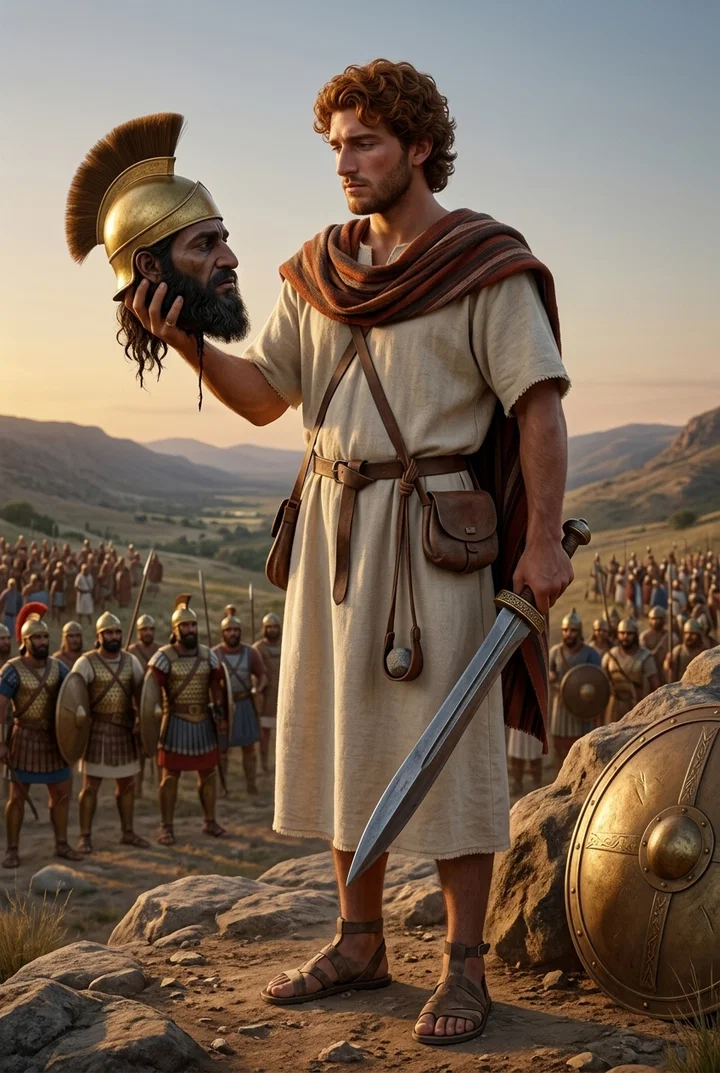
And David took the head of the Philistine, and brought it to Jerusalem; but he put his armour in his tent.
Translations
American King James Version, Webster Bible, American Standard Version
And David took the head of the Philistine, and brought it to Jerusalem; but he put his armor in his tent.
King James Version, KJV Cambridge Paragraph Bible, Revised Version
And David took the head of the Philistine, and brought it to Jerusalem; but he put his armour in his tent.
And David taketh the head of the Philistine, and bringeth it in to Jerusalem, and his weapons he hath put in his own tent.
And David took the head of the Philistine and brought it to Jerusalem; but he put his armour in his tent.
And David took the head of the Philistine, and brought it into Jerusalem,—but, his armour, put he into his tent.
Berean Standard Bible, Majority Standard Bible
David took the head of the Philistine and brought it to Jerusalem, and he put Goliath’s weapons in his own tent.
David took the head of the Philistine and brought it to Jerusalem, but he put his armor in his tent.
And David took the head of the Philistine to Jerusalem, but the metal war-dress and the arms he put in his tent.
And Dauid tooke the head of ye Philistim, and brought it to Ierusalem, and put his armour in his tent.
Douay-Rheims (Challoner revision)
And David taking the head of the Philistine brought it to Jerusalem: but his armour he put in his tent.
Pictures
Cross-references
- 1 Samuel 17:45-47
Then said David to the Philistine, Thou comest to me with a sword, and with a spear, and with a shield: but I come to thee in the name of the LORD of hosts, the God of the armies of Israel, whom thou hast defied.
David trusts God to win the battle, not weapons or human strength.
- 1 Samuel 17:37
David said moreover, The LORD that delivered me out of the paw of the lion, and out of the paw of the bear, he will deliver me out of the hand of this Philistine. And Saul said unto David, Go, and the LORD be with thee.
David trusts the LORD to deliver him from Goliath as he did from the lion and bear.
- 1 Samuel 17:38-40
And Saul armed David with his armour, and he put an helmet of brass upon his head; also he armed him with a coat of mail.
David lays aside Saul’s armor and goes with the weapons he has proved.
- 1 Samuel 17:4-7
And there went out a champion out of the camp of the Philistines, named Goliath, of Gath, whose height was six cubits and a span.
Goliath is contrasted with David as a more unequal match.
Commentary
Each commentary is drawn from primary sources: the writings of Ellen G. White and Adventist pioneers and periodicals. Each commentary is separate. Its own words are not a quotation; follow the references to read the source passages.
Ellen G. White
2 sources
1 Samuel 17:54 belongs to David's victory over Goliath, which was God's deliverance of Israel.1SP 370.1–3 The particular meaning of bringing Goliath's head to Jerusalem and putting his armor in the tent is not specified.1SP 370.1–3 That victory was won not by human strength, weapons, armor, or prepared human power, but by the Lord's power received through trusting God.1SP 370.1–33T 219.2
David refused Saul's armor because he had not proved it and went forward relying on God.3T 219.2 By contrast, Goliath trusted in his armor and boasted in his own strength.3T 219.2 The verse therefore calls for humility and faith in God rather than self-confidence.3T 219.2
Sources
Pioneers and periodicals
10 sources
The verse records David's victory over Goliath and the Philistines, in his role as champion of God's people.ST Mar 4, 1886ST Sep 20, 1883 Through that victory he became distinguished and served Israel.ST Mar 4, 1886ST Sep 20, 1883 Saul recognized in it that David was the man God had chosen to succeed him as king and mark as Israel's future king.ST Mar 4, 1886ST Sep 20, 1883
David did not rely on his own strength but on God, and he had to venture in faith to slay Goliath.ST Mar 4, 1886ST Mar 4, 1886ST Dec 20, 1910ST Sep 17, 1896 His deed stands among deeds of valor done through God by people of faith who ask for great things and venture much.ST Sep 17, 1896 In this the Lord makes His strength perfect in human weakness.ST Mar 4, 1886ST Dec 20, 1910 True greatness is measured by spirit and courage rather than physical size, for the youthful David faced Goliath with heroic resolve while the physically imposing Saul was less brave.RH Mar 2, 1905
The victory humbled God's enemies and exposed the weakness of their cause.ST Mar 4, 1886RH Apr 9, 1872 Goliath stood defiant at the head of the Philistine army with his supporters jubilant and certain of victory before the contest, and when their champion fell their triumph gave place to wrath as the weakness of their cause became apparent.ST Mar 4, 1886RH Apr 9, 1872 The verse marks the earlier event after which Saul kept David at court and David gained public praise that provoked Saul's jealousy.ST Nov 28, 1895
Those loyal to God in keeping all His commandments will meet the same spirit of contempt and opposition David met from Goliath.ST Mar 4, 1886ST Dec 20, 1910 Proud and boastful learned men despise the little band loyal to God, many without college education, who with the Bible in hand stand in defense of God's truth and vindicate His Sabbath trodden beneath lawless feet.ST Mar 4, 1886ST Dec 20, 1910 Like David, believers are to forget self, rely ever on God's strength and Jesus, and seek to honor God and defend His name and truth.ST Mar 4, 1886ST Dec 20, 1910RH Nov 28, 1871 God commissions His Davids to slay the mightiest giant, works mightily with them, and crowns their efforts with success.ST Mar 4, 1886ST Dec 20, 1910RH Nov 28, 1871 They are to keep working though the enemy's laughter sweeps over the valleys, because God's patient workers hereafter shall laugh when the enemies weep.RH Nov 28, 1871
The victory also warns against taking the glory to self when God prospers the work, since pride and self-sufficiency and flattering of one's own ability can turn such prosperity into ruin.ST Mar 4, 1886ST Dec 20, 1910 Goliath stands as the type of the defeated opponent, as when a lecturer who mocked the Bible and seemed powerful was reduced to confusion and weakness before the congregation.RH Jan 29, 1867
Sources