2 Kings 20:17
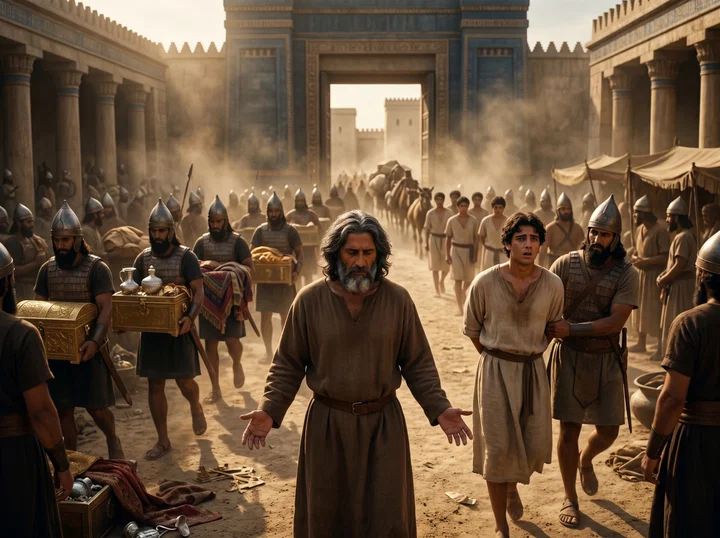
Behold, the days come, that all that is in thine house, and that which thy fathers have laid up in store unto this day, shall be carried into Babylon: nothing shall be left, saith the LORD.
Translations
Behold, the days come, that all that is in your house, and that which your fathers have laid up in store to this day, shall be carried into Babylon: nothing shall be left, says the LORD.
Behold, the days come, that all that is in thine house, and that which thy fathers have laid up in store unto this day, shall be carried into Babylon: nothing shall be left, saith the LORD.
Behold, the days come, that all that is in thine house, and that which thy fathers have laid up in store unto this day, shall be carried unto Babylon: nothing shall be left, saith the Lord.
Behold, the days come, that all that is in thy house, and that which thy fathers have laid up in store to this day, shall be carried into Babylon: nothing shall be left, saith the LORD.
Behold, the days come, that all that is in thine house, and that which thy fathers have laid up in store unto this day, shall be carried to Babylon: nothing shall be left, saith the LORD.
Behold, the days come, that all that is in thy house, and that which thy fathers have laid up in store unto this day, shall be carried to Babylon: nothing shall be left, saith Jehovah.
Lo, days are coming, and borne hath been all that [is] in thy house, and that thy father have treasured up till this day, to Babylon; there is not left a thing, said Jehovah;
Behold, days come that all that is in thy house, and what thy fathers have laid up until this day, shall be carried to Babylon; nothing shall be left, saith Jehovah.
Lo! days are coming, when all that is in thine house, and that thy fathers have treasured up, unto this day, shall be carried into Babylon,—nothing shall be left, saith Yahweh;
Berean Standard Bible, Majority Standard Bible
The time will surely come when everything in your palace and all that your fathers have stored up until this day will be carried off to Babylon. Nothing will be left, says the LORD.
‘ Behold, the days come that all that is in your house, and that which your fathers have laid up in store to this day, will be carried to Babylon. Nothing will be left,’ says the LORD.
Truly, days are coming when everything in your house, and whatever your fathers have put in store till this day, will be taken away to Babylon: all will be gone, says the Lord.
Beholde, the dayes come, that all that is in thine house, and what so euer thy fathers haue layed vp in store vnto this day, shall be caryed into Babel: Nothing shall be left, saith the Lord.
Douay-Rheims (Challoner revision)
Behold the days shall come, that all that is in thy house, and that thy fathers have laid up in store unto this day, shall be carried into Babylon: nothing shall be left, saith the Lord.
Pictures
Cross-references
- Isaiah 39:1-6
At that time Merodach-baladan, the son of Baladan, king of Babylon, sent letters and a present to Hezekiah: for he had heard that he had been sick, and was recovered.
Records the visit and the prophecy that Babylon would take the treasures.
- 2 Chronicles 32:31
Howbeit in the business of the ambassadors of the princes of Babylon, who sent unto him to enquire of the wonder that was done in the land, God left him, to try him, that he might know all that was in his heart.
The Babylonian envoys tested Hezekiah and revealed his heart.
- Daniel 1:3-4
And the king spake unto Ashpenaz the master of his eunuchs, that he should bring certain of the children of Israel, and of the king’s seed, and of the princes;
Royal descendants are taken to Babylon to serve in the king’s palace, fulfilling the foretold captivity.
- 2 Chronicles 32:25
But Hezekiah rendered not again according to the benefit done unto him; for his heart was lifted up: therefore there was wrath upon him, and upon Judah and Jerusalem.
Hezekiah’s pride and failure to repay God’s kindness brought judgment.
- Isaiah 38
In those days was Hezekiah sick unto death. And Isaiah the prophet the son of Amoz came unto him, and said unto him, Thus saith the LORD, Set thine house in order: for thou shalt die, and not live.
Another account of Hezekiah’s petition.
- 2 Chronicles 32:26
Notwithstanding Hezekiah humbled himself for the pride of his heart, both he and the inhabitants of Jerusalem, so that the wrath of the LORD came not upon them in the days of Hezekiah.
Hezekiah’s repentance postponed the judgment.
- 2 Kings 18:5-6
He trusted in the LORD God of Israel; so that after him was none like him among all the kings of Judah, nor any that were before him.
Hezekiah’s trust and obedience precede his later failure.
Commentary
Each commentary is drawn from primary sources: the writings of Ellen G. White and Adventist pioneers and periodicals. Each commentary is separate. Its own words are not a quotation; follow the references to read the source passages.
Ellen G. White
10 sources
After Hezekiah showed his riches and stored possessions to the Babylonian ambassadors and visitors, the days were to come when all that was in his house and all that his fathers had laid up in store unto that day, including the wealth stored by earlier generations and the treasures in God's house and the sacred treasures of the temple, would be carried into Babylon with nothing left behind.Ms 199, 1899, par. 1–4RH May 13, 1915Ms 199, 1899, par. 5–64MR 146.2Ms 123, 1902, par. 9 The display that drew this word was a grievous sin and a serious, unwise mistake, for which was pronounced a curse of total loss.4MR 146.2Ms 123, 1902, par. 9Ms 1, 1853, par. 26–27Ms 196, 1898, par. 6 What he showed was the nation's riches and all his treasures and advantages, and thereby he gave the Babylonians knowledge of what they could later take for themselves.RH May 13, 191510MR 248.1–252.1Ms 123, 1902, par. 9Ms 173, 1902, par. 24Ms 1, 1853, par. 26–27
He failed to use the visit to honor God and left God out of the matter, acting from pride and self-exaltation and from the thought that displaying his resources would give him influence.RH May 13, 1915Ms 199, 1899, par. 5–6Ms 173, 1902, par. 24 The showing of the riches was a test and part of a trial that revealed and exposed what was in his heart.Ms 199, 1899, par. 1–4Ms 199, 1899, par. 5–6 The ambassadors returned with a report that would lead Babylon's rulers to seek Jerusalem's treasures, and they went away and began to lay plans to possess those resources and advantages for themselves.RH May 13, 191510MR 248.1–252.1Ms 173, 1902, par. 24
Displaying wealth and advantages to outsiders invites them to plot to take them, and exposing the prosperity of God's people to an enemy is a sin bringing grave consequences.Ms 173, 1902, par. 24Ms 196, 1898, par. 6 Displaying entrusted resources in a way that dishonors God, while leaving God out, reveals what is in the heart.Ms 199, 1899, par. 1–4Ms 199, 1899, par. 5–6 The harm is like exposing an institution's private affairs to outsiders, like opening its books to them.4MR 146.2Ms 123, 1902, par. 9
The same danger comes from entertaining foreigners in Oakland and San Francisco and from mingling with unbelievers and admitting them to councils without discernment of what will break upon the world.Ms 173, 1902, par. 24 The warning reaches those who betray sacred trusts by joining themselves to unbelievers and relying on them instead of God, thereby losing God's favor and weakening their Christian example to others.Ms 197, 1899, par. 5–6
Sources
Pioneers and periodicals
15 sources
Isaiah spoke the warning to Hezekiah after his miraculous recovery from sickness, when the Babylonian messengers came to congratulate him, declaring that everything in his house and all his fathers had stored up, especially the treasures he had shown them, would be carried to Babylon with nothing left.RH Jan 12, 1869ST Jan 21, 1886ST May 3, 1910ST Jul 13, 1904ST Apr 15, 1903 His descendants also would be taken away to serve in the palace of the king of Babylon.RH Jan 12, 1869 The sin that brought this judgment was pride of heart, vaunting his own wealth and strength before the heathen to appear formidable instead of leaning upon God.STRH Sep 11, 1860 He had been healed to be a blessing by testifying to those kings of the living God who gives life and health and of His grace and gospel, but he dishonored God by exalting himself and displaying his own greatness and possessions.ST May 3, 1910ST The word was fulfilled more than a century later when Nebuchadnezzar took the royal family including Daniel to Babylon, after judgment had been postponed about a hundred years following Hezekiah's time while Judah continued in departure from God until she fell into Babylonian hands.RH Jan 12, 1869ST Jan 21, 1886ST Aug 16, 1905STST Jun 28, 1905
Setting and Predicted Judgment
The verse stands in the history of the remaining kingdom of Judah after the ten tribes had been swept away, in the section covering 2 Kings 18-25, which completes one continuous history of the kings from the accession of Solomon to the Babylonian captivity.ST Dec 9, 1897 It belongs to the account of Hezekiah's embassy to Merodach-baladan, the ruler who had rebelled at Babylon against the king of Assyria at Nineveh.ST Nov 27, 1884 That embassy was a political blunder rightly rebuked by Isaiah, a setting confirmed by the monuments.ST Nov 27, 1884
The message was given through Isaiah after messengers of the king of Babylon came to congratulate Hezekiah on his restoration to health from sickness.ST Apr 15, 1903 It stands in the chapter recording his sickness and miraculous recovery, a history of intense interest.ST Jul 13, 1904 The lengthening of the king's life granted there was not used altogether as it should have been, for his son Manasseh, born three years after the recovery, became one of the most wicked kings the nation ever had.ST Jul 13, 1904
The verse predicts that all that is in Hezekiah's house and all that his fathers have laid up in store shall be carried into Babylon with nothing left.RH Jan 12, 1869ST Jan 21, 1886ST May 3, 1910ST Aug 16, 1905 This means especially the treasures and valuable things he showed the Babylonian representatives, including the gold and silver vessels in the house of the Lord.ST Jan 21, 1886ST May 3, 1910ST Apr 15, 1903 The surrounding prediction also declares that Hezekiah's descendants would be taken to Babylon and serve in the king's palace, so that his descendants would face captivity.RH Jan 12, 1869
Hezekiah's display of his treasures aroused Babylon's desire for them. The ambassadors returned with a report that would lead Babylon's rulers to seek Jerusalem's treasures, and that display dishonored God and naturally excited the covetousness of the Babylonians.RH May 13, 1915ST Apr 15, 1903 So the treasures shown became a temptation that was later taken when Babylon conquered Jerusalem more than a century after the warning.RH May 13, 1915STST Apr 15, 1903
Fulfillment in Babylonian Captivity
The treasures Hezekiah had displayed, with all that he and his fathers had laid up in store, were carried to Babylon when Nebuchadnezzar conquered Jerusalem and took members of the royal family there, Daniel being present among them in fulfillment of the word.ST Jan 21, 1886ST Daniel and his companions are the fulfillment of the adjoining word that Hezekiah's descendants would be taken to Babylon and serve in the king's palace.RH Jan 12, 1869 They may have been made eunuchs, though the term may denote their office rather than their physical condition.RH Jan 12, 1869
The taking came more than a century after the warning, about a hundred years before the days of Jeremiah, after Babylon had conquered Assyria.ST Aug 16, 1905STST Jun 28, 1905 The judgment on Judah was postponed for about a hundred years after Hezekiah's repentance.ST Jun 28, 1905 The promise of protection from further Assyrian oppression was nevertheless kept.ST Jun 28, 1905
Judah continued in departure from God until captivity came upon her, when Jerusalem and the people of Judah fell into Babylonian hands.ST Aug 16, 1905ST Jun 3, 1913 Her later trouble came from Babylon, which carried away Hezekiah's stored wealth and possessions.ST Aug 16, 1905ST Jun 28, 1905 Because Hezekiah missed the opportunity to share the gospel with Babylon when its representatives stood before him, his descendants would afterward have to give that message while in captivity.ST May 3, 1910
Sin, Prayer, and Witness
Hezekiah's sin in showing his treasures to the heathen ambassadors was pride of heart, his heart being lifted up when he displayed his choicest treasures to the nobility of Babylon.RH Sep 11, 1860 It was proud conceit in what he possessed and vain confidence in his own strength, a vaunting of himself and leaning upon the arm of flesh instead of God in order to appear formidable before the nations.RH Sep 11, 1860 This was the same sin as David numbering Israel without the consent of the Lord.RH Sep 11, 1860 The woeful message that fell upon his ears by the mouth of the prophet in judgment for that display shows the fearfulness of sinning against God.
It proves God is still the same holy being as when He gave the law on Sinai, unbending and uncorrupted, who never parleys with evil nor tolerates it in His people, but surely punishes it even in great men. Hezekiah had been healed of his sickness and saved from death by the gift of indwelling life so that he individually would be a blessing by telling the heathen kings the glories of the living God who bestows life and health.RH Aug 5, 1902 The messengers from Babylon inquired concerning this thing, giving opportunity to reveal the gospel that saves from death, to testify that God dwells with flesh and to tell of the greatness and goodness of the God of heaven who had healed him, of God's grace, Christ, and righteousness by faith.ST Apr 15, 1903RH Aug 5, 1902
Instead of directing them to God's grace and showing them Christ, he failed to honor God, exalted himself in the place of God, and showed the strangers his own greatness, wealth, and material possessions, including the valuable gold and silver vessels in the house of the Lord, as evidence of God's favor.RH May 13, 1915STST Apr 15, 1903RH Aug 5, 1902 The coming loss, that all in his house and all stored by his fathers would be carried to Babylon with nothing left, shows that trusting in outward wealth and display cannot establish God's work or reveal His favor. By this failure he dishonored God, naturally excited the covetousness of the Babylonians, and brought great evil upon Jerusalem.ST Apr 15, 1903RH Aug 5, 1902
His course stands opposite to Daniel the captive, who when sought to be put to death recognized the call for the gospel of righteousness by faith, did the right thing in the right way at the right time, and averted the sentence of death.RH Aug 5, 1902 The lengthening of the king's life granted in the chapter recording his sickness and miraculous recovery was not used altogether as it should have been, for his son Manasseh, born three years after the recovery, became one of the most wicked kings the nation ever had.ST Jul 13, 1904 As part of the record of Hezekiah, who pressed his petition until the Lord granted it, the account is an admonition that prayer should not seek to make God yield to human wishes, but should be offered in submission to His will.RH Dec 29, 1868
Sources