Translations
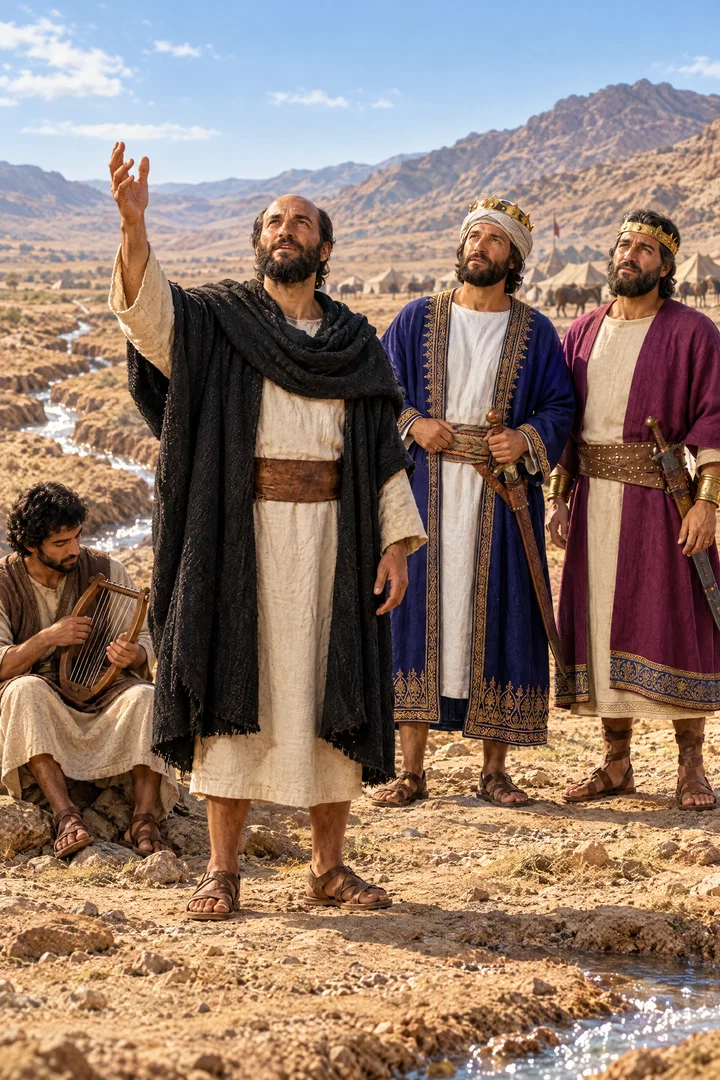
And he said, Thus says the LORD, Make this valley full of ditches.
King James Version, Webster Bible
And he said, Thus saith the LORD, Make this valley full of ditches.
And he said, Thus saith the Lord, Make this valley full of ditches.
And he said, Thus saith the LORD, Make this valley full of trenches.
And he said, Thus saith Jehovah, Make this valley full of trenches.
and he saith, 'Thus said Jehovah, Make this valley ditches — ditches;
And he said, Thus saith Jehovah: Make this valley full of ditches.
Then said he, Thus, saith Yahweh, Make, in this torrent-bed, pits, pits!
Berean Standard Bible, Majority Standard Bible
and he said, “ This is what the LORD says: ‘Dig this valley full of ditches.’
He said, “ The LORD says, ‘ Make this valley full of trenches.’
And he said, The Lord says, I will make this valley full of water-holes.
And he saide, Thus saith the Lord, Make this valley full of ditches.
Douay-Rheims (Challoner revision)
Thus saith the Lord: Make the channel of this torrent full of ditches.
Pictures
Cross-references
- 2 Kings 3:5
But it came to pass, when Ahab was dead, that the king of Moab rebelled against the king of Israel.
Both texts record Moab’s revolt after Ahab’s death.
Commentary
Each commentary is drawn from primary sources: the writings of Ellen G. White and Adventist pioneers and periodicals. Each commentary is separate. Its own words are not a quotation; follow the references to read the source passages.
Ellen G. White
3 sources
The command to make the valley full of ditches was unexpected, given as a deliberate test of faith.STMW7 19.2Ms 1, 1874, par. 37Ms 1b, 1874, par. 9–11 That same test will still be met in a similar manner, requiring faith and patience under severe trial.Ms 1, 1874, par. 37Ms 1b, 1874, par. 9–11 It is a test and temptation to be faced without questioning the length of the way or the obstacles obstructing it.Ms 1b, 1874, par. 9–11
Its meaning is to put no trust in human strength or in what can be done by human power, but to trust in what God can do for and through those who trust Him.STMW7 19.2Ms 1, 1874, par. 37Ms 1b, 1874, par. 9–11 Success comes only by that trust, going forward with the grace of Christ despite apparent impossibilities.STMW7 19.2Ms 1b, 1874, par. 9–11 All who so trust will certainly realize His power in their work.Ms 1, 1874, par. 37
The battle is turned against the enemy not by human strength but by the strength of the mighty General of armies working for His own name's glory.Ms 1, 1874, par. 37 For the Lord has ways and means for every emergency and works in ways least expected.Ms 1, 1874, par. 37Ms 1b, 1874, par. 9–11 His power is of old and His ways are past finding out, so none are to limit the Holy One by marking out how He must work, nor to walk by sight with small faith, or they will be disappointed.Ms 1b, 1874, par. 9–11
Sources
Pioneers and periodicals
9 sources
The command was spoken through Elisha to the armies of Judah and Israel, joined by Edom, when they were marching to subdue Moab after Mesha's revolt and were suffering for lack of water after a seven days' journey without finding any.RH Jan 16, 1872RH Aug 4, 1910RH Aug 12, 1875 In that war the Moabite king Mesha fought against Jehoram and Jehoshaphat.RH Aug 12, 1875 Elisha, Elijah's pupil, gave this prophetic instruction as one of the experiences that demonstrate the development produced by the schools of the prophets.ST Jun 7, 1899 The word for ditches is better translated trenches, and the duty of faith was to obey and dig without questioning how they would be filled.RH Jan 16, 1872
The trenches were dug by human hands and then were filled with water covering the wilderness country, though there was neither wind nor rain seen.RH Jan 16, 1872 The water stole in from a mysterious invisible source, not by an ordinary process of nature but by supernatural process through the direct agency of God.RH Jan 16, 1872 It came when the morning offering of consecration was offered.RH Jul 20, 1916 The setting belongs to a short Bible narrative about Moab and its king, supplemented by the Moabite Stone from Dibon, an inscription narrating the achievements of Mesha king of Moab and commemorating his deliverance from Israel's rule around 850 B.C.RH Sep 28, 1905RH Aug 4, 1910ST Jun 14, 1905 That monument is about two feet wide, four feet high, and fourteen and a half inches thick.ST Dec 21, 1915
That inscription confirms the essential and historical accuracy of the record of the wars between Israel and Moab and of the reigns of Omri, Ahab, Jehoram, and Jehoshaphat concerning Moab.RH Sep 28, 1905ST Dec 21, 1915RH Aug 12, 1875 It illustrates the historical, geographical, and religious relations of Israel and Moab with its Hebrew neighbors, shedding added light on its historical setting.RH Aug 4, 1910RH Aug 12, 1875ST Jun 14, 1905 This includes the taking of the vessels of Jehovah from captured Nebo and dedicating them to Chemosh, the national deity of Moab.RH Aug 12, 1875 Spiritually, the ditches represent institutions, other facilities, and personal abilities, while the water represents the blessing of the Holy Spirit, which consecration brings.RH Jul 20, 1916
The ditches are prepared by hard work, generosity in giving for Christ, repentance, and consecration, making room for spiritual influence.RH Jul 20, 1916RH Jan 16, 1872 Human agency acts only up to digging the trench, and all awakening, converting, and quickening power is really supernatural, with divine agency filling what humans prepare, not by human power.RH Jan 16, 1872RH Jan 16, 1872 Applied to churches languishing in spiritual drought, if spiritual blessings are wanted trenches must be dug to receive them, preparing channels so the blessing comes.RH Jan 16, 1872RH Jul 20, 1916 It may come without visible signs or excitement, with the Holy Spirit's blessings flowing quietly and steadily.RH Jan 16, 1872
Sources