2 Kings 3:17
For thus saith the LORD, Ye shall not see wind, neither shall ye see rain; yet that valley shall be filled with water, that ye may drink, both ye, and your cattle, and your beasts.
Translations
For thus says the LORD, You shall not see wind, neither shall you see rain; yet that valley shall be filled with water, that you may drink, both you, and your cattle, and your beasts.
King James Version, Webster Bible
For thus saith the LORD, Ye shall not see wind, neither shall ye see rain; yet that valley shall be filled with water, that ye may drink, both ye, and your cattle, and your beasts.
For thus saith the Lord, Ye shall not see wind, neither shall ye see rain; yet that valley shall be filled with water, that ye may drink, both ye, and your cattle, and your beasts.
For thus saith the LORD, Ye shall not see wind, neither shall ye see rain, yet that valley shall be filled with water: and ye shall drink, both ye and your cattle and your beasts.
For thus saith Jehovah, Ye shall not see wind, neither shall ye see rain; yet that valley shall be filled with water, and ye shall drink, both ye and your cattle and your beasts.
for thus said Jehovah, Ye do not see wind, nor do ye see rain, and that valley is full of water, and ye have drunk — ye, and your cattle, and your beasts.
For thus saith Jehovah: Ye shall not see wind, neither shall ye see rain; yet this valley shall be filled with water, and ye shall drink, both ye, and your cattle, and your beasts.
For, thus, saith Yahweh—Ye shall not see wind, and ye shall not see rain, yet, that torrent-bed, shall be filled with water,—And ye shall drink, ye, and your cattle, and your beasts;
Berean Standard Bible, Majority Standard Bible
For the LORD says, ‘ You will not see wind or rain, but the valley will be filled with water, and you will drink— you and your cattle and your animals.’
For the LORD says, ‘ You will not see wind, neither will you see rain, yet that valley will be filled with water, and you will drink, both you and your livestock and your other animals.
For the Lord says, Though you see no wind or rain, the valley will be full of water, and you and your armies and your beasts will have drink.
For thus saith the Lord, Ye shall neither see winde nor see raine, yet the valley shalbe filled with water, that ye may drinke, both ye and your cattel, and your beastes.
Douay-Rheims (Challoner revision)
For thus saith the Lord: You shall not see wind, nor rain: and yet this channel shall be filled with waters, and you shall drink, you and your families, and your beasts.
Pictures
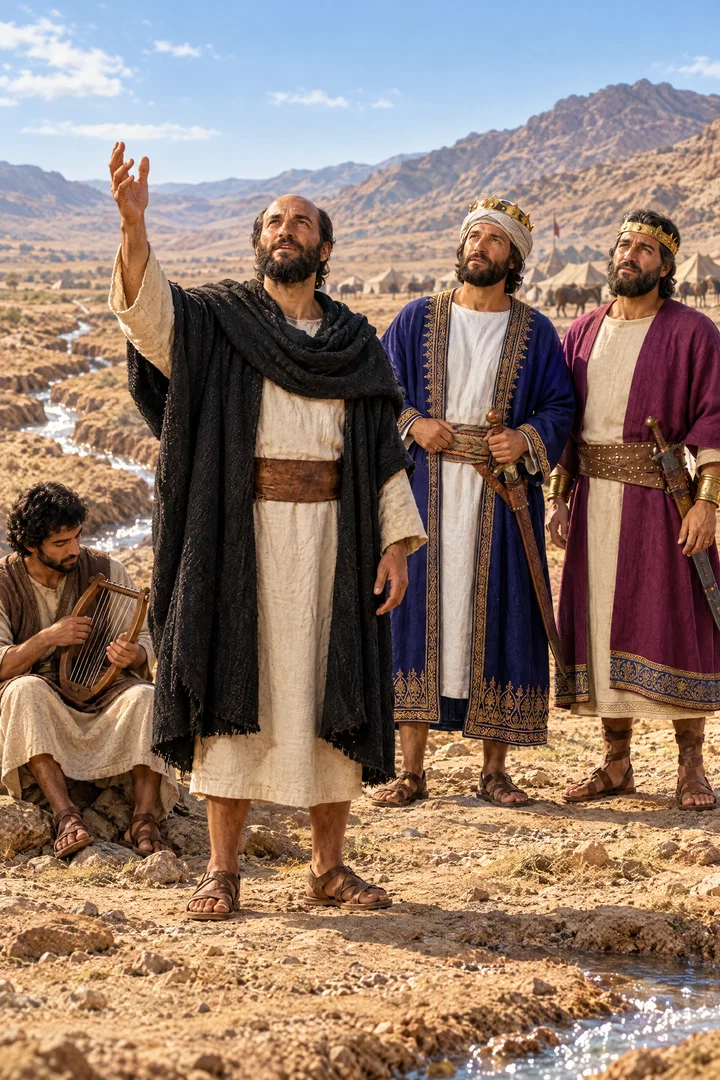
Cross-references
- 2 Kings 3:5
But it came to pass, when Ahab was dead, that the king of Moab rebelled against the king of Israel.
Both recount Moab’s revolt against Israel after Ahab’s death.
- 2 Kings 3:9
So the king of Israel went, and the king of Judah, and the king of Edom: and they fetched a compass of seven days’ journey: and there was no water for the host, and for the cattle that followed them.
same story's dry condition applied to churches
- 2 Kings 2:11-14
And it came to pass, as they still went on, and talked, that, behold, there appeared a chariot of fire, and horses of fire, and parted them both asunder; and Elijah went up by a whirlwind into heaven.
Elijah is taken to heaven and Elisha succeeds him.
Commentary
Each commentary is drawn from primary sources: the writings of Ellen G. White and Adventist pioneers and periodicals. Each commentary is separate. Its own words are not a quotation; follow the references to read the source passages.
Ellen G. White
3 sources
No wind would be seen and no rain would be seen, yet the valley would be filled with water for drinking for men and cattle and beasts, so deliverance comes not by human strength or sight but in ways least expected.STMW7 19.2Ms 1, 1874, par. 37Ms 1b, 1874, par. 9–11 The word is a sifting test of faith, in which success depends not on what God's people can do themselves but on trusting what God can do for them and through them.STMW7 19.2Ms 1, 1874, par. 37Ms 1b, 1874, par. 9–11
God has ways and means for every emergency, and He delivers His people when apparent impossibilities obstruct the way, filling their need and giving power in the work.Ms 1, 1874, par. 37Ms 1b, 1874, par. 9–11 He works in this manner for the glory of His own name.STMW7 19.2Ms 1, 1874, par. 37 The battle is turned against the enemy not by human strength but by the strength of the mighty General of armies, and all who so trust Him will certainly realize His power.Ms 1, 1874, par. 37
Those who believe must go forward in faith and patience through the trial without questioning its length or the obstacles of the way, expecting God to work in least-expected ways.Ms 1b, 1874, par. 9–11 They must refuse to mark out beforehand how He will work or to limit His power, for His power is of old and His ways are past finding out.Ms 1b, 1874, par. 9–11
Sources
Pioneers and periodicals
11 sources
The Lord promised the armies of Israel in their campaign and war against Moab in Moab's revolt after Ahab's death that though they would see neither wind nor rain, the valley where they dug ditches would be filled with water for them and their cattle and beasts to drink.RH Jan 16, 1872ST Dec 21, 1915RH Jul 20, 1916 The wind named is ordinary wind, and to be filled means simply to become full of water.ST Mar 10, 1881ST Mar 14, 1878 The history is true, and is confirmed and illuminated by the thirty-four line inscription of Mesha found among the ruins of Dibon, in which Moab commemorates its deliverance from Israel's rule in harmony with the biblical record.RH Sep 28, 1905ST Dec 21, 1915RH Aug 4, 1910 The water came by a supernatural process through God's direct agency from a mysterious invisible source, not by an ordinary process of nature, and how it would come was not their concern, for the duty of faith is to obey without questioning.RH Jan 16, 1872 Digging the ditches means hard work, consecration, liberality in giving, and faith to prepare for blessing, and the wider they are cut the fuller the blessing, for the water is the blessings of the Holy Spirit given not by human might nor power but by God's Spirit, coming without sound of violent excitement yet silently and steadily like rising tides to awaken, convert, and quicken thirsting souls and churches when human agency has done its part and God gives the increase.RH Jan 16, 1872RH Jul 20, 1916RH Jan 16, 1872
Words and Historical Setting
The Hebrew word translated in the promise is roo-agh in the sense of wind.ST Mar 14, 1878 The Hebrew word often translated replenish means simply that the valley would be filled with water, and does not imply that the valley had been filled before.ST Mar 10, 1881
The promise belongs to the account of the battle between Mesha, king of Moab, and Israel. It belongs to the historical account of Israel's campaign against Moab during the reigns of Jehoram and Jehoshaphat, set during Moab's revolt after Ahab's death.ST Dec 21, 1915ST Aug 12, 1913 It belongs to the account of the wars between Israel and Moab in which King Mesha of Moab fought against Jehoram and Jehoshaphat, and to the account of Israel's relations with Moab.RH Aug 4, 1910RH Aug 12, 1875 That account vividly pictures real historical, geographical, and religious relations between Israel and Moab.RH Aug 12, 1875
The historical setting of the short Bible narrative receives added light from discoveries such as the Moabite Stone, which records events involving the kings of Israel and Moab.ST Jun 14, 1905 That setting is supplemented by the Moabite Stone, an inscription in which Mesha commemorates Moab's deliverance from Israel's rule.RH Sep 28, 1905 Its essential accuracy is confirmed by Mesha's own thirty-four line inscription found among the ruins of Dibon, made by a people dwelling in immediate contact with Israel, which narrates Mesha's achievements and his taking vessels of Jehovah from captured Nebo to dedicate to Chemosh.RH Aug 12, 1875 The Stone's account of Moab's revolt and of Moab's relations with Israel harmonizes and agrees with the biblical record, and the Old Testament history including this campaign is supported by the monument's information about the kings and events of that period.ST Dec 21, 1915RH Aug 4, 1910ST Aug 12, 1913
Miraculous Provision and Application
The promise was that no wind would be seen and no rain would be seen, yet the valley would be filled with water for drinking for the men themselves and for their cattle and their beasts.RH Jan 16, 1872RH Jul 20, 1916 That word was fulfilled when, after ditches had been dug, water came by the way of Edom and filled the country for the armies and their animals.RH Jan 16, 1872RH Jul 20, 1916 The digging was joined with consecration of themselves, showing that consecration and faith bring blessing.RH Jan 16, 1872RH Jul 20, 1916
How the water would come was not their concern, for the duty of faith is to obey without questioning.RH Jan 16, 1872 It stole in from a mysterious, invisible source by a supernatural process accomplished by the direct agency of God, not by an ordinary process of nature.RH Jan 16, 1872 All awakening, converting, and quickening power upon human souls is likewise supernatural, with human agency acting only up to a point and then divine agency giving the increase.RH Jan 16, 1872
The command to make the valley full of ditches in order to receive blessing signifies hard work and liberality in giving for Christ, as well as consecration and faith.RH Jul 20, 1916RH Jan 16, 1872 The wider the ditches are cut, the broader and fuller will be the stream of blessing.RH Jan 16, 1872 Seeing no wind nor rain means no sound of violent excitement will be heard, but silently and steadily the tides of spiritual influence will flow into souls and churches, as ocean tides rise over bare ground and lift grounded vessels.RH Jan 16, 1872 The water filling the valley is the blessings of the Holy Spirit, given not by might nor by human power but by God's Spirit.RH Jul 20, 1916RH Jan 16, 1872 Preparation for blessing brings blessing, so thirsting people and churches languishing in spiritual drought with no water must dig channels and trenches to receive spiritual blessings, and when the trenches are ready the currents of spiritual power will flow in.RH Jan 16, 1872RH Jul 20, 1916RH Jan 16, 1872
Sources