2 Kings 3:22
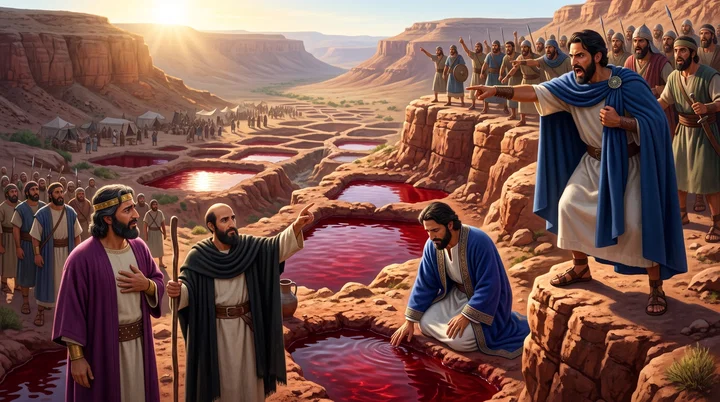
And they rose up early in the morning, and the sun shone upon the water, and the Moabites saw the water on the other side as red as blood:
Translations
And they rose up early in the morning, and the sun shone on the water, and the Moabites saw the water on the other side as red as blood:
King James Version, KJV Cambridge Paragraph Bible
And they rose up early in the morning, and the sun shone upon the water, and the Moabites saw the water on the other side as red as blood:
And they rose early in the morning, and the sun shone upon the water, and the Moabites saw the water on the other side as red as blood:
Revised Version, American Standard Version
And they rose up early in the morning, and the sun shone upon the water, and the Moabites saw the water over against them as red as blood:
And they rise early in the morning, and the sun hath shone on the waters, and the Moabites see, from over-against, the waters red as blood,
And they rose up early in the morning, and the sun rose upon the water, and the Moabites saw the water on the other side red as blood.
And, when they rose early in the morning, the sun, shone forth upon the waters,—and so the Moabites beheld over against them, the waters, red as blood.
Berean Standard Bible, Majority Standard Bible
When they got up early in the morning, the sun was shining on the water, and it looked as red as blood to the Moabites across the way.
They rose up early in the morning, and the sun shone on the water, and the Moabites saw the water opposite them as red as blood.
And early in the morning they got up, when the sun was shining on the water, and they saw the water facing them as red as blood.
And they rose earely in the morning, when the sunne arose vpon the water, and the Moabites saw the water ouer against them, as red as blood.
Douay-Rheims (Challoner revision)
And they rose early in the morning, and the sun being now up, and shining upon the waters, the Moabites saw the waters over against them red, like blood,
Pictures
Cross-references
- 2 Kings 3:5
But it came to pass, when Ahab was dead, that the king of Moab rebelled against the king of Israel.
Moab’s revolt after Ahab’s death aligns with its account of regaining independence.
Commentary
Each commentary is drawn from primary sources: the writings of Ellen G. White and Adventist pioneers and periodicals. Each commentary is separate. Its own words are not a quotation; follow the references to read the source passages.
Ellen G. White
3 sources
The verse belongs to the account of God's deliverance of Israel's forces in the conflict with Moab, where the outcome depended on God's power rather than human strength.STMW7 19.2 It presents a test of faith, showing that all who trust God will be tested and tempted in a similar manner.STMW7 19.2Ms 1, 1874, par. 37Ms 1b, 1874, par. 9–11 Its lesson is to put trust not in what can be done by human strength, not in what men can do, but in what God can do for and through those who trust Him.STMW7 19.2Ms 1, 1874, par. 37Ms 1b, 1874, par. 9–11
God works in ways least expected to turn the battle against the enemy, and He can act in unexpected ways.STMW7 19.2Ms 1, 1874, par. 37Ms 1b, 1874, par. 9–11 How He will work cannot be laid out beforehand in clear lines.Ms 1b, 1874, par. 9–11 His power is from of old and His ways are beyond human discovery, past finding out.Ms 1b, 1874, par. 9–11
The victory comes by the strength of the mighty General and Commander of armies, who works for the glory of His own name.Ms 1, 1874, par. 37 All who trust in this way will certainly realize and experience His power in their work.Ms 1, 1874, par. 37 No one is to limit the Holy One or mark out and prescribe the ways whereby He must work, or disappointment will follow.Ms 1b, 1874, par. 9–11
Sources
Pioneers and periodicals
6 sources
The verse belongs to the account in 2 Kings 3:22-27 of the rebellion and war of Mesha king of Moab against Jehoram king of Israel, who was joined by Jehoshaphat king of Judah, a conflict involving Israel, Judah, and Moab.RH Sep 28, 1905ST Dec 21, 1915RH Aug 4, 1910RH Aug 12, 1875 It is part of the historical record of Israel's conflict with Moab and of the relations between Moab and Israel, including Mesha's rebellion.RH Sep 28, 1905ST Dec 21, 1915RH Aug 4, 1910RH Nov 16, 1916 The Moabite Stone that parallels this account was found among the ruins of Dibon, inscribed with the achievements of Mesha, and is a contemporary monumental inscription describing Mesha's wars against Israel.RH Aug 12, 1875RH Nov 16, 1916
The Stone supplements the biblical account with Mesha's commemoration of his deliverance from Israel's rule around 850 B.C.RH Sep 28, 1905RH Aug 12, 1875 It preserves historical accounts of the reigns of Omri, Ahab, and the king of Moab.RH Aug 12, 1875ST Jun 14, 1905 It illustrates the historical, geographical, and religious relations of Israel and Moab, including that Mesha took vessels of Jehovah from captured Nebo and dedicated them to Chemosh.RH Aug 12, 1875
The account is true history whose essential accuracy is confirmed by the Moabite Stone.RH Sep 28, 1905RH Aug 4, 1910RH Aug 12, 1875 The Stone harmonizes with, supplements, and illuminates the biblical record of Moab and Israel.RH Sep 28, 1905ST Dec 21, 1915RH Aug 4, 1910RH Nov 16, 1916 Even a short account of events involving Israel, Judah, and Moab is thereby shown to receive added light from archaeology.ST Dec 21, 1915ST Jun 14, 1905
Sources