2 Kings 3:23
And they said, This is blood: the kings are surely slain, and they have smitten one another: now therefore, Moab, to the spoil.
Translations
American King James Version, King James Version, Webster Bible
And they said, This is blood: the kings are surely slain, and they have smitten one another: now therefore, Moab, to the spoil.
and they said, This is blood: the kings are surely slain, and they have smitten one another: now therefore, Moab, to the spoil.
Revised Version, American Standard Version
and they said, This is blood; the kings are surely destroyed, and they have smitten each man his fellow: now therefore, Moab, to the spoil.
and say, 'Blood this [is]; the kings have been surely destroyed, and they smite each his neighbour; and now for spoil, Moab!'
And they said, This is blood: the kings are entirely destroyed, and have smitten one another; and now, Moab, to the spoil!
They said therefore—Blood,—this! Destroyed! The kings have destroyed each other! Yea they have smitten every man his neighbour,—Now, then, to the spoil, O Moab!
Berean Standard Bible, Majority Standard Bible
“ This is blood!” they exclaimed. “ The kings have clashed swords and slaughtered one another. Now to the plunder, Moab!”
They said, “ This is blood. The kings are surely destroyed, and they have struck each other. Now therefore, Moab, to the plunder!”
Then they said, This is blood: it is clear that destruction has come on the kings; they have been fighting one another: now come, Moab, let us take their goods.
And they saide, This is blood the Kings are surely slaine, and one hath smitten another: now therefore, Moab, to the spoyle.
Douay-Rheims (Challoner revision)
And they said: It is the blood of the sword: the kings have fought among themselves, and they have killed one another: go now, Moab, to the spoils.
Pictures
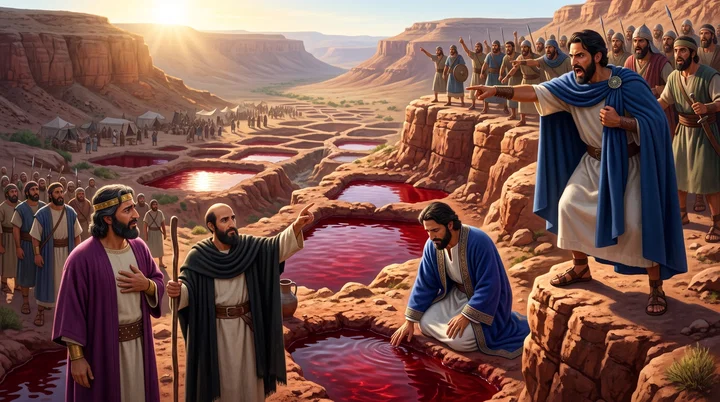
Cross-references
- 2 Kings 3:4-5
And Mesha king of Moab was a sheepmaster, and rendered unto the king of Israel an hundred thousand lambs, and an hundred thousand rams, with the wool.
Records Moab’s revolt after Ahab’s death, the setting for the campaign in this verse.
- 2 Kings 1:1
Then Moab rebelled against Israel after the death of Ahab.
Records Moab’s revolt after Ahab’s death.
Commentary
Each commentary is drawn from primary sources: the writings of Ellen G. White and Adventist pioneers and periodicals. Each commentary is separate. Its own words are not a quotation; follow the references to read the source passages.
Ellen G. White
3 sources
The chapter in which the Moabites mistake the water for blood and rush to the spoil is a history of faith tested and tempted.STMW7 19.2Ms 1, 1874, par. 37Ms 1b, 1874, par. 9–11
Its lesson is that trust is not to rest in human ability and strength, but in what God can do for and through those who put their trust in Him.STMW7 19.2Ms 1, 1874, par. 37Ms 1b, 1874, par. 9–11
His working is not to be mapped out in advance, for He works in unexpected ways, in ways least expected.STMW7 19.2Ms 1, 1874, par. 37Ms 1b, 1874, par. 9–11
By such unexpected working He turns the battle against the enemy, so that victory comes not by human strength but by God's strength.STMW7 19.2Ms 1, 1874, par. 37
All who so trust Him will certainly realize His power in their work.STMW7 19.2Ms 1, 1874, par. 37
That victorious strength is the strength of the mighty General of armies, who works for His own name's glory.Ms 1, 1874, par. 37
Sources
Pioneers and periodicals
7 sources
This is blood belongs to the short account of the wars, conflict, revolt and rebellion between Israel and Moab and of Mesha's rebellion against Israel.RH Sep 28, 1905ST Dec 21, 1915RH Aug 4, 1910ST Aug 12, 1913RH Aug 12, 1875 That revolt by Moab against Israel came after Ahab's death and led to Israel's campaign against Moab, in which Mesha, king of Moab, fought against Jehoram and Jehoshaphat.RH Aug 4, 1910ST Aug 12, 1913RH Aug 12, 1875 The account is essentially accurate history, confirmed by archaeology.RH Aug 12, 1875RH Nov 16, 1916
The Moabite Stone is a thirty-four-line inscription by Mesha made about twenty-seven hundred years ago, around 850 B.C. in the year Elijah was translated, and found at Dibon in Moab.RH Sep 28, 1905RH Aug 12, 1875 The inscription commemorates Mesha's deliverance from Israel's rule and Moab's regaining of independence, narrates the achievements of Mesha, and depicts the same wars between Israel and Moab.RH Sep 28, 1905RH Aug 4, 1910RH Aug 12, 1875 It preserves accounts concerning the kings of Israel and Moab.RH Aug 12, 1875ST Jun 14, 1905 It illustrates the historical, geographical, and religious relations of the kingdoms, including the taking of vessels of Jehovah from captured Nebo and dedicating them to Chemosh, the national god of Moab.RH Aug 12, 1875
The Bible's record of the relations and conflict between Moab and its Hebrew neighbors is essentially accurate history, harmonizing and according with the Moabite monument.RH Aug 4, 1910ST Aug 12, 1913RH Aug 12, 1875 That monument supports and confirms it.ST Dec 21, 1915RH Aug 12, 1875 It supplements it and illuminates it with added historical light on its setting.RH Sep 28, 1905RH Nov 16, 1916ST Jun 14, 1905
Sources