2 Kings 4:8
And it fell on a day, that Elisha passed to Shunem, where was a great woman; and she constrained him to eat bread. And so it was, that as oft as he passed by, he turned in thither to eat bread.
Translations
American King James Version, King James Version, KJV Cambridge Paragraph Bible, Revised Version, American Standard Version
And it fell on a day, that Elisha passed to Shunem, where was a great woman; and she constrained him to eat bread. And so it was, that as oft as he passed by, he turned in thither to eat bread.
And it fell on a day, that Elisha passed to Shunem, where was a distinguished woman; and she constrained him to eat bread. And so it was, that as oft as he passed by, he turned in thither to eat bread.
And the day cometh that Elisha passeth over unto Shunem, and there [is] a great woman, and she layeth hold on him to eat bread, and it cometh to pass, at the time of his passing over, he turneth aside thither to eat bread,
And it came to pass on a day, that Elisha passed to Shunem, where was a wealthy woman; and she constrained him to eat bread. And so it was, [ that] as oft as he passed by, he turned in thither to eat bread.
And so it was, on a day, that Elisha passed over unto Shunem, where was a woman of position, and she constrained him to eat bread,—and so it came about, whensoever he passed that way, that he turned aside thither, to eat bread.
Berean Standard Bible, Majority Standard Bible
One day Elisha went to Shunem, and a prominent woman who lived there persuaded him to have a meal. So whenever he would pass by, he would stop there to eat.
One day Elisha went to Shunem, where there was a prominent woman; and she persuaded him to eat bread. So it was, that as often as he passed by, he turned in there to eat bread.
Now there came a day when Elisha went to Shunem, and there was a woman of high position living there, who made him come in and have a meal with her. And after that, every time he went by, he went into her house for a meal.
And on a time Elisha came to Shunem, and there a woman of great estimation constrained him to eate bread: and as he passed by, he turned in thither to eate bread.
Douay-Rheims (Challoner revision)
And there was a day when Eliseus passed by Sunam: now there was a great woman there, who detained him to eat bread; and as he passed often that way, he turned into her house to eat bread.
Pictures
Cross-references
- 2 Kings 4:32-37
And when Elisha was come into the house, behold, the child was dead, and laid upon his bed.
Elisha prays, and the Shunammite woman’s dead son is restored to life.
- Acts 16:14-15
And a certain woman named Lydia, a seller of purple, of the city of Thyatira, which worshipped God, heard us: whose heart the Lord opened, that she attended unto the things which were spoken of Paul.
Lydia welcomes the apostles and opens her home.
- Matthew 25:40
And the King shall answer and say unto them, Verily I say unto you, Inasmuch as ye have done it unto one of the least of these my brethren, ye have done it unto me.
Her hospitality to Elisha is accepted as kindness done to Christ.
Commentary
Each commentary is drawn from primary sources: the writings of Ellen G. White and Adventist pioneers and periodicals. Each commentary is separate. Its own words are not a quotation; follow the references to read the source passages.
Ellen G. White
3 sources
2 Kings 4:8 belongs to the account of Elisha's peaceful ministry among the people, marked by personal contact and a ministry that brought healing and rejoicing.PK 235.1PK 235.2–236.1 That peaceful work strengthened and taught the people.PK 235.2–236.1 The verse shows the Shunammite woman welcoming Elisha and repeatedly offering him food whenever he passed through Shunem.PK 237.3–239.2 Her hospitality expressed a kindly spirit and began a friendly relationship in which she provided him a quiet place to stay.PK 237.3–239.2 God later rewarded her kindness with a son.PK 237.3–239.2
Sources
Pioneers and periodicals
18 sources
Elisha repeatedly passed through Shunem and each time turned in to the home of the great woman there to eat bread when she urged him.RH Jul 25, 1907ST May 13, 1908RH Jan 4, 1906 Her urging was a willing, cheerful and generous hospitality, thoughtfully planned to comfort him as a man of God and to support him in the work God had given him.RH Jul 25, 1907ST Jun 16, 1914ST Jun 16, 1914 Her kindness to God's servant was remembered by the Lord as done unto Him and richly rewarded, first with the gift of a son and then with having that son restored even from the dead.RH Jul 25, 1907ST Jul 28, 1898 The restoration that follows this welcome was a genuine resurrection from the dead, taking place before Christ's own resurrection.RH Aug 6, 1872ST Mar 30, 1876ST Apr 30, 1896 It was done by the saving power of Christ's sacrifice, who is the resurrection and the life, proving that His being called the first-fruits of those who slept means first in preeminent rank and not first in order of time.ST Oct 12, 1876ST Apr 30, 1896
Shunem and Its Welcome
Elisha repeatedly passed through Shunem, and each time he passed by he turned in to the home of the Shunammite woman to eat bread when she constrained him, receiving food without charge whenever he came through her city.RH Jul 25, 1907ST May 13, 1908ST Jun 16, 1914ST Jun 16, 1914ST Jul 28, 1898 She welcomed the Lord's traveling prophet warmly into her home, providing him a meal on every passage and supporting him in the work God had given him.RH Jul 25, 1907ST May 13, 1908RH Jan 4, 1906ST Jun 16, 1914ST Jun 16, 1914 Shunem was a city of the tribe of Issachar about five miles south of Mount Tabor, about the same distance from Mount Gilboa, and about three miles from Jezreel. It stood in full view of the place on Mount Carmel where the choice between the Lord and Baal was made, and it was the same place where the Philistines camped when Saul saw them from Gilboa and sought a medium at Endor.
The great woman of Shunem took a special interest in Elisha, and later events proved her to be also a good woman.ST Jul 28, 1898 She perceived him to be a holy man of God passing continually by. Her urging him to eat was a standing, repeated invitation, offered cheerfully and generously.ST Jun 16, 1914ST Jul 28, 1898 It made him genuinely welcome rather than an intrusion, illustrating a guest's need to feel truly welcome and not to be asked to set a departure date.ST Jun 16, 1914ST Jul 28, 1898ST Jun 16, 1914
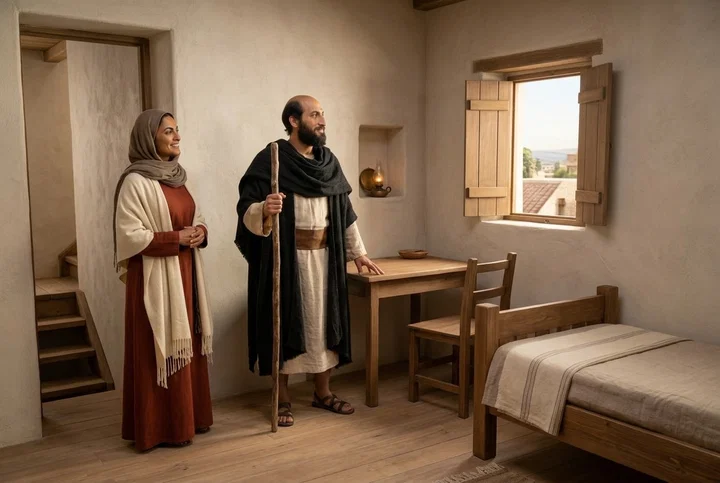
Beyond meals she gave him a regular place to stop, preparing a little walled chamber furnished with a bed, table, stool, and candlestick for him to turn into.RH Jul 25, 1907ST Jul 28, 1898 That furnished bedchamber served as his special accommodation and regular place to stay, also used when his servant passed through with him.RH Sep 14, 1916ST Jun 25, 1912RH Jul 25, 1907ST Jul 28, 1898 Her example represents a generous gift of hospitality and care for a man of God, though few could give as much as she did.RH Sep 14, 1916 The verse belongs to the life of Elisha and the miracles God worked through him.ST May 13, 1908ST Jan 24, 1906 It shows the development of Elijah's prophetic school through his devout pupil Elisha, as evidence of that education's power and value, and these miracles are true events rather than pious legends or myths.ST May 13, 1908ST Jun 7, 1899ST Jan 24, 1906
Hospitality Taught and Rewarded
The Shunammite's hospitality was willing, cheerful, generous, practical, and loving, a standing and repeated invitation to eat whenever Elisha passed through.RH Jul 25, 1907ST Jun 16, 1914ST Jun 16, 1914ST Jun 16, 1914 She thought and planned and acted to make him comfortable, especially because he was a man of God, the Lord's traveling prophet.RH Jul 25, 1907ST Jun 16, 1914 In so doing she supported him in the work God had given him and gave him a regular place to stop for his needs.RH Jul 25, 1907ST Jun 16, 1914
The welcome of a home refreshed the weary traveler, showing practical, loving service to one passing through.ST Jun 16, 1914 Her guest's repeated acceptance implies that she provided safe, healthful lodging rather than damp, harmful sleeping quarters.ST Jun 16, 1914 Her repeated urging to eat illustrates sincere hospitality, in which a guest needs to feel genuinely welcome rather than treated as an intrusion or asked to set a departure date.ST Jun 16, 1914
The account stands as a model for generous hospitality in modern homes.ST Jun 16, 1914 It remains a lasting example of the light a Christian home gives through thoughtful care for others, as seen when she also provided a room for Elisha and his servant when they passed through.ST Jun 16, 1914ST Jun 25, 1912
Her example represents generous, self-sacrificing care for a traveling minister, given repeatedly without charge.RH Jul 25, 1907ST Jun 16, 1914 She refused any payment for this service, yet few women could give as much as she did.RH Sep 14, 1916ST Jul 28, 1898 The value of a gift lies not in its size but in the love that prompts it.RH Sep 14, 1916
Her kindness to God's servant was remembered by the Lord and accepted as done unto Him.ST Jul 28, 1898 It was richly rewarded in loving-kindness, first with the gift of embracing a son, the highest aspiration of every wife among the children of Israel in hope of the coming Messiah. Second came the wonderful blessing of having that son restored to her even from the dead, when Elisha prayed and God restored his life, so that her family had no cause to regret caring for him.RH Jul 25, 1907
The chapter's account of her son's death and restoration to life brings comfort in grief over a child's death.RH Jan 4, 1906 It points to reunion through resurrection.RH Jan 4, 1906
Resurrection Before Christ
2 Kings 4:8 opens the account of the raising of the Shunammite's son, which took place before Christ's resurrection.RH Aug 6, 1872ST Mar 30, 1876ST Apr 30, 1896 His restoration was a genuine resurrection from the dead, and not a different category because he was not raised to immortality.RH Aug 6, 1872 The raising centers in Christ, who is the resurrection and the life and stands foremost and preeminent in it.ST Apr 30, 1896
It was done by the saving power of Christ's sacrifice as established in God's purpose even before it was carried out, and Christ supplied the power by which it was done.ST Oct 12, 1876ST Apr 30, 1896 Its timing before Christ rose proves that Christ being called the first-fruits of those who slept does not mean first in order of time but first in preeminent rank and station in redemption.ST Apr 30, 1896 Shunem lay on the opposite side of the hill from Nain, where Jesus raised a widow's only son.
Sources