2 Kings 7:3
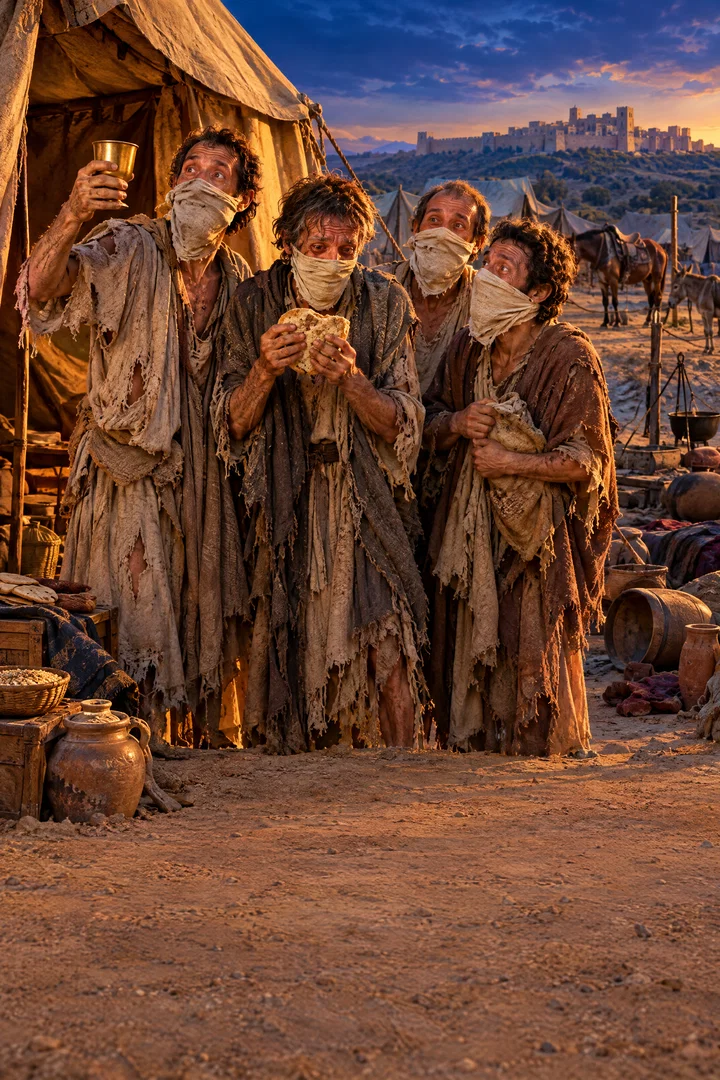
And there were four leprous men at the entering in of the gate: and they said one to another, Why sit we here until we die?
Translations
American King James Version, King James Version, KJV Cambridge Paragraph Bible
And there were four leprous men at the entering in of the gate: and they said one to another, Why sit we here until we die?
And there were four leprous men at the entrance of the gate: and they said one to another, Why sit we here until we die?
Now there were four leprous men at the entering in of the gate: and they said one to another, Why sit we here until we die?
Now there were four leprous men at the entrance of the gate: and they said one to another, Why sit we here until we die?
And four men have been leprous, at the opening of the gate, and they say one unto another, 'What — we are sitting here till we have died;
And there were four leprous men at the entrance of the gate, and they said one to another, Why do we abide here until we die?
Now there were, four men, lepers, at the entrance of the gate,—and they said one to another—Why are, we, sitting here until we are dead?
Berean Standard Bible, Majority Standard Bible
Now there were four men with leprosy at the entrance of the city gate, and they said to one another, “ Why just sit here until we die?
Now there were four leprous men at the entrance of the gate. They said to one another, “ Why do we sit here until we die?
Now there were four lepers seated at the doorway into the town: and they said to one another, Why are we waiting here for death?
Nowe there were foure leprous men at the entring in of the gate: and they saide one to an other, Why sitte we here vntill we die?
Douay-Rheims (Challoner revision)
Now there were four lepers, at the entering in of the gate: and they said one to another: What mean we to stay here till we die?
Pictures
Cross-references
- 2 Kings 7:9
Then they said one to another, We do not well: this day is a day of good tidings, and we hold our peace: if we tarry till the morning light, some mischief will come upon us: now therefore come, that we may go and tell the king’s household.
The lepers recognize they should tell others the good news.
- 2 Kings 6:24-25
And it came to pass after this, that Ben-hadad king of Syria gathered all his host, and went up, and besieged Samaria.
The siege and famine explain the lepers’ desperate situation.
- Leviticus 13:45-46
And the leper in whom the plague is, his clothes shall be rent, and his head bare, and he shall put a covering upon his upper lip, and shall cry, Unclean, unclean.
Requires lepers to live apart from the community.
- 2 Kings 7:17-20
And the king appointed the lord on whose hand he leaned to have the charge of the gate: and the people trode upon him in the gate, and he died, as the man of God had said, who spake when the king came down to him.
The doubting captain dies as Elisha foretold, while the city receives the promised abundance.
Commentary
Each commentary is drawn from primary sources: the writings of Ellen G. White and Adventist pioneers and periodicals. Each commentary is separate. Its own words are not a quotation; follow the references to read the source passages.
Pioneers and periodicals
12 sources
The verse stands at the beginning of the history running from Joram king of Israel through Jehu and his dynasty to the fall of Israel under Hoshea, and it belongs to the varied events in the life of Elisha, who ministered about sixty years and died under Jehoash in 796 B.C., when Hosea, Jonah and Amos were also prophesying.ST May 5, 1909 It falls within the account of Elisha's life and ministry, in which God works notable miracles and reproves and instructs backsliding Israel.ST May 13, 1908 It presents four starving leprous men at the entering in and outside of Samaria's gate during the Syrian siege and severe famine.RH Feb 17, 1916ST Oct 1, 1885RH Mar 11, 1915ST Oct 1, 1885RH Sep 8, 1874
They were excluded from the city under the law that required lepers to live apart.ST Oct 1, 1885ST Oct 1, 1885 Their leprosy was incurable by any medicine or skill and could be healed only by divine power.RH Sep 8, 1874 There was no food in the city, and the famine was so severe that begging could not provide food.ST Oct 1, 1885RH Dec 3, 1914
Their question expresses a desperate but practical resolve to act rather than wait passively to die: staying where they were meant death and going into the famine-struck city meant death, so as a last resort they decided to surrender to the Syrian army and put themselves at its mercy, reasoning that the Syrians might kill them but might spare and feed them, and that if they were killed they would only die as they expected to die anyway.ST Oct 1, 1885RH Mar 11, 1915ST Oct 1, 1885RH Sep 8, 1874RH Dec 3, 1914 They went to the Syrian camp and found it deserted with its provisions and supplies left behind.RH Feb 17, 1916ST Oct 1, 1885RH Mar 11, 1915RH Sep 8, 1874RH Dec 3, 1914 The camp was empty because the Lord had made the Syrians hear a noise like a mighty host coming in battle array, so they fled in haste leaving everything behind, which the lepers discovered when they cautiously approached.RH Sep 8, 1874
They became the messengers who told the city that the Syrians had fled, their report was confirmed and the people took the Syrians' provisions, so the promised abundance literally came to pass despite unbelief, confirming Elisha's prophecy of food for the city.RH Feb 17, 1916ST Oct 1, 1885 Their story teaches that people who receive good things should not keep them to themselves but should share the blessing with others.RH Nov 12, 1914 Applied to people who know the good news of salvation, their refusal to sit passively while death is imminent means that while others are spiritually starving and dying without hope, believers must not keep the good news to themselves or spend their lives only securing their own wealth, but should promptly tell others of deliverance.RH Mar 11, 1915 Their desperate condition pictures humanity under sin: sin is like leprosy, lying deep within and infecting the whole race, and it has brought death and sorrow into the world, so their question calls sinners not to remain in despair under sin's fatal outcome but to seek the life and salvation offered through Christ.RH Sep 8, 1874
Sources