2 Samuel 1:7
And when he looked behind him, he saw me, and called unto me. And I answered, Here am I.
Translations
American King James Version, Webster Bible
And when he looked behind him, he saw me, and called to me. And I answered, Here am I.
King James Version, KJV Cambridge Paragraph Bible, Revised Version, American Standard Version
And when he looked behind him, he saw me, and called unto me. And I answered, Here am I.
and he turneth behind him, and seeth me, and calleth unto me, and I say, Here [am] I.
And he looked behind him, and saw me, and called to me. And I said, Here am I.
so he turned behind him, and saw me,—and cried out unto me, and I said, Behold me!
When he turned around and saw me, he called out and I answered, ‘ Here I am!’
When he turned around and saw me, he called out to me, and I answered, ‘ Here I am!’
When he looked behind him, he saw me and called to me. I answered, ‘ Here I am.’
And looking back, he saw me and gave a cry to me. And answering him I said, Here am I.
And when he looked backe, he saw me, and called me. And I answered, Here am I.
Douay-Rheims (Challoner revision)
And looking behind him, and seeing me, he called me. And I answered, Here am I.
Pictures
Cross-references
- 1 Samuel 31:4-6
Then said Saul unto his armourbearer, Draw thy sword, and thrust me through therewith; lest these uncircumcised come and thrust me through, and abuse me. But his armourbearer would not; for he was sore afraid. Therefore Saul took a sword, and fell upon it.
This account describes Saul’s death, which the passage connects with 2 Samuel 1.
Commentary
Each commentary is drawn from primary sources: the writings of Ellen G. White and Adventist pioneers and periodicals. Each commentary is separate. Its own words are not a quotation; follow the references to read the source passages.
Ellen G. White
1 source
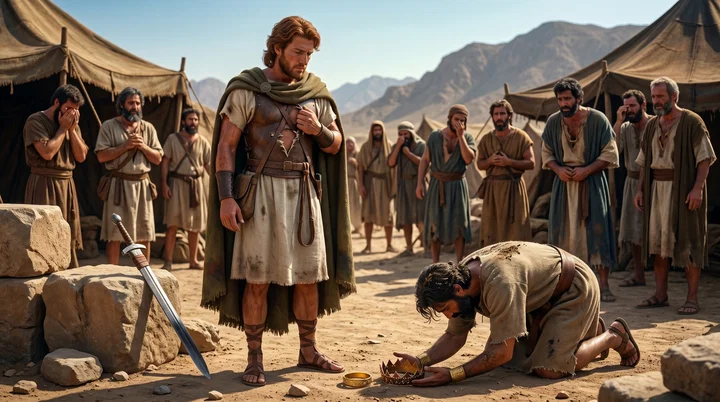
The words form part of the report given by the Amalekite stranger concerning his encounter with Saul on the battlefield.PP 694.3–695.2 In that account the wounded king turned to look behind himself, noticed the man standing nearby, summoned him by calling out, and was met with a reply of ready presence.PP 694.3–695.2 This brief exchange was set forth as the opening to Saul's plea that the stranger put the injured monarch to death, a story that served to condemn the teller out of his own mouth.PP 694.3–695.2
Sources
Pioneers and periodicals
2 sources
The verse belongs to the account of Saul's death and David's response to the Amalekite who claimed to have slain him.ST Apr 7, 1909 It stands within the report of the messenger who brought David news of Saul's death expecting him to rejoice over it.ST That same messenger was afterward put to death by David.ST Of the moment itself when Saul looked behind him, saw the man, and called to him, no separate explanation is given.ST Apr 7, 1909
Sources