2 Samuel 11:7
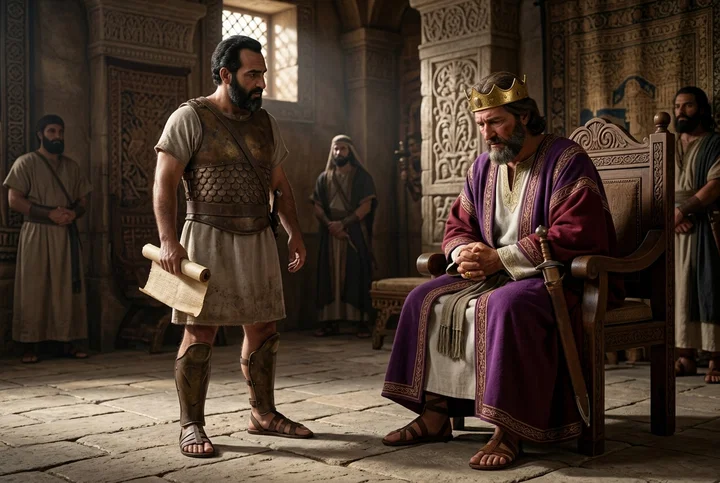
And when Uriah was come unto him, David demanded of him how Joab did, and how the people did, and how the war prospered.
Translations
And when Uriah was come to him, David demanded of him how Joab did, and how the people did, and how the war prospered.
King James Version, KJV Cambridge Paragraph Bible
And when Uriah was come unto him, David demanded of him how Joab did, and how the people did, and how the war prospered.
And when Uriah had come to him, David inquired of him how Joab did, and how the people did, and how the war prospered.
Revised Version, American Standard Version
And when Uriah was come unto him, David asked of him how Joab did, and how the people fared, and how the war prospered.
and Uriah cometh unto him, and David asketh of the prosperity of Joab, and of the prosperity of the people, and of the prosperity of the war.
And when Urijah had come to him, David asked how Joab prospered, and how the people prospered, and how the war prospered.
And, when Uriah had come in unto him, David asked—how Joab prospered, and how the people prospered, and how the war prospered.
When Uriah came to him, David asked how Joab and the troops were doing with the war.
When Uriah came to him, David asked how Joab and the troops were doing and how the war was going.
When Uriah had come to him, David asked him how Joab did, and how the people fared, and how the war prospered.
And when Uriah came to him, David put questions to him about how Joab and the people were, and how the war was going.
And when Vriah came vnto him, Dauid demanded him how Ioab did, and howe the people fared, and how the warre prospered.
Douay-Rheims (Challoner revision)
And Urias came to David. And David asked how Joab did, and the people, and how the war was carried on.
Pictures
Cross-references
- 2 Samuel 12:9-14
Wherefore hast thou despised the commandment of the LORD, to do evil in his sight? thou hast killed Uriah the Hittite with the sword, and hast taken his wife to be thy wife, and hast slain him with the sword of the children of Ammon.
Nathan rebukes David for Uriah’s murder and announces consequences for his sin.
- 2 Samuel 11:15-17
And he wrote in the letter, saying, Set ye Uriah in the forefront of the hottest battle, and retire ye from him, that he may be smitten, and die.
David orders Uriah into a fatal battle, where he is killed.
- 2 Samuel 12:14
Howbeit, because by this deed thou hast given great occasion to the enemies of the LORD to blaspheme, the child also that is born unto thee shall surely die.
David’s deed gives the Lord’s enemies occasion to blaspheme.
- 1 Kings 15:5
Because David did that which was right in the eyes of the LORD, and turned not aside from any thing that he commanded him all the days of his life, save only in the matter of Uriah the Hittite.
It identifies the matter of Uriah as David’s exception to his otherwise faithful conduct.
- 2 Samuel 23:39
Uriah the Hittite: thirty and seven in all.
Names Uriah the Hittite among David’s officers.
- 2 Samuel 12:9
Wherefore hast thou despised the commandment of the LORD, to do evil in his sight? thou hast killed Uriah the Hittite with the sword, and hast taken his wife to be thy wife, and hast slain him with the sword of the children of Ammon.
Nathan confronts David over Uriah’s death.
- 2 Samuel 11:27
And when the mourning was past, David sent and fetched her to his house, and she became his wife, and bare him a son. But the thing that David had done displeased the LORD.
The Lord was displeased with David’s actions.
- Daniel 2:27
Daniel answered in the presence of the king, and said, The secret which the king hath demanded cannot the wise men, the astrologers, the magicians, the soothsayers, shew unto the king;
same word translated demanded
Commentary
Each commentary is drawn from primary sources: the writings of Ellen G. White and Adventist pioneers and periodicals. Each commentary is separate. Its own words are not a quotation; follow the references to read the source passages.
Ellen G. White
11 sources
When Uriah came to him after being summoned, David asked him how Joab was doing, how the people or army were doing, and how the war was prospering or progressing.PP 719.2–3PP 719.4–720.1PP 718.3 The questioning was part of David's effort to conceal his adultery and prevent suspicion, in order to protect his honor and take Bathsheba as his wife, adding murder to adultery.PP 718.3 He then arranged Uriah's death and sent him back to the battle carrying a letter ordering Joab to place him where the fighting was fiercest and withdraw support, so that the Ammonites would kill him.PP 719.1PP 719.2–3PP 719.4–720.1
The verse belongs to the account of David's grievous and heinous crime, sin and fall involving Uriah and Bath-sheba in adultery and murder.SG4 86.2–87.11SP 378.1–379.1 The episode followed David's idleness, for his failure to occupy himself in useful work led to the wrongdoing and guilt that ended in Uriah's murder, and useful employment would have kept him from it.4T 411.1–412.2GW92 168.3 After turning from God's teachings and wisdom and departing from God, David sinned and sullied a once-fair reputation, which led to further sin and shows that setting aside God's wisdom has serious consequences.1SP 378.1–379.121MR 169.1
Though especially favored by God, David was led through indulgence of appetite and passion to incur God's displeasure.ST Feb 22, 1883 God did not excuse or justify David's wrongdoing, but met it with reproof and punishment.SG4 86.2–87.11SP 378.1–379.1 The record is preserved as an honest account of the failings of people entrusted with great responsibilities to warn readers against sin, showing that even those favored by God can be overcome by temptation, teaching later generations and encouraging people who struggle and fall to rise again through God's grace.ST May 31, 1910
Sources
Pioneers and periodicals
48 sources
David asked Uriah about Joab, the army, and how the war was prospering as a cover to conceal his adultery with Bathsheba.RH Oct 8, 1861ST Apr 28, 1909RH Mar 30, 1869 The inquiry belongs to a fearful double crime of adultery giving occasion to murder, uniting lust, cruelty, treachery and base ingratitude against God and man.RH Jul 27, 1869RH Mar 19, 1861RH Nov 15, 1870ST Sep 22, 1898 By this wickedness David gave great occasion to the enemies of the Lord to blaspheme and left a reproach upon the cause of God in every age since.RH Oct 12, 1869RH Jul 27, 1869RH Nov 15, 1870 Though he repented with deep humiliation and was forgiven through Christ, he suffered years of anguish and lifelong chastening in his family, showing there is no lasting profit in sin.ST Sep 10, 1896RH Mar 30, 1869RH Jul 27, 1869RH Nov 15, 1870 The account is told without shading or partiality, to warn him that thinketh he standeth to take heed lest he fall and to teach the fallen to rise again through repentance rather than to excuse sin.STST May 1, 1907ST Apr 19, 1910RH Jun 10, 1875ST
Words and Historical Setting
The word rendered demanded is the Hebrew sha'el, which means ask, beg, demand, request, and require, so asked gives its right sense.ST Apr 28, 1909 Uriah the Hittite was a foreigner living in Jerusalem and one of David's leading officers, showing that a stranger could be an inhabitant of the land.RH Oct 8, 1861 In the verse David questions Uriah about Joab, the Israelite army, and how the war is prospering, while trying to conceal his adultery.RH Mar 30, 1869
David committed this grievous sin against Uriah around 1035 BC, when he was about fifty years old.ST Jul 27, 1904 That fall came about sixty years after Samuel's words about a man after God's own heart, which were spoken before David was born.ST Jul 27, 1904 The verse belongs to the record of David's fearful sin against Uriah the Hittite, set among the internal troubles and strifes connected with establishing his reign, evidences of his generous disposition, the setting of his throne in Jerusalem, his victories over enemies, his plan to build a temple for God, and his kindness to the house of Saul for Jonathan's sake.ST In that setting it warns him that thinketh he standeth to take heed lest he fall.ST
The transgression happened many years after David was called a man after God's own heart, at a time when there was not one blemish on his character.RH Oct 12, 1869 The verse does not present him as a man after God's own heart while guilty of great crime, nor does it present God as pleased with such conduct.RH Oct 12, 1869 His guilt in this matter is greatly to be deplored, and to make God responsible for the crimes of those who transgress His law is wicked misrepresentation nearly as great as David's own guilt.RH Oct 12, 1869
Nature of David's Sin
The chapter tells of idleness and luxury leading to adultery, then a plot to kill Uriah in order to hide the sin, followed by Nathan's reproof, humble repentance, and forgiveness. The sin was a fearful combination of many dreadful sins against God and man, in which adultery gave occasion to murder, a crime more heinous than adultery itself.RH Jul 27, 1869 It united lust, cruelty, treachery, and base ingratitude with awful intensity, as a work done when Satan has complete control.RH Jul 27, 1869
In the matter of Uriah the Hittite the guilt was the double crime of adultery and murder, grave crimes involving Bathsheba which God condemned and severely judged.RH Mar 19, 1861RH Nov 15, 1870ST Sep 22, 1898ST Apr 8, 1897 He was already an adulterer when he formed his design concerning Uriah's wife, before the outward act, for God's law judges sinful desire and intention and not only completed actions.ST Sep 27, 1883 His actions bore cruelly on Uriah and wronged Bathsheba and the nation, but the chief guilt lay in its relation to God, which his penitence recognized as sin against God.RH Sep 2, 1862
His conduct in the matter of Uriah was flagrant, open wickedness directly contrary to God's command.ST Apr 17, 1907 He was not a young man in the heat of passion but a man old in years and experience and a man of wisdom, yet he sinned.RH Jun 10, 1875 By this great wickedness he gave great occasion to the enemies of the Lord to blaspheme, furnishing occasion for reproaching the cause of God in every age since, and the wrong is not covered up or excused.RH Oct 12, 1869RH Jul 27, 1869RH Nov 15, 1870
Causes of David's Fall
Prosperity intoxicated David and nearly brought ruin upon him in the matter of Uriah.ST Dec 16, 1880RH Jun 9, 1868 His earlier hardship and humiliation had prepared him for the throne, but did not keep him from a near-fatal fall when his circumstances changed, which warns that prosperity can be dangerous.ST Dec 16, 1880RH Jun 9, 1868
God had suffered him to receive injustice at the hand of Saul to school him in poverty, humiliation, and sorrow, to teach him to hate such wickedness and never act that way when himself made king.ST Jul 28, 1881 That schooling was of inestimable value to prepare him for the throne, yet with all that previous training he was well-nigh ruined by the prosperity that flowed in upon him.ST Jul 28, 1881 His case stands as a lighthouse built near most dangerous rocks, showing that an exalted station is perilous, that a lowly station in life is far preferable and infinitely safer, and that honor must be preceded by humility.ST Jul 28, 1881ST Dec 8, 1881 Even prior humility and affliction and moral education do not make an elevated position safe when prosperity overwhelms.ST Dec 8, 1881
A person can fall into terrible sin after cherishing the love of evil in the heart, and high position in God's church does not make anyone safe from such a fall. Like an unwary soldier David did not flee when he should have, showing the danger of failing to retreat from temptation. He fell into a grave course of sin while neglecting prayer, and his conduct stains his religious character.ST Jun 23, 1887 Though especially favored by God, he was led through indulgence of appetite and passion to incur God's displeasure.ST Feb 22, 1883
Judgment and Repentance
The questioning of Uriah belongs to the wrong that brought retribution upon David through the rest of his life, especially in his own family.ST Mar 31, 1881RH Apr 26, 1870 The later sorrows in the histories of Amnon and Tamar, of Absalom, and of Adonijah show that wrongdoing brings consequences in kind.ST Mar 31, 1881RH Apr 26, 1870 The wrong was followed by the terrible denunciation of the prophet Nathan, which was completely accomplished in the judgments that came upon David in his subsequent history.RH Oct 12, 1869
Even though David repented with deep humiliation and was forgiven, he suffered years of anguish and lifelong chastening because of his sin.ST Sep 10, 1896RH Mar 30, 1869RH Jul 27, 1869 Carefully laid plans and deception in questioning Uriah about Joab, the army, and the war could not hide sin from God.RH Mar 30, 1869 There is no lasting profit in sin, for David was punished when he turned from the path of obedience.RH Jul 27, 1869RH Mar 17, 1904 God severely rebuked and punished the crime against Uriah, and David later openly confessed his grievous wrongdoing with humility and penitence.ST Jul 17, 1884
David repented bitterly and lastingly, suffered terrible punishment, and did not afterward relapse into sin against the marriage law.RH Feb 6, 1879 Taken in the Devil's snare before he knew his danger and blinded by sin until pointedly rebuked by Nathan, he truly repented with most heartfelt sorrow once made to see his awful guilt.RH Jul 27, 1869 He came nearer to perdition than any man who yet escaped.RH Jul 27, 1869 Under deep conviction he came to deep sorrow and sincere repentance joined with strong, abiding faith, pouring his whole soul into hearty and humble confession and prayer to be washed thoroughly from iniquity, cleansed from sin, and delivered from blood-guiltiness by the God of his salvation.RH Nov 15, 1870
After being brought to repentance for these sins, David prayed for cleansing, a clean heart, and renewal by God's Spirit.ST Jul 29, 1889 He often mourned that sin, whose full hateful and harmful nature becomes clearer as a person grows in holiness.RH Oct 4, 1864 He was given an opportunity to repent and was restored to his throne, and his testimony remained established until his death.RH Apr 26, 1906 His murder and adultery, like sins committed in other ages, could be forgiven when the sinner repented, through Christ, who gives comfort when a person hates and loathes that sin.ST Apr 10, 1893ST Apr 8, 1897
Truthfulness of Scripture Record
The account to which this verse belongs records and rebukes David's sin without glossing over the wrongdoing of Israel's king, faithfully exposing his conduct rather than concealing it.ST May 1, 1907STST Apr 7, 1881 That sin against Uriah the Hittite and the sin in numbering Israel are told without any shading or partiality, showing that God is as impartial in recording the deeds of the great as of the small.ST May 1, 1907ST Apr 19, 1910 Scripture in this way honestly records the sin of even a true servant of God and of people entrusted with great responsibilities.ST May 31, 1910ST Dec 21, 1915 Such records testify to the Bible's truthfulness and give encouragement, warning readers against sin, teaching later generations that even those favored by God can be overcome by temptation, and encouraging people who struggle and fall to rise again through God's grace.ST May 31, 1910ST Dec 21, 1915
It is a truthful record of public wrongdoing, showing David, once faithful, yielding to wicked desire and becoming guilty of murder and sin before God.RH Sep 11, 1860 It is included as a warning rather than an example to follow, while Uriah is held up as worthy of honor.RH Sep 11, 1860 It is recorded not to show how good David was, for his evil conduct with Uriah deserved life in state prison and hell forever, but to show how the grace of God brings salvation to the very worst of men and makes saints out of the vilest sinners.ST Nov 1, 1910 Its place in inspired, accurate Scripture does not mean that David's conduct had God's approval.RH Mar 19, 1861RH Jul 9, 1908ST Jan 29, 1885 The Bible condemns the crime of adultery and murder without palliation, as an act for which God pronounced severe judgment on David, and the account is preserved to warn later readers about the sins of God's former servants and the punishment that followed.RH Mar 19, 1861ST Jan 29, 1885
Though David as a professed friend of the cause of God took up immoral principles and by evil practice brought great reproach upon the truth and left a stain upon his own character, the cause of God in its native purity still exists apart from his sin.ST Apr 7, 1881 Enemies of truth feed upon that sin like birds that live on carrion and use it to predict the overthrow of God's cause, yet the sin can ruin David himself but not the Christian religion.ST Apr 7, 1881 The account of David and Uriah belongs to the human element of Scripture, an example of human failure that does not make the divine message any less valuable, for God can still speak through weak and sinful people.RH Feb 26, 1914
Warning and Encouragement
The inquiry about Joab, the army, and the progress of the war belongs to the record of David's fearful sin against Uriah the Hittite, set among the internal troubles connected with establishing his reign, his generous disposition, the setting of his throne in Jerusalem, his victories, his plan to build a temple, and his kindness to Saul's house for Jonathan's sake, and it warns him that thinketh he standeth to take heed lest he fall.ST David was then not a young man in the heat of passion but a man old in years and experience and a man of wisdom, yet he sinned, proving that even mature believers can fall and that safety lies only in persevering to the end.RH Jun 10, 1875
His fall warns all who fear God never for a moment to forget their danger, for he was taken in the Devil's snare before he knew his danger and blinded by sin until pointedly rebuked, coming nearer to perdition than any man who yet escaped.RH Jul 27, 1869 His case stands as a lighthouse set near most dangerous rocks, and as a beacon whose sins and their terrible effects should deter the proud and presumptuous.RH May 25, 1876 Yet that sin gives no one permission to do the same, for the sins of godly people are failures to resist temptation, not examples to imitate, not grounds for deliberate wrongdoing, and not a justification for others in committing sin.RH Aug 17, 1869ST Aug 26, 1880
The lesson to be drawn is to follow his repentance, not to excuse wrongdoing by his example, for he afterward repented bitterly and lastingly, suffered terrible punishment, and did not relapse into sin against the marriage law.RH Feb 6, 1879 That repentance gives not the slightest ground of hope to the deliberate transgressor of God's law, for a return afterward to the like transgression would not receive pardon.RH Jul 27, 1869 The failures of even those favored by God and entrusted with great responsibilities are honestly recorded to teach later generations, to warn readers against sin, and to encourage those who struggle and fall to rise again through God's grace, including those who have gone wrong and those shamed by sin, showing the shame that follows sin and the comfort Christ gives when a person hates and loathes that sin.ST May 31, 1910ST Apr 10, 1893RH May 25, 1876
As a professed friend of God's cause David took up immoral principles and by evil practice brought great reproach upon the truth and left a stain upon his own character.ST Apr 7, 1881 Enemies of truth feed upon that sin like birds that live on carrion and use it to predict the overthrow of God's cause.ST Apr 7, 1881 Yet the cause of God in its native purity still exists apart from his sin, which can ruin the sinner himself but not the Christian religion.ST Apr 7, 1881
Sources