2 Samuel 11:15
And he wrote in the letter, saying, Set ye Uriah in the forefront of the hottest battle, and retire ye from him, that he may be smitten, and die.
Translations
And he wrote in the letter, saying, Set you Uriah in the forefront of the hottest battle, and retire you from him, that he may be smitten, and die.
King James Version, KJV Cambridge Paragraph Bible, Revised Version, American Standard Version
And he wrote in the letter, saying, Set ye Uriah in the forefront of the hottest battle, and retire ye from him, that he may be smitten, and die.
And he wrote in the letter, saying, Set ye Uriah in the front of the hottest battle, and retire ye from him, that he may be smitten, and die.
and he writeth in the letter, saying, 'Place ye Uriah over-against the front of the severest battle, and ye have turned back from after him, and he hath been smitten, and hath died.'
And he wrote in the letter saying, Set Urijah in the front of the thickest fight, and withdraw from him, that he may be smitten and die.
and he wrote in the letter, saying,—Set ye Uriah in the forefront of the hottest battle, and retire ye from him, that he be smitten and die.
Berean Standard Bible, Majority Standard Bible
In the letter he wrote: “ Put Uriah at the front of the fiercest battle; then withdraw from him, so that he may be struck down and killed.”
He wrote in the letter, saying, “Send Uriah to the forefront of the hottest battle, and retreat from him, that he may be struck and die.”
And in the letter he said, Take care to put Uriah in the very front of the line, where the fighting is most violent, and go back from him, so that he may be overcome and put to death.
And he wrote thus in the letter, Put ye Vriah in the forefront of the strength of the battell, and recule ye backe from him, that he may be smitten, and die.
Douay-Rheims (Challoner revision)
Writing in the letter: Set ye Urias in the front of the battle, where the fight is strongest: and leave ye him, that he may be wounded and die.
Pictures

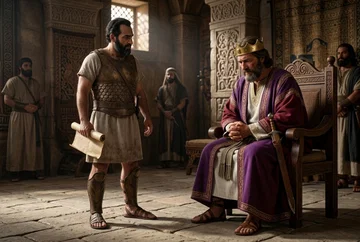
Cross-references
- 2 Samuel 12:9-10
Wherefore hast thou despised the commandment of the LORD, to do evil in his sight? thou hast killed Uriah the Hittite with the sword, and hast taken his wife to be thy wife, and hast slain him with the sword of the children of Ammon.
Nathan confronts David over Uriah’s death and announces consequences.
- Psalms 51
Have mercy upon me, O God, according to thy lovingkindness: according unto the multitude of thy tender mercies blot out my transgressions.
David confesses his sin involving Uriah and pleads for mercy and cleansing.
- 2 Samuel 12:14
Howbeit, because by this deed thou hast given great occasion to the enemies of the LORD to blaspheme, the child also that is born unto thee shall surely die.
David’s deed gave the Lord’s enemies occasion to blaspheme and brought the child’s death.
- 2 Samuel 11:3
And David sent and enquired after the woman. And one said, Is not this Bath-sheba, the daughter of Eliam, the wife of Uriah the Hittite?
Uriah is identified as a Hittite, the foreigner David used as an example.
- 2 Samuel 11:27
And when the mourning was past, David sent and fetched her to his house, and she became his wife, and bare him a son. But the thing that David had done displeased the LORD.
David takes Bathsheba as his wife, and the Lord is displeased with his conduct.
- Psalms 51:14
Deliver me from bloodguiltiness, O God, thou God of my salvation: and my tongue shall sing aloud of thy righteousness.
David asks God to deliver him from bloodguilt.
- 2 Samuel 12:9
Wherefore hast thou despised the commandment of the LORD, to do evil in his sight? thou hast killed Uriah the Hittite with the sword, and hast taken his wife to be thy wife, and hast slain him with the sword of the children of Ammon.
Nathan charges David with causing Uriah’s death by the sword.
- 1 Kings 15:5
Because David did that which was right in the eyes of the LORD, and turned not aside from any thing that he commanded him all the days of his life, save only in the matter of Uriah the Hittite.
Excepts the matter of Uriah from David’s otherwise faithful conduct.
- 2 Samuel 23:39
Uriah the Hittite: thirty and seven in all.
Identifies Uriah as a Hittite and one of David’s officers.
- 2 Samuel 12:7
And Nathan said to David, Thou art the man. Thus saith the LORD God of Israel, I anointed thee king over Israel, and I delivered thee out of the hand of Saul;
Nathan’s rebuke exposed David’s guilt and led him to repentance.
- 2 Samuel 12:11
Thus saith the LORD, Behold, I will raise up evil against thee out of thine own house, and I will take thy wives before thine eyes, and give them unto thy neighbour, and he shall lie with thy wives in the sight of this sun.
David’s household treachery brings the foretold judgment upon him.
Commentary
Each commentary is drawn from primary sources: the writings of Ellen G. White and Adventist pioneers and periodicals. Each commentary is separate. Its own words are not a quotation; follow the references to read the source passages.
Ellen G. White
12 sources
The order was written by David to Joab, directing that Uriah be set in the forefront of the hottest and fiercest fighting and then abandoned by withdrawing support, so that he would be smitten by the enemy and die.1T 255.1PP 719.1PP 719.4–720.1PP 719.2–3PP 718.3 Uriah himself carried the letter containing his own death warrant, Joab obeyed the order, and Uriah fell in battle to the Ammonites.1T 255.1PP 719.1 The intent was to make the death appear as an ordinary battle casualty, hiding David's own guilt and preserving his royal honor, and the attempt to conceal adultery thus led him to commit murder as part of his sin against Uriah and Bath-sheba.SG4 86.2–87.11SP 378.1–379.1PP 718.3
The crime grew out of idleness, for David's failure to occupy himself in useful work left room for thoughts leading to evil actions, and had he been engaged in worthwhile labor he would not have arranged Uriah's death.4T 411.1–412.2GW92 168.3 Indulgence of appetite and passion led him to this act, in turning from God's teachings and incurring God's displeasure.21MR 169.1ST Feb 22, 1883 The order made the king responsible for the murder of his faithful soldier, illustrating how those in command can abuse power by sending subordinates into hopeless danger to get rid of them.1T 255.1PP 719.4–720.1 Joab in obeying the king rather than God thereby transgressed God's law, for authority given by God must be exercised in harmony with divine law, and when a ruler commands what violates that law obedience to the ruler is sinful and must be refused.PP 719.2–3
God did not excuse or justify the heinous crime but sent Nathan to rebuke David, and though David's repentance and confession brought forgiveness and spared his life, he was still punished for his sin.SG4 86.2–87.11SP 378.1–379.1 His sin sullied his reputation, showing that violating God's will brings retribution.SG4 86.2–87.11SP 378.1–379.121MR 169.1 The record shows that even a man favored by God and entrusted with great responsibility could yield to temptation and commit grave wrongdoing, and it is preserved as a warning of the danger and consequences of disobedience, not as an excuse to sin, while his struggle and recovery through grace encourage others to resist evil and continue the conflict against sin.ST May 31, 1910
Sources
Pioneers and periodicals
54 sources
The order directed that Uriah be placed where fighting was fiercest and then abandoned by his fellow soldiers so that he would be struck down and killed.RH Sep 11, 1860ST Mar 31, 1881RH Apr 26, 1870 It was the murderous cover for adultery with Bath-sheba, to hide the sin and take her as wife.ST Apr 29, 1913RH Jul 27, 1869 It was David's one great, grave and fearful sin, a deliberate double crime of adultery joined with murder, directly contrary to God's command and displeasing to Him.STRH Oct 12, 1869ST Apr 14, 1909RH Jul 27, 1869ST Nov 11, 1880 Nathan exposed and rebuked it, and though David confessed and was forgiven, retribution and calamity followed him all his life, especially in his own house, and gave God's enemies occasion to blaspheme ever since.ST Mar 31, 1881RH Oct 12, 1869RH Jul 27, 1869RH Jul 27, 1869 His bitter repentance and pardon show that even the worst sinners can find mercy through Christ, while warning all who stand to take heed lest they fall.STST Jul 29, 1889RH Jul 27, 1869RH Sep 25, 1856ST Nov 1, 1910
Verse Wording and Setting
The verse records David's written order to set Uriah in the forefront of the hottest battle and then to retire from him, that he might be smitten and die, by placing him in the fiercest fighting and withdrawing the other soldiers so he would be abandoned and killed.RH Sep 11, 1860ST Mar 31, 1881RH Apr 26, 1870RH Oct 12, 1869ST Sep 10, 1896 The order was part of David's plot to have the loyal Uriah killed in order to hide and cover David's adultery in seducing Bath-sheba and to obtain her as his wife, so that adultery gave occasion to murder, and the plot was carried out.ST Apr 29, 1913RH Jul 27, 1869RH Feb 6, 1879RH Jan 7, 1904 Uriah is the Hittite, one of David's faithful men, a valiant and brave and faithful soldier, and his deliberate exposure and abandonment illustrates cruelty and the deadly cost of war to those who die and to the widows and orphans left behind.ST Jul 29, 1889ST May 6, 1897RH Jan 7, 1904RH Jul 3, 1856ST May 27, 1897
The sin came after the establishment of David's reign in Jerusalem, his victories over his enemies, his plan to build a temple for God, and his kindness to Saul's house for Jonathan's sake, and after the period described as his first ways.STRH Oct 12, 1869ST Sep 22, 1898 It occurred late in his life, about 1035 B.C. when he was about fifty years old, long after he had been commended as a man after God's own heart.ST Jul 27, 1904ST Nov 11, 1880RH Oct 12, 1869 In giving the order David abused the authority God had given him as king, and Joab's obedience to the king instead of God in carrying it out transgressed God's law. Carrying out murder indirectly by battle placement and withdrawal does not make the act less guilty.RH Jul 3, 1856 The account is sometimes misstated as David killing Ahab to obtain his wife, whereas it was Uriah exposed to the fiercest fighting and abandoned to be killed.RH Jun 4, 1867
Nature and Gravity of Sin
The order to expose Uriah belongs to David's fearful sin against Uriah the Hittite, coming after the establishment of his reign in Jerusalem, his victories, his plan to build a temple, and his kindness to Saul's house for Jonathan's sake.STST Apr 14, 1909ST Sep 10, 1896 It was an awful, great, grave sin and a grave evil in the history of his reign, his one great sin showing the power of sin manifest even in a true servant of God.STST Apr 14, 1909ST Sep 10, 1896ST Dec 21, 1915 It was a fearful combination of many dreadful sins against God and man, uniting lust, cruelty, treachery and base ingratitude with awful intensity.RH Jul 27, 1869RH Nov 15, 1870 It was a double crime in which adultery gave occasion to murder and was joined with murder, murder being the only crime more heinous than adultery.RH Jul 27, 1869RH Nov 15, 1870
The killing of Uriah by placement in the fiercest fighting and abandonment was deliberate, flagrant wickedness directly contrary to God's command.RH Oct 12, 1869ST Nov 11, 1880RH Mar 19, 1861ST Apr 17, 1907 It was great, grave and inexcusable wickedness, displeasing to God, not excused, concealed, approved or palliated by Him, and its inclusion in the inspired, accurate record does not mean it met the divine standard of righteousness.RH Oct 12, 1869RH Mar 19, 1861RH Oct 12, 1869RH Jul 9, 1908 It was different from other failures where no command forbade the act or where duty was not clearly understood.ST Apr 17, 1907
The sin harmed Uriah, Bathsheba and the nation, but its chief guilt lay in its relation to God.RH Jul 27, 1869RH Jul 27, 1869RH Sep 2, 1862 It was done when David was taken in the Devil's snare before he knew his danger and blinded by sin, and could only be wrought when Satan had complete control of the man.RH Jul 27, 1869RH Jul 27, 1869 It plunged a man of noble qualities and excellent traits of character into an abyss of sin and shame.RH Jul 27, 1869 It grew from indulgence of appetite and passion that incurred God's displeasure, from a love of evil cherished in the heart, and from neglect of prayer which stained his religious character.ST Feb 22, 1883ST Jun 23, 1887
Judgment and Consequences
Nathan denounced the sin, and judgments followed that fulfilled the denunciation.RH Oct 12, 1869 David was openly exposed, reproved, rebuked and punished for arranging Uriah's death, though he humbly confessed, repented and was forgiven.ST Jul 17, 1884 His great crime in connection with Uriah's death became the sowing for which he later reaped bitter consequences.ST Nov 4, 1889
The wrong against Uriah brought retribution and calamities directly traceable to that sin through the rest of David's life.ST Mar 31, 1881RH Apr 26, 1870RH Jul 27, 1869 The retribution came especially through troubles in his own family, including those involving Amnon, Tamar, Absalom and Adonijah.ST Mar 31, 1881RH Apr 26, 1870 Though he repented with deepest humiliation, God's chastening hand was upon him all his life long.RH Jul 27, 1869
For one moment of sinful pleasure he suffered inexpressible anguish of spirit during many long years, proving there is no profit in sin.RH Jul 27, 1869 His punishment was terrible, and his repentance was bitter and lasting.RH Feb 6, 1879
God's warning that evil would rise against him from his own household was fulfilled when Absalom rebelled and publicly took David's wives.ST Nov 4, 1889 David's guilt in Uriah's death is reflected in similar guilt in Absalom, showing that punishment can resemble the sin.ST Nov 10, 1881
The sin gave the Lord's enemies occasion to blaspheme and has furnished reproach to the cause of God in every age since.RH Oct 12, 1869RH Jul 27, 1869 It left a stain on David's character in all succeeding generations.RH Nov 15, 1870ST Apr 7, 1881 Enemies of God's cause feed upon it, yet the cause of God itself continues in its native purity and is not overthrown by it.ST Apr 7, 1881
Repentance and Forgiveness
The order to set Uriah in the fiercest fighting and withdraw from him was part of the sin for which David was afterward brought to repentance.ST Jul 29, 1889ST Jul 17, 1884 When pointedly rebuked by Nathan he saw his awful guilt, done toward God and toward man while taken in the Devil's snare and blinded by sin, and he repented with all his heart.RH Jul 27, 1869 That conviction of sin led to sorrowful, humble, believing confession and prayer for mercy, for washing and cleansing and for deliverance from blood-guiltiness.RH Nov 15, 1870 His repentance was with deep grief and self-condemnation, a true turning after reproof.RH Jul 27, 1869RH Nov 15, 1870ST Jul 17, 1884
He mourned his sin in the matter of Uriah repeatedly.RH Oct 4, 1864 As a person grows in holiness the sin becomes more fully visible in its hateful and harmful character, so sorrow for it deepens even after an earlier repentance.RH Oct 4, 1864 His repentance was bitter and lasting, and he did not afterward transgress against the marriage law, though his punishment was terrible.RH Feb 6, 1879 The account of his great sin provides the Old Testament setting for his prayer for restoration and conversion in Psalm 51.ST Aug 19, 1886 His prayer of confession and appeal for mercy was answered, for he confessed to God and received forgiveness, though he was punished.ST Sep 10, 1896RH Jan 7, 1904
His grave sin in arranging for Uriah, one of his brave and faithful soldiers, to be killed in battle so as to take Uriah's wife would have destroyed him had he not repented.RH Jan 7, 1904 He escaped perdition by the barest possibility that remained to him, which his most noble qualities enabled him to seize.RH Jul 27, 1869 He came nearer to perdition than any other man who yet escaped.RH Jul 27, 1869 After his offenses he repented and was forgiven, and despite those crimes he remained known as a man after God's own heart.RH Sep 25, 1856 His forgiveness shows that God's grace brings salvation even to the worst sinners and makes saints of the vilest, so that a repentant sinner can receive mercy and be encouraged to hope when repenting.RH Jan 7, 1904ST Nov 1, 1910 Even in the Mosaic dispensation repentant sinners, though among the best people, were pardoned through Christ.ST Apr 8, 1897 Yet his repentance gives not the slightest ground of hope to the deliberate transgressor of God's law, for had he ever returned to the like transgression God would not have pardoned him.RH Jul 27, 1869
Scripture's Faithful Record
2 Samuel 11:15 is part of the inspired and accurate record of David's great sin against Uriah the Hittite.ST Apr 19, 1910RH Jul 9, 1908 It is told without any shading or partiality, showing that God records the deeds of the great just as He records the deeds of the small, as seen also in the numbering of Israel.ST Apr 19, 1910 The Bible reveals and rebukes David's sins rather than glossing them over, and the record of his arranging Uriah's death by placing him in the fiercest fighting and then abandoning him shows grave sin, not conduct God approved or excused.RH Mar 19, 1861ST Its inclusion does not mean God approved David's command or that the act met the divine standard of righteousness, for God condemned and severely punished him for it, and genuine repentance involves deep grief and self-condemnation.RH Mar 19, 1861RH Jul 9, 1908 The sins of God's chosen servants are recorded as warnings, not as approval, and sin so recorded still brings punishment.STST Jan 29, 1885
The description of David as a man after God's own heart referred to a time long before this crime and does not mean God approved it.ST Nov 11, 1880RH Oct 12, 1869 The crime of deliberate complicity in Uriah's death, ordering him placed in the fiercest fighting and abandoned by the others so he would be killed, occurred late in David's life, long after that commendation.ST Nov 11, 1880 That later conduct was inexcusable and displeasing to God, and God condemned and punished it rather than approving it.ST Nov 11, 1880RH Oct 12, 1869 Its faithful record testifies to the truthfulness of the Bible and is preserved for encouragement.ST Dec 21, 1915 The account of David's fall, in which as king he arranged for Uriah, one of his valiant soldiers, to be exposed and abandoned to be killed to cover adultery, later served both to bring shame on Scripture and to encourage sinners to hope in God's mercy when they repent, for its guilt had far-reaching influence.ST May 6, 1897
The account is preserved as a warning and a lesson for later generations, not as an excuse to sin.ST May 31, 1910ST Jan 29, 1885 Even a man favored by God and entrusted with great responsibility could yield to temptation and commit grave wrongdoing, showing the power of sin manifest even in a true servant of God.ST May 31, 1910ST Dec 21, 1915 The failures of biblical figures show the danger and consequences of disobedience, while their struggles and recovery through God's grace encourage others to resist evil and continue the conflict against sin.ST May 31, 1910
Warning and Moral Application
The order to place Uriah in the fiercest fighting and withdraw from him was murder, a public sin committed after falling into wickedness, and it stands as a warning, not an example to follow.RH Sep 11, 1860RH Jul 27, 1869 It warns all who fear God never for a moment to forget danger, for he who thinks he stands must take heed lest he fall.STRH Jul 27, 1869RH Jun 10, 1875 The dreadful crime toward God and man was done when taken in the Devil's snare before danger was known and blinded by sin until pointedly rebuked, when awful guilt was seen and repented with all the heart.RH Jul 27, 1869 That repentance escaped perdition by the barest possibility that remained, which most noble qualities enabled seizure, coming nearer to perdition than any other who yet escaped, and it gives not the slightest ground of hope to the deliberate transgressor, for return to the like transgression would not have been pardoned.RH Jul 27, 1869
It shows that even a man favored by God and entrusted with great responsibility could yield to temptation and commit grave wrongdoing.ST May 31, 1910 It was the sin of a man old in years and experience, a man of wisdom, not a young man acting in the heat of passion, and even one of the best people of the Mosaic dispensation, so that those long in profession can fall and believers must persevere to the end.ST May 31, 1910RH Jun 10, 1875ST Apr 8, 1897 The account of the crime is preserved as a warning and lesson for later generations, not as an excuse to sin: failures show the danger and consequences of disobedience, while struggles and recovery through God's grace encourage resistance to evil and continuance in the conflict against sin, and repentant sinners in that dispensation were pardoned through Christ.ST May 31, 1910ST Apr 8, 1897
David's near-fatal moral fall came when prosperity came to him and intoxicated him and nearly brought ruin upon him through the matter of Uriah.ST Dec 16, 1880RH Jun 9, 1868ST Jul 28, 1881ST Dec 8, 1881 Despite earlier schooling in poverty, humility, and affliction, and experience of injustice under Saul, prosperity nearly caused his ruin, and high position did not protect him from ruin.ST Dec 16, 1880ST Jul 28, 1881ST Dec 8, 1881 His terrible sin grew from a love of evil cherished in the heart. A good man's vice wrongly used to justify similar conduct does not make imitation permissible, does not excuse anyone else's cruelty, and does not make the moral standard violated any less good, though people point to it in attempting to justify doing wrong themselves.RH Aug 17, 1869ST Aug 26, 1880ST Oct 29, 1912
David abused the authority God had given him as king by ordering Uriah placed in the fiercest fighting and abandoned there to be killed, and Joab in obeying the king instead of God thereby transgressed God's law, for obedience to a ruler is sinful when the ruler commands what is contrary to that law. Sinful desire and design make a person guilty in God's sight even before the outward act, for adultery began when the design concerning Uriah's wife was formed.ST Sep 27, 1883 The matter of Uriah illustrates the shame of sin, and when a person hates and loathes sin, Christ sends the Comforter within.ST Apr 10, 1893
Sources