2 Samuel 14:26
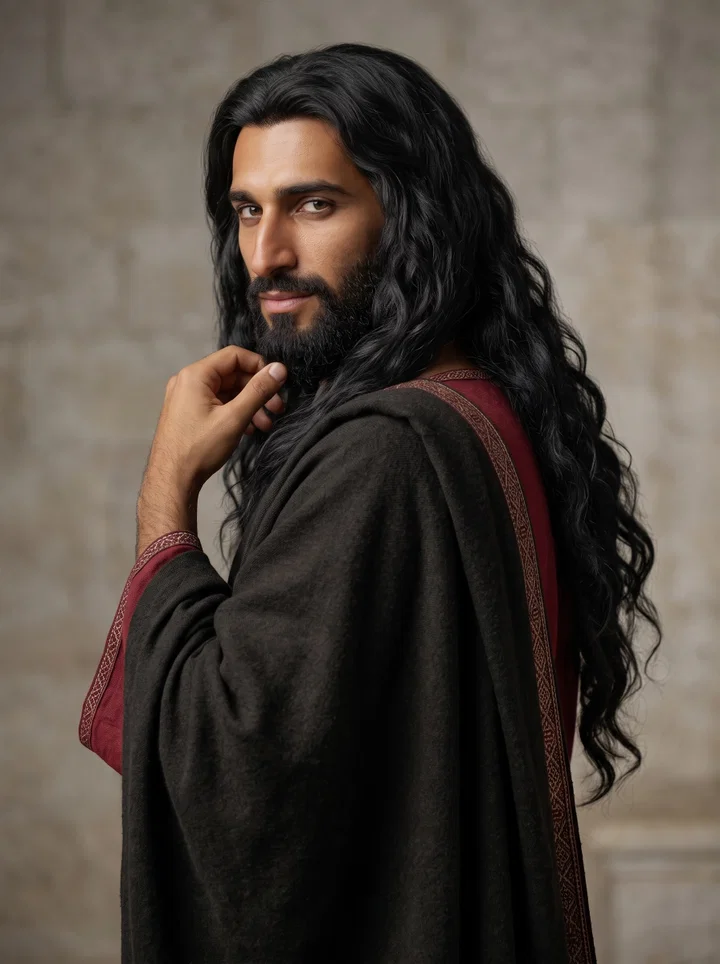
And when he polled his head, (for it was at every year’s end that he polled it: because the hair was heavy on him, therefore he polled it:) he weighed the hair of his head at two hundred shekels after the king’s weight.
Translations
American King James Version, King James Version, KJV Cambridge Paragraph Bible
And when he polled his head, (for it was at every year’s end that he polled it: because the hair was heavy on him, therefore he polled it:) he weighed the hair of his head at two hundred shekels after the king’s weight.
And when he polled his head, (for it was at every year's end that he polled it: because the hair was heavy on him, therefore he polled it:) he weighed the hair of his head at two hundred shekels after the king's weight.
And when he polled his head, ( now it was at every year’s end that he polled it: because the hair was heavy on him, therefore he polled it:) he weighed the hair of his head at two hundred shekels, after the king’s weight.
And when he cut the hair of his head ( now it was at every year’s end that he cut it; because it was heavy on him, therefore he cut it); he weighed the hair of his head at two hundred shekels, after the king’s weight.
and in his polling his head — and it hath been at the end of year by year that he polleth [it], for it [is] heavy on him, and he hath polled it — he hath even weighed out the hair of his head — two hundred shekels by the king's weight.
And when he shaved his head ( for it was at every year's end that he shaved it, because it was heavy on him, therefore he shaved it), he weighed the hair of his head at two hundred shekels after the king's weight.
And when he polled his head—and it was at every year’s end that he used to poll it, because it was heavy upon him, therefore he used to poll it—he would weigh the hair of his head, two hundred shekels, by the royal standard.
Berean Standard Bible, Majority Standard Bible
And when he cut the hair of his head— he shaved it every year because his hair got so heavy— he would weigh it out to be two hundred shekels, according to the royal standard.
When he cut the hair of his head ( now it was at every year’s end that he cut it; because it was heavy on him, therefore he cut it), he weighed the hair of his head at two hundred shekels, after the king’s weight.
And when he had his hair cut, ( which he did at the end of every year, because of the weight of his hair;) the weight of the hair was two hundred shekels by the king's weight.
And when he polled his head, (for at euery yeeres ende he polled it: because it was too heauie for him, therefore he polled it) he weyghed the heare of his head at two hundreth shekels by the Kings weight.
Douay-Rheims (Challoner revision)
And when he polled his hair ( now he was polled once a year, because his hair was burdensome to him) he weighed the hair of his head at two hundred sicles, according to the common weight.
Pictures
Cross-references
- 2 Samuel 18:9
And Absalom met the servants of David. And Absalom rode upon a mule, and the mule went under the thick boughs of a great oak, and his head caught hold of the oak, and he was taken up between the heaven and the earth; and the mule that was under him went away.
Absalom’s hair catches in an oak, leaving him suspended while fleeing.
- 2 Samuel 15:1-6
And it came to pass after this, that Absalom prepared him chariots and horses, and fifty men to run before him.
Absalom’s striking appearance supports his princely display as he wins the people’s favor and undermines David’s rule.
- 2 Samuel 13
And it came to pass after this, that Absalom the son of David had a fair sister, whose name was Tamar; and Amnon the son of David loved her.
The account of Amnon and Tamar recounts later sorrows following David’s wrongdoing.
- 2 Samuel 18:14-17
Then said Joab, I may not tarry thus with thee. And he took three darts in his hand, and thrust them through the heart of Absalom, while he was yet alive in the midst of the oak.
Joab kills Absalom, whose body is buried under stones.
- Numbers 6:5
All the days of the vow of his separation there shall no razor come upon his head: until the days be fulfilled, in the which he separateth himself unto the LORD, he shall be holy, and shall let the locks of the hair of his head grow.
The Nazarite vow required letting the hair grow without a razor.
- Judges 13:5
For, lo, thou shalt conceive, and bear a son; and no razor shall come on his head: for the child shall be a Nazarite unto God from the womb: and he shall begin to deliver Israel out of the hand of the Philistines.
Samson is instructed not to cut his hair as a Nazarite.
Commentary
Each commentary is drawn from primary sources: the writings of Ellen G. White and Adventist pioneers and periodicals. Each commentary is separate. Its own words are not a quotation; follow the references to read the source passages.
Ellen G. White
1 source
Absalom was celebrated for exceptional physical beauty that made him the pride of Israel.PP 743.2 His luxuriant hair, shorn at each year's end because its heaviness burdened him, weighed two hundred shekels by the king's standard.PP 743.2 That princely life ended in shame with his death in the rebellion he led.PP 743.2
Sources
Pioneers and periodicals
11 sources
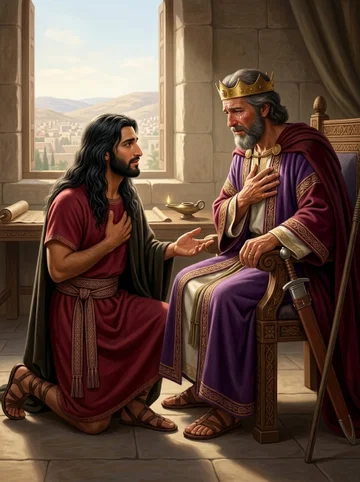
The verse stands in 2 Samuel, which covers almost the entire reign of David over all Israel, with the passage itself falling in chapters 14-16.ST Apr 18, 1911 The two books of Samuel are one in the Hebrew, named from the prominence of Samuel in the first part.ST Apr 18, 1911 The book was not written by Samuel but was drawn from the books of Samuel and Nathan and Gad the seers, records of the kingdom kept by scribes and secretaries, and the poetry and songs of the nation, written by one like the faithful Nathan or Gad who tells the whole truth without fear or favor.ST Apr 18, 1911 The verse belongs to the history in 2 Samuel 11-24 and 1 Kings 1-2 that records the judgments that came upon David after his great wickedness in the case of Uriah, showing how completely Nathan's terrible denunciation was accomplished, with the transgression openly recorded and not covered up or excused, and David's own humble confession also placed on record for all future time.RH Oct 12, 1869 The verse stands in the history of David's heavy disgrace and sorrow on account of his sons Amnon and Absalom, including his fleeing from Jerusalem, his war against Absalom, his victory over Absalom and his return to Jerusalem.ST Apr 14, 1909 It belongs with the lesson of the awful evil of a multiplicity of wives, to which all the miseries that came upon David may be traced largely.ST Apr 14, 1909
The verse belongs to the inspired history of the reign of David, showing the difficulties he encountered and the sad consequences of his many wives and of sons he was unable to control, including Absalom's rebellion against him and the death of the petted idol of the kingdom, told with detailed faithfulness that stamps the whole account with inspiration and shows that God does not hide the sins of the greatest of kings.ST May 6, 1913 The verse presents Absalom as of very striking and commanding appearance, a graceful youth of finely featured face and broad tress-topped brow, without spot or blemish from head to sandaled soles, at home on costly carpets of the court.ST Feb 20, 1912ST Aug 6, 1896 His noble appearance and personal qualities helped him win people's hearts as he undermined David's authority and pursued the throne, using that appearance to draw attention to himself by a display of princely pomp as he began working against his father.ST Dec 30, 1913ST Aug 6, 1896
The word poll in the verse means to lop or cut off the hair, from the French polle, a use of the word now obsolete. The verse records that Absalom wore long, unusually heavy and abundant hair, which he cut off once each year, at every year's end, because it was heavy on him and became burdensome.RH Jul 4, 1871STST May 17, 1910 The verse gives the weight of the hair of his head when polled as two hundred shekels after the king's weight, by the king's standard.RH Jul 4, 1871STST Jul 15, 1908ST May 17, 1910 Using a shekel of about three fifths of an avoirdupois ounce, the two hundred shekels comes to 120 ounces, or about seven and a half pounds.ST Jul 15, 1908
His hair was a source of pride and the ornament he gloried in, and his beauty sealed his doom.RH Jul 4, 1871ST Feb 20, 1912 The ornament he gloried in became connected with his death when his head caught in tree branches during battle, so that his heavy hair became as a halter that left him dangling from an oak tree's knotted bough between earth and sky, and his broad breast gave ample room for whizzing angry arrows to gorge till he died, proving that false furrows men plow often lead to a fatal halting-place.RH Jul 4, 1871ST Feb 20, 1912 No reproof is recorded in the verse for his wearing long hair.ST His abundant hair did not mean that men were expected to wear long hair.ST May 17, 1910
Sources