2 Samuel 15:28
See, I will tarry in the plain of the wilderness, until there come word from you to certify me.
Translations
American King James Version, King James Version, KJV Cambridge Paragraph Bible
See, I will tarry in the plain of the wilderness, until there come word from you to certify me.
See, I will tarry in the plain of the wilderness, until word shall come from you to certify me.
Revised Version, American Standard Version
See, I will tarry at the fords of the wilderness, until there come word from you to certify me.
see ye, I am tarrying in the plains of the wilderness till the coming in of a word from you to declare to me.'
See, I will stop in the plains of the desert, until there come word from you to inform me.
See! I, am tarrying in the waste plains of the wilderness—until there come word from you, to tell me.
Berean Standard Bible, Majority Standard Bible
See, I will wait at the fords of the wilderness until word comes from you to inform me.”
Behold, I will stay at the fords of the wilderness until word comes from you to inform me.”
See, I will be waiting at the way across the river, in the waste land, till I get news from you.
Behold, I wil tarie in the fieldes of the wildernesse, vntill there come some worde from you to be tolde me.
Douay-Rheims (Challoner revision)
Behold I will lie hid in the plains of the wilderness, till there come word from you to certify me.
Pictures
Cross-references
- 2 Samuel 15:1-18
And it came to pass after this, that Absalom prepared him chariots and horses, and fifty men to run before him.
Absalom’s rebellion is named as part of David’s retribution.
- 2 Samuel 19
And it was told Joab, Behold, the king weepeth and mourneth for Absalom.
The cited history through chapter 19 continues the account of David’s troubles.
Commentary
Each commentary is drawn from primary sources: the writings of Ellen G. White and Adventist pioneers and periodicals. Each commentary is separate. Its own words are not a quotation; follow the references to read the source passages.
Ellen G. White
2 sources
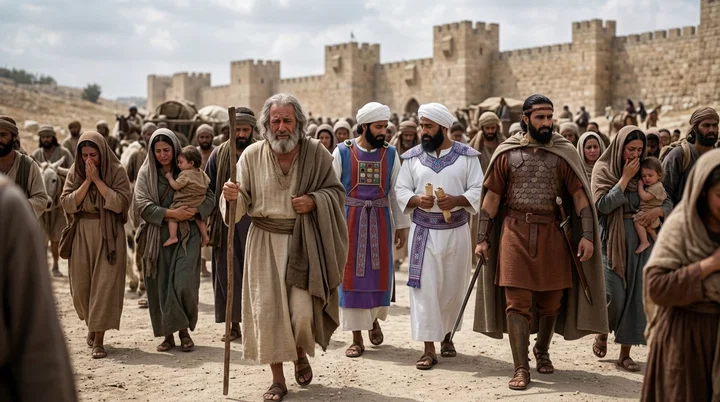
While fleeing Absalom, after commanding Zadok to carry the ark of God back into the city, David declares he will tarry in the plain of the wilderness without advancing until word comes from the priests to certify him.Lt 6, 1880, par. 14–17PP 735.1–3 He addresses Zadok as a seer appointed to instruct the people and tells him to return into the city in peace with Ahimaaz and Jonathan, the sons of Zadok and Abiathar.PP 735.1–3 The waiting arrangement provides secret communication with Jerusalem, so the priests remaining in the city can learn the movements and purposes of the rebels and secretly report them to the king through their sons.PP 735.1–3
In sending the sacred chest back to be placed in the tabernacle of Zion rather than gathering everything to build up his sinking fortunes and secure his safety, he refuses to take the ark with him as a charm to preserve his kingly honor and life or to rally Israel and win back the disaffected, though with that symbol of God's presence and of Israel's strength he could greatly improve his situation.Lt 6, 1880, par. 14–17 His reverence and respect for the ark will not allow it to be imperiled by the vicissitudes of his hasty flight.Lt 6, 1880, par. 14–17 His high sense of right and of sacred things holds that kings and priests have no right to remove the ark from its place of rest without a divine command and that the city must not be robbed of the symbol that gives it the name Mount of Holiness.Lt 6, 1880, par. 14–17
His action shows unselfish and noble resolve in overwhelming affliction, because he views his humiliation as from the Lord and not merely the work of man's device.Lt 6, 1880, par. 14–17 He submits himself to whether he shall find favor to be brought again to see the ark and God's habitation or be left to God's judgment as seeming good to Him.Lt 6, 1880, par. 14–17
Sources
Pioneers and periodicals
10 sources
The verse belongs to the history of David's reign during Absalom's rebellion, when in fear David fled Jerusalem from Absalom after Absalom turned Israel against him, amid persecution, treachery, difficulties and bitterness before his eventual return to Jerusalem.ST May 6, 1913ST Apr 29, 1908ST Mar 31, 1881RH Aug 17, 1911ST Mar 16, 1915 It stands within the troubles in David's family told in chapters 13 to 20, including his pathetic journey that touched the hearts of his old friends.ST May 6, 1913ST Apr 29, 1908 The verse records David waiting in the plain of the wilderness for word from the priests and supporters to certify and confirm what was happening in Jerusalem, while enduring hardship and uncertainty.ST Jun 18, 1885ST Oct 4, 1877ST Oct 27, 1898 The flight includes David crossing the Kidron in bitterness, grief and under threat.RH Aug 17, 1911ST Mar 16, 1915
The account involves Abiathar, descended from Eli, who cared for the ark at Jerusalem, and Zadok, descended from Aaron through Eleazar, who served at the tabernacle in Gibeon.ST Sep 18, 1884 After Solomon became king he removed Abiathar from Jerusalem and put Zadok in his place.ST Sep 18, 1884 The family troubles grew out of David multiplying wives to himself, resulting in a large family of children by different wives in which idleness, luxury, jealousy, enmity and rivalry developed unenviable and divided characters, so that he could not be present as a father to his household.ST Apr 29, 1908ST Oct 27, 1898 The troubles revolve around the beautiful Absalom, a shrewd and handsome prince whose ambitions were roused by fulsome flattery, with the base conduct of Absalom, the treachery of Ahithophel and the cursing of Shimei.ST Apr 29, 1908 They ended in the defeat of Absalom, a pathetic journey by David that touched the hearts of his old friends, and the sorrow and humiliation of a father over his wicked son's fate.ST Apr 29, 1908ST Oct 27, 1898
Absalom's rebellion and David's flight are part of the retribution David suffered for his wrong against Uriah, especially through troubles in his own family, and they came upon him as consequences of his sin despite his pardon.ST Mar 31, 1881RH Mar 10, 1868 The verse teaches that no one can walk contrary to God's laws without suffering, for in every transgression of divine law lies the inherent curse even when God does not openly reprove and seems to wink at blindness.ST Apr 29, 1908 David's flight was one of the trials that disciplined and softened his character.ST Oct 4, 1877 David's flight across the Kidron in grief and sorrow is a type and parallel of Jesus leaving Jerusalem in sorrow and crossing the same stream to Gethsemane before his betrayal, where he faced betrayal and the cross.RH Aug 17, 1911ST Mar 16, 1915
Sources