2 Samuel 21:16
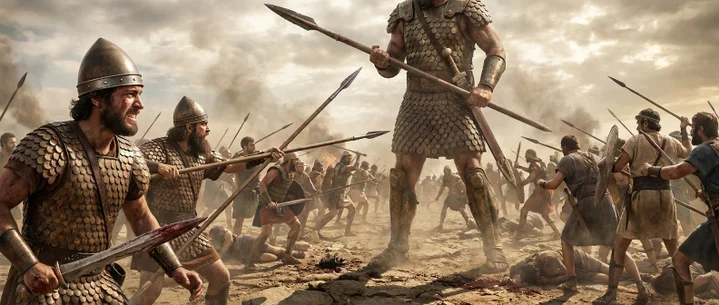
And Ishbi-benob, which was of the sons of the giant, the weight of whose spear weighed three hundred shekels of brass in weight, he being girded with a new sword, thought to have slain David.
Translations
And Ishbibenob, which was of the sons of the giant, the weight of whose spear weighed three hundred shekels of brass in weight, he being girded with a new sword, thought to have slain David.
King James Version, KJV Cambridge Paragraph Bible
And Ishbi-benob, which was of the sons of the giant, the weight of whose spear weighed three hundred shekels of brass in weight, he being girded with a new sword, thought to have slain David.
And Ishbi-benob, who was of the sons of the giant, the weight of whose spear was three hundred shekels of brass in weight, he being girded with a new sword, thought to have slain David.
and Ishbi-benob, which was of the sons of the giant, the weight of whose spear was three hundred shekels of brass in weight, he being girded with a new sword, thought to have slain David.
and Ishbi-benob, who was of the sons of the giant, the weight of whose spear was three hundred shekels of brass in weight, he being girded with a new sword, thought to have slain David.
and Ishbi-Benob, who [is] among the children of the giant — the weight of his spear [is] three hundred [shekels] weight of brass, and he is girded with a new one — speaketh of smiting David,
And Ishbibenob, who was of the children of Raphah — the weight of his lance was three hundred shekels of bronze, and he was girded with new [armour] — thought to smite David.
So, Ishbi-benob, who was of the descendants of the giant, the weight of whose spear-head, was three hundred shekels of bronze, he also being newly armed, thought to smite David;
Berean Standard Bible, Majority Standard Bible
Then Ishbi-benob, a descendant of Rapha, whose bronze spear weighed three hundred shekels and who was bearing a new sword, resolved to kill David.
and Ishbibenob, who was of the sons of the giant, the weight of whose spear was three hundred shekels of bronze in weight, he being armed with a new sword, thought he would kill David.
And there came against David one of the offspring of the Rephaim, whose spear was three hundred shekels of brass in weight, and having a new sword, he made an attempt to put David to death.
Then Ishi-benob which was of the sonnes of Haraphah (the head of whose speare wayed three hundreth shekels of brasse) euen he being girded with a newe sword, thought to haue slaine Dauid.
Douay-Rheims (Challoner revision)
Jesbibenob, who was of the race of Arapha, the iron of whose spear weighed three hundred ounces, being girded with a new sword, attempted to kill David.
Pictures
Commentary
Each commentary is drawn from primary sources: the writings of Ellen G. White and Adventist pioneers and periodicals. Each commentary is separate. Its own words are not a quotation; follow the references to read the source passages.
Pioneers and periodicals
4 sources
The account belongs to the later history of David, set in a record of victories won by David and his men.ST Apr 29, 1908RH Oct 12, 1869 It stands among the judgments that followed David's great transgression, fulfilling the prophetic denunciation spoken by Nathan.RH Oct 12, 1869 The surrounding chapter shows that God holds His people collectively responsible when many allow the transgressions of a few to continue.ST Apr 29, 1908 It also illustrates God's opposition to oppression, even oppression against people outside the household of faith.RH Jul 30, 1908 Here David still wanted to go into battle when it was no longer prudent for him to do so, while his associates recognized the danger and exposed themselves to protect him.RH Aug 15, 1912
Sources