Translations
American King James Version, King James Version, KJV Cambridge Paragraph Bible
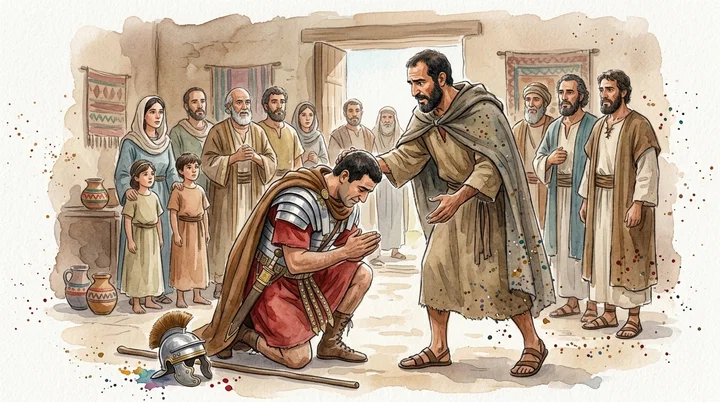
But Peter took him up, saying, Stand up; I myself also am a man.
But Peter took him up, saying, Stand up: I myself also am a man.
Revised Version, American Standard Version
But Peter raised him up, saying, Stand up; I myself also am a man.
and Peter raised him, saying, 'Stand up; I also myself am a man;'
But Peter made him rise, saying, Rise up: I myself also am a man.
But, Peter, raised him up, saying—Arise! I also myself, am, a man.
Berean Standard Bible, Majority Standard Bible
But Peter helped him up. “ Stand up,” he said, “ I am only a man myself.”
But Peter raised him up, saying, “ Stand up! I myself am also a man.”
But Peter, lifting him up, said, Get up, for I am a man as you are.
But Peter tooke him vp, saying, Stand vp: for euen I my selfe am a man.
Douay-Rheims (Challoner revision)
But Peter lifted him up, saying: Arise, I myself also am a man.
Pictures
Cross-references
- Acts 10:34-35
Then Peter opened his mouth, and said, Of a truth I perceive that God is no respecter of persons:
God shows no partiality, accepting in every nation those who fear him and do what is right.
- Acts 10:1-6
There was a certain man in Cæsarea called Cornelius, a centurion of the band called the Italian band,
An angel directs devout Cornelius to seek Peter’s instruction.
- Acts 14:15
And saying, Sirs, why do ye these things? We also are men of like passions with you, and preach unto you that ye should turn from these vanities unto the living God, which made heaven, and earth, and the sea, and all things that are therein:
Paul and Barnabas likewise reject worship, saying they are human.
- Acts 15:7
And when there had been much disputing, Peter rose up, and said unto them, Men and brethren, ye know how that a good while ago God made choice among us, that the Gentiles by my mouth should hear the word of the gospel, and believe.
Peter recalls that Gentiles heard and believed the gospel through his preaching.
- Revelation 19:10
And I fell at his feet to worship him. And he said unto me, See thou do it not: I am thy fellowservant, and of thy brethren that have the testimony of Jesus: worship God: for the testimony of Jesus is the spirit of prophecy.
The angel refuses worship and directs it to God.
- Acts 11:1-18
And the apostles and brethren that were in Judæa heard that the Gentiles had also received the word of God.
Peter recounts God’s direction to the Gentiles, and the church accepts their inclusion.
- Acts 10:19-20
While Peter thought on the vision, the Spirit said unto him, Behold, three men seek thee.
The Spirit directs Peter to go with Cornelius’s messengers.
- Acts 10:33
Immediately therefore I sent to thee; and thou hast well done that thou art come. Now therefore are we all here present before God, to hear all things that are commanded thee of God.
Cornelius gathers his household to hear the message God gave Peter.
- Revelation 22:9
Then saith he unto me, See thou do it not: for I am thy fellowservant, and of thy brethren the prophets, and of them which keep the sayings of this book: worship God.
The angel refuses worship and directs John to worship God.
- Acts 10:9-16
On the morrow, as they went on their journey, and drew nigh unto the city, Peter went up upon the housetop to pray about the sixth hour:
God’s vision prepares Peter to go to the Gentiles.
- Acts 10:5-6
And now send men to Joppa, and call for one Simon, whose surname is Peter:
An angel directs Cornelius to send for Peter to hear his message.
- Acts 10:44-48
While Peter yet spake these words, the Holy Ghost fell on all them which heard the word.
Recounts the gospel reaching Cornelius and his household.
- Acts 12:22-23
And the people gave a shout, saying, It is the voice of a god, and not of a man.
Herod accepts divine honors, unlike Peter, who refuses them.
- Galatians 3:28
There is neither Jew nor Greek, there is neither bond nor free, there is neither male nor female: for ye are all one in Christ Jesus.
Believers are one in Christ regardless of Jewish or Gentile status.
Commentary
Each commentary is drawn from primary sources: the writings of Ellen G. White and Adventist pioneers and periodicals. Each commentary is separate. Its own words are not a quotation; follow the references to read the source passages.
Ellen G. White
46 sources
When Cornelius fell at his feet in worship as one sent from heaven, Peter lifted him up and refused such reverence as belonging to God alone and not to any human messenger.Ms 67, 1900, par. 17–22Ms 116, 1903, par. 8–14Ms 1, 1908, par. 5–14Lt 144, 1902, par. 18–21Ms 96, 1893, par. 10–12 He presented himself only as a fellow man, erring and fallible, claiming no divine authority or right to be venerated.Ms 171, 1905, par. 213SP 330.1AC1 62.1–2 The meeting at Caesarea opened the gospel to the Gentiles, showing that God is no respecter of persons but accepts in every nation him that fears Him and works righteousness.Ms 116, 1903, par. 8–14Lt 51, 1902, par. 9–12RH Apr 13, 1911ST May 15, 1879Lt 17, 1900, par. 5–6 Though an angel appeared to Cornelius, he did not preach the gospel to him, because God works through chosen human agents to bring light to those seeking truth.Ms 171, 1903, par. 16–17Lt 191, 1905, par. 16–17Ms 43c, 1901, par. 22–236MR 311.3–312.1Ms 43b, 1901, par. 39–41 In this heaven and earth were united, with heavenly agencies cooperating with human instruments to overcome prejudice and carry grace to a heathen city.Ms 171, 1905, par. 21Ms 17, 1908, par. 29Lt 17, 1900, par. 5–66MR 328.3–329.1Lt 144, 1902, par. 22–23
Event and Its Meaning
When Cornelius met Peter he fell down at his feet in worship and veneration, regarding him not as an ordinary visitor but as one honored of heaven and sent by God.Ms 116, 1903, par. 8–14Ms 1, 1908, par. 5–14AC1 62.1–2ST Feb 28, 1884 Peter took him up, lifted him to his feet, raising him and declaring, stand up, for he himself also was a man, a human being like Cornelius and only a man.Ms 116, 1903, par. 8–14Ms 1, 1908, par. 5–14Lt 144, 1902, par. 18–21Ms 96, 1893, par. 10–123SP 330.1 He shrank with horror from that veneration and checked rather than encouraged it.3SP 330.1ST Feb 28, 1884
Peter then spoke with Cornelius familiarly in order to remove his awe and extreme reverence and to ease the reverence with which Cornelius regarded him.AC1 62.1–2ST May 15, 18793SP 329.1–2RH Apr 13, 1911ST Feb 28, 1884 The refusal means that reverence and worship belong to God, not to human messengers.Lt 144, 1902, par. 18–21AA 137.3–138.3 Even when a messenger is sent by God as a gospel teacher to bring further knowledge of Christ, he is only a human being and must not be worshiped, though people should receive the help and instruction God gives through them.Ms 67, 1900, par. 17–22Ms 96, 1893, par. 10–12AA 137.3–138.33SP 329.1–2
Peter presented himself as only a fellow man with Cornelius, standing with him on the same level.Ms 171, 1905, par. 21Lt 197, 1904, par. 5–8 He claimed no exalted divine authority and no special authority making him worthy of such homage, no right to be revered as divine or to be given the authority of a ruler, but confessed himself an erring and fallible man.3SP 330.1AC1 62.1–2ST May 15, 18797RED 61.2–62.2 His checking of veneration contrasts with the later practice of those claiming to be his successors, his so-called successors, in requiring kings and emperors to bow before them and bow at their feet.AC1 62.1–27RED 61.2–62.2ST Feb 28, 1884
Gospel Opened to Gentiles
The words belong to the meeting at Caesarea, after Peter was commanded to go to the Gentiles and Cornelius told of the vision directing him to send for Peter, when God was dealing with Peter as he was about to preach to the Gentiles.EW 67.2RH Apr 13, 1911GC88 328.1 That encounter opened the church's work among the Gentiles and marked the extension of the gospel beyond the chosen people.RH Apr 13, 1911GC88 328.1 Cornelius's conversion became the first major conversion among the Gentiles, only the firstfruits of a harvest to be gathered from the world.ST May 15, 1879Lt 17, 1900, par. 5–66MR 328.3–329.1Ms 87, 1907, par. 17–18
God was carefully overcoming prejudice against Gentiles fixed in Peter and the disciples by all their Jewish training and by rabbinical ideas of separation.Ms 116, 1903, par. 8–14Ms 126, 1902, par. 21–22 Though Christ's death had broken down the barrier that kept Gentiles from the privileges of the gospel, it still persisted in the apostles' minds.ST May 15, 1879 He was teaching them not to belittle those who had had no opportunity of hearing the truth and not to call any man common or unclean.Ms 116, 1903, par. 8–14Ms 126, 1902, par. 21–22
Peter undertook the duty laid on him by divine command with reluctance at every step, treating it as an exception done because of divine revelation rather than on general principle, and the result was a great surprise to him.Lt 17, 1900, par. 5–66MR 328.3–329.1Ms 87, 1907, par. 17–18 The disciples had been called first to Judea and then to Samaria and the uttermost parts of the earth to preach to every creature, yet they lingered in and near Jerusalem among church members instead of going into all the world, until persecution scattered them to work earnestly for the salvation of the Gentiles.Ms 126, 1902, par. 21–22 From that scattering and leading came the divinely guided opening of the gospel to Cornelius, a God-fearing centurion.Ms 126, 1902, par. 21–22GC88 328.1
The verse teaches that God is no respecter of persons, but in every nation accepts him that fears Him and works righteousness.Ms 116, 1903, par. 8–14Lt 51, 1902, par. 9–126MR 328.3–329.1Ms 87, 1907, par. 17–18 Its setting marks a new phase for the Christian church, in which Gentiles who accepted the gospel were to share its blessings equally with Jewish believers as fellow citizens, without having to be circumcised.Lt 51, 1902, par. 9–12RH Apr 13, 1911Ms 160, 1898, par. 32–34 That mission breaks down prejudice and shows that God teaches and uses those willing to yield their own ideas.Ms 160, 1898, par. 32–34
From the household of Cornelius a widespread work of grace was carried on in a heathen city, showing that earnest work will bring light to honest souls seeking truth even among those opposed to God's message.Lt 17, 1900, par. 5–66MR 328.3–329.1Ms 87, 1907, par. 17–18 The account stands as an example of visions correcting those who err from Bible truth, not providing a new rule of faith.EW 67.2
Heaven and Human Cooperation
Cornelius was devout in piety, prayers and alms, and what he offered under all the light he had received and improved was remembered, accepted and commended as far as his knowledge went.Ms 171, 1905, par. 21Ms 171, 1903, par. 16–17Lt 20a, 1893, par. 48–49 Having believed God's Word promising a Messiah, he now had to receive its fulfillment and obtain an advance in faith and a new experience to do his work intelligently through Jesus Christ.Ms 171, 1905, par. 21 Neither prayer nor almsgiving can take the place of Christ Jesus, in whom all fullness dwells and in whom alone Jews and Gentiles by faith are joined to Christ and made complete.Ms 171, 1905, par. 21
Though an angel appeared to Cornelius, and instruction is often given to men by immortal messengers who act as powerful helpers of chosen messengers, the angel did not preach the gospel message to him.Ms 171, 1903, par. 16–17Lt 191, 1905, par. 16–17Ms 43d, 1901, par. 40 God's plan was to send chosen human messengers to people needing enlightenment and to bring Gentiles into connection with the gospel.Ms 171, 1903, par. 16–17Ms 43c, 1901, par. 22–23 The angel could have told Cornelius the whole message directly, but that is not God's way.Ms 43c, 1901, par. 22–236MR 311.3–312.1Ms 43b, 1901, par. 39–41Ms 43d, 1901, par. 40Ms 43a, 1901, par. 39–40
God knew every person by name and just where they live, the spirit they possess and every act of life, and He knew just where Peter was lodging with Simon a tanner by the seaside at Joppa.Ms 43c, 1901, par. 22–236MR 311.3–312.1Lt 20a, 1893, par. 48–49 He told Cornelius every particular with direction to send men to Joppa to call Simon Peter to tell what ought to be done, working out every detail.Ms 43c, 1901, par. 22–23Lt 20a, 1893, par. 48–49Ms 43d, 1901, par. 40Ms 43a, 1901, par. 39–40 He deliberately required this connection so that the light and truth He had given to Peter would be imparted by Peter to Cornelius and all his family, because His church must connect together and He works through human agents bringing truth to one another.Ms 43c, 1901, par. 22–236MR 311.3–312.1Ms 43b, 1901, par. 39–41Ms 43d, 1901, par. 40Ms 43a, 1901, par. 39–40
Heaven and earth are united in the work, with the agencies of heaven ever ready to cooperate with human agencies in working out God's simple plans.Ms 171, 1905, par. 21Lt 144, 1902, par. 22–23 Heaven is much nearer to the Christian engaged in soul-saving than many suppose, as shown in another instance of the ministration of heavenly angels resulting in the conversion of Cornelius and his company.Ms 171, 1905, par. 21Ms 17, 1908, par. 29 Peter stood with Cornelius as a fellow man appointed to become the human instrument in the hands of heavenly agencies, and in the transaction more than one man was converted, for Peter himself was put on the housetop in prayer to receive the truth of God's purpose to the Gentiles and the taking away of barriers between Jew and Gentile, so that the man of influence could accomplish a great work in connection with believers in Jesus Christ.Ms 171, 1905, par. 21 The account shows God's regard for every human being, and that each should treat his fellow man as one of the Lord's instrumentalities for accomplishing His work in the earth, with God sending people to serve as His representatives among those who need divine help and guidance, as seen when Peter was sent to the Roman centurion.Ms 17, 1908, par. 29MH 472.4–473.1
Instruction for Gospel Workers
The meeting at Caesarea where the Lord worked for one who feared His name shows how God works on human minds, with His arm breaking the power of oppression and tyranny and scattering the dark clouds of ignorance and superstition.Ms 1, 1908, par. 5–145MR 212.2–314MR 137.2–3 That instruction in Acts 10:1-35 is to be read and prayed over until understanding is opened, so that workers will begin earnestly to labor for souls in their home field.Ms 1, 1908, par. 5–145MR 212.2–314MR 137.2–3 Unless God's people arouse to home mission duties they will be found wanting in the day of God.Ms 1, 1908, par. 5–145MR 212.2–314MR 137.2–3
In every age God brings honest hearts into connection with those of His people who can best reach their individual needs, using different servants fitted by special knowledge and training to help different classes of inquirers.6MR 328.3–329.1Ms 87, 1907, par. 17–18 Workers should therefore be ready to make personal efforts for those who have not received the whole truth yet are serving God with sincere, earnest purpose and walking in all the light they have received.Lt 144, 1902, par. 22–23 There are many in the world like Cornelius, souls much nearer the kingdom of heaven than is supposed and precious jewels in this dark world of sin to whom God will guide His servants, and this gives courage for the work.Lt 144, 1902, par. 22–23 Cornelius is among those who longed and prayed for light from heaven and received Christ gladly when He was revealed, and his story reveals God's care for those seeking truth.6T 79.2–3COL 116.1
Cornelius, a Roman officer in high position who lived according to the light he had received, illustrates the devout, God-fearing men of nobility and influence for whom God is working, to give them advanced light through angels and through connection with men of superior knowledge of His Word.6T 79.2–3Lt 197, 1904, par. 5–8AA 139.4–140.1 They are to be made true witnesses to take the place of those who had Bible truth and disappointed Christ.Lt 197, 1904, par. 5–8 Men like Cornelius are stewards in trust who bear responsibilities and face the temptations that come with positions of stewardship, whose sympathies are with the truth but who are held in the world by binding threads and lack moral courage to take their position.Lt 4, 1900, par. 5–7 They need special care and special, determined effort because of the responsibilities they bear, and laboring for them is often a heavier cross than letting sympathy go out to the poorer and more lowly ones.Lt 4, 1900, par. 5–7
God's messengers must not be exalted as divine, even while people should receive the help and instruction God gives through them, and they must not accept flattery or let men be exalted as gods.Ms 96, 1893, par. 10–12Lt 197, 1904, par. 5–8 The work for these new witnesses will succeed only if unconsecrated workers do not spoil them by flattery and exalting them, but follow Peter in keeping them standing in integrity before God alone.Lt 197, 1904, par. 5–8 Cornelius shows the kind of man the Lord now calls for, a man taught by God, for mere lifelong profession does not make a true man sanctified and ennobled through the truth.Lt 197, 1904, par. 15 Those who have lost spiritual discernment and are right in their own eyes and wise in their own sight build upon sand, and when the tempest comes the house will be swept away because the foundation was not built upon the solid rock.Lt 197, 1904, par. 15 The same leading will happen in the last days, when many will prize the wisdom of God above any earthly advantage and obey the Word of God as the supreme standard, and being led to great light and knowledge of the truth, those who receive it will seek to set it before anxious acquaintances and thus become conscientious lightbearers who, constrained by the love of God, constrain others and improve every opportunity to invite and urge others to see its beauty and give their abilities to advance God's work.Ms 97, 1898, par. 16
Sources
Pioneers and periodicals
76 sources
Peter refused the worship Cornelius offered at his feet, lifted him up and told him to stand because he himself was only a man and a human being like Cornelius.ST Feb 28, 1884RH Nov 16, 1916ST Oct 21, 1897ST Mar 25, 1897 No person is to be treated as divine or worshiped, for such reverence and homage belong to God alone and not to any fellow servant or religious leader.ST Oct 21, 1897ST Mar 25, 1897ST Aug 13, 1874ST Feb 27, 1912 Peter was on a par with his fellow disciples and not above them as a pope, claiming no special authority that made him worthy of homage but declaring himself an erring and fallible man.ST May 15, 1879ST Feb 28, 1884ST Nov 4, 1930ST Oct 21, 1897ST Mar 20, 1884 The refusal belongs to his first preaching of the gospel to the Gentiles, when he used the keys of the kingdom to open the door of faith to them as he had to the Jews at Pentecost.ST Jul 24, 1907ST May 14, 1902ST Jul 5, 1910 God sent Cornelius to Peter rather than letting the angel tell him the way of life, showing that he uses human agents to preach his word while angels cooperate from above.ST Sep 30, 1908
Peter's Refusal and Words
Peter refused the reverence and worship Cornelius offered him, raised him up and told him to stand.RH Nov 16, 1916ST Oct 21, 1897ST Mar 25, 1897RH Jan 23, 1908ST Dec 1, 1909 He declared that he himself also was a man, only a human being like Cornelius, not divine and not to be worshiped.RH Nov 16, 1916ST Oct 21, 1897ST Mar 25, 1897ST Nov 15, 1899ST Dec 1, 1909 He refused to be treated as more than human and refused the honor given him, making clear he was not its source and not its object.RH Nov 16, 1916ST Mar 25, 1897RH Jan 23, 1908ST Nov 15, 1899ST Dec 1, 1909 As God's human messenger the glory for the work done through him belonged to God, for apostles are human ministers and not objects of exaltation.ST Nov 15, 1899ST Dec 1, 1909
Cornelius had fallen at Peter's feet and worshiped him because he regarded him not as an ordinary visitor but as one honored of heaven and sent by God.ST Feb 28, 1884 From that veneration Peter shrank with horror, lifting Cornelius to his feet and declaring his own mere humanity.ST Feb 28, 1884
Having raised him, Peter spoke with him familiarly in order to dispel his excessive awe and remove his extreme reverence.ST Apr 20, 1904ST May 15, 1879RH Apr 13, 1911ST Feb 28, 1884 He rejected the worship, reminded Cornelius that he was only a man, and then eased that awe by familiar conversation rather than by accepting exalted treatment.ST Apr 20, 1904ST May 15, 1879RH Apr 13, 1911
Setting at Caesarea
The meeting took place at Caesarea in the private home of Cornelius.RH Jul 4, 1907ST Aug 7, 1893 Caesarea was a city with a mainly Gentile population and a large admixture of Jews.ST Aug 7, 1901 There Cornelius, a devout Roman centurion, told Peter of the vision by which he had been directed to send for Peter.RH Apr 13, 1911ST Aug 7, 1901 Peter had been sent to visit that Roman centurion with the gospel, and the verse shows Peter among the believers there.RH May 2, 1907ST Aug 7, 1901 It belongs to Peter's first effort among the Gentiles and to the account of Cornelius's conversion at Caesarea.RH Jul 4, 1907ST Aug 7, 1893
It occurred about seven years after Stephen was stoned.ST It came more than seven or eight years after the commission to preach the gospel to all nations, and before the gospel was spoken to Gentiles at Antioch.ST Apr 23, 1902 It followed the expiration of the seventy weeks and the admission of the Gentiles to equal privileges with the Hebrews, as part of carrying out Christ's commission to preach to the Gentiles.RH Mar 4, 1862 The believing Romans at Caesarea marked the spread of the message beyond the Jews to other peoples.RH Jan 19, 1911 Yet with rare exceptions Christian Jews still had no burden for the salvation of any but their own race.ST Apr 23, 1902
Cornelius was praying when an angel told him to send for Peter, and Peter was found praying at noon. They kept regular seasons of prayer. God answered the prayers of Cornelius and Peter by bringing them together.RH Nov 21, 1912 In this he sent people to minister to one seeking light.RH Nov 21, 1912
Peter's vision taught him not to call any person common or unclean, for God's offer of salvation was not limited to the Jewish people.ST Oct 31, 1906ST Sep 17, 1902 Peter was unprepared to go because of Jewish prejudice, and God gave him the vision and lesson to remove it.ST Sep 17, 1902 The one lesson of the tenth chapter of Acts is that no man is to be called common or unclean.ST Sep 17, 1902 The vision did not make unclean animals fit for food and did not permit Peter to eat them.ST Oct 31, 1906ST Sep 17, 1902
The account of Peter's vision and meeting with Cornelius shows that God communicated with the church through visions after Christ's ascension.RH Jun 26, 1855 The Spirit directed Peter's mission to Cornelius by direct revelation.ST Apr 1, 1875 That directing revelation added nothing to the body of Scripture.ST Apr 1, 1875
Gospel Opened to Gentiles
This is Peter's first preaching of the gospel to the Gentiles, in carrying out Christ's commission after the expiration of the seventy weeks and the admission of Gentiles to equal privileges with Hebrews.ST May 14, 1902RH Mar 4, 1862 By it he used the keys of the kingdom of heaven to open it to them as he had opened it to the Jews on the day of Pentecost.ST May 14, 1902ST Jul 5, 1910 Together that preaching to Jews and to Gentiles in the house of Cornelius opened the door of the kingdom of heaven and the door of faith to both.ST Jul 5, 1910ST Aug 26, 1880 It was the exercise of the privilege given him of opening the truths of salvation to both Jews and Gentiles so they could hear and believe.ST Jul 24, 1907ST Aug 26, 1880ST Dec 3, 1894
Through the vision and the visit Peter learned that no person is to be called common or unclean, for God shows no partiality but accepts from every nation those who fear him and do what is right.ST Sep 17, 1902RH Oct 21, 1851ST Jul 15, 1886 God's love is not confined to one race, and the gospel and other aid are to be offered equally to people of every nation and condition, with no person treated as spiritually superior or as unclean and inferior on account of people or background.RH Apr 21, 1851RH Oct 21, 1851ST Jul 15, 1886 Gentiles who accepted the gospel were to share its blessings equally with Jewish believers without having to be circumcised, for God regards differences of character rather than nationality or religious distinction.RH Apr 13, 1911ST Oct 7, 1875 Peter's words treat Cornelius as a fellow human being, refusing reverence because he himself is only a man.RH Apr 21, 1851ST Mar 23, 1904ST Oct 7, 1875
Although Christ's death had broken down the barrier that kept Gentiles from gospel privileges, it persisted in the apostles' minds, and with rare exceptions Christian Jews still had no burden for the salvation of any but their own race.ST May 15, 1879ST Apr 23, 1902 Peter was unprepared to go because of Jewish prejudice, and God gave him the vision and lesson to remove it, astonishing him that God would save a Gentile.ST Sep 17, 1902ST Jul 29, 1913 The one lesson of the tenth chapter of Acts is not permission to eat any kind of meat but that no man is to be called common or unclean.ST Sep 17, 1902 The gospel then worked effectively among the centurion's household and led Peter to accept their baptism.ST Jul 29, 1913
Cornelius's conversion was the first Gentile convert in the gospel record and the first major conversion among the Gentiles, marking the beginning of an important mission and the opening of the church's work among the Gentiles.RH Apr 13, 1911ST May 15, 1879RH Dec 10, 1908 He needed to hear about Christ, so Peter came and preached peace through Jesus Christ, and those who heard received the Holy Spirit and were baptized.ST Jan 20, 1887 Peter commanded water baptism after the listeners had received the Holy Spirit.ST Jan 20, 1887ST May 27, 1880 That role in opening the gospel to the Gentiles did not give him a position over the other apostles or make him greater than them or the foundation of the church, for like every believer he was a human being and a living stone built on Christ.ST May 14, 1902ST Feb 28, 1911 The greater privileges a person has received bring a greater duty to serve those who have had fewer.ST Mar 23, 1904
Human and Angelic Agency
God directed Cornelius to Peter instead of having the angel declare the way of life to him directly.ST Sep 30, 1908 Although an angel met Cornelius and Peter and the Spirit guided them both, preaching God's word belonged to Peter and not to the angel.ST Dec 1, 1909 This shows that God uses human agents to preach, with angels above cooperating with His people on earth to bring a soul to salvation.ST Sep 30, 1908ST Dec 1, 1909 The conversion itself displays an angel taking part in leading a soul to God, while Peter lifts Cornelius and identifies himself as a human being like him.ST Dec 1, 1909
Peter was God's human messenger and not the source of the message nor the source of saving and cleansing power.ST Dec 1, 1909ST Jul 22, 1913ST Mar 4, 1913 His role was to proclaim Christ's message and to tell Cornelius what to do, refusing reverence and telling him to stand because he was only a human being like Cornelius and not an object of worship nor a lord over his hearers.ST Dec 1, 1909ST Jul 22, 1913ST Mar 4, 1913 It was the gospel and not Peter as a man that opened hearts and brought belief, while the church serves as a channel for instruction to seekers after God.ST Jul 22, 1913ST Mar 6, 1884 Its work is to reveal Christ and bring salvation.ST Mar 4, 1913ST Mar 6, 1884
The Lord sent Peter to give the gospel while the Holy Spirit prepared Cornelius to receive it.ST Oct 23, 1901RH Nov 28, 1912 The account gives an example of a heart fully prepared before the gospel seed-sower was sent to sow.ST Oct 23, 1901RH Nov 28, 1912 In the same way heavenly messengers can guide workers to people who are praying and ready to receive the truth.RH Nov 28, 1912RH Dec 31, 1903 God worked under the former rain to enlighten Cornelius as a devout man searching after truth, knowing just where this honest soul was and giving special revelation from heaven to bring His servant Peter, a man who recognized the workings of the Holy Spirit, into direct communication with him.RH Dec 1, 1904 This former-rain work, much smaller than the promised latter rain when God will pour out His Spirit upon all flesh with dreams and visions, proves that He can bring His servants into direct contact with every honest soul in all the earth and thus cut the work short in righteousness in the closing hours of the last generation.RH Dec 1, 1904 Holy angels opening the way for the gospel to go to the Gentiles stands as a conspicuous example that angels are servants sent to secure salvation, showing their intense interest, watchful care, and rejoicing over the saving of sinners.RH Dec 1, 1904RH Nov 5, 1872
Peter was sent to help Cornelius, illustrating personal service by one person to another, with Peter raising him and making clear that he was a human being like Cornelius and not someone to be worshiped.RH May 4, 1911 The meeting shows that God brings sincere seekers and those able to share the truth together.RH May 4, 1911RH Jun 1, 1916 He does this by preparing hearts and opening opportunities for personal ministry.RH May 4, 1911RH Jun 1, 1916
No Worship of Man
No one is to be treated as divine or worshiped, for the homage Cornelius offered belongs to God alone and not to a fellow servant or human religious leader, and Peter refused it by raising Cornelius and telling him to stand because he himself was only a human being like him.ST Oct 21, 1897ST Mar 25, 1897ST Aug 13, 1874ST Sep 23, 1886ST Nov 18, 1913 Kneeling before a man and kissing his hand is such an act of worship that no man is entitled to receive, and the same rule condemns kneeling before the pope, since the pope also is only a man and must not accept worship.RH Jun 16, 1904 Human worship is improper even when it is offered to a religious leader, for Peter refused to accept worship or reverence as though he were more than human.ST Feb 27, 1912
Peter claimed no special authority that made him worthy of such homage but declared himself an erring and fallible man, and his experience at Joppa and Caesarea and his later conduct at Antioch show that he remained fallible.ST May 15, 1879ST Feb 28, 1884ST Mar 20, 1884 He was on a par with his fellow disciples and not above them as a pope or uniquely preeminent apostle, with no special authority belonging only to God rightly claimed for him or his successors.ST Nov 4, 1930ST Oct 21, 1897ST Mar 20, 1884 This stands in contrast with the later practice of requiring kings and emperors to bow at the feet of those claiming to be his successors, who accepted the exalted religious authority and awe and extreme reverence that Peter shrank from with horror and sought to remove.ST Feb 28, 1884
Apostles are human ministers and not objects of exaltation, and the glory for the work done through them belongs to God.ST Nov 15, 1899 God's true servants refuse worship for themselves and give all the glory to God, and this divine unselfishness belongs to all God's angels and human agents at all times.ST Mar 6, 1901 It marks God's true working and miracles as different from Satan's false miracles, which exalt man or Satan's agency.ST Mar 6, 1901 People are not to be treated as objects of reverence or honor that leads to pride and self-exaltation, for Peter refused human exaltation and refused to be exalted above his brethren.RH Jun 16, 1903RH Jul 23, 1914
His lowly declaration that he was only a man gives the pattern of humility for the whole church, bringing the grace of humility to each member so that there will be no strife for supremacy.RH Jun 16, 1903 The highest calling is to be a humble child of God rather than to occupy official position, and a man may occupy official position yet be very deficient in Christian experience.RH Jun 16, 1903 His going to labor for the Gentile Cornelius when the Spirit directed shows the kind of Spirit-led work that church organization must never restrain.RH Jun 16, 1903 Peter's role in preaching to the Gentiles was a work God chose him to do, not proof that he alone was chosen for salvation or that others were rejected, for he was a human being and not the source of the power that saves and cleanses, and it was the gospel he proclaimed, not Peter as a man, that opened hearts and brought belief.ST Jul 22, 1913ST Jun 22, 1915
Cornelius as Seeking Believer
Cornelius was already a sincere worshiper of God, converted and acceptable to him before Peter arrived, a devout man who feared God and lived faithfully according to all the light he had with great honesty and integrity of purpose.ST Jun 12, 1907ST Oct 7, 1875ST Nov 4, 1886ST May 17, 1883 He was a Gentile stranger, not naturalized as one born in the land and therefore not under every obligation resting on a Jew, yet he was no idolater but kept patriarchal worship, one of the other sheep not of the Jewish fold.RH Oct 29, 1872 His devotion and honest heart were what drew further light, for God regards differences of character rather than nationality or religious distinction.ST Oct 7, 1875
Though thus acceptable, he still needed more light, the full light of the gospel centering on Jesus Christ, and Peter was sent to bring him that greater blessing.ST Jun 12, 1907ST Nov 4, 1886 He needed to hear about Christ, so Peter came and preached peace through Jesus Christ, and when Christ was revealed through that visit and message Cornelius and his household received him gladly, receiving the Holy Spirit and being baptized.ST Jan 20, 1887 Peter's visit by divine command brought that fuller revelation to one who had longed and prayed for light from heaven.ST Nov 4, 1886
Because of his unusual integrity and faithfulness God showed him special favor by unusual methods, sending the angel and bringing truth to his understanding to lead him in the way of salvation, an act of mercy toward men in blindness and willfulness.ST May 17, 1883 That special leading was no exception to personal responsibility, for his ultimate salvation depended entirely on his acceptance of and obedience to the truth.ST May 17, 1883 The same account warns that those who neglect the light they have may grow more blind and ungodly even while boasting of religious privileges.ST Oct 7, 1875
God displayed extraordinary grace by giving the Holy Spirit to Cornelius and the other hearers before baptism, and this occurred on Peter's first mission to the Gentiles.RH Jul 29, 1858 That order was not the order set out in the baptismal promise and does not establish a general right to expect the same exception.RH Jul 29, 1858 The account also shows that God hears and answers prayer before baptism.RH Aug 3, 1876
Baptism does not save by itself but publicly confirms the believer's commitment to Christ.ST Jun 12, 1907 The preaching of Peter to Cornelius as a Gentile stands as an example of apostolic preaching to converts, and it is cited to challenge the claim that the apostles did not teach converts to keep the Sabbath.RH Nov 9, 1911
The Lord works to bring humble and devoted people to the knowledge of saving truth and the full faith of present truth, even by study of the Bible alone as he did for Cornelius, for light is sown for the righteous.RH Feb 13, 1872 God's Spirit was working among honest people then and continues to work in hearts today, leading them to break away from bad habits and sins.RH Mar 9, 1916 Cornelius is named as an example of one to whom God revealed himself as he faithfully performed his duties, among examples of service undertaken as a privilege and not as a way to earn God's gifts.RH Mar 19, 1861
Sources