Acts 15:7
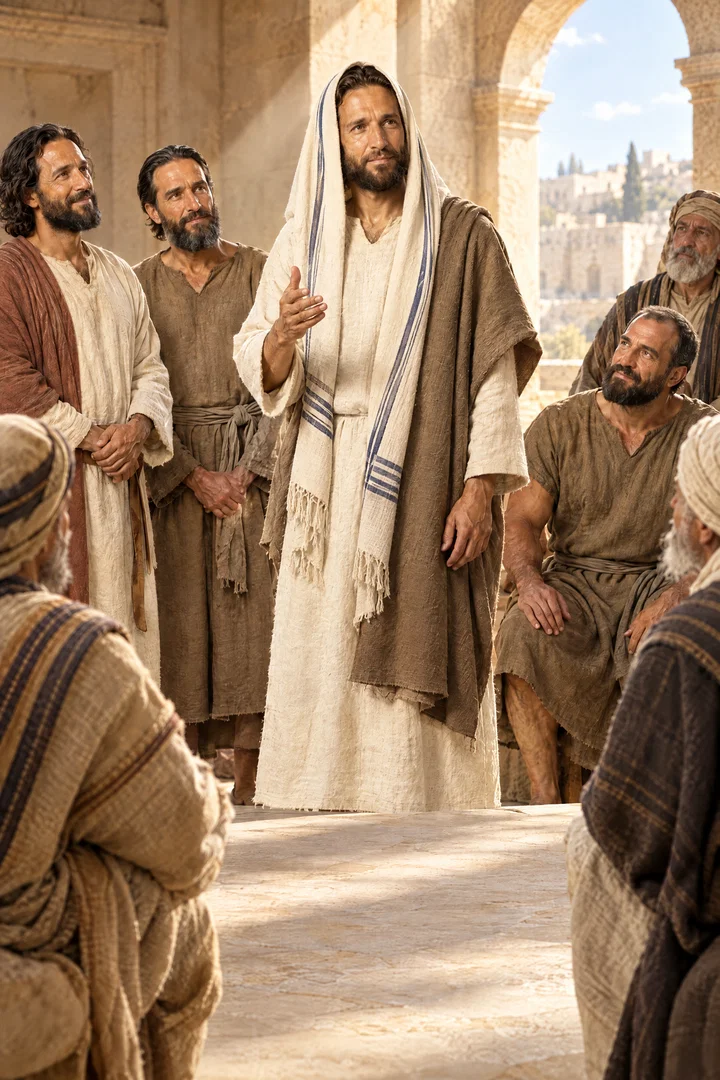
And when there had been much disputing, Peter rose up, and said unto them, Men and brethren, ye know how that a good while ago God made choice among us, that the Gentiles by my mouth should hear the word of the gospel, and believe.
Translations
And when there had been much disputing, Peter rose up, and said to them, Men and brothers, you know how that a good while ago God made choice among us, that the Gentiles by my mouth should hear the word of the gospel, and believe.
King James Version, KJV Cambridge Paragraph Bible
And when there had been much disputing, Peter rose up, and said unto them, Men and brethren, ye know how that a good while ago God made choice among us, that the Gentiles by my mouth should hear the word of the gospel, and believe.
And when there had been much disputing, Peter rose and said to them, Men, brethren, ye know that a good while ago, God made choice among us, that the Gentiles, by my mouth should hear the word of the gospel, and believe.
And when there had been much questioning, Peter rose up, and said unto them, Brethren, ye know how that a good while ago God made choice among you, that by my mouth the Gentiles should hear the word of the gospel, and believe.
And when there had been much questioning, Peter rose up, and said unto them,Brethren, ye know that a good while ago God made choice among you, that by my mouth the Gentiles should hear the word of the gospel, and believe.
and there having been much disputing, Peter having risen up said unto them, 'Men, brethren, ye know that from former days, God among us did make choice, through my mouth, for the nations to hear the word of the good news, and to believe;
And much discussion having taken place, Peter, standing up, said to them, Brethren, ye know that from the earliest days God amongst you chose that the nations by my mouth should hear the word of the glad tidings and believe.
And, when much discussion had arisen, Peter standing up, said unto them—Brethren! Ye yourselves, well know that, in days long past, amongst you, God chose that, through my mouth, the nations should hear the word of the glad tidings, and believe.
After much discussion, Peter got up and said to them, “Brothers, you know that in the early days God made a choice among you that the Gentiles would hear from my lips the message of the gospel and believe.
After much debate, Peter got up and said to them, “Brothers, you know that in the early days God made a choice among us that the Gentiles would hear from my lips the message of the gospel and believe.
When there had been much discussion, Peter rose up and said to them, “Brothers, you know that a good while ago God made a choice among you that by my mouth the nations should hear the word of the Good News and believe.
And when there had been much discussion, Peter got up and said to them, My brothers, you have knowledge that some time back it was God's pleasure that by my mouth the good news might be given to the Gentiles so that they might have faith.
And when there had bene great disputation, Peter rose vp, and said vnto them, Ye men and brethren, ye know that a good while ago, among vs God chose out me, that the Gentiles by my mouth should heare the worde of the Gospel, and beleeue.
Douay-Rheims (Challoner revision)
And when there had been much disputing, Peter, rising up, said to them: Men, brethren, you know, that in former days God made choice among us, that by my mouth the Gentiles should hear the word of the gospel, and believe.
Pictures
Cross-references 20 of 71
- Acts 15:28-29
For it seemed good to the Holy Ghost, and to us, to lay upon you no greater burden than these necessary things;
The council sets out Spirit-guided requirements for Gentile believers.
- Acts 10:44-48
While Peter yet spake these words, the Holy Ghost fell on all them which heard the word.
Peter preached to Gentiles, who believed and received the Holy Spirit.
- Acts 15:1
And certain men which came down from Judæa taught the brethren, and said, Except ye be circumcised after the manner of Moses, ye cannot be saved.
States the claim that circumcision was necessary for salvation, prompting the council.
- Acts 15:19-20
Wherefore my sentence is, that we trouble not them, which from among the Gentiles are turned to God:
James says not to burden Gentile converts, but to give them specific instructions.
- Galatians 2:7-9
But contrariwise, when they saw that the gospel of the uncircumcision was committed unto me, as the gospel of the circumcision was unto Peter;
The leaders recognize Paul’s Gentile mission alongside Peter’s ministry to the circumcision.
- Acts 15:14
Simeon hath declared how God at the first did visit the Gentiles, to take out of them a people for his name.
James recounts Peter’s testimony that God gathered a people from the Gentiles.
- Galatians 2:11-14
But when Peter was come to Antioch, I withstood him to the face, because he was to be blamed.
Peter’s conduct toward Gentile believers threatened church unity and contradicted the gospel.
- Acts 15:12
Then all the multitude kept silence, and gave audience to Barnabas and Paul, declaring what miracles and wonders God had wrought among the Gentiles by them.
Paul and Barnabas report God’s work among the Gentiles after Peter’s stand.
- Acts 11:15-18
And as I began to speak, the Holy Ghost fell on them, as on us at the beginning.
Gentiles receive the Holy Spirit and repentance as God’s gift, confirming their inclusion.
- Acts 2
And when the day of Pentecost was fully come, they were all with one accord in one place.
Peter first preached to the Jews at Pentecost.
- Galatians 2:1-2
Then fourteen years after I went up again to Jerusalem with Barnabas, and took Titus with me also.
Paul brings his gospel mission to the Jerusalem leaders.
- Acts 15:24
Forasmuch as we have heard, that certain which went out from us have troubled you with words, subverting your souls, saying, Ye must be circumcised, and keep the law: to whom we gave no such commandment:
The council rejects imposing circumcision and the law on Gentile believers.
- Acts 10:9-20
On the morrow, as they went on their journey, and drew nigh unto the city, Peter went up upon the housetop to pray about the sixth hour:
Peter’s vision leads to his commission to preach to Gentiles.
- Acts 15:2
When therefore Paul and Barnabas had no small dissension and disputation with them, they determined that Paul and Barnabas, and certain other of them, should go up to Jerusalem unto the apostles and elders about this question.
The dispute leads Paul and Barnabas to consult the apostles and elders in Jerusalem.
- Acts 21:25
As touching the Gentiles which believe, we have written and concluded that they observe no such thing, save only that they keep themselves from things offered to idols, and from blood, and from strangled, and from fornication.
James restates the council’s decision about requirements for Gentile believers.
- Acts 11:19
Now they which were scattered abroad upon the persecution that arose about Stephen travelled as far as Phenice, and Cyprus, and Antioch, preaching the word to none but unto the Jews only.
Earlier preaching was directed only to Jews.
- Galatians 1:6-7
I marvel that ye are so soon removed from him that called you into the grace of Christ unto another gospel:
The controversy concerns a perverted gospel, which Paul says is no true gospel.
- Acts 16:4
And as they went through the cities, they delivered them the decrees for to keep, that were ordained of the apostles and elders which were at Jerusalem.
Churches receive and keep the decrees issued by the Jerusalem council.
- 1 Corinthians 7:19
Circumcision is nothing, and uncircumcision is nothing, but the keeping of the commandments of God.
Circumcision does not matter; keeping God’s commandments does.
- Matthew 16:19
And I will give unto thee the keys of the kingdom of heaven: and whatsoever thou shalt bind on earth shall be bound in heaven: and whatsoever thou shalt loose on earth shall be loosed in heaven.
keys fulfilled by Peter's first preaching
Commentary
Each commentary is drawn from primary sources: the writings of Ellen G. White and Adventist pioneers and periodicals. Each commentary is separate. Its own words are not a quotation; follow the references to read the source passages.
Ellen G. White
22 sources
God chose Peter to be the one through whose preaching the Gentiles would hear the gospel and believe.AA 192.4–193.2SLP 192.3–194.1SLP 70.1–71.1 He said this at the Jerusalem council when there was sharp dispute over whether Gentile converts must be circumcised and keep the law of Moses and the whole ceremonial law in order to be saved and admitted to the church.LS 406.3–407.1AA 188.2–189.1ST Jun 26, 1879 His point was that God had already decided the question by giving the Holy Spirit with the same power to uncircumcised Gentiles as to circumcised Jews, making no distinction between them and showing He accepted both alike.AA 192.4–193.2SLP 192.3–194.18RED 33.2 The council therefore recognized that Gentile believers were not bound by the ceremonial law and could enter the church without circumcision.SLP 192.3–194.1SLP 70.1–71.18RED 33.2 The matter was settled not by church authority but by the Holy Spirit witnessing to the testimony, giving the counselors grace, wisdom and sanctified judgment and bringing them into unity.LS 406.3–407.1SLP 209.2–210.2ST May 1, 1884
Council Setting and Dispute
Acts 15:7 belongs to the Jerusalem council called to settle much disputing over whether Gentile converts must be circumcised and keep the law of Moses and the entire ceremonial law in order to be saved and to be admitted to the church.LS 406.3–407.1AA 188.2–189.1SLP 121.1–122.114MR 176.1–2Lt 7, 1891, par. 2–5 It was a brief difference of understanding over circumcision, whether admission to the church should be granted to uncircumcised Gentiles, and apart from that short dispute union prevailed after the resurrection and ascension with believers all of one heart and one mind.14MR 176.1–2Lt 7, 1891, par. 2–5 The matter was soon settled, and through divine illumination and sanctification of the Spirit the believers were perfectly joined together in the same mind and in the same judgment.14MR 176.1–2Lt 7, 1891, par. 2–5
Its background includes Antioch in Syria, a large and growing center of missionary activity whose membership included many classes of people from both Jews and Gentiles, where Paul and Barnabas reported how God had opened the door of faith to the Gentiles.AA 188.1 At the council itself Paul recounted his conversion and the work God had done through him among the Gentiles, and the Spirit witnessed to the testimony given there.SLP 209.2–210.2ST May 1, 1884 The council set aside its prejudice, agreed with the apostle's position, and sent that agreement in an address to the churches.SLP 209.2–210.2ST May 1, 1884
Peter's testimony and speech came amid debate over the Gentile converts and the requirements for joining the church, declaring that God had chosen that Gentiles hear the gospel through Peter and believe.SLP 70.1–71.13SP 372.2 The council recognized God's favor to the Gentiles, shown by the gift of the Holy Spirit, as evidence that the question had already been decided by God, with their task to follow the Spirit's guidance.SLP 70.1–71.1 That stand forms part of the defense of Christianity at Jerusalem against the narrow restrictions of Judaism.SLP 304.1–2
Some Jewish Christians remained attached to the ceremonial law and resisted the change when the council accepted that God had opened the gospel to the Gentiles.ST Jun 26, 1879 Their attachment to Jewish customs and jealousy of Paul led them to regard his principles as too lax about the law, remaining zealous for the ceremonial law.8RED 34.1 The council's decision about Gentile converts was later ignored by false teachers who urged Gentile believers to observe the ceremonial law.AA 383.1–2
Divine Acceptance of Gentiles
God made choice among the believers that the Gentiles by Peter's mouth should hear the word of the gospel and believe, choosing Peter to bring and preach the gospel to them.AA 192.4–193.2SLP 192.3–194.1SLP 70.1–71.1RH Apr 13, 1911 Cornelius's conversion was the first major step in opening the church's work to the Gentiles, who were to share the gospel's blessings equally with Jewish believers without having to be circumcised.RH Apr 13, 1911
The event demonstrated that God accepted Gentiles as well as Jews.AA 192.4–193.2 The Holy Spirit came upon uncircumcised Gentiles with the same power as upon circumcised Jews, showing that God made no distinction between them.AA 192.4–193.2 Peter's vision taught him not to call unclean what God had cleansed, and Christ's blood could cleanse all from uncleanness.AA 192.4–193.2
The question had already been decided by God by His giving the Holy Spirit to the Gentiles and showing them favor, so the council's task was to follow the Spirit's guidance.SLP 70.1–71.18RED 33.2 The council recognized God's call of Paul to preach to the Gentiles.SLP 192.3–194.1 It agreed that Gentile believers were not bound by the ceremonial law but could enter the church without circumcision, with the Mosaic ordinances not obligatory for them.SLP 192.3–194.1SLP 121.1–122.1
Spirit-Led Decision and Unity
The question before the council was settled by the Holy Spirit, who witnessed to the testimony given there concerning the work among the Gentiles.SLP 209.2–210.2ST May 1, 18843SP 372.2 The apostles and elders acted as counselors and received grace, wisdom, and sanctified judgment to decide it.LS 406.3–407.13SP 372.2 They allowed the Spirit to guide the decision rather than imposing it by church authority.LS 406.3–407.1
The council set aside its prejudice and agreed with the apostle's position after Paul recounted his conversion and the work God had done through him among the Gentiles.SLP 209.2–210.2ST May 1, 1884 That agreement was sent in an address to the churches expressing support for the Gentile work.SLP 209.2–210.2ST May 1, 1884 The council reached decisions about rites and customs, including circumcision, and united in supporting the work among the Gentiles, helping bring unity among believers.AA 400.2–401.1 Those decisions acknowledged Paul's apostolic position, and Paul complied with them in all his work among the Gentiles.AA 387.2–388.1
The council's decision concerning Gentile converts and the ceremonial law remained in force.ST May 1, 1884 The advice later given to Paul was inconsistent with it and was not prompted by the Holy Spirit.ST May 1, 1884
Apart from that brief difference of understanding over circumcision, whether admission to the church should be granted to uncircumcised Gentiles, union prevailed after the resurrection and ascension of Christ with believers all of one heart and one mind.14MR 176.1–2Lt 7, 1891, par. 2–5 The matter was soon settled, and through divine illumination and sanctification of the Spirit the believers were perfectly joined together in the same mind and in the same judgment.14MR 176.1–2Lt 7, 1891, par. 2–5 Such unity in believing and speaking the same things is and always will be the fruit borne under the influence of the Holy Spirit in proportion to illumination and sanctification.14MR 176.1–2Lt 7, 1891, par. 2–5
The chapter stands as a New Testament account of church order and unity.LS 406.3–407.1Lt 178, 1909, par. 14–16 It is offered as a pattern for resolving difficulties without giving leaders power to command the Lord's laborers.LS 406.3–407.1Lt 178, 1909, par. 14–16
Sources
Pioneers and periodicals
101 sources
After much disputing in the gathering of the apostles and elders at Jerusalem over whether Gentile believers must be circumcised and keep the law of Moses to be saved, Peter rose up to remind the brethren that God had chosen him a good while before for the Gentiles to hear the word of the gospel by his mouth and believe.CO 82.4–83.1ST Nov 28, 1892ST Aug 8, 1900RH May 5, 1863 That choice was his earlier sending to preach first to the Gentiles in the house of Cornelius at Caesarea, where they heard, believed, and received the Holy Spirit, opening the work equally to the Gentiles without circumcision.ST Apr 13, 1915ST Jul 22, 1880ST Jul 7, 1898 God himself accepted uncircumcised Gentiles by giving the Holy Spirit to believing Gentiles just as to believing Jews, putting no difference between them and purifying their hearts by simple faith, so Jews and Gentiles alike are saved in exactly the same way through the grace of the Lord Jesus Christ and not by works of law.ST Aug 8, 1900ST Aug 30, 1877RH Jan 2, 1900ST May 28, 1902 The yoke set aside was the law of circumcision and the ceremonial law of Moses with its typical services, not the moral law of the Ten Commandments, and the council's silence about the Sabbath brings no release from it but attests that the seventh-day Sabbath remained observed and binding.ST Aug 12, 1875ST Sep 9, 1880ST Mar 13, 1884RH Feb 26, 1901ST May 28, 1902 Peter spoke in that council as one apostle among equals and brethren, not as pope or infallible head, while James as presiding officer stated the decision, and under the Spirit the church set aside prejudice, ended discord, and came into complete harmony.RH May 5, 1863RH Apr 29, 1909RH Dec 28, 1905RH Jun 13, 1871ST Feb 28, 1911
Jerusalem Council Setting
The verse stands in the Jerusalem council convened to settle whether Gentile believers must be circumcised and keep the law of Moses in order to be saved.CO 82.4–83.1ST Nov 28, 1892ST Aug 8, 1900ST Nov 28, 1892 The trouble began at Antioch in Syria, where men from Judea taught the brethren that circumcision after the custom of Moses was necessary for salvation.CO 82.4–83.1ST Nov 28, 1892ST Aug 8, 1900ST Mar 13, 1884 Paul and Barnabas strongly resisted that teaching, and when the dissension required settlement the church sent them to consult the apostles and elders at Jerusalem.RH Aug 31, 1916ST Mar 13, 1884RH May 5, 1863RH Apr 29, 1909ST May 6, 1897 It was the first serious internal trouble of the church, arising in prosperous Antioch after the return of Paul and Barnabas, because Judean Jews were slow to acknowledge that Gentiles stood on an equal footing with themselves under the gospel.ST Mar 13, 1884 The partition between Jew and Gentile had first been fully demonstrated under Peter's own ministry, although Peter himself afterward showed prejudice by which even Barnabas was carried away.ST Mar 13, 1884
After much disputing and questioning in the gathering of the apostles and elders, Peter rose up to speak.ST Aug 8, 1900RH May 5, 1863RH Feb 26, 1901ST May 28, 1902RH Jul 30, 1861 The meeting was a church discussion marked by much disputing, rather than an ordinary public worship service.RH Jul 30, 1861 He was the first to speak directly to the heart of the matter, and he reminded the brethren that God had chosen him from among them for the Gentiles to hear the word of the gospel by his mouth and believe.ST Nov 28, 1892ST Aug 8, 1900ST Nov 28, 1892RH Feb 26, 1901ST Aug 8, 1900 When the Gentiles heard the word at Peter's mouth they believed, and his remarks formed part of the apostles' and elders' effort, with the Holy Spirit, to settle the dissension and preserve unity among the churches.RH May 5, 1863ST Aug 8, 1900 From his own experience he testified that the Gentiles should hear the gospel and believe, and he pressed the pointed question why God should be tempted by putting upon Gentile disciples a yoke which neither the fathers nor that generation were able to bear.ST Mar 13, 1884RH Feb 26, 1901ST May 28, 1902
The setting marks the early church's transition from a community of Jewish converts to one including Gentile believers, with the gospel spreading beyond Judea to the wider world.RH Nov 16, 1916 This came after a period in which the work pertained exclusively to the Hebrews and the message was directed to the Jews, until God used Peter to bring Gentiles to hear and believe the gospel.RH Nov 16, 1916ST Feb 22, 1883 The conference took place about A.D. 49 to 52, about seventeen years after Paul's conversion in about A.D. 34.ST Dec 15, 1898ST Mar 4, 1886RH Nov 7, 1865 That reckoning follows three years in Arabia and Damascus, then a fifteen-day stay with Peter in Jerusalem, then fourteen more years to the same Jerusalem visit described in Galatians 2.ST Dec 15, 1898ST Mar 4, 1886 John was present at that council in Jerusalem in A.D. 49 or 50, which came after the death of Mary about fifteen years after the crucifixion.RH Nov 7, 1865
The brief record concerns a council of apostles and elders with delegates from Antioch and Jerusalem representing Jewish and Gentile Christian churches.RH Aug 31, 1916RH Apr 29, 1909RH Jan 16, 1900 As believers spread so widely that they could not all meet in one place, representatives were chosen to gather and address teaching that conflicted with the faith of the churches.RH Aug 31, 1916RH Apr 29, 1909 It was a critical moment when dispute over the Gentiles threatened to divide Jewish and Gentile believers over whether Gentile converts had to follow Jewish requirements.ST Jul 29, 1897RH Jan 16, 1900ST May 6, 1897 There the early church addressed practical questions affecting Christians, deliberating with enlightened judgment and standing by truth even when it meant admitting error and abandoning it.RH Aug 31, 1916ST Jul 29, 1897ST May 6, 1897
Peter's Words Explained
The words about a good while ago look back to an earlier divine choice of Peter to be the first to preach the gospel to the Gentiles so that by his mouth they might hear and believe.ST Nov 28, 1892ST Nov 28, 1892ST Dec 12, 1892ST Dec 16, 1897ST Jul 24, 1907 He rose and recalled this after much disputing in the Jerusalem council over whether Gentile believers must be circumcised and keep the law of Moses.ST Nov 28, 1892ST Nov 28, 1892ST May 28, 1902 God had chosen him long before for this preaching, and those Gentiles heard and believed.ST Dec 12, 1892ST Dec 16, 1897ST Jul 24, 1907
That choice points to the vision at Joppa and the experience at Caesarea in the house of Cornelius, where Peter opened the gospel to the Gentiles.ST Apr 13, 1915ST Jul 7, 1898ST Jan 30, 1879 There Cornelius and his friends heard, believed, and received the Holy Spirit, whose coming upon Gentile believers matched His gift to Jewish believers.ST Apr 13, 1915ST Jul 22, 1880 Their hearts were purified through faith and they received the witness of the Spirit through faith before baptism, showing that cleansing and assurance come by faith apart from baptism and that God still works in the same way now.ST Jul 22, 1880 The commission given in connection with the vision marked the opening of the work for the Gentiles after the period when the gospel work pertained exclusively to the Hebrews, and Cornelius's conversion was the first major step in opening the church's work to Gentiles to share the gospel's blessings equally with Jewish believers without having to be circumcised.RH Apr 13, 1911ST Jan 30, 1879 Spirit-directed preaching to the Gentiles and organized counsel belong together, so organization must not restrain such Spirit-led work as Peter to Cornelius, Paul to Macedonia, and Philip to the eunuch, while the Spirit controls the church through pure, peaceable, gentle, merciful counsel without partiality and through humility with no strife for supremacy.RH Jun 16, 1903
God's choice of Peter was an assignment to preach the gospel to the Gentiles first, not a choice guaranteeing Peter's salvation or rejecting others.ST Jun 22, 1915 God chooses people for particular work, and anyone who yields to Him will be chosen for the work He has for them.ST Jun 22, 1915
Peter's preaching to the Jews at Pentecost and then to the Gentiles fulfilled the privilege represented by the keys of the kingdom.ST Jan 16, 1907ST May 14, 1902 A key is that which opens, first opened to the Jews on the day of Pentecost and then to the Gentiles at the house of Cornelius.ST May 14, 1902 By proclaiming the living gospel of the risen Christ he opened the way of salvation and the doors of the kingdom to those who accepted it, while its reception brought life and its rejection left people outside.ST Jan 16, 1907ST Jul 24, 1907 This opening illustrates authority to proclaim God's message, not personal power to forgive sins, with power belonging to the message rather than to Peter as a person. The choice gave Peter no position over the other apostles, for Paul was afterward chosen as the especial apostle to the Gentiles and was in nothing behind the very chiefest apostles, and the same gospel key used by Paul opened blind eyes, unlocked deaf ears, and swung wide many doors, with all these servants only typifying Christ, by whose Word and Spirit alone doors are opened.ST May 14, 1902
God's plan uses human messengers in bringing others into His kingdom, so that even an angel directed Cornelius to Peter rather than telling him the way of life directly.ST Sep 30, 1908 Heavenly messengers and believers on earth cooperate, and the work belongs to neither one person nor one angel alone, so sower and reaper will rejoice together.ST Sep 30, 1908
James later refers to Peter's testimony at this meeting by the Hebrew name Simeon, an alternate form of Simon, which Peter bore before Jesus gave him the name Peter.ST Sep 5, 1911
Salvation by Grace Alone
God himself accepted uncircumcised Gentiles, for when they heard the gospel and believed he gave them the Holy Spirit just as he gave him to believing Jews, putting no difference between them and purifying their hearts by simple faith rather than by circumcision or any other human work.RH Jan 2, 1900ST May 28, 1902ST Jul 16, 1896 This gift showed that nothing further was required for their salvation, and that Jews must be saved in the same way as Gentiles.RH Jan 2, 1900ST Jul 22, 1880ST Dec 12, 1892 The cleansing and assurance seen in Cornelius and his friends, who through faith received the witness of the Spirit before baptism, shows that cleansing comes by faith apart from baptism and that God still works in the same way now.ST Jul 22, 1880
Jews and Gentiles alike are saved in exactly the same way through the grace of the Lord Jesus Christ by faith in his name, not by works of law or by coming under Jewish law.RH Jan 2, 1900RH Feb 26, 1901ST May 28, 1902ST Jul 16, 1896 Faith in the name of Christ is the only way of salvation, for the question at issue was nothing less than salvation itself.ST Aug 8, 1900 To teach that something else is necessary denies Christ and preaches another gospel which is no gospel at all, because there is no good news in a gospel of damnation.ST Aug 8, 1900 To depend on typical services after their purpose was served makes salvation a matter of works, a grievous yoke of trying to save oneself by dead works, standing opposed to being saved through grace.ST Jun 4, 1902
The yoke which neither the fathers nor that generation were able to bear is the law of circumcision and the law of Moses with its typical ceremonial service and salvation by dead works.ST Mar 13, 1884ST May 28, 1902RH Apr 16, 1861ST Jun 4, 1902 It is not the law of God itself nor the perfect moral law of ten commandments, which stands distinct, was the delight of David, and was kept by Christ and therefore cannot be the faulty unbearable yoke.RH Apr 16, 1861ST Jun 4, 1902 The dispute arose because men from Judea taught that the brethren must be circumcised and keep the law of Moses, and Judean Jews were slow to acknowledge that Gentiles were on an equal footing under the gospel even though the broken partition had first been fully demonstrated under Peter's own ministry.ST Mar 13, 1884 The council rejected imposing that law as a yoke on Gentile converts, while distinguishing it from God's law whose moral precepts remain necessary.ST Feb 22, 1883
Circumcision had been proper in its season, but its time had passed, with circumcision of the heart taking its place as the distinguishing mark of God's people.ST Dec 20, 1883 Requiring Gentile Christians to be circumcised and keep the law of Moses discouraged them and caused dissension, so to require the old ceremonies now tempts God.ST May 28, 1902ST Dec 20, 1883
Peter's words turned the tide of discussion against circumcision, for after much disputing he rose and went directly to the heart of the matter by recalling that God had chosen him a good while before so that the Gentiles should hear the word of the gospel by his mouth and believe.ST May 28, 1902ST Aug 8, 1900ST May 28, 1902 His Spirit-guided speech ended the discord, and with the similar testimony of Barnabas and Paul it closed the free discussion, after which James as presiding officer stated facts and rendered the decision which all gladly accepted.RH May 23, 1907RH May 18, 1905 When Peter rose the discussion was decidedly one-sided in favor of the Gentile contention, giving a complete victory to the truth that the Gentiles should hear the gospel and believe without taking up Jewish customs, while the apostles utterly repudiated the teachers who had claimed to represent their views.ST May 28, 1902
God visited the Gentiles to take out of them a people for his name, calling those who were not his people to become his people and children of the living God.ST Oct 9, 1879ST Jul 16, 1896RH Aug 12, 1858 The gospel was meant to reach the Gentiles and bring believers from among the nations to belong to God, linking their inclusion through Peter's preaching with the promised glory of the Gentiles flowing to God's people.ST Oct 9, 1879RH Aug 12, 1858 The gospel makes salvation possible for all and freely invites all to come, but it does not ensure that all will accept, and its work of gathering a people is not a failure when many refuse.ST Oct 9, 1879
Moral Law Still Binding
The law debated at Jerusalem was the ceremonial and civil law given through Moses, including circumcision and the typical services pointing to Christ which passed away at his death, not the moral law, the Ten Commandments, or the commandments to love God and neighbor.ST Aug 12, 1875ST Sep 9, 1880RH May 27, 1875ST Aug 30, 1877ST Jun 3, 1875 The Ten Commandments were not the question before the council, and the dispute concerned whether Gentile believers had to be circumcised and keep the law of Moses to be saved, not whether Christians were free to break God's commandments.RH May 27, 1875RH Mar 4, 1862ST Aug 30, 1877 The council's decision was that Gentiles, like Jews, are saved through the grace of Jesus Christ, and it did not abolish the Ten Commandments or the Sabbath.RH Mar 4, 1862ST Aug 30, 1877ST Jun 3, 1875 Its failure to mention a commandment in its letter does not release Gentiles from it, and silence in the chapter cannot outweigh scriptures that directly show Gentiles are accountable to the law.ST Aug 12, 1875RH May 27, 1875RH May 27, 1875
The letter named only abstaining from meats offered to idols, blood, things strangled, and fornication, yet that does not release Gentiles from other duties, for the four requirements address dividing practices rather than the whole Christian duty and are Christian rules of action, not an exhaustive list of moral duties.ST Aug 12, 1875RH May 27, 1875RH Oct 26, 1911RH Jul 21, 1868RH May 23, 1854 Only one precept of the Ten is mentioned there while the other eight are also left out, including the commands against idolatry, taking God's name in vain, dishonoring parents, and stealing, yet those commands remain binding, for where no law is there is no transgression.ST Aug 12, 1875RH Oct 26, 1911 The stated exemption concerned circumcision and the law of Moses, and any argument drawn from the chapter for freedom from the law is based on silence.RH May 27, 1875RH May 27, 1875RH Jul 21, 1868
No dispute about Sabbath observance was brought before the council, and the Sabbath was not identified as a matter of dispute but treated as unchallenged and not an issue.ST Sep 9, 1880RH Mar 4, 1862ST Jun 8, 1882ST Nov 5, 1912ST Oct 29, 1912 No accusation that Gentile Christians were breaking the Sabbath was made, which attests that they were not doing so and that the seventh-day Sabbath was still observed.ST Sep 9, 1880RH Mar 4, 1862ST Jun 8, 1882 It was not abolished or changed to the first day, but remained upheld as sacred within the fourth commandment.ST Sep 9, 1880RH Mar 4, 1862ST Jun 8, 1882 The presence of such long and heated disputing over doing away with the ceremonial law proves that the apostolic church faithfully observed the seventh-day rest in the way taught by Christ, since neither the Jews nor the Jewish Christians ever found any fault against the rising church on the Sabbath.ST Nov 5, 1912ST Oct 29, 1912ST Jun 15, 1904
The decision freed Gentile believers from keeping the ceremonial law, requiring only that they keep themselves from things offered to idols, and from blood, and from strangled, and from fornication, and that decision was sanctioned by the Holy Spirit and still held good afterward.ST Jan 22, 1885RH Oct 11, 1906 The prohibition against eating blood remained obligatory for Gentile believers, and the letter addressed particular practices that could trouble Jewish believers.ST Jan 22, 1885RH Dec 31, 1861RH Oct 11, 1906 The distinction between clean and unclean animals was treated as a lasting principle rather than a rule created only by the old Levitical laws.ST Jan 22, 1885 Not imposing the ceremonial law did not mean Christians were free to disregard God's commandments or live unholy lives.ST Jan 22, 1885RH Oct 11, 1906
The conference was assembled to settle divisions over eating with the Gentiles and other points of the law of Moses taught as necessary to salvation, while converts from the Jews still followed its food distinctions and judged Gentile converts who used swine's flesh and other meats that were abomination to the Jews, binding on them burdens the gospel did not require.RH May 23, 1854ST Jan 22, 1885 It wrote to the Gentile brethren in Antioch, Syria, and Cilicia to lay on them no greater burden than the four abstentions, which does not embrace the whole Christian duty but only the points dividing the flock.RH Oct 26, 1911RH Jul 21, 1868RH May 23, 1854 That list does not include swine's flesh, and its right decision brought rejoicing among the churches and forever settles that to forbid swine's flesh as a test lays a greater burden than seemed good to the Holy Spirit and the apostles.RH May 23, 1854ST Jan 22, 1885
The council was needed because ceremonial shadows and ordinances were being put in place of the moral precepts of God's law and true faith in Christ.ST Aug 30, 1877ST Jun 3, 1875RH Jun 15, 1911 It concerned the distinction between temporary ceremonial requirements, including shadowy sabbaths, and the Sabbath of the Decalogue, which was given before the age of shadows and is a lasting memorial of Jehovah's rest.RH Mar 4, 1862ST Jun 8, 1882RH Jun 15, 1911 The chapter shows nothing that releases Christians from obeying the Ten Commandments and keeping the seventh-day Sabbath.RH Nov 30, 1869RH Nov 17, 1859RH Jul 28, 1868 When it is made a main argument that the law is set aside and the Sabbath is no longer binding, that use fails and is easily answered, for it gives no weapon for abolishing the Ten Commandments and stays in the hands of those who keep God's commandments, so those who try to use it against commandment-keepers only seize the blade and wound themselves.RH Nov 30, 1869RH Nov 17, 1859RH Jul 28, 1868
In disagreement with the above, those who held otherwise taught that the council's silence about keeping the Ten Commandments argues that they had been abolished.ST Feb 14, 1906RH Feb 26, 1857 They described its decision favoring liberty rather than uniformity, in addressing a threatened division in the early church, as a concession that set aside the Sinai code.ST Feb 14, 1906RH Feb 26, 1857
Church Order and Unity
The verse stands in the church's first general council or conference at Jerusalem, held with delegate representation to consider and decide the unsettling question whether Gentile believers must be circumcised and keep the law of Moses.RH Feb 28, 1856ST Jun 11, 1874RH May 23, 1907 The question was placed before the conference by experience when Paul and Barnabas recited their service, then investigated and debated with free discussion before decision, with Peter reciting how God had wrought for the Gentiles through him.RH Feb 28, 1856RH May 23, 1907RH Jan 13, 1874 In that meeting the apostles and elders acted as counselors rather than rulers commanding the church or lording over God's heritage, leaving room for the Holy Spirit to act as Judge and to give wisdom and sanctified judgment.LS 406.3–407.1ST Jun 11, 1874RH Dec 1, 1874 Christ by His Spirit came into that teachable assembly of apostles, elders, and all the brotherhood and led them out of the difficulty, and the decision was expressed as seeming good to the Holy Spirit and to the believers together, bringing rejoicing and consolation.ST Jun 11, 1874RH Dec 1, 1874 Business done in this order remains a model of Christian piety, proving the leadership of Christ and the equality of the ministerial brotherhood, so that differences settled in this way remain settled.LS 406.3–407.1RH Dec 1, 1874
Peter took part as one apostle among equals and brethren, not as pope, presiding officer, authoritative head, vicar of Christ, or infallible teacher.RH Apr 29, 1909RH Jun 13, 1871ST Feb 28, 1911 He did not call the council, preside over it, settle its disputed questions, or publish its decrees, for the circumcision controversy was resolved by counseling together rather than by Peter deciding alone.RH Jun 13, 1871ST Dec 3, 1894 James presided and gave the final decision, as the divinely appointed president and chief spokesman framing the conclusions and stating facts and rendering the decision of the conference in session.RH Apr 29, 1909RH May 23, 1907ST That decision went out in the name of the apostles and elders and brethren together, and the absence of any special lordship, presidency, or sole authority for Peter proves he held no primacy over the other apostles.RH Jun 13, 1871ST Jul 5, 1910 His God-given work of opening the kingdom by preaching so the Gentiles would hear and believe did not make him greater than the other apostles or the church's foundation, for Christ is the foundation.ST Feb 28, 1911ST Jul 5, 1910
The council began with much disputing yet reached complete harmony under the influence of the Holy Spirit, so that unresolved disputes would not impair the church's spiritual efficiency.RH May 5, 1863RH Dec 28, 1905RH May 18, 1905 Peter rising after the dispute formed part of the effort to settle the dissension and preserve unity, and his Spirit-guided speech ended the discord so the council could proceed with its decision.RH May 5, 1863RH May 18, 1905 Under that influence the council set aside its prejudices, agreed with the apostle's position on the Gentile mission, and sent that agreement in an address to the churches.ST May 1, 1884ST Jan 15, 1885 In this way the first serious internal trouble and first internal disturbance, a momentous question for that age and people, was happily adjusted by honestly endeavoring to keep the unity of the Spirit in the bond of peace.RH Dec 28, 1905ST Mar 13, 1884 No faction grew out of it, no separate church was set up, and there was no agreement to disagree, but peace was restored and the brethren were encouraged.RH May 5, 1863ST Mar 13, 1884
The united decisions were recognized as authoritative under the word of God for harmonious action and cooperation among the churches, so that harmony and unity could prevail.CO 28.2–29.2RH Apr 29, 1909 The conference also evidenced recognition of Paul and Barnabas's call to gospel ministry when Peter recalled that God had chosen him to bring the gospel to the Gentiles and that they believed.CO 28.2–29.2RH Apr 29, 1909 Some resisted the decision in a spirit of independence and anarchy.RH Apr 29, 1909 Such opposition came from a faction of false brethren who murmured, found fault, proposed plans on their own responsibility, and tried to undermine experienced men ordained to teach Christ's doctrine, an opposition arising from the church's beginning and continuing until the end of time.CO 84.3
The pattern shows God gave the church general councils for consultation, with various offices, divisions, gifts, powers, and agencies, to counsel about things of general interest no local church can settle and to make the sacred work effective both inside and outside, the same purpose served by a General Conference.RH Nov 12, 1903RH Aug 18, 1874 When new conditions and emergencies arise they must be faced and dealt with when they arise, and every step must be governed by Bible principles.RH Nov 12, 1903ST Dec 13, 1905 The discussion and final action at Jerusalem recognized liberty in the church, with Spirit-directed preaching to the Gentiles and organized counsel belonging together under pure, peaceable, gentle, merciful counsel without partiality and through humility with no strife for supremacy.ST Dec 13, 1905RH Jun 16, 1903 The same question whether a Hebrew in becoming a Christian must abrogate Mosaic ritual, Levitical customs and ceremonies, is met only by the Word of God, letting God say what shall be done and then doing it without quibble or hesitation.RH Jun 16, 1903ST May 8, 1901
The apostles' decisions were correct when they acted collectively under the guidance of the Spirit, but this did not make any one apostle infallible alone, for they had differences of faith that needed to be settled by a council.ST Nov 22, 1883RH Jun 24, 1875 The former council's Spirit-sanctioned decision concerning Gentile converts and the ceremonial law freed Gentile believers from keeping the ceremonial law, requiring only abstinence from things offered to idols, blood, things strangled, and fornication, while circumcision was ruled nothing without abolishing God's moral law.ST Jan 22, 1885ST Nov 22, 1883RH May 9, 1907 That decision still held good afterward.ST May 1, 1884ST Jan 22, 1885 The advice later given to Paul was inconsistent with it and was not prompted by the Holy Spirit.ST May 1, 1884ST Jan 22, 1885
Prophecy and Scripture Links
The question agitated at Antioch and settled at Jerusalem was nothing less than salvation itself, and its force is known only with Galatians in view, since much of Galatians 2 deals with the same conference, the things leading to it and growing out of it.ST Aug 8, 1900ST Dec 15, 1898 The Jerusalem visit in Acts 15 is the same visit described in Galatians 2, taking place about A.D. 51, seventeen years after Paul's conversion in about A.D. 34, reckoned as three years in Arabia and Damascus, then a fifteen-day stay with Peter in Jerusalem, then fourteen more years.ST Dec 15, 1898 The issue in both accounts was whether Gentile believers had to be circumcised and keep the ceremonial law to be saved, the same troubling of the Galatian believers over making circumcision a condition of salvation contrary to justification through Christ known by revelation.ST Dec 15, 1898RH Oct 8, 1857 To require something else besides faith in the name of Christ denies Christ and preaches another gospel than the gospel of the power of God to salvation, even a gospel of damnation which is no gospel at all because there is no good news in it.ST Aug 8, 1900 Acts 15 must therefore be understood and borne in mind to understand Galatians 2, of which Galatians 2 is merely an adjunct, while Acts 15 is presented as the setting for understanding Galatians 2.ST Dec 15, 1898
Gentile salvation by hearing and believing through Peter's mouth was already part of God's plan, as shown by the promises to Abraham and the prophecies of Amos, Joel, and Isaiah.RH Mar 25, 1873ST Dec 12, 1892 God first visited the Gentiles through Peter's preaching to take out of them a people for his name, linking their inclusion with the promised glory of the Gentiles flowing to God's people.RH Aug 12, 1858ST Dec 12, 1892 The work of restoring David's kingdom is a gospel prophecy fulfilled through Christ, David's heir: it begins with Christ being presented to the Jews, gathers the true seed from all nations, and reaches completion when Christ receives David's throne, the nations are destroyed, and his kingdom is established under the whole heavens.RH Mar 25, 1873 Israel in that prophecy refers to the people defined in Romans 9, not to the Jews as a nation awaiting restoration, and the prophecy teaches neither their national return nor the conversion of the whole world.RH Mar 25, 1873
The testing of professed apostles at Jerusalem exposed as false the teachers who claimed that Gentile converts had to keep the law of Moses, for the council's decision settled against them.RH Mar 26, 1857 Counting back seventeen years from A.D. 51 fixes Paul's conversion in A.D. 34 at the termination of the 490 years allotted especially to the Jewish people, when God raised up the great apostle to the Gentiles.ST Mar 4, 1886 This preaching to Gentiles that they might hear and believe came after the covenant had been confirmed to Israel during the seventieth week, when the Gentiles were then admitted to the household of God as fellow citizens with the saints.ST Mar 4, 1886RH Mar 1851 At the earlier council Paul was urged to remember the poor, and the later gifts from Gentile churches showed that he had kept that promise.ST Jan 15, 1885
Sources