Acts 19:9
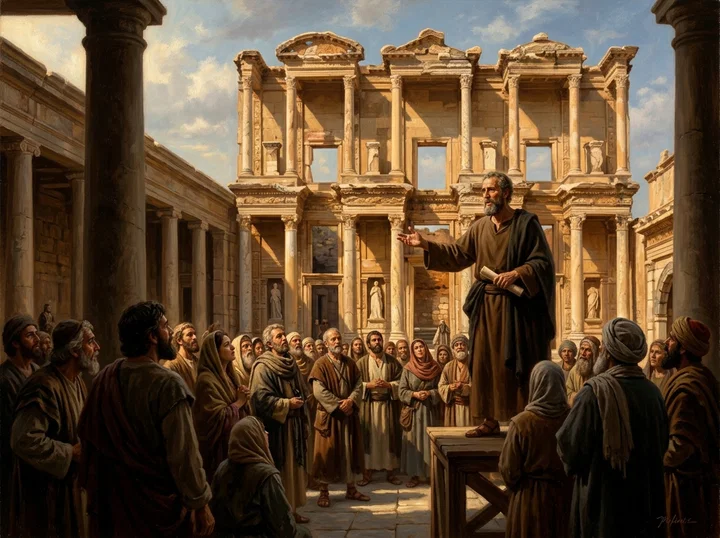
But when divers were hardened, and believed not, but spake evil of that way before the multitude, he departed from them, and separated the disciples, disputing daily in the school of one Tyrannus.
Translations
American King James Version, Webster Bible
But when divers were hardened, and believed not, but spoke evil of that way before the multitude, he departed from them, and separated the disciples, disputing daily in the school of one Tyrannus.
King James Version, KJV Cambridge Paragraph Bible
But when divers were hardened, and believed not, but spake evil of that way before the multitude, he departed from them, and separated the disciples, disputing daily in the school of one Tyrannus.
Revised Version, American Standard Version
But when some were hardened and disobedient, speaking evil of the Way before the multitude, he departed from them, and separated the disciples, reasoning daily in the school of Tyrannus.
and when certain were hardened and were disbelieving, speaking evil of the way before the multitude, having departed from them, he did separate the disciples, every day reasoning in the school of a certain Tyrannus.
But when some were hardened and disbelieved, speaking evil of the way before the multitude, he left them and separated the disciples, reasoning daily in the school of Tyrannus.
But, when some were hardening themselves, and refusing to be persuaded, speaking evil of the Way before the throng, withdrawing from them, he separated the disciples; day by day, reasoning in the school of Tyrannus.
But when some of them stubbornly refused to believe and publicly maligned the Way, Paul took his disciples and left the synagogue to conduct daily discussions in the lecture hall of Tyrannus.
But when some of them stubbornly refused to believe and publicly maligned the Way, Paul took his disciples and left the synagogue to conduct daily discussions in the lecture hall of a man named Tyrannus.
But when some were hardened and disobedient, speaking evil of the Way before the multitude, he departed from them and separated the disciples, reasoning daily in the school of Tyrannus.
But because some of the people were hard-hearted and would not give hearing, saying evil words about the Way before the people, he went away from them, and kept the disciples separate, reasoning every day in the school of Tyrannus.
But when certaine were hardened, and disobeyed, speaking euill of the way of God before the multitude, hee departed from them, and separated the disciples, and disputed dayly in the schoole of one Tyrannus.
Douay-Rheims (Challoner revision)
But when some were hardened, and believed not, speaking evil of the way of the Lord, before the multitude, departing from them, he separated the disciples, disputing daily in the school of one Tyrannus.
Pictures
Cross-references
- Acts 19:23-27
And the same time there arose no small stir about that way.
Opposition to Paul’s preaching against handmade gods develops into the uproar over Diana.
- 2 Corinthians 6:17
Wherefore come out from among them, and be ye separate, saith the Lord, and touch not the unclean thing; and I will receive you,
Commands separation, as Paul models.
- John 14:6
Jesus saith unto him, I am the way, the truth, and the life: no man cometh unto the Father, but by me.
identifies that way as Christ
- Acts 18:24-28
And a certain Jew named Apollos, born at Alexandria, an eloquent man, and mighty in the scriptures, came to Ephesus.
Sets the Ephesus background before Paul arrived.
- Acts 19:5
When they heard this, they were baptized in the name of the Lord Jesus.
Both verses belong to the account of rebaptism.
- Acts 18:18-19
And Paul after this tarried there yet a good while, and then took his leave of the brethren, and sailed thence into Syria, and with him Priscilla and Aquila; having shorn his head in Cenchrea: for he had a vow.
they accompanied Paul to Asia
Commentary
Each commentary is drawn from primary sources: the writings of Ellen G. White and Adventist pioneers and periodicals. Each commentary is separate. Its own words are not a quotation; follow the references to read the source passages.
Ellen G. White
12 sources
Ephesus was a major commercial center and a promising field for missionary effort, yet a stronghold of heathenism where God worked among the Gentiles to raise up a large church.AA 281.3AA 281.2SLP 209.2–210.2 Providence had prepared the way for apostolic work there, for Jews dispersed across many lands expected the Messiah, and those who had heard John the Baptist proclaim Jesus as the Promised One carried that news widely.AA 281.3 Paul's ministry there and in its region was a long, aggressive evangelistic effort lasting three years.AA 351.1 During that time he again worked at his trade for support, as he had done in Corinth, and he was cheered by the presence of Aquila and Priscilla, who had accompanied him on his return to Asia at the close of his second missionary journey.AA 351.1 Before withdrawing, he spoke boldly for three months in the synagogue at Ephesus, disputing and persuading about the kingdom of God.Ms 127, 1905, par. 22–23AA 285.2–3
Some in Ephesus, identified as Jews, hardened themselves, refused to believe despite sufficient evidence, and publicly spoke evil against the Christian faith, called that way, before the multitude.Ms 127, 1905, par. 22–23AA 285.2–3RH Sep 7, 1911SLP 215.1–216.3 After they persisted in rejecting the message, Paul stopped preaching in the synagogue, departed from them, and separated the disciples from the opposers into a distinct group.AA 285.2–3RH Sep 7, 1911SLP 133.3–134.1SLP 215.1–216.3 This separation protected the believers, so that continued association with opponents would not endanger their faith.AA 285.2–3RH Sep 7, 1911SLP 133.3–134.1 He then continued teaching publicly and daily in the school of Tyrannus, a teacher of some note, meeting with the disciples separately each day apart from the opposers.Ms 127, 1905, par. 22–23AA 285.2–3RH Sep 7, 1911SLP 133.3–134.1RH Sep 14, 1911
This daily work continued for two years, so that all who lived in Asia, both Jews and Greeks, heard the word of the Lord Jesus.Ms 127, 1905, par. 22–23 The believers who met separately stood apart from the city's festival season, especially the annual festival honoring Diana, and faced ridicule, reproach, and insult.SLP 141.2AA 291.3–292.1RH Sep 14, 1911 Paul's teaching weakened pagan worship, so that festival attendance and worshipers' enthusiasm declined, and even some who had not openly accepted the faith lost confidence in their gods.SLP 141.2AA 291.3–292.1RH Sep 14, 1911 Support for the festival and the business of making Diana shrines was reduced, provoking further hostility, and opposition at Ephesus grew as the Christian church succeeded, which helps explain why Jews from Asia later remained hostile toward Paul.SLP 215.1–216.3RH Sep 14, 1911
Sources
Pioneers and periodicals
47 sources
After three months of bold reasoning in the synagogue about the kingdom of God, some hearers hardened themselves and refused to believe, and when they spoke evil of the way publicly before the multitude Paul departed from them and separated the disciples to teach daily in the school of Tyrannus for two years.RH May 27, 1852ST Jun 28, 1883RH Sep 4, 1866RH Aug 24, 1916ST Feb 10, 1898 That way is the Christian faith and gospel, and in its Advent application it is the Lord's coming and the doctrine of the coming and kingdom of God at hand.RH Jan 13, 1852GSAM 174.2RH Mar 6, 1855 The rule for separation is to remain with the churches until opposition hardens into public evil speaking and only then to depart, and this departure is the pattern for turning away from the corrupt popular churches of the last days and coming out of Babylon in order not to partake of her sins.RH Jan 13, 1852RH Mar 6, 1855RH Mar 6, 1855 He did not leave Ephesus or abandon the message but continued teaching daily, and during those two years all who dwelt in Asia, both Jews and Greeks, heard the word of the Lord Jesus as its sound and report spread widely even without every person hearing Paul in person.RH Jul 11, 1854RH Feb 19, 1857RH Jul 21, 1853RH Jan 18, 1870ST Oct 4, 1883 Amid persecution the word triumphed and was put forth with greater power after the separation, with God blessing the work with special miracles of healing and casting out evil spirits.ST Jun 28, 1883ST Jul 7, 1909
Words and Ephesian Setting
Paul spoke boldly in the synagogue for three months, reasoning and persuading about the kingdom of God until some were hardened, refused to believe, and spoke evil of that way before the multitude, and only then did he depart from them and separate the disciples.RH Jan 13, 1852RH May 27, 1852RH Mar 6, 1855ST Oct 4, 1883ST Feb 10, 1898 That dispute concerned the kingdom of God taught as a reason to repent and believe in Christ, including the kingdom's coming.ST Jun 28, 1883 His move after that opposition was to stay in Ephesus and continue reasoning and teaching the disciples daily in a public place, the school of Tyrannus, a work that continued for two years so that the word reached Jews and Greeks throughout Asia.RH May 27, 1852ST Jun 28, 1883ST Oct 4, 1883ST Feb 10, 1898 That way means the Christian faith and gospel way, and in its Advent application it means the Lord's coming and the doctrine of the coming and kingdom of God at hand, the blessed hope.RH Jan 13, 1852GSAM 174.2RH Mar 6, 1855RH May 21, 1901RH Jan 12, 1905
The school of Tyrannus was a public schoolroom and place where Paul could teach after leaving the synagogue.RH Jul 11, 1854RH Sep 6, 1906ST Oct 4, 1883 The Greek word translated school means leisure or time free from physical work.RH Sep 6, 1906 After leaving, he disputed and taught daily, which was his usual practice while there, and this daily teaching continued for two years.RH May 27, 1852RH Sep 4, 1866RH Sep 6, 1906ST Feb 10, 1887ST Feb 10, 1898
The setting is Ephesus, a major city in Asia Minor known for the great temple of Diana or Artemis.ST Nov 29, 1910 It was known for Diana worship and magic and was a stronghold of heathenism, yet a strong and large church was established there through Paul laboring there for several years with power displayed in healing and casting out evil spirits.ST Nov 29, 1910ST Jan 15, 1885 The Ephesian setting includes the riot stirred up by Demetrius and his fellow craftsmen, but Paul did not contend with them and was scarcely in danger in that disturbance, which is not the fight with beasts described in 1 Corinthians 15:32.RH Dec 3, 1867
Opposition and Continued Witness
Some hearers hardened themselves against the gospel, refused to believe and were disobedient even though the evidence set before them was sufficient.RH Sep 7, 1911RH Aug 24, 1916ST Feb 10, 1898ST Feb 10, 1898 Those who were thus hardened spoke evil of the way publicly before the multitude.RH Sep 7, 1911RH Jan 13, 1852GSAM 174.2RH Aug 24, 1916ST Feb 10, 1898 After they persisted in rejection Paul stopped preaching in the synagogue, departed from them, and separated the disciples into a distinct group so that believers would not be endangered by continued association with its opponents.RH Sep 7, 1911ST Jun 4, 1885RH May 27, 1852ST Jun 28, 1883ST Oct 4, 1883
He did not leave Ephesus or abandon the message but continued reasoning and teaching the disciples daily in the school of Tyrannus, adapting his work to the circumstances and giving others opportunity to hear the truth.RH Jul 11, 1854ST Oct 4, 1883ST Oct 4, 1883ST Jul 29, 1897 The hardening, unbelief and evil speaking took place amid persecution, yet in Ephesus as everywhere the word of God triumphed.ST Jun 28, 1883ST Jul 7, 1909 Indeed the truth was put forth with greater power after the separation, and God blessed the work with special miracles of healing and casting out evil spirits.ST Jun 28, 1883ST Sep 10, 1894 Illnesses departed and evil spirits went out through handkerchiefs or aprons carried from Paul.ST Sep 10, 1894
The gospel changed consciences without force, and as God's word took hold people confessed their evil deeds and burned the books that had supported their former practices.ST Sep 3, 1896 The believing Ephesians in burning their books of magic showed the right kind of conversion that gives up and destroys idols and sinful gain, as when a convert tears out his opium poppy field, and so it will be with anyone possessed of idols.ST Dec 14, 1904 In this way the gospel transformed people in Ephesus, turning former idolaters into saints and martyrs.RH Oct 16, 1860
Paul proclaimed the truth without softening or withholding Christian teaching to avoid offense, and his method was not to use honeyed phrases but to proclaim the truth even when hearers rejected it.ST Mar 5, 1894 He taught the distinct doctrines of the Christian faith, and his eloquence made a strong impression on people associated with the worship of Diana, so that some were nearly persuaded to become Christians.RH Jun 30, 1863 The converted were not to return to the temple of Diana merely to please friends, and their separation illustrates the need to continue reform despite reproach.RH Jul 2, 1861 The believers who met separately stood apart from the city's Diana festival and faced ridicule, reproach and insult, while Paul's work weakened confidence in pagan worship and reduced support for the festival and the business of making Diana shrines, provoking further hostility.RH Sep 14, 1911
Missionary Pattern and Widespread Hearing
Paul's sustained and energetic effort to preach and persuade about the kingdom of God in the face of stubborn rejection is the pattern of faithfully carrying on missionary work despite opposition.RH Jan 9, 1913RH Sep 4, 1866 When some hardened, refused to believe, and spoke publicly against the way, he left them and carried his teaching with him to the school of Tyrannus, and that continued labor in a new place for two years raised up a large and strong church, showing how he established strong churches wherever he worked.RH Sep 4, 1866RH May 12, 1903 His persistence there illustrates energetic, day-by-day gospel labor that did not stop when opposed.RH Sep 4, 1866
That two-year continuance is the measure of what effective city work may require, so that a pastor may need more time in a city to accomplish it.RH Sep 4, 1866ST Jun 27, 1900 The same persistence supports the inference that during the seven days at Troas he would have preached on each day, even though meetings on every day are not recorded. In the school he trained students not only in how to study but also in how to work, demonstrating the lessons in practice and impressing upon them the world's need and their calling to meet it, and this practical training led to conversions.RH Feb 7, 1907
From that daily teaching continued for two years, the word of the Lord Jesus was heard throughout Asia by both Jews and Greeks, so that all who dwelt in Asia heard the word.RH Feb 19, 1857RH Jul 21, 1853RH Jan 18, 1870RH Feb 6, 1855 They did not all hear Paul preach a sermon in person.RH Feb 19, 1857RH Jul 21, 1853RH Jan 18, 1870RH Feb 6, 1855 What reached them was the sound, message, and report of the gospel spreading widely from his teaching, showing that a gospel proclamation can reach a whole region through its spread without every person hearing the original preacher directly.RH Feb 19, 1857RH Jul 21, 1853RH Jan 18, 1870ST Jan 15, 1880
Separation Precedent and Doctrinal Arguments
Believers are to remain with the churches until opposition hardens into unbelief and public evil speaking of the way, and only then to depart and separate the disciples, and this departure is the pattern for turning away from the corrupt popular churches of the last days and coming out of Babylon in order not to partake of her sins and receive of her plagues.RH Jan 13, 1852RH Mar 6, 1855RH Mar 6, 1855 Paul's rule is seen in that he spoke boldly in the synagogue for three months about the kingdom of God and did not separate until some were hardened, believed not, and spoke evil of that way before the multitude, when he departed from them and separated the disciples to dispute daily in the school of Tyrannus.RH Jan 13, 1852RH Mar 6, 1855 That way means the Lord's coming and the doctrine of the coming and kingdom of God at hand, the blessed hope, so that when churches harden and speak evil of and oppress those looking for that hope, instant and final separation from all who speak lightly of or oppose the Lord's coming is required.RH Jan 13, 1852RH Mar 6, 1855
In its application to the Advent movement and to 1844, the verse marks the point when believers who looked for Christ's coming left churches that hardened, ridiculed, opposed, spoke lightly against, and withheld the message of that hope.GSAM 174.2RH May 21, 1901LDT 160.2–161.1RH Jan 12, 1905 Paul's separation from people who had become hardened, refused to believe, and spoke publicly against the Christian way is the precedent for separating from churches that oppose or speak lightly of the teaching of the Lord's coming.GSAM 174.2RH May 21, 1901 Their separation was a response to this opposition, as they came out of what they regarded as Babylon, stood on the Word of God rather than human tradition, and continued looking for the Lord's return.LDT 160.2–161.1RH Jan 12, 1905
Churches that take that course of oppression and evil speaking against those looking for the blessed hope are daughters of mystic Babylon.RH Jan 13, 1852RH Mar 6, 1855RH May 21, 1901RH Jan 12, 1905 To remain connected with such bodies that speak lightly of or oppose the coming of the Lord is death, while to come out from all human tradition, stand upon the word of God, look daily for the Lord's appearing, and continue reform despite reproach is life and the liberty of the gospel.RH Jan 13, 1852RH Mar 6, 1855RH Jul 2, 1861LDT 160.2–161.1RH Jan 12, 1905 The converted are not to return to false worship merely to please friends, but to continue reform despite reproach.RH Jul 2, 1861
Defending the truth among willing hearers is right, while one should move on when hearers harden themselves and oppose it.RH May 27, 1852 When many listeners became hardened, refused to believe, and spoke against the gospel message about God's kingdom, Paul left them, separated the disciples from them, and continued teaching elsewhere in a schoolroom for two years rather than abandoning the message.RH May 27, 1852RH Jul 11, 1854RH Aug 24, 1916 This is an example of firmly separating disciples from those who oppose and undermine the truth, not of hating or persecuting them, and of continuing to preach Christ's coming and kingdom as a motive for repentance and faith elsewhere rather than giving it up when a church rejects that teaching.RH Jul 11, 1854RH Aug 24, 1916ST Jun 28, 1883
The verse provides no hint that Paul introduced a new Sabbath and records no change from the Sabbath to another day.RH Nov 21, 1871 His daily disputing in the school of Tyrannus is an example of Luke explicitly describing an activity as daily when it was customary, supporting the claim that Luke would likewise have identified a regular weekly first-day meeting if one existed.RH Dec 12, 1871 The wider chapter presents an unusual case concerning John's baptism that does not clearly prove that everyone baptized with John's baptism must be baptized again.ST Jun 3, 1880 The Ephesian disciples had been baptized by some of John's followers, had not heard about the Holy Spirit or that the Holy Spirit had been given, had not received the instruction John gave those he baptized, and were not believers in the risen, glorified Jesus, so Paul began teaching them as novices and they were baptized in the name of the Lord Jesus according to Christ's commission.ST Jun 3, 1880ST Jun 14, 1883
That later baptism was a distinct occasion, described as baptized rather than partly baptized, supporting re-baptism when the first baptism did not meet the requirements of the gospel rite, not a final part completing one baptism through repeated immersions.ST Jun 3, 1880ST Jun 14, 1883
Sources