Acts 19:8
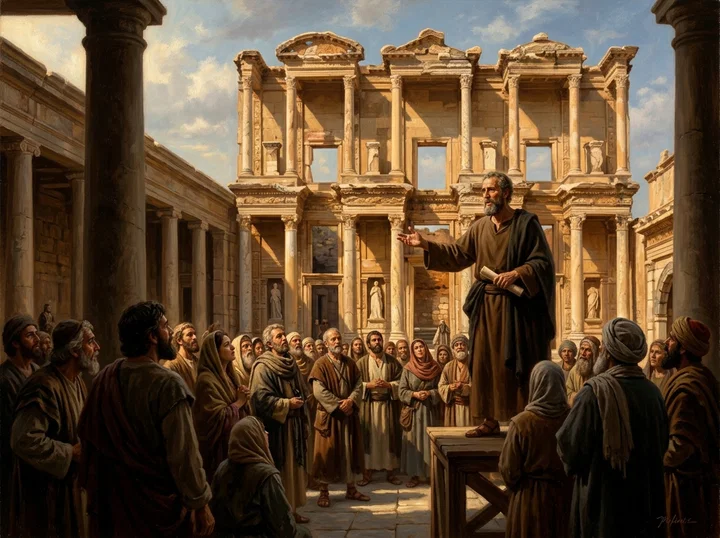
And he went into the synagogue, and spake boldly for the space of three months, disputing and persuading the things concerning the kingdom of God.
Translations
American King James Version, Webster Bible
And he went into the synagogue, and spoke boldly for the space of three months, disputing and persuading the things concerning the kingdom of God.
King James Version, KJV Cambridge Paragraph Bible
And he went into the synagogue, and spake boldly for the space of three months, disputing and persuading the things concerning the kingdom of God.
Revised Version, American Standard Version
And he entered into the synagogue, and spake boldly for the space of three months, reasoning and persuading as to the things concerning the kingdom of God.
And having gone into the synagogue, he was speaking boldly for three months, reasoning and persuading the things concerning the reign of God,
And entering into the synagogue, he spoke boldly during three months, reasoning and persuading [ the things] concerning the kingdom of God.
And, entering into the synagogue, he was speaking boldly for three months, reasoning and persuading concerning the kingdom of God.
Berean Standard Bible, Majority Standard Bible
Then Paul went into the synagogue and spoke boldly there for three months, arguing persuasively about the kingdom of God.
He entered into the synagogue and spoke boldly for a period of three months, reasoning and persuading about the things concerning God’s Kingdom.
And he went into the Synagogue, and for three months he was preaching there without fear, reasoning and teaching about the kingdom of God.
Moreouer he went into the Synagogue, and spake boldly for the space of three moneths, disputing and exhorting to the things that appertaine to the kingdome of God.
Douay-Rheims (Challoner revision)
And entering into the synagogue, he spoke boldly for the space of three months, disputing and exhorting concerning the kingdom of God.
Pictures
Cross-references
- Acts 18:19
And he came to Ephesus, and left them there: but he himself entered into the synagogue, and reasoned with the Jews.
Paul reasons with Jews in the Ephesian synagogue.
- Mark 1:14-15
Now after that John was put in prison, Jesus came into Galilee, preaching the gospel of the kingdom of God,
Both proclaim the kingdom of God.
- Acts 19:19-20
Many of them also which used curious arts brought their books together, and burned them before all men: and they counted the price of them, and found it fifty thousand pieces of silver.
Ephesian preaching led people to abandon magic, and God’s word grew mightily.
- Acts 28:30-31
And Paul dwelt two whole years in his own hired house, and received all that came in unto him,
Paul boldly preached the kingdom of God and taught about Jesus in Rome.
- Luke 9:60
Jesus said unto him, Let the dead bury their dead: but go thou and preach the kingdom of God.
Jesus directs a follower to preach the kingdom of God.
- Acts 17:2
And Paul, as his manner was, went in unto them, and three sabbath days reasoned with them out of the scriptures,
Paul’s synagogue teaching follows his customary method of reasoning from Scripture.
- Acts 18:4
And he reasoned in the synagogue every sabbath, and persuaded the Jews and the Greeks.
Paul reasoned and persuaded listeners in a synagogue.
- John 14:6
Jesus saith unto him, I am the way, the truth, and the life: no man cometh unto the Father, but by me.
defines 'the Way' Paul proclaimed
- Acts 28:23
And when they had appointed him a day, there came many to him into his lodging; to whom he expounded and testified the kingdom of God, persuading them concerning Jesus, both out of the law of Moses, and out of the prophets, from morning till evening.
Paul continued preaching and persuading people about the kingdom of God.
- Acts 20:17-18
And from Miletus he sent to Ephesus, and called the elders of the church.
Paul recalls his extended ministry in Ephesus.
- Matthew 6:10
Thy kingdom come. Thy will be done in earth, as it is in heaven.
The prayer for God’s kingdom to come is described as nearing fulfillment.
- Acts 19:23-27
And the same time there arose no small stir about that way.
Paul’s teaching about God’s kingdom turns people from handmade gods and threatens Diana’s worship.
- Daniel 2:44
And in the days of these kings shall the God of heaven set up a kingdom, which shall never be destroyed: and the kingdom shall not be left to other people, but it shall break in pieces and consume all these kingdoms, and it shall stand for ever.
Daniel’s prophecy promises God’s everlasting kingdom.
- 1 Corinthians 15:32
If after the manner of men I have fought with beasts at Ephesus, what advantageth it me, if the dead rise not? let us eat and drink; for to morrow we die.
Paul’s reference to fighting beasts at Ephesus connects with the events in Acts 19.
- Revelation 11:15
And the seventh angel sounded; and there were great voices in heaven, saying, The kingdoms of this world are become the kingdoms of our Lord, and of his Christ; and he shall reign for ever and ever.
The heavenly announcement declares the world’s kingdom to belong to God and Christ.
Commentary
Each commentary is drawn from primary sources: the writings of Ellen G. White and Adventist pioneers and periodicals. Each commentary is separate. Its own words are not a quotation; follow the references to read the source passages.
Ellen G. White
13 sources
Paul began his work in Ephesus in the Jewish synagogue, where he labored openly and boldly for three months, reasoning with his hearers and persuading them concerning the kingdom of God.AA 285.2–3RH Sep 7, 1911SLP 133.3–134.1 Ephesus was a major commercial center whose busy harbor and streets brought people from many countries, its way prepared by widespread news that Jesus was the promised Messiah, and Paul came there on his return through Asia Minor strengthening the believers in the churches he had established.AA 281.3AA 281.1AA 281.2 His synagogue preaching followed finding about twelve disciples who knew only John's baptism, who were then baptized in the name of the Lord Jesus and received the Holy Spirit when he laid hands on them, speaking with tongues and prophesying.7MR 353.4Ms 127, 1905, par. 22–23Ms 43, 1907, par. 2–5 He at first received a favorable hearing, but some hardened themselves against the gospel and spoke evil of the way, the Jews being defeated in controversy and growing angry as a Christian church was raised up, so he withdrew to teach daily in the school of Tyrannus for two years until all in Asia heard, with special miracles of healing and expulsion of evil spirits, the failure of the seven sons of Sceva, fear falling on Jews and Greeks, the magnifying of Jesus, confession, and the burning of books of curious arts valued at fifty thousand pieces of silver.Ms 127, 1905, par. 22–23AA 285.2–3RH Sep 7, 1911SLP 133.3–134.1SLP 215.1–216.3 This began a long, aggressive evangelistic ministry in Ephesus and that region lasting three years, cheered by Aquila and Priscilla and supported by tent-making, which established a large church in a stronghold of heathenism and is recorded for the instruction of the churches today that the same Holy Spirit presence will go with everyone who labors together with God in humility, prayer, and surrender of the will.Ms 43, 1907, par. 2–5RH Mar 13, 1900SLP 209.2–210.2AA 351.1
Setting and Sequence
Ephesus was a major commercial center whose busy harbor and streets brought people from many countries, making it a promising field for missionary work.AA 281.2 The way for the work there was prepared by widespread news that Jesus was the promised Messiah, carried by Jews returning from Jerusalem's annual feasts.AA 281.3 The preaching in the synagogue belongs to Paul's return to Ephesus after traveling through Asia Minor strengthening the believers in the churches he had established.AA 281.1
That synagogue preaching followed his finding about twelve disciples who knew only John's baptism of repentance toward Christ to come.Ms 43, 1907, par. 2–5 They were then baptized in the name of the Lord Jesus and received the Holy Spirit when Paul laid his hands on them, speaking with tongues and prophesying.7MR 353.4Ms 127, 1905, par. 22–23Ms 43, 1907, par. 2–5 With that beginning, Paul began his work in Ephesus in the Jewish synagogue, where he labored openly and boldly for three months, reasoning and persuading concerning the kingdom of God.7MR 353.4Ms 127, 1905, par. 22–23AA 285.2–3RH Sep 7, 1911SLP 133.3–134.1
The three months of bold reasoning and persuading preceded the hardening and unbelief of some who spoke evil of the way.Ms 127, 1905, par. 22–23 Paul then withdrew to teach daily in the school of Tyrannus for two years so that all in Asia heard.Ms 127, 1905, par. 22–23 God worked special miracles by Paul's hands healing disease and expelling evil spirits through cloths brought from his body, while the seven sons of Sceva failed and were wounded when attempting exorcism in the name of Jesus whom Paul preaches.Ms 127, 1905, par. 22–23 Fear then fell on Jews and Greeks at Ephesus, the name of Jesus was magnified, believers confessed, and books of curious arts valued at fifty thousand pieces of silver were publicly burned, so that the word of God grew mightily and prevailed.Ms 127, 1905, par. 22–23
Ministry and Application
Paul began in the synagogue with open, bold reasoning and persuasion about the kingdom of God, and at first he was given a favorable response and hearing.AA 285.2–3RH Sep 7, 1911SLP 133.3–134.1 Opposition then grew as some hardened themselves against the gospel, persisted in rejecting it, and spoke against it and against the way.AA 285.2–3RH Sep 7, 1911SLP 133.3–134.1 Because of that unbelieving persistence he stopped preaching in the synagogue and withdrew from it.AA 285.2–3RH Sep 7, 1911SLP 133.3–134.1 In that disputing the Jews were defeated in controversy with him, and they grew increasingly angry as his work succeeded and a Christian church was raised up.SLP 215.1–216.3
The three months of synagogue work opened a long, aggressive evangelistic ministry in Ephesus and throughout that region.AA 351.1 That Ephesian ministry lasted three years, during which he again worked at his tent-making trade for support.AA 351.1 Those who describe the stay and preaching more fully put it at three years and six months, adding that his manual labor did not diminish his ministry.RH Mar 13, 1900 As in Corinth, he was cheered in Ephesus by the presence of Aquila and Priscilla, who had accompanied him to Asia at the close of his second missionary journey.AA 351.1 Through this labor a large church was established in a stronghold of heathenism, showing the power of God working through the ministry and helping convince others of the truth and of the reach of the gospel among the Gentiles.SLP 209.2–210.2
The experience is recorded for the instruction of the churches today.Ms 43, 1907, par. 2–5 The same presence of the Holy Spirit given to disciples especially set apart will go with everyone who will be a laborer together with God, seeking His counsel and surrendering the will to His will.Ms 43, 1907, par. 2–5 The Holy Spirit is the sacred endowment of those who humble their hearts before God and submit to His guidance, and the secret of their power.Ms 43, 1907, par. 2–5 That endowment is brought by much prayer and constant humbling of the heart and surrender of the will.Ms 43, 1907, par. 2–5 To those who yield to the Spirit's leading are pledged the help of the Father, the Son, and the Holy Spirit, with angels working for them.Ms 43, 1907, par. 2–5
Sources
Pioneers and periodicals
49 sources
Paul went into the Jewish synagogue at Ephesus and spoke boldly for three months, disputing and persuading about the kingdom of God.GSAM 174.2RH Jan 13, 1852ST Jun 28, 1883 The kingdom he set forth was Christ's coming and reign, preached to move men to repent, believe in Christ and accept the claims of the gospel.ST Jun 28, 1883RH Jul 11, 1854RH Mar 8, 1915ST Jun 28, 1883 He did this in seventh-day synagogue meetings, showing he still observed the Sabbath and gave no sanction to first-day sacredness, though those gatherings are also taught to have been missionary reasoning with the Jews rather than Christian assemblies for Sabbath-keeping.RH Jun 7, 1864ST Jul 13, 1882RH Mar 25, 1873RH Nov 21, 1871RH Mar 25, 1873 When unbelievers hardened and spoke evil of the Way he left the synagogue, separated the disciples and reasoned daily in the school of Tyrannus about two years, so that all in Asia, Jews and Greeks, heard the word of the Lord.ST Jun 4, 1885RH Sep 7, 1911ST Feb 10, 1898RH Feb 26, 1914ST Jul 29, 1897 That widespread hearing, even by sound and report, counts as the gospel of the kingdom truly preached, and his bold public work followed by quieter labor elsewhere is the pattern for continuing the message when hearers harden and oppose.GSAM 174.2ST Jun 28, 1883RH Jan 18, 1870RH Feb 19, 1857RH Feb 6, 1855
Paul's Work in Ephesus
Paul entered the Jewish synagogue at Ephesus and spoke boldly for three months, disputing and persuading about the things concerning the kingdom of God.GSAM 174.2RH Jan 13, 1852ST Jun 28, 1883RH Jan 9, 1913RH Jul 11, 1854 That work he next took up at Ephesus was sustained public reasoning to persuade his hearers, continued unweariedly even twenty-one years after his conversion.RH Jan 9, 1913ST Feb 10, 1898 He began or resumed his Ephesian labor there with a favorable hearing, but unbelieving hearers hardened, rejected the gospel and spoke evil of the Way before the multitude, so he stopped preaching in the synagogue and was driven out from it.ST Jun 4, 1885RH Sep 7, 1911ST Jul 29, 1897
After leaving the synagogue he departed from the opposers, separated the disciples, and reasoned daily in the school of Tyrannus.ST Feb 10, 1898ST Jul 29, 1897RH Nov 22, 1906 Strong prejudice forced an end to the public synagogue effort, after which he continued teaching in that quieter setting.RH Feb 26, 1914ST Jul 29, 1897 That daily reasoning continued about two years, so that all who dwelt in Asia, both Jews and Greeks, heard the word of the Lord.ST Feb 10, 1898ST Jul 29, 1897RH Nov 22, 1906
This Ephesian work came after he found about twelve disciples who knew only John's baptism.ST Feb 10, 1898ST Aug 12, 1897 He taught them to believe on Jesus, baptized them in the name of the Lord Jesus, and laid hands on them so the Holy Spirit came on them.ST Feb 10, 1898ST Aug 12, 1897 Those disciples had received John's baptism without learning that Jesus had come, risen and been glorified and that the Holy Spirit had been given, so their baptism by John and their later baptism in Christ's commission were two separate occasions, not three immersions making one baptism.ST Jun 14, 1883ST Feb 10, 1898
He resided in Ephesus more than two years and did a marvelous work there with fullest instruction in Christian life.RH Mar 13, 1900ST Jan 7, 1913 One account describes his stay and preaching there as lasting three years and six months, accompanied by work at his trade which did not diminish his ministry.RH Mar 13, 1900ST Jan 7, 1913 The Ephesian account belongs with his statement about fighting beasts there; he did not contend with Demetrius and his fellow craftsmen and was scarcely in danger in their uprising, while Gaius and Aristarchus were in greater danger.RH Dec 3, 1867 It stands within the latter portion of Acts that records his arrival in Rome, his reception, his effort to reach his own people with its twofold result, without recording his last imprisonment and death, as part of an inspiring record of men who trusted God.ST Oct 29, 1912
Meaning of the Kingdom
Paul went into the synagogue at Ephesus and spoke boldly for three months, reasoning and persuading about the kingdom of God.ST Jun 28, 1883RH Jul 11, 1854RH Mar 8, 1915ST Jun 28, 1883 That kingdom was the central subject of apostolic preaching, meaning Christ's coming and reign.RH Mar 8, 1915ST Jun 28, 1883 Its coming and kingdom was preached as the gospel motive to move people to repent, believe in Christ, and accept the claims of the gospel.ST Jun 28, 1883RH Jul 11, 1854ST Jun 28, 1883 When many hardened themselves, refused to believe, and spoke against the teaching, he continued the message elsewhere rather than stopping, and God blessed the continued work with special miracles, so the example calls for continuing to preach it elsewhere even when church hearers become hardened and oppose it.ST Jun 28, 1883RH Jul 11, 1854ST Jun 28, 1883
The message he proclaimed was Christ as the Way of Life.ST Aug 12, 1897 That proclamation dethroned idols in the hearts of the people and caused the stir against him.ST Aug 12, 1897 In Ephesus the gospel about God's kingdom helped turn idolaters into saints and martyrs.RH Oct 16, 1860ST Aug 12, 1897 The work there included the baptism of disciples who had not been baptized in the name of Jesus, the reception of the Holy Ghost by those disciples, teaching in the school of Tyrannus, miracles of healing by the hand of Paul, the failed attempt of Jewish exorcists to use the name of Jesus in casting out spirits, and the burning of books of magic by converts.ST Aug 12, 1897
Sabbath and Worship Setting
The three months of bold speaking in the synagogue at Ephesus came two years after the work at Corinth.RH Jun 7, 1864 Those Ephesian synagogue meetings were seventh-day Sabbath meetings, continuing the same pattern as before, and they show that turning to the Gentiles had not ended Sabbath observance.RH Jun 7, 1864RH Dec 19, 1871 The claim that these were Sunday services is therefore rejected, since the synagogue meetings had previously been held on the Sabbath.RH Jun 7, 1864 Continuance in attending synagogue meetings after Acts 18:4 is evidence of continued Sabbath observance.RH Dec 19, 1871 Even after declaring at Corinth that exclusive labor would be for Gentiles, work among Jews continued elsewhere, and teaching in the synagogue at Ephesus proves that declaration did not mean addressing Jews generally had ceased or conduct toward the Sabbath had changed.RH Dec 19, 1871
Continued access to preach in the Ephesian synagogue for three months, reasoning and persuading about the kingdom of God, is evidence of not having abandoned the Sabbath or taught that the first day had replaced the seventh.ST Jul 13, 1882 No trace of first-day sanctification is found there.ST Jul 13, 1882 The history of Acts 19 gives no hint of a new Sabbath.ST Jul 13, 1882RH Nov 21, 1871
The work was missionary reasoning with Jews in the synagogue at Ephesus, seeking to persuade them about the kingdom of God through three months of missionary labor.RH Mar 25, 1873RH Mar 25, 1873 It was carried on among Jews and others gathered there in their seventh-day synagogue meetings.RH Mar 25, 1873RH Mar 25, 1873 It was preaching to a Jewish gathering and a synagogue gathering, not a Christian church meeting assembled to observe the Sabbath.RH Mar 25, 1873RH Mar 25, 1873
Worldwide Gospel Proclamation
Paul's teaching work centered at Ephesus for two years caused the word of the Lord Jesus to be heard throughout all Asia by both Jews and Greeks.RH Jan 18, 1870RH Feb 19, 1857RH Feb 6, 1855ST Feb 11, 1875 That hearing did not mean every person heard Paul preach a sermon in person.RH Jan 18, 1870RH Jul 21, 1853RH Feb 19, 1857RH Feb 6, 1855ST Feb 11, 1875 What reached them was the sound and report that the gospel was preached, the message spreading widely enough for people across the region to hear it.RH Jan 18, 1870RH Jul 21, 1853RH Feb 19, 1857RH Feb 6, 1855ST Jun 12, 1879 Such widespread hearing through the spread of its sound counts as the gospel being preached, so a proclamation can reach a wide region without every person hearing the same single sermon.RH Jan 18, 1870RH Jul 21, 1853ST Feb 11, 1875ST Jun 12, 1879
The work that began in the synagogue and continued in teaching thus fulfills its purpose when the gospel's message is heard across a region, without requiring every person to hear a sermon directly.RH Feb 19, 1857RH Feb 6, 1855 This precedent shows that news that the truth is preached is sufficient proclamation.RH Feb 19, 1857RH Feb 6, 1855 On that ground the gospel of the kingdom has been or can be preached in all the world to fulfill prophecy, its message heard across the world as the Ephesian message was heard across Asia.RH Feb 19, 1857RH Feb 6, 1855
Power and Fruit There
Ephesus was a major city in Asia Minor, known for its great Temple of Diana, for the worship of Diana, and for the practice of magic, a stronghold of heathenism where Paul labored for several years among the Gentiles and a strong and large church of God was established.ST Nov 29, 1910ST Jan 15, 1885 His bold speaking in the synagogue for three months, disputing and persuading about the kingdom of God, was confirmed by God with special miracles, with power displayed through him in healing the sick and casting out evil spirits.ST Jun 28, 1883RH Nov 22, 1906 When many hardened themselves and spoke against the teaching, he continued his work elsewhere, teaching and disputing daily for two years so that the word spread through Asia among Jews and Greeks, and God still blessed the work with special miracles.ST Jun 28, 1883RH Nov 22, 1906
The word of God triumphed and prevailed at Ephesus despite opposition and persecution.ST Jul 7, 1909RH Nov 22, 1906 That triumph brought a deeper and lasting peace, as idolaters and sorcerers turned from idolatry to God, abandoned their former practices, and destroyed their books, thereby breaking their ties with their evil past.ST Jan 23, 1907 The resulting loss to the business of Diana's worshipers stirred opposition and caused Paul to be treated as a threat to the city's peace.ST Jan 23, 1907 The preaching brought a true change of conscience through the Gospel and the Spirit, not by compulsion or force of law: some believed while others hardened themselves, and those whose consciences were awakened confessed their evil deeds and burned their costly books of divination, abandoning idolatry and the practices that bound them to sin.ST Sep 3, 1896
The right kind of conversion illustrated here is a yielding to Christ that tears out and destroys whatever stands in the way, as the believing Ephesians burned their books of magic, requiring anyone possessed by idols to give up even profitable sin to follow God.ST Dec 14, 1904 Converts so changed were not to return to the worship of Diana merely to please friends or avoid reproach.RH Jul 2, 1861 The same work included the baptism of disciples who had not been baptized in the name of Jesus and their reception of the Holy Ghost, teaching in the school of Tyrannus, miracles of healing by the hand of Paul, the failed attempt of Jewish exorcists to use the name of Jesus in casting out spirits, and the burning of books of magic by converts who honored Jesus, confessed their deeds, and abandoned those books.RH Nov 22, 1906ST Aug 12, 1897 The message proclaimed was Christ as the Way of Life, and that proclamation dethroned idols in the hearts of the people, caused the stir against Paul, and showed the word of God growing and prevailing.RH Nov 22, 1906ST Aug 12, 1897
Doctrine Practice and Application
Paul's extended bold reasoning and persuading about the kingdom of God during three months in the Ephesian synagogue was part of the labor that established a large church there.RH Sep 4, 1866ST Jan 15, 1885 That church stood in Ephesus, a major city in Asia Minor known for its great Temple of Diana, and included a strong church of God among the Gentiles raised up in that stronghold of heathenism through what God accomplished by him.ST Nov 29, 1910ST Jan 15, 1885 His sustained three months in the synagogue, followed by daily teaching elsewhere, was his ordinary practice of speaking boldly, disputing and persuading about God's kingdom.RH Jan 9, 1913ST Feb 10, 1887 It showed that he had not grown weary of preaching even twenty-one years after his conversion, adapting his approach to both synagogue and school of Tyrannus while continuing the gospel.RH Jan 9, 1913 Strong prejudice eventually forced an end to the public synagogue effort, after which he continued in a quieter setting.RH Feb 26, 1914
His mighty work in Ephesus, together with his work in Corinth, shows that ministers need more time to do good work in great cities.ST Jun 27, 1900 His ministry at Ephesus, described as a stay and preaching lasting three years and six months, was accompanied by work at his trade, which did not diminish his ministry.RH Mar 13, 1900 He preached openly and directly rather than softening difficult teachings until hearers were supposedly ready.ST Mar 5, 1894 His preaching was not entertainment to win applause like humorous revival sermons.ST Apr 1, 1886 He gave the Jews the first opportunity to hear the teaching about Christ by speaking boldly in their synagogue for three months.ST Oct 4, 1883
His warning to professed servants of God about neglected duties and rejected truth was rightful warning and not merely an effort to win church members, since even zealous worshipers indulging in sin needed to be warned.ST Oct 4, 1883 The Ephesus record gives an apostolic example of rebaptism to be followed when circumstances justify it, and prejudice against rebaptism is wrong.RH Apr 2, 1857 Sprinkling in infancy or at any other time is not baptism, so to baptize such a person afterward is not rebaptism.RH Apr 2, 1857 Mode alone is not the only essential in the ordinance, for the order and purpose specified in the gospel plan are essential, so one baptized out of that order and for other purposes must be baptized in that order and for that purpose even if baptized twenty times before, and no unauthorized ceremony contrary to Scripture can invalidate or render unnecessary the authorized scriptural ordinance.RH Apr 2, 1857
His example directs believers proclaiming the Lord's coming and kingdom to continue working among the existing churches, reasoning and persuading, rather than separating at once or stopping preaching.GSAM 174.2RH Jan 13, 1852RH Mar 6, 1855 Separation followed only when some hardened themselves and publicly spoke evil against the way of the Lord's coming.GSAM 174.2RH Jan 13, 1852RH Mar 6, 1855 Even when church hearers become hardened, refuse to believe, and oppose the kingdom message, the call is to continue preaching it elsewhere rather than stop.ST Jun 28, 1883RH Jul 11, 1854ST Jun 28, 1883 The kingdom so preached means Christ's coming and reign, proclaimed as the gospel motive to move people to repent, believe in Christ, and accept the gospel's claims, and when Paul so continued elsewhere God blessed the work with special miracles.ST Jun 28, 1883RH Jul 11, 1854ST Jun 28, 1883
Sources