Deuteronomy 1:24
And they turned and went up into the mountain, and came unto the valley of Eshcol, and searched it out.
Translations
American King James Version, Darby Translation
And they turned and went up into the mountain, and came to the valley of Eshcol, and searched it out.
And they turned and went up into the mountain, and came unto the valley of Eshcol, and searched it out.
and they turned and went up into the mountain, and came unto the valley of Eshcol, and searched it out.
And they turned and ascended the mountain, and came to the valley of Eshcol, and explored it.
and they turned and went up into the mountain, and came unto the valley of Eshcol, and spied it out.
and they turned and went up into the hill-country, and came unto the valley of Eshcol, and spied it out.
'And they turn and go up to the hill-country, and come in unto the valley of Eshcol, and spy it,
And they turned and went up the hill-country, and entered in as far as the ravine of Eshcol, and explored it.
Berean Standard Bible, Majority Standard Bible
They left and went up into the hill country, and came to the Valley of Eshcol and spied out the land.
They turned and went up into the hill country, and came to the valley of Eshcol, and spied it out.
And they went up into the hill-country and came to the valley of Eshcol, and saw what was there.
Who departed, and went vp into the mountaine, and came vnto the riuer Eshcol, and searched out the land.
Douay-Rheims (Challoner revision)
Who, when they had set forward and had gone up to the mountains, came as far as the valley of the cluster: and having viewed the land,
Pictures
Cross-references
- Numbers 13:17-24
And Moses sent them to spy out the land of Canaan, and said unto them, Get you up this way southward, and go up into the mountain:
The spies explore Canaan and bring back fruit from Eshcol.
- Numbers 14:34
After the number of the days in which ye searched the land, even forty days, each day for a year, shall ye bear your iniquities, even forty years, and ye shall know my breach of promise.
Israel’s refusal to obey led to forty years of wilderness wandering.
- Numbers 13:23
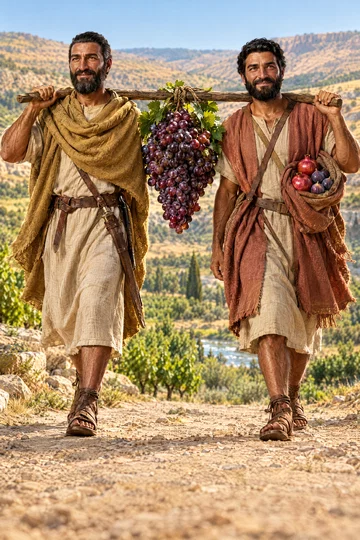
And they came unto the brook of Eshcol, and cut down from thence a branch with one cluster of grapes, and they bare it between two upon a staff; and they brought of the pomegranates, and of the figs.
The spies searched Eshcol and brought back its fruit.
- Numbers 14:1-4
And all the congregation lifted up their voice, and cried; and the people wept that night.
Israel rejects entry into Canaan after hearing the spies’ report.
- Numbers 13:28
Nevertheless the people be strong that dwell in the land, and the cities are walled, and very great: and moreover we saw the children of Anak there.
saw walled cities and giants and feared
- Numbers 13:25
And they returned from searching of the land after forty days.
Reports the spies’ return after exploring the land.
- Numbers 32:8-9
Thus did your fathers, when I sent them from Kadesh-barnea to see the land.
Both recount the search of Eshcol and the discouragement of Israel.
Commentary
Each commentary is drawn from primary sources: the writings of Ellen G. White and Adventist pioneers and periodicals. Each commentary is separate. Its own words are not a quotation; follow the references to read the source passages.
Ellen G. White
6 sources
The verse records a reconnaissance in which twelve men, one from each tribe, went up into the mountain country of Canaan, came to the valley of Eshcol, and searched out the land.Ms 9, 1903, par. 7–9Lt 106, 1897, par. 21–24RH Dec 31, 1903 They brought back fruit from the land and reported that the land the Lord had given to Israel was good.Ms 9, 1903, par. 7–9RH Dec 31, 1903 After seeing the land, the spies through unbelief and fear discouraged the heart of Israel, so the people refused to enter the land the Lord had given them and rebelled against God's command to enter, doing as their fathers did when sent from Kadesh-barnea.Ms 9, 1903, par. 7–9Lt 106, 1897, par. 21–24RH Dec 31, 1903
The verse belongs to the history of Israel's failures and victories during forty years of wandering that Moses was to repeat to the people as they approached possession of Jericho, carrying forward the principles God had given them.Lt 204, 1908, par. 2–3 The first chapter where the verse stands must be read carefully to see why the Lord refused to bring the adults of the army that left Egypt into the promised land.15MR 292.3 This disobedience kindled the Lord's anger so that He swore that none of the men that came up out of Egypt from twenty years old and upward would see the land sworn to Abraham, Isaac and Jacob, because they had not wholly followed Him, save Caleb and Joshua who wholly followed the Lord.Lt 106, 1897, par. 21–24 He made Israel wander forty years until all that evil generation was consumed.Lt 106, 1897, par. 21–24
The verse proves that the Lord's promises are upon condition of obedience and of keeping His judgments and ordinances.15MR 292.3Lt 106, 1897, par. 21–24 The verse warns that rising up in the fathers' stead to turn away will again leave His people in the wilderness and destroy them.Lt 106, 1897, par. 21–24
The verse is written for admonition for those living when the ends of the world are come, and its setting in Deuteronomy 1, 7 and 8 is to be read in the light of the example of Christ.Lt 73, 1896, par. 30–31 It requires following the Lord's guidance fully rather than only up to the point that agrees with human judgment and personal ideas.Lt 73, 1896, par. 30–31 This means looking to Christ who is truth for self-denial and self-sacrifice and perfection of character instead of living to please self.Lt 73, 1896, par. 30–31
Sources
Pioneers and periodicals
6 sources
Deuteronomy 1:24 was spoken in the final year of Moses' life, in the fortieth year after Israel left Egypt and the thirty-eighth year of its journey from Sinai, while Israel was camped in Moab east of the Jordan waiting to enter the promised land and Moses was preparing to rehearse God's laws for the people.ST May 23, 1911 It belongs to Moses' retelling of the law and of God's dealings with Israel during the forty years in the wilderness, recalled just before crossing the Jordan, which recounts Israel's unbelief and stumbling alongside a reminder of God's goodness.ST Mar 1, 1910RH Aug 20, 1903 That retelling revived in Israel a spirit to go over the Jordan and enter the promised land.RH Aug 20, 1903
The verse describes part of the reconnaissance of Canaan, when twelve spies sent from Kadesh-barnea went up into the mountain country and searched out the valley of Eshcol.RH Dec 31, 1903ST Aug 13, 1902ST Mar 1, 1910 The spies were princes among the people, regarded as bright, clear-headed, able men who had drawn near to the murmuring people and possessed their confidence.ST Aug 13, 1902 They saw that the land was good, fertile and productive just as God had promised, and returned laden with its fruit confirming its goodness, but they also saw great high-walled cities and gigantic men, measured these against their own small stature, and remembered the women and children and the way-worn host from Egypt.RH Dec 31, 1903ST Aug 13, 1902
Ten of them looked with physical sight only and, coming back to a murmuring and discouraged people, gave a despairing and fatal report.ST Aug 13, 1902 The people gave way to unbelief and fear, rebelled against God's command to enter, and refused the opportunity given at Kadesh-barnea.RH Dec 31, 1903ST Mar 1, 1910 Their refusal turned an eleven-day journey into thirty-eight years of wilderness wandering, turned the multitude back into the wilderness, and buried a whole generation in desert graves.ST Aug 13, 1902ST Mar 1, 1910 In connection with this journey, two of those who left Egypt entered the land, without implying that only two had been obedient when they left Egypt or counting those who were under twenty.
Sources