Deuteronomy 1:4
After he had slain Sihon the king of the Amorites, which dwelt in Heshbon, and Og the king of Bashan, which dwelt at Astaroth in Edrei:
Translations
After he had slain Sihon the king of the Amorites, which dwelled in Heshbon, and Og the king of Bashan, which dwelled at Astaroth in Edrei:
After he had slain Sihon the king of the Amorites, which dwelt in Heshbon, and Og the king of Bashan, which dwelt at Astaroth in Edrei:
after he had slain Sihon the king of the Amorites, which dwelt in Heshbon, and Og the king of Bashan, which dwelt at Astaroth in Edrei:
After he had slain Sihon the king of the Amorites, who dwelt in Heshbon, and Og the king of Bashan, who dwelt at Astaroth in Edrei:
after he had smitten Sihon the king of the Amorites, which dwelt in Heshbon, and Og the king of Bashan, which dwelt in Ashtaroth, at Edrei:
after he had smitten Sihon the king of the Amorites, who dwelt in Heshbon, and Og the king of Bashan, who dwelt in Ashtaroth, at Edrei.
after his smiting Sihon king of the Amorite who is dwelling in Heshbon, and Og king of Bashan who is dwelling in Ashtaroth in Edrei,
after he had smitten Sihon the king of the Amorites, who dwelt at Heshbon, and Og the king of Bashan, who dwelt at Ashtaroth [ and] at Edrei.
after he had smitten Sihon, king of the Amorites, who dwelt in Heshbon,—and Og, king of Bashan, who dwelt in Ashtaroth, in Edrei:
Berean Standard Bible, Majority Standard Bible
This was after he had defeated Sihon king of the Amorites, who lived in Heshbon, and then at Edrei had defeated Og king of Bashan, who lived in Ashtaroth.
after he had struck Sihon the king of the Amorites who lived in Heshbon, and Og the king of Bashan who lived in Ashtaroth, at Edrei.
After he had overcome Sihon, king of the Amorites, ruling in Heshbon, and Og, king of Bashan, ruling in Ashtaroth, at Edrei:
After that he had slaine Sihon the king of the Amorites which dwelt in Heshbon, and Og king of Bashan, which dwelt at Ashtaroth in Edrei.
Douay-Rheims (Challoner revision)
After that he had slain Sehon king of the Amorrhites, who dwelt in Hesebon: and Og king of Basan who abode in Astaroth, and in Edrai,
Pictures
Cross-references
- Joshua 24:1-13
And Joshua gathered all the tribes of Israel to Shechem, and called for the elders of Israel, and for their heads, and for their judges, and for their officers; and they presented themselves before God.
Joshua recounts Israel’s history and God’s defeat of the Amorite kings.
Commentary
Each commentary is drawn from primary sources: the writings of Ellen G. White and Adventist pioneers and periodicals. Each commentary is separate. Its own words are not a quotation; follow the references to read the source passages.
Ellen G. White
13 sources
Deuteronomy 1:4 marks the time of Moses's address in Moab after Israel had defeated Sihon king of the Amorites and Og king of Bashan.Lt 204, 1908, par. 2–320MR 111.2–112.2Lt 321, 1905, par. 8–14 Israel had crossed the desert and was encamped on the borders of the Jordan, ready to enter the promised land, as Moses neared death and spoke to the new generation that would possess Canaan.RH Jan 30, 1908Ms 101, 1905, par. 2SG4 52.217MR 344.3–4Ms 9, 1903, par. 1–2 He then rehearsed all the Lord's dealings with Israel from Egypt, with their trials, blessings, failures and judgments, and repeated and explained God's laws already given at Sinai so the people would understand His claims and the conditions for entering and prospering in the land.Lt 204, 1908, par. 2–3Ms 101, 1905, par. 2SG4 52.2Ms 9, 1903, par. 1–2Ms 12, 1904, par. 5 The opening chapter shows why the adult generation that left Egypt was refused entrance, because they disobeyed and did not wholly follow Him and died in forty years of wandering, while Caleb and Joshua were spared, proving that God's promises are upon condition of obedience.15MR 292.3Lt 106, 1897, par. 21–24Ms 12, 1904, par. 5 Those words in Deuteronomy 1, with Deuteronomy 7 and 8, were written for admonition upon whom the ends of the world are come, to turn from human judgment and self-pleasing to Christ's self-denying example and perfection of character, setting the pattern of reviewing God's early leading for those who have since come into the truth.Lt 73, 1896, par. 30–3120MR 111.2–112.217MR 344.3–4
Setting and Mosaic Rehearsal
The verse fixes the moment of Moses's address and history to the time after Israel had slain Sihon king of the Amorites and Og king of Bashan.Lt 204, 1908, par. 2–320MR 111.2–112.2Lt 321, 1905, par. 8–14Ms 113, 1906, par. 12–14 It belongs to the history God told Israel to remember, including their failures and victories, and to the words of the Lord to be read whole together with Deuteronomy 7 and Deuteronomy 8.Lt 204, 1908, par. 2–320MR 111.2–112.2 It places Moses' recounting of Israel's experiences and his final account after the defeat of Sihon, king of the Amorites who dwelt in Heshbon, and Og, king of Bashan who dwelt at Astaroth in Edrei, reminding the people of blessings received, mistakes made, and God's dealings with them.Lt 321, 1905, par. 8–14Ms 113, 1906, par. 12–14
Moses spoke in Moab when Israel had crossed the desert and was encamped on the borders of the Jordan, as Moses neared death.RH Jan 30, 1908Ms 101, 1905, par. 217MR 344.3–4 The people stood ready to enter the promised land before crossing over, at the Jordan ready to enter Canaan.Ms 9, 1903, par. 1–2Ms 12, 1904, par. 5 There Moses gathered the people and repeated and explained God's laws.RH Jan 30, 1908Ms 101, 1905, par. 2
The gathering was commanded by God shortly before Moses's death to address the new generation who would possess Canaan.SG4 52.2Ms 9, 1903, par. 1–2 These were the children grown up to whom the promise of possessing Canaan was to be fulfilled, after the journeyings of the host since departure from Egypt and after the judgments for the great transgressions of the fathers that kept them from entering the promised land.SG4 52.2 Many had been small children when the law was given with no remembrance of the grandeur of the event, and others had been born in the wilderness.SG4 52.2 They needed to hear the law and its conditions for entering and possessing the land.Ms 9, 1903, par. 1–2
Moses then rehearsed all the Lord's dealings with Israel in their journeyings from Egypt and through the wilderness.Ms 101, 1905, par. 2SG4 52.217MR 344.3–4 He related those journeyings and transgressions, including trials, failures, warnings received, blessings received, and mistakes.Lt 204, 1908, par. 2–3Ms 101, 1905, par. 2SG4 52.2Lt 321, 1905, par. 8–14 He set before them the judgments for the fathers' great transgressions that kept them from entering the land.SG4 52.2
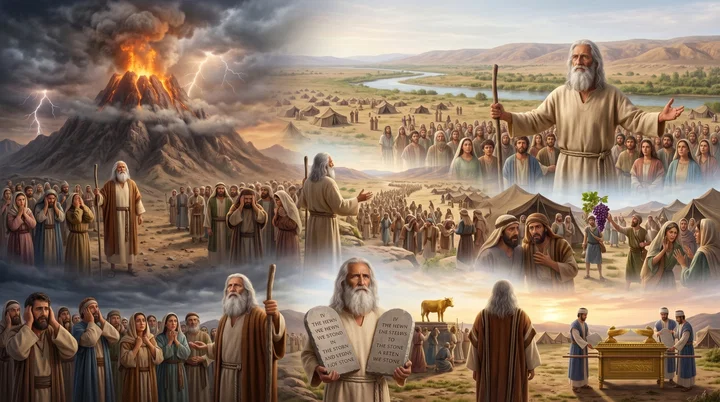
At the same time Moses repeated God's law to the new generation before they crossed the Jordan and recapitulated the ten commandments with all the laws and judgments given to Moses and all the circumstances connected with the giving of the law.SG4 52.2Ms 9, 1903, par. 1–2 He was to recount their deliverance and wilderness journey and repeat the law so the people would understand God's claims and obey as the condition of prosperity in the promised land.Ms 12, 1904, par. 5 In this way they would realize the necessity of obeying them and know the conditions for entering, possessing, and prospering in the land.SG4 52.2Ms 9, 1903, par. 1–2Ms 12, 1904, par. 5
That repetition was not a new revelation but a restatement and enlargement of laws previously given at Sinai.RH Jan 30, 1908 Their enforcement was explained, some precepts were clarified, and the reasons for them were made plain.RH Jan 30, 1908 Commands violated in earlier judgments were repeated so that the people would know that disobedience brings God's punishment.RH Jan 30, 1908
Warning and Present Application
The opening chapter explains why the Lord refused to bring the adult army and generation that left Egypt into the promised land.15MR 292.3Lt 106, 1897, par. 21–24 They disobeyed and did not wholly follow Him, so they died during forty years of wilderness wandering, while Caleb and Joshua were spared because they wholly followed the Lord.Lt 106, 1897, par. 21–24 The chapter thus proves that the Lord's promises, including prosperity in the promised land, are upon condition of obedience and full following of His guidance.15MR 292.3Lt 106, 1897, par. 21–24Ms 12, 1904, par. 5
The words of the Lord in Deuteronomy 1, to be read whole together with Deuteronomy 7 and 8, were written for admonition upon whom the ends of the world are come, to be learned, appreciated, and obeyed.Lt 73, 1896, par. 30–3120MR 111.2–112.2 They lead away from following human judgment and self-pleasing to viewing everything in the light of Christ's example.Lt 73, 1896, par. 30–3120MR 111.2–112.2 Copying His self-denial and self-sacrifice, being molded after the Lord's similitude, they bring to perfection of character through Christ's merits.Lt 73, 1896, par. 30–3120MR 111.2–112.2
The rehearsal sets the pattern to be followed now.17MR 344.3–4 It is to be a reviewing and republishing of the experience through which God led His people in their early history.17MR 344.3–4 Those who have since come into the truth and are ignorant of how the Lord wrought are thereby to have it kept before them.17MR 344.3–4
Sources
Pioneers and periodicals
15 sources
Moses spoke these words in Moab while Israel waited to cross the Jordan into the promised land, in the final year of his life forty years after the exodus, after Israel had defeated Sihon king of the Amorites who dwelt in Heshbon and Og king of Bashan who dwelt at Astaroth in Edrei.RH Jan 30, 1908ST Feb 27, 1912RH Feb 24, 1916ST Feb 28, 1911ST May 23, 1911 It belongs to his rehearsal of God's goodness, deliverances and dealings with Israel along the way, including the unbelief and stumbling of the people.ST Feb 27, 1912ST Feb 28, 1911 Deuteronomy means second giving of the law, and this introduces Moses' rehearsal of the law and the events connected with its first giving at Sinai as his last work shortly before his death.ST Mar 9, 1888RH Aug 20, 1903 The laws repeated here were not a new revelation but a restatement and enlargement of those given at Sinai, with their enforcement explained, reasons made plain, and violated commands repeated so the people would know disobedience brings God's punishment, and this recounting revived in Israel a spirit to go over Jordan.RH Jan 30, 1908RH Aug 20, 1903 These are Moses' words speaking the other, second, ceremonial law to all Israel with his own voice, in contrast to the Ten Commandments which God himself spoke from heaven, the one written by Moses in a book and kept in the side of the ark relating to ceremonial ordinances, the other written by God on stone and kept inside the ark relating to moral duties.ST May 20, 1875ST Sep 21, 1876ST Mar 20, 1879ST Mar 20, 1879RH Jan 12, 1905
Historical Setting and Context
Moses gives his account and addresses after Israel had defeated Sihon the king of the Amorites who dwelt in Heshbon and Og the king of Bashan who dwelt at Astaroth in Edrei, naming their peoples, titles and dwelling places to fix the historical setting.ST Feb 27, 1912RH Feb 24, 1916ST Feb 28, 1911 Those victories had already taken place before Moses delivered his addresses, so the verse places what follows after them.ST Feb 27, 1912RH Feb 24, 1916 It belongs to the account in which Moses rehearses God's goodness to Israel.RH Feb 24, 1916
The address was spoken in Moab while Israel waited to cross the Jordan into the promised land.RH Jan 30, 1908ST May 23, 1911 It falls in the final year of Moses' life, forty years after the exodus from Egypt.ST May 23, 1911 There in Moab, after the victories over Sihon and Og, Moses repeated and explained God's laws.RH Jan 30, 1908 The verse is part of his recounting to Israel of God's deliverances along the way, recalling in particular the defeat of Sihon king of the Amorites and Og king of Bashan.ST Feb 27, 1912ST Feb 28, 1911 It places his rehearsal of God's dealings with Israel after those defeats.ST Feb 27, 1912ST Feb 28, 1911 That recounting joins together the goodness of God with the unbelief and stumbling of the people.
The surrounding chapter records that only two of the adults who left Egypt entered the promised land. Those under twenty were not included in that count. Hence this does not mean that no others were obedient when they left Egypt.
Repetition and Explanation of Law
Deuteronomy means second giving of the law, and the opening verses through this verse introduce Moses' rehearsal of the law and the events connected with its first giving at Sinai.ST Mar 9, 1888 This rehearsal was given shortly before his death as his last work of writing Israel's early experiences.ST Mar 9, 1888RH Aug 20, 1903 The laws repeated in Moab after the victories over Sihon and Og were not a new revelation but a restatement and enlargement of laws previously given at Sinai.RH Jan 30, 1908 Their enforcement was explained, some precepts were clarified, and the reasons for them were made plain.RH Jan 30, 1908 Commands violated in earlier judgments were repeated so that the people would know that disobedience brings God's punishment.RH Jan 30, 1908
The rehearsal came at the end of forty years in the wilderness, after the original commandments had been given in the third month after the departure from Egypt.RH Jan 7, 1862 Moses' later repetition of the fourth commandment is therefore distinct from the original commandment given at Horeb.RH Jan 7, 1862 This recounting is the second statement of the law, rich in righteous precept, joining a recounting of God's goodness with the unbelief and stumbling of the people. That repetition of the law and Israel's early experiences revived in Israel a spirit to go over Jordan and enter the promised land.RH Aug 20, 1903
Distinction Between Two Laws
Deuteronomy 1:1-6, including this verse, is Moses' own speaking of the other, second law to all Israel with his own voice.ST May 20, 1875ST Sep 21, 1876ST Mar 20, 1879ST Mar 20, 1879RH Nov 16, 1869 That other law is the ceremonial law, the law of Moses, the law of types.ST May 20, 1875ST Sep 21, 1876ST Mar 20, 1879ST Mar 20, 1879RH Nov 16, 1869 It stands in contrast to the Ten Commandments, the moral law, which God himself spoke from heaven with his own voice.ST May 20, 1875ST Sep 21, 1876ST Mar 20, 1879ST Mar 20, 1879RH Nov 16, 1869
All the ceremonies and other laws besides the Ten Commandments were given through Moses to the people.ST Mar 20, 1879RH Jan 12, 1905 They were written by Moses with his own hand in a book of parchment.ST Mar 20, 1879RH Jan 12, 1905 They were kept in the side of the ark.ST Mar 20, 1879RH Jan 12, 1905 By contrast the Ten Commandments were spoken by God's own voice to the people, written twice by God's own finger on tables of stone, engraved on stone, and kept inside the sacred ark in the most holy place.ST Mar 20, 1879RH Jan 12, 1905
Thus God made a plain difference between the Ten Commandment law and all other laws.ST Mar 20, 1879RH Jan 12, 1905 There is one law in the ark and another outside the ark, one on stone and another in a book, one by God and another by Moses.ST Mar 20, 1879 One relates to moral duties and the other to ceremonial ordinances and types.ST Mar 20, 1879ST Mar 20, 1879
Sources