Deuteronomy 1:5
On this side Jordan, in the land of Moab, began Moses to declare this law, saying,
Translations
American King James Version, King James Version
On this side Jordan, in the land of Moab, began Moses to declare this law, saying,
on this side Jordan, in the land of Moab, began Moses to declare this law, saying,
On the east side of Jordan, in the land of Moab, began Moses to declare this law, saying,
beyond Jordan, in the land of Moab, began Moses to declare this law, saying,
Beyond the Jordan, in the land of Moab, began Moses to declare this law, saying,
beyond the Jordan, in the land of Moab, hath Moses begun to explain this law, saying:
On this side the Jordan, in the land of Moab, began Moses to unfold this law, saying,
over the Jordan, in the land of Moab, did Moses take in hand to expound this law, saying:—
Berean Standard Bible, Majority Standard Bible
On the east side of the Jordan in the land of Moab, Moses began to explain this law, saying:
Beyond the Jordan, in the land of Moab, Moses began to declare this law, saying,
On the far side of Jordan in the land of Moab, Moses gave the people this law, saying,
On this side Iorden in the lande of Moab began Moses to declare this lawe, saying,
Douay-Rheims (Challoner revision)
Beyond the Jordan in the land of Moab. And Moses began to expound the law, and to say:
Pictures
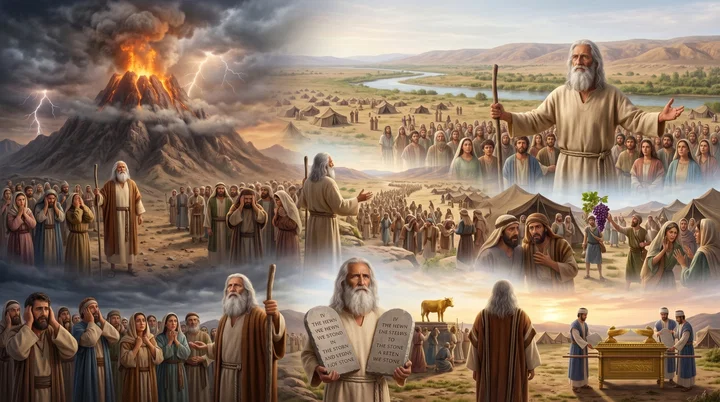
Cross-references
- Deuteronomy 31:24
And it came to pass, when Moses had made an end of writing the words of this law in a book, until they were finished,
Both describe Moses writing the law in a book.
- Deuteronomy 31:9
And Moses wrote this law, and delivered it unto the priests the sons of Levi, which bare the ark of the covenant of the LORD, and unto all the elders of Israel.
Moses writes the law and delivers it to Israel’s leaders.
- Exodus 19:1-20
In the third month, when the children of Israel were gone forth out of the land of Egypt, the same day came they into the wilderness of Sinai.
The law recapitulated in Moab was first given at Sinai.
- Exodus 24:12
And the LORD said unto Moses, Come up to me into the mount, and be there: and I will give thee tables of stone, and a law, and commandments which I have written; that thou mayest teach them.
God gave Moses the law and commandments written on stone tablets.
- Deuteronomy 5:1-21
And Moses called all Israel, and said unto them, Hear, O Israel, the statutes and judgments which I speak in your ears this day, that ye may learn them, and keep, and do them.
Moses rehearses the law and addresses Israel’s covenant responsibility.
- Deuteronomy 4:12-13
And the LORD spake unto you out of the midst of the fire: ye heard the voice of the words, but saw no similitude; only ye heard a voice.
Contrasts God speaking the law with Moses declaring it.
- Deuteronomy 33:4
Moses commanded us a law, even the inheritance of the congregation of Jacob.
both show law given through Moses
- Deuteronomy 29:1
These are the words of the covenant, which the LORD commanded Moses to make with the children of Israel in the land of Moab, beside the covenant which he made with them in Horeb.
Names the covenant made in Moab, besides the one at Horeb.
- Galatians 3:19
Wherefore then serveth the law? It was added because of transgressions, till the seed should come to whom the promise was made; and it was ordained by angels in the hand of a mediator.
The law was given through Moses as mediator.
- Luke 2:22-23
And when the days of her purification according to the law of Moses were accomplished, they brought him to Jerusalem, to present him to the Lord;
The law is called both the law of Moses and the law of the Lord.
- Deuteronomy 32:45-46
And Moses made an end of speaking all these words to all Israel:
both show Moses speaking the law
- Acts 15:5
But there rose up certain of the sect of the Pharisees which believed, saying, That it was needful to circumcise them, and to command them to keep the law of Moses.
names it the law of Moses
- Acts 3:22
For Moses truly said unto the fathers, A prophet shall the Lord your God raise up unto you of your brethren, like unto me; him shall ye hear in all things whatsoever he shall say unto you.
Peter attributes the prophecy’s words to Moses.
- Deuteronomy 4:1-2
Now therefore hearken, O Israel, unto the statutes and unto the judgments, which I teach you, for to do them, that ye may live, and go in and possess the land which the LORD God of your fathers giveth you.
Moses declares the law and urges Israel to heed it.
- Deuteronomy 31:1
And Moses went and spake these words unto all Israel.
both show Moses speaking the law
- Nehemiah 9:13-14
Thou camest down also upon mount Sinai, and spakest with them from heaven, and gavest them right judgments, and true laws, good statutes and commandments:
both distinguish God's voice law from Moses' hand law
- 2 Kings 21:8
Neither will I make the feet of Israel move any more out of the land which I gave their fathers; only if they will observe to do according to all that I have commanded them, and according to all the law that my servant Moses commanded them.
Distinguishes what God commanded from what Moses commanded.
- Exodus 34:27-28
And the LORD said unto Moses, Write thou these words: for after the tenor of these words I have made a covenant with thee and with Israel.
Moses wrote the covenant words at God’s command.
Commentary
Each commentary is drawn from primary sources: the writings of Ellen G. White and Adventist pioneers and periodicals. Each commentary is separate. Its own words are not a quotation; follow the references to read the source passages.
Ellen G. White
14 sources
On this side of the Jordan in the land of Moab, after crossing the desert as the time to enter Canaan approached, Moses began his final work before his death to declare the law.RH Jan 30, 1908Ms 9, 1903, par. 1–217MR 344.3–4 His hearers were the new generation grown up to inherit the promise, for the adult army that left Egypt had died in the wilderness, and many had been small children with no remembrance of the giving of the law or had been born in the wilderness.SG4 52.2Ms 9, 1903, par. 1–2 To declare the law was to rehearse Israel's journeyings, deliverance, blessings, failures, transgressions and judgments since leaving Egypt, and to repeat and expand the laws given at Sinai with their reasons and conditions made plain rather than to give a new revelation.Lt 204, 1908, par. 2–3RH Jan 30, 1908SG4 52.2Lt 100, 1907, par. 1017MR 344.3–4 He enjoined obedience as the condition of prosperity and possession of the land, proving that God's promises are conditional, so that obedience brings life and disobedience brings death and punishment and can alter His purpose toward His people.15MR 292.3Lt 106, 1897, par. 21–24RH Jan 30, 1908Ms 9, 1903, par. 1–2Ms 12, 1904, par. 5 The chapter is the Lord's own instruction and warning for those living at the end of the world, to be read in full and carefully with Deuteronomy 7, Deuteronomy 8 and Deuteronomy 28, calling for full following of His voice and the example of Christ rather than human judgment.STMW9 52.320MR 111.2–112.2Lt 73, 1896, par. 30–31
Setting and Audience
On this side of Jordan, in the land of Moab, beside the Jordan on its borders, Moses and Israel were encamped after crossing the desert as the time to enter Canaan approached.Ms 9, 1903, par. 1–217MR 344.3–4Ms 12, 1904, par. 5 This was Moses's final work before his death, the beginning of his final instruction to declare the law.RH Jan 30, 1908SG4 52.2Ms 12, 1904, par. 5 His hearers were the new generation preparing to possess the promised land, for the adults of the army that left Egypt had died in the wilderness and their children had grown up to inherit the promise of possessing Canaan.SG4 52.2Ms 9, 1903, par. 1–2 Many had been small children when the law was given and had no remembrance of its grandeur, and others had been born in the wilderness, so the law with its commands and the conditions for possessing the land had to be taught to them again.SG4 52.2Ms 9, 1903, par. 1–2
To declare this law meant to rehearse Israel's history and God's instruction and dealings with them.Lt 204, 1908, par. 2–317MR 344.3–4Ms 113, 1906, par. 12–14 Moses was to relate all their journeyings since leaving Egypt, their deliverance from Egypt and forty years of wandering, the blessings received, trials, failures and victories, mistakes, warnings received, and the great transgressions of their fathers that brought God's judgments upon them.Lt 204, 1908, par. 2–3SG4 52.217MR 344.3–4Lt 321, 1905, par. 8–14Ms 113, 1906, par. 12–14 The book of Deuteronomy is the record of that rehearsal directed by the Lord.17MR 344.3–4 The declaration was not a new revelation but a repeating and expanding of laws previously given at Sinai.RH Jan 30, 1908Lt 100, 1907, par. 10 Its enforcement was further explained, some precepts were clarified, reasons were made plain, commands violated in earlier judgments were repeated, and the Ten Commandments with all the laws and judgments and the circumstances connected with their giving were recapitulated.RH Jan 30, 1908SG4 52.2Lt 100, 1907, par. 10 These written and repeated commands were as truly God's words to the people as the commandments spoken aloud at Sinai and written on stone.Lt 100, 1907, par. 10
Obedience Decides Destiny
The opening of the chapter explains why the Lord refused to bring the adult men of the army that came out of Egypt into the promised land.15MR 292.3Lt 106, 1897, par. 21–24 His promises are upon condition of obedience, and the exclusion of that generation proves the condition.15MR 292.3Lt 106, 1897, par. 21–24 Their disobedience caused Him to alter His purpose toward Israel.15MR 292.3 The chapter is to be read carefully together with Deuteronomy 28 in order to see that condition of obedience.Lt 106, 1897, par. 21–24
Moses presented the claims of the law and enjoined obedience as the condition of prosperity.Ms 12, 1904, par. 5 He repeated and expanded laws previously given at Sinai rather than giving a new revelation.RH Jan 30, 1908 Their enforcement was further explained, some precepts were clarified, and the reasons for them were made plain.RH Jan 30, 1908 Commands that had been violated in earlier judgments were repeated so the people would understand that disobedience brings God's punishment.RH Jan 30, 1908Ms 12, 1904, par. 5
The precepts were to be kept before the people, taught by parents to their children, and read publicly.Ms 9, 1903, par. 1–2 This was necessary lest the new generation fail to realize the necessity of obeying the Ten Commandments and all the laws and judgments.SG4 52.2Ms 9, 1903, par. 1–2 Israel's prosperity depended on obedience.Ms 9, 1903, par. 1–2 Obedience brought life, and disobedience brought death.Ms 9, 1903, par. 1–2
Warning for Last Days
The chapter opened here is the Lord's own words and instruction for the people living at the end of the world.STMW9 52.320MR 111.2–112.2Lt 73, 1896, par. 30–31 It is to be read in full and carefully, together with Deuteronomy 7 and Deuteronomy 8, and with Deuteronomy 28, as warning and admonition for those on whom the ends of the world are come.STMW9 52.320MR 111.2–112.2Lt 73, 1896, par. 30–31Lt 106, 1897, par. 21–24
It sets the Lord's standard of perfection of character against feeble human standards.20MR 111.2–112.2Lt 73, 1896, par. 30–31 It calls for learning the word of the Lord and appreciating and obeying His voice with full following of His guidance, instead of following human judgment and ideas up to a point and then holding to self and to one's own judgment.20MR 111.2–112.2Lt 73, 1896, par. 30–31 Everything is to be viewed in the light of the example of Christ, who is the truth and the true light, to be copied and followed in self-denial and self-sacrifice and in living not to please self.20MR 111.2–112.2Lt 73, 1896, par. 30–31
At the Lord's direction Moses rehearsed to Israel all the dealings of the Lord with them during their journeyings through the wilderness, and the book of Deuteronomy is the record of that rehearsal, giving the pattern that the same work of rehearsing God's past dealings must now be done.17MR 344.3–4
Sources
Pioneers and periodicals
19 sources
On the east side of the Jordan in the land of Moab, in the eleventh month of the fortieth year after leaving Egypt and shortly before his death, Moses began to declare the law in what is the opening of Deuteronomy as a second giving and repetition of the law first given at Sinai and Horeb.ST Mar 11, 1913RH Feb 24, 1916RH Oct 7, 1851 He rehearsed God's dealings, deliverances and goodness and Israel's rebellion and failures in a first address recalling the past, not as a new revelation but as a renewed and expanded statement that clarified precepts, added reasons for obedience, and warned that disobedience brings punishment.RH Jan 30, 1908RH Feb 24, 1916ST Feb 27, 1912RH Aug 20, 1903 Knowing his death was near and fearing future apostasy, he pleaded as a loving father through whom the people were shut out with him from earthly promise by his own hasty failure, to impress the sacred import of keeping God's law.ST Mar 1, 1910ST May 23, 1911 This law declared by Moses as speaker and mediator is the ceremonial law of types and ordinances written by his own hand in a book and placed beside the ark, distinct from the Ten Commandments which God himself spoke from heaven and wrote with his finger on stone to be placed inside the ark.RH Oct 7, 1851ST May 20, 1875ST Feb 1, 1877ST Sep 21, 1876RH Jan 12, 1905 Its moral principles still bind in every age, and the seventh-day Sabbath stands at the center of the Ten apart from the shadowy ceremonial sabbaths, for its wording in Deuteronomy points back to the command given after the Exodus which memorializes creation, while deliverance from Egypt was added as a motive of gratitude and did not make it a Jewish institution.ST Feb 27, 1912RH Jan 12, 1905RH Jan 7, 1862
Place, Time and Purpose
On this side of the Jordan, in the land of Moab east of the Jordan, Moses encamped with Israel poised to cross into the promised land began to declare the law before they passed over.ST Mar 11, 1913RH Oct 7, 1851ST Mar 1, 1910ST May 23, 1911ST Feb 28, 1911 Israel was encamped there ready to enter, and Moses was not giving the law for the first time but rehearsing it for them on the eve of crossing.ST Mar 1, 1910ST May 23, 1911ST Feb 28, 1911
The declaration began at the close of the forty years' wandering, in the fortieth year after Israel left Egypt, in the eleventh month of that year.ST Mar 11, 1913RH Oct 7, 1851ST May 23, 1911ST Feb 28, 1911 It was in the final year of Moses' life and the thirty-eighth year of the journey from Sinai, shortly before his death on Mount Nebo and his handing over of his work.RH Feb 24, 1916ST May 23, 1911ST Feb 28, 1911 It was given by Moses shortly before his death as his last work.RH Aug 20, 1903
The verse begins the book of Deuteronomy, whose name means second law, repetition or duplicate of the law, or second giving and second statement of the law.ST Mar 11, 1913RH Feb 24, 1916ST Feb 28, 1911 It is not the first giving of its commandments, since the Lord had first given the law at Mount Sinai and Horeb.ST Mar 1, 1910ST Feb 28, 1911 A later section reviews the law for the new generation as a repetition and emphasis of the law.RH Feb 24, 1916
The verse begins a series of three addresses given shortly before Moses' death, the first in chapters 1-4:40 recalling God's goodness to Israel.RH Feb 24, 1916 This repetition of the law and of Israel's early experiences revived in Israel a spirit to go over Jordan and enter the promised land.RH Aug 20, 1903
Moses rehearses the law God gave at Sinai, which he faithfully wrote down to serve as Israel's constitutional and legal text for the rest of its history.ST May 23, 1911 In doing so he makes a reckoning of God's dealings with His children, recalling God's deliverances, goodness, and wonderful works, as well as Israel's unbelief, failures, rebellion, and early experiences.ST Mar 11, 1913ST Mar 1, 1910RH Aug 20, 1903 He calls the people's attention to laws already given and recalls chief laws connected with Israel.ST Feb 27, 1912ST Mar 1, 1910
The declaration is not a new revelation but a renewed statement that repeats and expands what was given before.RH Jan 30, 1908ST Feb 27, 1912 Sometimes it adds reasons for keeping laws rather than repeating exact wording, further explains enforcement, and clarifies precepts and makes plain the reasons for them.RH Jan 30, 1908ST Feb 27, 1912 Commands violated in earlier judgments were repeated so the people would understand disobedience brings God's punishment.RH Jan 30, 1908
Knowing his death is near and fearing Israel's future apostasy, Moses uses this declaration to solemnly remind, warn, plead with, and encourage the people.ST Mar 1, 1910ST May 23, 1911 Having cared like a great and loving father through forty years of wilderness wandering for often rebellious children, he brings to their remembrance the lessons God taught them during the forty years.ST Mar 1, 1910 Himself shut out from the promised land because, provoked by their rebellion, he yielded in impatience to hasty words glorifying himself instead of God, he before leaving them impresses upon them the sacred import of God's holy law and the necessity of keeping it.ST Mar 1, 1910
The law Moses set before Israel in Moab is a constitution that stressed rulers' duties more than their privileges and taught that the state's welfare depends on citizens' righteousness.RH Dec 17, 1901
Moses-Spoken Law Distinguished
On this side of Jordan in the land of Moab, Moses himself began to speak and declare this law to the people as speaker and mediator.ST May 20, 1875ST Feb 1, 1877ST Mar 20, 1879RH Nov 16, 1869 This Moses-spoken declaration stands in contrast to the Ten Commandments, which God himself spoke from heaven directly to the people.ST May 20, 1875ST Sep 21, 1876ST Mar 20, 1879ST Mar 20, 1879RH Nov 16, 1869 The opening verses through verse 6 together mark the same distinction, showing Moses speaking one law while God spoke the other.ST Sep 21, 1876ST Mar 20, 1879
The law thus declared by Moses is the ceremonial law, the law of Moses, the law of types and ceremonial ordinances.ST May 20, 1875ST Sep 21, 1876ST Mar 20, 1879ST Mar 20, 1879 It includes the covenant made with Israel in Moab, east of the Jordan in the fortieth year after Israel left Egypt, distinct from the covenant made at Horeb.RH Oct 7, 1851 That Moab setting identifies it as the law of Moses written in a book and kept beside the ark, in contrast to the moral law on the covenant tablets.RH Oct 7, 1851ST May 20, 1875ST Feb 1, 1877
This Mosaic law was written by Moses' own hand in a book of parchment and afterward placed beside or in the side of the ark.ST May 20, 1875ST Feb 1, 1877ST Mar 20, 1879RH Jan 12, 1905RH May 7, 1867 It is distinct from the moral law written by God's finger on tables of stone and placed inside the ark.ST Mar 20, 1879RH Jan 12, 1905RH May 7, 1867 The Ten Commandments were spoken by God with His own voice to the people and written by Him on stone to be kept inside the sacred ark, while all the ceremonies and other laws outside the Ten were given through Moses, written by Moses in a book, and kept in the side of the ark.RH Jan 12, 1905 The passage thus proves a plain God-made difference between the Ten Commandment law and all other ceremonies and laws outside it given through Moses.RH Jan 12, 1905
Moral Force and Application
The renewed declaration begun in Moab is a renewed statement of laws already given, sometimes adding reasons for keeping them rather than repeating their exact wording, recalling God's deliverances and calling attention to chief laws connected with Israel.ST Feb 27, 1912 Deuteronomy means repetition or second statement of the law, and the law so restated contains righteous precepts. Its moral principles apply to people in every age.ST Feb 27, 1912 The seventh-day Sabbath stands in the center of the Ten, showing its difference from the shadowy ceremonial sabbaths given through Moses.RH Jan 12, 1905
The fourth commandment as repeated in Deuteronomy is not the original Sabbath commandment.ST Feb 27, 1912RH Jan 7, 1862 Its wording, as the Lord thy God hath commanded thee, points back to the earlier command given after the Exodus.RH Jan 7, 1862 The original in Exodus 20:8-11 explains the Sabbath was established at creation and memorializes the Creator.ST Feb 27, 1912RH Jan 7, 1862 The later rehearsal gives Israel an added appeal to keep the Sabbath in gratitude for deliverance from slavery in Egypt.ST Feb 27, 1912RH Jan 7, 1862 That rescue motivates obedience but did not create the Sabbath or make it a Jewish institution.RH Jan 7, 1862 Israel had a special reason to keep it because God had redeemed them from slavery, while the Sabbath itself memorializes the Creator.ST Feb 27, 1912 The chapter's account of the two who entered the land does not mean only two Israelites were obedient when they left Egypt, and it does not count those who were under twenty years old.
Sources