Deuteronomy 21:1
If one be found slain in the land which the LORD thy God giveth thee to possess it, lying in the field, and it be not known who hath slain him:
Translations
If one be found slain in the land which the LORD your God gives you to possess it, lying in the field, and it be not known who has slain him:
If one be found slain in the land which the LORD thy God giveth thee to possess it, lying in the field, and it be not known who hath slain him:
If one be found slain in the land which the Lord thy God giveth thee to possess it, lying in the field, and it be not known who hath slain him:
If one shall be found slain in the land which the LORD thy God giveth thee to possess it, lying in the field, and it be not known who hath slain him:
If one be found slain in the land which the LORD thy God giveth thee to possess it, lying in the field, and it be not known who hath smitten him:
If one be found slain in the land which Jehovah thy God giveth thee to possess it, lying in the field, and it be not known who hath smitten him;
'When one is found slain on the ground which Jehovah thy God is giving to thee to possess it — fallen in a field — it is not known who hath smitten him,
If one be found slain in the land which Jehovah thy God giveth thee to possess, lying in the field, [ and] it be not known who hath smitten him,
When there shall be found one slain on the soil which Yahweh thy God is giving unto thee to possess, lying prostrate in the field,—it not being known who smote him,
Berean Standard Bible, Majority Standard Bible
If one is found slain, lying in a field in the land that the LORD your God is giving you to possess, and it is not known who killed him,
If someone is found slain in the land which the LORD your God gives you to possess, lying in the field, and it isn’t known who has struck him,
If, in the land which the Lord your God is giving you, you come across the dead body of a man in the open country, and you have no idea who has put him to death:
If one be founde slaine in the lande, which the Lord thy God giueth thee to possesse it, lying in the field, and it is not knowe who hath slaine him,
Douay-Rheims (Challoner revision)
Then there shall be found in the land, which the Lord thy God will give thee, the corpse of a man slain, and it is not known who is guilty of the murder,
Pictures
Commentary
Each commentary is drawn from primary sources: the writings of Ellen G. White and Adventist pioneers and periodicals. Each commentary is separate. Its own words are not a quotation; follow the references to read the source passages.
Ellen G. White
1 source
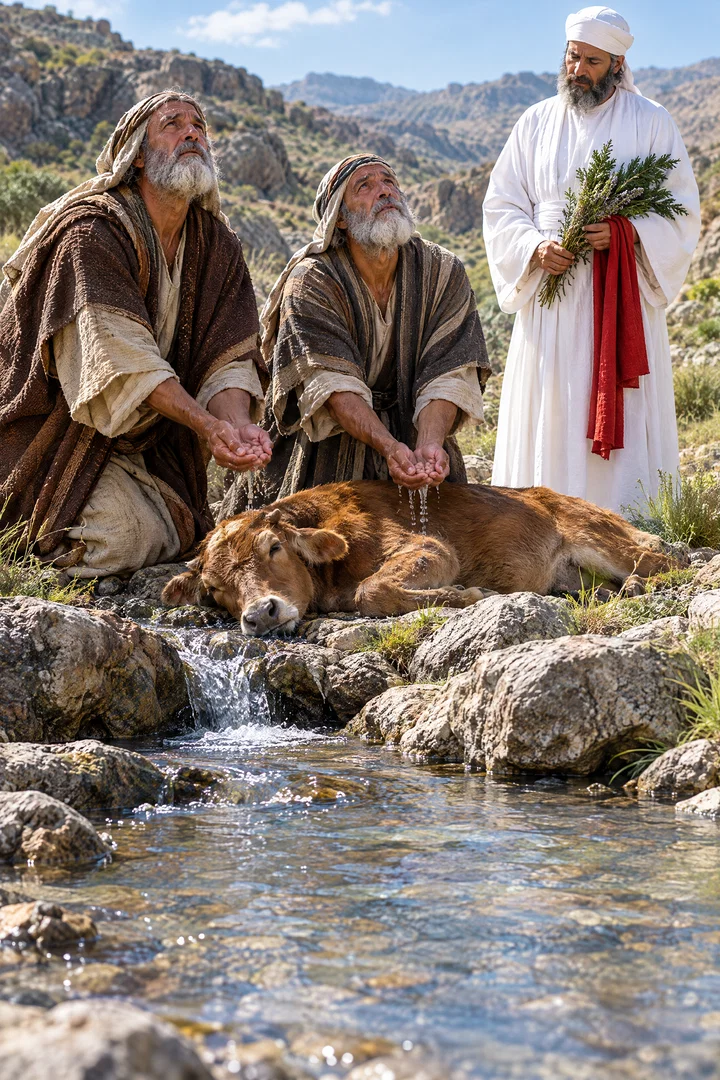
The law opens with the case of a murdered body discovered lying out in open country inside the territory given to Israel for possession, where the identity of the killer cannot be established.ST Jan 20, 1881 That discovery does not leave the death as a private misfortune but triggers a prescribed legal response.ST Jan 20, 1881 The response is a solemn public inquiry and atoning ceremony carried out under the direction of the elders, the judges, and the priests.ST Jan 20, 1881
The ceremony is a public testimony that the rulers regard the shedding of blood with abhorrence rather than indifference.ST Jan 20, 1881 It forbids carelessness or neglect toward the crime and lays upon them the duty to exert every possible effort to find the wrongdoer and bring him to justice.ST Jan 20, 1881 Behind the requirement stands the principle that unpunished murder pollutes the land itself.ST Jan 20, 1881 Those in authority who through negligence shield the guilty become partakers in the guilt.ST Jan 20, 1881
Sources
Pioneers and periodicals
4 sources
The verse belongs to Moses' rehearsal of the law given before Israel crossed the Jordan into the promised land, recalling the wonderful things God had done for His people and restating chief laws connected with Israel to impress the sacred importance of God's holy law and the necessity of keeping it.ST Mar 1, 1910 Within that rehearsal it stands in the special instructions and various directions of Deuteronomy 18-26, which set forth great principles for deciding questions and repeat laws for the government of Israel and the regulation of their worship. It describes the case of a person found slain lying in the field in the open country in the land the Lord gives to possess, when it is not known who killed him.ST Jan 20, 1881RH May 16, 1912 It opens a law requiring a solemn public inquiry and ceremony carried out under the direction of the elders, judges, and priests.ST Jan 20, 1881
Under that law the elders of the nearest city came forward, washed their hands over the body of a heifer, and prayed that God would not hold them responsible for innocent blood.RH May 16, 1912 The ceremony showed that the rulers abhorred the murder, would not treat it with carelessness or neglect, and had to make every effort to bring the wrongdoer to justice.ST Jan 20, 1881 Cities and towns were thus held responsible for crime committed near them.ST Mar 11, 1908 Unpunished crime contaminates the land and implicates those who negligently shield the guilty.ST Jan 20, 1881
Sources