Ecclesiastes 2:6
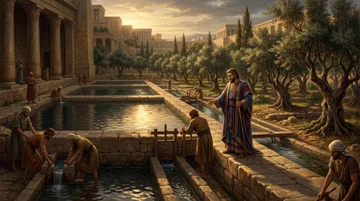
I made me pools of water, to water therewith the wood that bringeth forth trees:
Translations
I made me pools of water, to water therewith the wood that brings forth trees:
King James Version, KJV Cambridge Paragraph Bible
I made me pools of water, to water therewith the wood that bringeth forth trees:
I made me pools of water, to water with them the wood that bringeth forth trees:
I made me pools of water, to water therefrom the forest where trees were reared:
I made me pools of water, to water therefrom the forest where trees were reared;
I made for me pools of water, to water from them a forest shooting forth trees.
I made me ponds of water, to water therewith the wood, where the trees are reared.
I made me pools of water,—to irrigate therefrom the thick-set saplings growing up into trees:
Berean Standard Bible, Majority Standard Bible
I built reservoirs to water my groves of flourishing trees.
I made myself pools of water, to water the forest where trees were grown.
I made pools to give water for the woods with their young trees.
I haue made me cisternes of water, to water therewith the woods that growe with trees.
Douay-Rheims (Challoner revision)
And I made me ponds of water, to water therewith the wood of the young trees,
Pictures

Commentary
Each commentary is drawn from primary sources: the writings of Ellen G. White and Adventist pioneers and periodicals. Each commentary is separate. Its own words are not a quotation; follow the references to read the source passages.
Ellen G. White
4 sources
The verse records one of Solomon's great earthly works, the making of pools of water to water the wood that brings forth trees and the trees in his gardens.ED 153.2–4PK 76.1RH Dec 28, 1905ED 153.1 This work was part of his search for his highest good and lasting satisfaction in earthly things, in earthly pleasures and achievements, and in what his hands could make.ED 153.2–4PK 76.1RH Dec 28, 1905ED 153.1 That wider undertaking included houses, vineyards, gardens and orchards, servants and maidens, silver and gold and the special treasure of kings and of the provinces, singers and the delights of men.ED 153.1 By these things he became great and increased more than all that were before him in Jerusalem, keeping back nothing his eyes desired and withholding his heart from no joy, because his heart rejoiced in all his labor.ED 153.1
The work and its results gave no lasting satisfaction, and looking on all the works his hands had wrought he judged them vanity and vexation of spirit, with no profit under the sun and empty without God.ED 153.2–4PK 76.1RH Dec 28, 1905ED 153.1 That empty search led him to hate life and to hate all his labor.ED 153.2–4 His earthly goods were broken cisterns that left him wearied and thirsting, and in his later years he turned from them to drink again at the fountain of life.ED 153.2–4 By inspiration he recorded the history of those wasted years, including this work, as a lesson of warning for later generations, so that through the discipline of suffering his life work was not wholly lost, even though his people reaped harvests of evil from his sowing.ED 153.2–4
Sources
Pioneers and periodicals
17 sources
He built pools of water to irrigate the tree-bearing woodland and groves as part of his great works of building, planting, gardens, orchards and parks.RH May 27, 1915ST Apr 23, 1902ST Mar 27, 1901 They were three great reservoirs in the valley of Etham, partly hewn from rock and partly built of masonry and lined with cement, joined by conduits and an aqueduct to Jerusalem so that they watered both his paradise at Etham and his palaces and gardens in the city.ST Apr 23, 1902ST Mar 27, 1901ST Nov 27, 1884 With wealth, power, wisdom, riches and honor he thus fulfilled his desires and fully tested worldly pleasure, grandeur and achievement.RH Dec 28, 1905ST Mar 14, 1906ST Jun 22, 1904 Yet greatness and happiness do not go together, for all that the earth could give left him without real and undisturbed pleasure, and he judged earthly greatness, pleasure and success to be vanity and vexation of spirit.RH Dec 28, 1905RH Aug 26, 1875ST Feb 4, 1903RH May 25, 1916ST Oct 23, 1879 That selfish pursuit keeps mind and body in bondage and never reaches the contentment it seeks, while the greatest good that fills life with beauty is to fear God and keep His law, for God will bring every work into judgment.ST Jun 21, 1899ST Sep 12, 1900
Solomon's Pools and Gardens
The verse describes practical labor and skill in building, planting and other enterprises, for pools of water were constructed to irrigate the woodland and groves where trees grew, with gardens, orchards and parks around them.RH May 27, 1915ST Apr 23, 1902ST Mar 27, 1901 The pools were part of extensive waterworks for temporal provision, fed by springs and linked by aqueducts with a conduit carrying water toward Jerusalem.ST Apr 23, 1902ST Mar 27, 1901
Three pools were made in the side of the valley of Etham to keep the parks fresh and beautiful and to water the tree-bearing wood.ST Nov 27, 1884 The upper pool was 380 feet long, 236 feet wide at the eastern end and 229 at the western end, and 25 feet deep.ST Nov 27, 1884 One hundred and sixty feet below it lay the middle pool, 423 feet long, 250 feet broad at the eastern end and 160 at the western, and 39 feet deep, and 248 feet below that lay the lower pool, 582 feet long, 207 feet broad at the eastern end and 148 at the western, and 50 feet deep, each covering somewhat more than two acres.ST Nov 27, 1884 They were partly hewn from solid rock and partly built of masonry, all lined with cement, all with flights of steps from top to bottom, and all three connected by conduits and by an aqueduct to Jerusalem, so that they watered both the paradise at Etham and the palaces and gardens at the city.ST Nov 27, 1884
The pools are the reservoirs near Jerusalem and Bethlehem, past Rachel's tomb on the road from Jerusalem.ST Apr 23, 1902ST Aug 25, 1881ST Apr 23, 1902 They are enormous pools holding pure water, the longest about 580 feet, fed by springs and linked by aqueducts, a conduit, and pipes to Jerusalem and Bethlehem, with parts of the pipes still remaining.ST Apr 23, 1902ST Mar 27, 1901ST Aug 25, 1881ST Apr 23, 1902ST Nov 17, 1898 Below among barren hills lies the deep fertile vale of Urtas, filled with planted gardens and fruit-trees watered from them, and from these reservoirs water could be brought into the city.ST Aug 25, 1881ST Apr 23, 1902ST Nov 17, 1898
Pleasure Tested Found Vanity
Solomon used wealth, power, wisdom, riches, honor and sovereign power to fulfill his desires and test fully what life could offer, giving himself to worldly, carnal and temporal pleasure, grandeur and aggrandizement.RH Dec 28, 1905ST Mar 14, 1906ST Jun 22, 1904 He built up Jerusalem with the finest palaces, gold, costly furnishings, servants, gardens, orchards, pools to water tree-bearing woods, and abundant projects of every kind.RH Dec 28, 1905ST Mar 14, 1906ST Jun 22, 1904ST Oct 23, 1879 The pools for watering the wood that brings forth trees belong to that pursuit of pleasure and achievement through great works.RH Dec 28, 1905ST Mar 14, 1906ST Jun 22, 1904
Greatness and happiness do not always go together, and his experience warns that achievement and worldly success do not guarantee happiness.RH Aug 26, 1875ST Oct 23, 1879 Though he had all the earth could give with nothing seeming wanting to happiness, he had no real and undisturbed pleasure in these things.RH Aug 26, 1875ST Oct 23, 1879 His broad test of wealth, pleasure, achievement and earthly greatness as the greatest good ended in the judgment that they are empty, drear, disappointment, vanity and vexation of spirit.RH Dec 28, 1905ST Feb 4, 1903RH May 25, 1916ST Jun 21, 1899RH Sep 5, 1871 Worldly enjoyment cannot be depended upon because it is poisoned by vexation.ST Feb 4, 1903ST Oct 23, 1879 Seeking wealth, living for pleasure and striving for fame do not fill life with worth but cause loss of endless treasure, and such pursuits are vanity when they do not lead to the kingdom of God.ST Jun 21, 1899RH Sep 5, 1871
The pursuit shows the bondage of sin in selfish service for self, with selfish ideas and selfish work pervading the entire being and keeping mind and body in bondage.ST Sep 12, 1900 It is always thinking that joy, contentment and bliss are just ahead without ever reaching what is sought, bringing unhappiness and continual discontent.ST Sep 12, 1900 It brings entanglements that fill nights with sorrow and days with pain, and a lurking load of sadness carried under outward pleasantness and happiness that puts the sting of pain in every joy and leaves without desired contentment, as one of Satan's deceitful plans.ST Sep 12, 1900 The greatest good to live for, which fills life with beauty, is to fear God and keep His law and to live for God and hold His precepts fast, because God will bring every secret of the past into judgment.ST Jun 21, 1899
Sources