Esther 7:2
And the king said again unto Esther on the second day at the banquet of wine, What is thy petition, queen Esther? and it shall be granted thee: and what is thy request? and it shall be performed, even to the half of the kingdom.
Translations
And the king said again to Esther on the second day at the banquet of wine, What is your petition, queen Esther? and it shall be granted you: and what is your request? and it shall be performed, even to the half of the kingdom.
King James Version, KJV Cambridge Paragraph Bible
And the king said again unto Esther on the second day at the banquet of wine, What is thy petition, queen Esther? and it shall be granted thee: and what is thy request? and it shall be performed, even to the half of the kingdom.
And the king said again to Esther on the second day at the banquet of wine, What is thy petition, queen Esther? and it shall be granted thee: and what is thy request? and it shall be performed, even to the half of the kingdom.
And the king said again unto Esther on the second day at the banquet of wine, What is thy petition, queen Esther? and it shall he granted thee: and what is thy request? even to the half of the kingdom it shall be performed.
And the king said again unto Esther on the second day at the banquet of wine, What is thy petition, queen Esther? and it shall be granted thee: and what is thy request? even to the half of the kingdom it shall be performed.
and the king saith to Esther also on the second day, during the banquet of wine, 'What [is] thy petition, Esther, O queen? and it is given to thee; and what thy request? unto the half of the kingdom — and it is done.'
And the king said again to Esther on the second day, at the banquet of wine, What is thy petition, queen Esther? and it shall be granted thee; and what is thy request? even to the half of the kingdom it shall be done.
Then said the king unto Esther, on the second day also, during the banquet of wine, What is thy petition, Queen Esther, that it may be granted thee? and what is thy request—unto the half of the kingdom—that it may be performed?
Berean Standard Bible, Majority Standard Bible
and as they drank their wine on that second day, the king asked once more, “ Queen Esther, what is your petition? It will be given to you. What is your request? Even up to half the kingdom, it will be fulfilled.”
The king said again to Esther on the second day at the banquet of wine, “ What is your petition, queen Esther? It shall be granted you. What is your request? Even to the half of the kingdom it shall be performed.”
And the king said to Esther again on the second day, while they were drinking, What is your prayer, Queen Esther? for it will be given to you; and what is your request? for it will be done, even to the half of my kingdom.
And the King said againe vnto Ester on the second day at the banket of wine, What is thy petition, Queene Ester, that it may be giue thee? and what is thy request? It shalbe euen perfourmed vnto the halfe of the kingdome.
Douay-Rheims (Challoner revision)
And the king said to her again the second day, after he was warm with wine: What is thy petition, Esther, that it may be granted thee? and what wilt thou have done: although thou ask the half of my kingdom, thou shalt have it.
Pictures

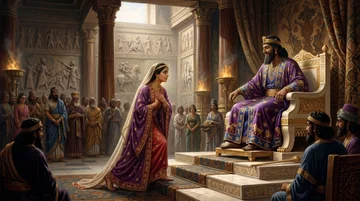
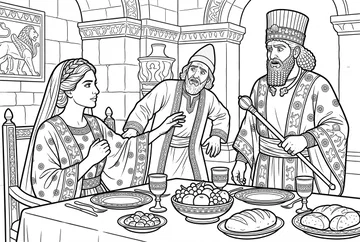

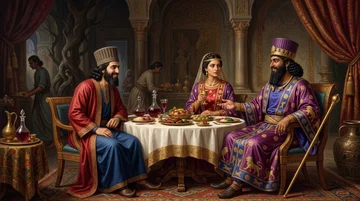
Cross-references
- Esther 6:14
And while they were yet talking with him, came the king’s chamberlains, and hasted to bring Haman unto the banquet that Esther had prepared.
The events leading to Esther’s second-day banquet occur the day before.
- Esther 8:3-8
And Esther spake yet again before the king, and fell down at his feet, and besought him with tears to put away the mischief of Haman the Agagite, and his device that he had devised against the Jews.
Esther’s appeal leads the king to act against Haman’s decree.
- Esther 5:1
Now it came to pass on the third day, that Esther put on her royal apparel, and stood in the inner court of the king’s house, over against the king’s house: and the king sat upon his royal throne in the royal house, over against the gate of the house.
Esther appears before the king on the third day of the fast.
- Esther 3:8-15
And Haman said unto king Ahasuerus, There is a certain people scattered abroad and dispersed among the people in all the provinces of thy kingdom; and their laws are diverse from all people; neither keep they the king’s laws: therefore it is not for the king’s profit to suffer them.
Haman’s decree threatened to destroy the Jewish people.
- Esther 4:16
Go, gather together all the Jews that are present in Shushan, and fast ye for me, and neither eat nor drink three days, night or day: I also and my maidens will fast likewise; and so will I go in unto the king, which is not according to the law: and if I perish, I perish.
The three-day fast is compared with Esther appearing on the third day.
Commentary
Each commentary is drawn from primary sources: the writings of Ellen G. White and Adventist pioneers and periodicals. Each commentary is separate. Its own words are not a quotation; follow the references to read the source passages.
Pioneers and periodicals
7 sources
The verse belongs to the book of Esther, covering the history of the Jews under Medo-Persian rule under the great Persian king Xerxes, called Ahasuerus in the Bible.ST Jun 27, 1911ST Nov 19, 1896ST Jun 16, 1909 It stands in the account of how in God's providence a Jewish maiden was brought to the throne of Persia while the Amalekites, the wicked and sworn enemies of God's children, were in the favor of the king with Haman the prime minister at their head, how Haman plotted to destroy the Jews, all God's people, and how God's overruling power frustrated the plan and saved them and brought salvation to them.ST Jun 27, 1911ST Nov 19, 1896ST Jun 16, 1909 It records the king's renewed offer on the second day at the banquet of wine that Esther had prepared for the king and Haman, asking for her petition and request with promise to grant it even to half the kingdom, and it marks the occasion on which she could appeal for her people's deliverance.ST Nov 19, 1896ST Apr 30, 1902
By calling the day after Esther's first feast or banquet the second day, the verse illustrates inclusive day-counting, in which the day of the first banquet or event is counted as the first and the day of speaking is counted as the second.ST Feb 3, 1881RH Aug 12, 1875RH Feb 7, 1871 At that moment, speaking to the king in the very presence of Haman, Esther presented her petition for her own life and her request for her people, declaring that she and her people were sold to be destroyed, to be slain, and to perish, and that she would have held her tongue if they had only been sold for bondmen and bondwomen, although the enemy could not countervail the king's damage.ST Apr 30, 1902 Her intervention at her banquet before Xerxes, where God's providence overruled Haman's plot, thus helped preserve the people through whom the promised Man Child would come.ST Jun 27, 1911
Sources