Esther 8:3
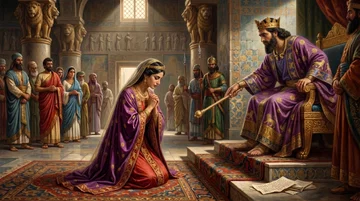
And Esther spake yet again before the king, and fell down at his feet, and besought him with tears to put away the mischief of Haman the Agagite, and his device that he had devised against the Jews.
Translations
And Esther spoke yet again before the king, and fell down at his feet, and sought him with tears to put away the mischief of Haman the Agagite, and his device that he had devised against the Jews.
King James Version, KJV Cambridge Paragraph Bible, Revised Version, American Standard Version
And Esther spake yet again before the king, and fell down at his feet, and besought him with tears to put away the mischief of Haman the Agagite, and his device that he had devised against the Jews.
And Esther spoke yet again before the king, and fell down at his feet, and besought him with tears to put away the mischief of Haman the Agagite, and his device that he had devised against the Jews.
And Esther addeth, and speaketh before the king, and falleth before his feet, and weepeth, and maketh supplication to him, to cause the evil of Haman the Agagite to pass away, and his device that he had devised against the Jews;
And Esther spoke yet again before the king, and fell down at his feet, and besought him with tears to put away the mischief of Haman the Agagite, and his device which he had devised against the Jews.
Yet again, spake Esther before the king, and fell down at his feet,—and wept and made supplication unto him, to cause the mischief of Haman the Agagite to pass away, even the plot which he had plotted against the Jews.
Berean Standard Bible, Majority Standard Bible
And once again, Esther addressed the king. She fell at his feet weeping and begged him to revoke the evil scheme of Haman the Agagite, which he had devised against the Jews.
Esther spoke yet again before the king, and fell down at his feet and begged him with tears to put away the mischief of Haman the Agagite, and his plan that he had planned against the Jews.
Then Esther again came before the king, falling down at his feet, and made request to him with weeping, that he would put a stop to the evil purposes of Haman the Agagite and the designs which he had made against the Jews.
And Ester spake yet more before the King, and fell downe at his feete weeping, and besought him that he would put away the wickednes of Haman the Agagite, and his deuice that he had imagined against the Iewes.
Douay-Rheims (Challoner revision)
And not content with these things, she fell down at the king’s feet and wept, and speaking to him besought him, that he would give orders that the malice of Aman the Agagite, and his most wicked devices which he had invented against the Jews, should be of no effect.
Pictures

Cross-references
- Esther 3:12-13
Then were the king’s scribes called on the thirteenth day of the first month, and there was written according to all that Haman had commanded unto the king’s lieutenants, and to the governors that were over every province, and to the rulers of every people of every province according to the writing thereof, and to every people after their language; in the name of king Ahasuerus was it written, and sealed with the king’s ring.
Haman’s decree sought to destroy the Jews Esther pleads to save.
- Esther 9:1
Now in the twelfth month, that is, the month Adar, on the thirteenth day of the same, when the king’s commandment and his decree drew near to be put in execution, in the day that the enemies of the Jews hoped to have power over them, (though it was turned to the contrary, that the Jews had rule over them that hated them;)
The Jews’ enemies are overthrown when Haman’s plot is defeated.
- Esther 3:6
And he thought scorn to lay hands on Mordecai alone; for they had shewed him the people of Mordecai: wherefore Haman sought to destroy all the Jews that were throughout the whole kingdom of Ahasuerus, even the people of Mordecai.
Haman plans to destroy all the Jews.
- Esther 8:11-12
Wherein the king granted the Jews which were in every city to gather themselves together, and to stand for their life, to destroy, to slay, and to cause to perish, all the power of the people and province that would assault them, both little ones and women, and to take the spoil of them for a prey,
The counterdecree lets the Jews defend themselves against Haman’s plot.
- Esther 7:9-10
And Harbonah, one of the chamberlains, said before the king, Behold also, the gallows fifty cubits high, which Haman had made for Mordecai, who had spoken good for the king, standeth in the house of Haman. Then the king said, Hang him thereon.
Haman is hanged on the gallows prepared for Mordecai.
- Esther 8:15-17
And Mordecai went out from the presence of the king in royal apparel of blue and white, and with a great crown of gold, and with a garment of fine linen and purple: and the city of Shushan rejoiced and was glad.
Shows the glad outcome of Esther’s plea.
- Esther 4:11-16
All the king’s servants, and the people of the king’s provinces, do know, that whosoever, whether man or woman, shall come unto the king into the inner court, who is not called, there is one law of his to put him to death, except such to whom the king shall hold out the golden sceptre, that he may live: but I have not been called to come in unto the king these thirty days.
Esther risks approaching the king to save her people.
Commentary
Each commentary is drawn from primary sources: the writings of Ellen G. White and Adventist pioneers and periodicals. Each commentary is separate. Its own words are not a quotation; follow the references to read the source passages.
Pioneers and periodicals
11 sources
The verse belongs to the history of the Jews under the great Persian king Xerxes, called Ahasuerus in the Bible.ST Jun 16, 1909 In it a Jewish maiden brought by the providence of God to the throne of Persia pleads before the king against Haman the prime minister.ST Jun 16, 1909 She speaks before the king yet again, falling down at his feet and beseeching him with tears to put away the mischief of Haman and his device that he had devised against the Jews.ST Aug 3, 1915ST Nov 19, 1896ST Jun 27, 1911 In doing so she again risks her life by approaching him without being summoned.ST Apr 30, 1902
Haman the Agagite, a descendant of Agag, was head of the Amalekites, the wicked and sworn enemies of God's children who were in the favor of the king.ST Jun 16, 1909 His plot aimed to destroy all God's people under Medo-Persian rule.ST Jun 27, 1911 He acted as the devil's agent.ST Jun 17, 1913 Esther's pleading is part of Heaven's intervention and God's overruling providence and power in saving them from their enemies.ST Aug 3, 1915ST Jun 16, 1909 That providence frustrated Haman's scheme to preserve His people from destruction and protect the godly line, showing God's eternal purpose cannot be overthrown.ST Aug 3, 1915ST Nov 19, 1896
Through that pleading the decree was reversed in effect, for the Jews were given the right to defend themselves against any who should attack them.ST Dec 20, 1899ST May 19, 1914 This brought vindication to God's people and utter and absolute defeat to wicked Haman, who was hanged on the gallows he had prepared, thus defending the rights of innocent people.ST Jun 17, 1913ST May 19, 1914RH May 13, 1915 The verse shows wisdom enabling Esther to save the Jewish nation from massacre and Mordecai to overcome Haman.RH May 9, 1865 It teaches that God cares for His peculiar people, turns the wrath of man to praise Him, and is able to deliver from any snare the evil one sets, and that committing the way to the Lord and trusting in Him brings deliverance to pass.ST Dec 20, 1899
The account presents God's providence as defending religious freedom for those who stood for it.ST May 19, 1914 It illustrates the final controversy over the Sabbath, in which God's people are under a death decree because they will not keep the Sabbath according to man's command, with earnest intercession made for them and God working deliverance for His people.ST Aug 20, 1896 The decree against the Jews is thus a precedent for a future decree against God's people.RH May 13, 1915
Sources