Exodus 1:19
And the midwives said unto Pharaoh, Because the Hebrew women are not as the Egyptian women; for they are lively, and are delivered ere the midwives come in unto them.
Translations
And the midwives said to Pharaoh, Because the Hebrew women are not as the Egyptian women; for they are lively, and are delivered before the midwives come in to them.
King James Version, KJV Cambridge Paragraph Bible
And the midwives said unto Pharaoh, Because the Hebrew women are not as the Egyptian women; for they are lively, and are delivered ere the midwives come in unto them.
And the midwives said to Pharaoh, Because the Hebrew women are not as the Egyptian women: for they are lively, and are delivered ere the midwives come in to them.
Revised Version, American Standard Version
And the midwives said unto Pharaoh, Because the Hebrew women are not as the Egyptian women; for they are lively, and are delivered ere the midwife come unto them.
And the midwives say unto Pharaoh, 'Because the Hebrew women [are] not as the Egyptian women, for they [are] lively; before the midwife cometh in unto them — they have borne!'
And the midwives said to Pharaoh, Because the Hebrew women are not as the Egyptian; for they are strong, and they have borne before the midwife comes to them.
And the midwives said unto Pharaoh. Because not like the Egyptian women, are the Hebrew women, for they are full of life, ere yet the midwife can come in unto them, they have given birth,
Berean Standard Bible, Majority Standard Bible
The midwives answered Pharaoh, “ The Hebrew women are not like the Egyptian women, for they are vigorous and give birth before a midwife arrives.”
The midwives said to Pharaoh, “ Because the Hebrew women aren’t like the Egyptian women; for they are vigorous and give birth before the midwife comes to them.”
And they said to Pharaoh, Because the Hebrew women are not like the Egyptian women, for they are strong, and the birth takes place before we come to them.
And the midwiues answered Pharaoh, Because the Ebrewe women are not as the women of Egypt: for they are liuely, and are deliuered yer the midwife come at them.
Douay-Rheims (Challoner revision)
They answered: The Hebrew women are not as the Egyptian women: for they themselves are skillful in the office of a midwife; and they are delivered before we come to them.
Pictures
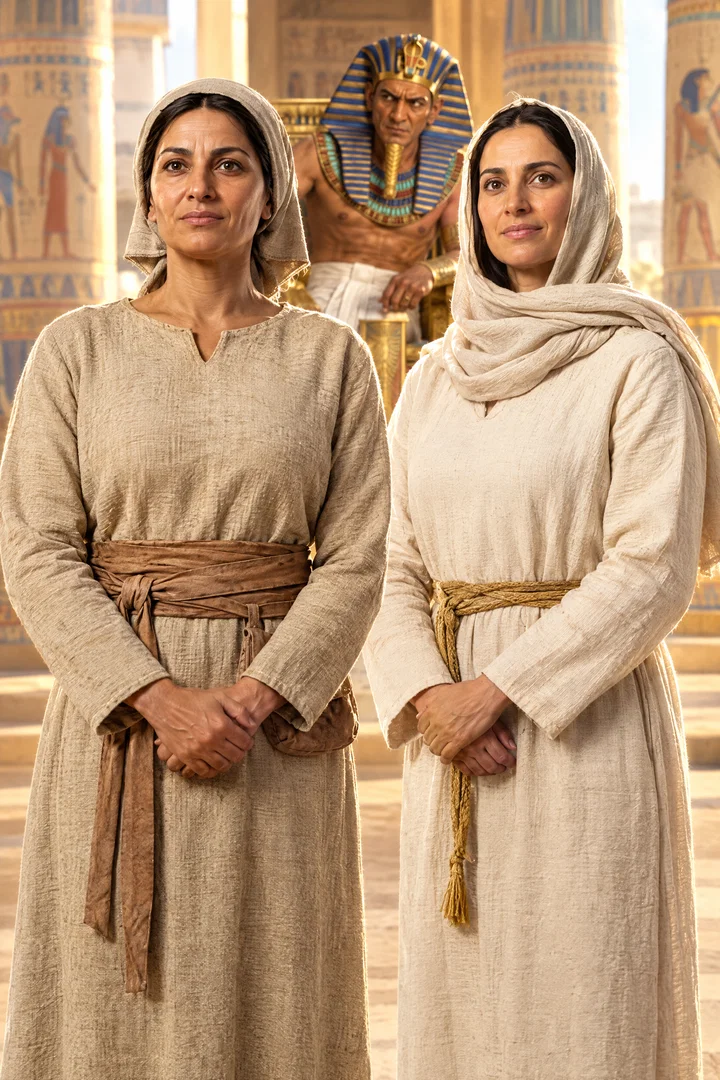
Cross-references
- Exodus 2:1-10
And there went a man of the house of Levi, and took to wife a daughter of Levi.
Moses is hidden and preserved from Pharaoh’s decree, becoming Israel’s deliverer.
- Matthew 2:16
Then Herod, when he saw that he was mocked of the wise men, was exceeding wroth, and sent forth, and slew all the children that were in Bethlehem, and in all the coasts thereof, from two years old and under, according to the time which he had diligently enquired of the wise men.
Herod’s decree against male children parallels Pharaoh’s.
- Acts 7:18
Till another king arose, which knew not Joseph.
same incident rehearsed by Stephen
- Hebrews 11:23
By faith Moses, when he was born, was hid three months of his parents, because they saw he was a proper child; and they were not afraid of the king’s commandment.
Moses’ parents hide him from Pharaoh’s decree.
Commentary
Each commentary is drawn from primary sources: the writings of Ellen G. White and Adventist pioneers and periodicals. Each commentary is separate. Its own words are not a quotation; follow the references to read the source passages.
Ellen G. White
13 sources
The verse belongs to the story in which the Hebrew midwives defied Pharaoh's command to kill the newborn sons and kept the male children alive.SG3 179.1PP 242.1 In it they answer Pharaoh that the Hebrew women were vigorous and gave birth before the midwives could reach them, and by this they concealed their refusal to carry out his order.PP 242.1Lt 22, 1911, par. 6–8Ms 53, 1907, par. 20 They acted as they did because they feared God, and God approved of them and prospered them.PP 242.1 The verse shows the appointed order that women are to attend, care for, and take charge of women in childbirth.STB 730.4STB 639.5–640.2CH 395.2–3 Women should therefore be educated, trained, employed, and fairly valued as midwives and physicians for women, so that women rather than men do this work and treat the diseases of their sex.STB 730.4STB 639.5–640.2CH 395.2–3Lt 22, 1911, par. 6–813MR 115.2
Narrative Setting and Meaning
The verse belongs to the account of the Hebrew midwives defying Pharaoh's order to kill the newborn sons and saving the male children alive.SG3 179.1PP 242.1 It records their explanation to Pharaoh that the Hebrew women were lively and gave birth before the midwives arrived, an explanation that concealed their refusal to carry out the order.PP 242.1Lt 22, 1911, par. 6–8Ms 53, 1907, par. 20Lt 34, 1911, par. 7 In that refusal the midwives feared God, and God approved of them and prospered them.PP 242.1 Their defiance angered Pharaoh, who then ordered all his people to throw every newborn Hebrew son into the river.SG3 179.1
Women Caring for Women
In Bible times it was the order and appointed work for women to serve as midwives who attended women in childbirth, cared for them, and took charge of them in delivery.STB 730.4STB 639.5–640.2CH 395.2–3STB 627.3–628.113MR 113.2 The verse belongs to that arrangement, showing Hebrew midwives as the attendants at birth who explain that the Hebrew women give birth before they arrive.STB 730.4STB 639.5–640.2STB 627.3–628.1Lt 22, 1911, par. 6–8Ms 53, 1907, par. 20 It therefore teaches that women should take responsibility for women in confinement and childbirth and care for them at that time.STB 730.4STB 639.5–640.2CH 395.2–39T 176.2–313MR 113.2 That responsibility includes taking charge of women in childbirth under the Bible-era order in which women cared for women.STB 730.4CH 395.2–39T 176.2–313MR 113.213MR 115.2
Men should not perform this childbirth work nor take over work assigned to women, but women rather than men should attend deliveries.STB 730.4CH 395.2–313MR 115.2 Women physicians rather than male physicians should attend childbirth, keeping men from taking what was assigned to women.STB 730.4CH 395.2–313MR 115.2 For this reason women should be educated and trained to do the work skillfully, to serve as midwives and physicians for women.STB 639.5–640.2CH 395.2–3Lt 22, 1911, par. 6–8Ms 53, 1907, par. 2013MR 113.2 They should be trained and employed as midwives and physicians for women, educated to take responsibility for childbirth care, to treat diseases of their sex, and to be fairly valued for their services.STB 639.5–640.2CH 395.2–3Ms 53, 1907, par. 2013MR 113.213MR 115.2
As women take responsibility for women, the Lord works with them in that care.13MR 114.2
Sources
Pioneers and periodicals
20 sources
The verse gives the Hebrew midwives' answer to Pharaoh that the Hebrew women give birth quickly before the midwives arrive, which was a true fact explaining why the infants were left alive.ST Mar 21, 1878ST Jul 21, 1881ST Nov 7, 1906 It belongs to the time when a new king who did not know Joseph forgot Joseph's service and turned Israel's prosperity into cruel slavery to stop them from multiplying.RH Mar 9, 1869ST Jul 21, 1881 Pharaoh's command to kill the newborn sons was an effort to destroy Israel and check its increase, behind which lay Satan's plan to cut off the promised seed and the nation through whom the promised Seed would come.ST Apr 30, 1894ST Aug 3, 1915ST God overruled the decree, was with His people under taskmasters and hard bondage, made them increase and grow strong, and preserved Moses to be raised up as their deliverer.ST Nov 13, 1901ST Jan 23, 1912ST Mar 30, 1904ST Apr 30, 1894 The midwives feared God and refused to become executioners of the children, showing that when a human ordinance conflicts with duty to God, disobedience to man becomes duty and obedience to rulers is sin.ST Mar 21, 1878RH May 12, 1868RH Nov 28, 1912
Setting and Meaning
Exodus 1:19 belongs to the opening history in Exodus 1-4 that begins with the oppression of Israel in Egypt and relates the birth and upbringing of Moses until he is called to be the deliverer of his people. Its setting is the change from Hebrew prosperity in Egypt to cruel oppression after Joseph and his service were forgotten.RH Mar 9, 1869ST Jul 21, 1881 A new king and dynasty arose who did not know Joseph, under whom the Israelites were treated as despised slaves, and Pharaoh sought to stop the Hebrews from multiplying.RH Mar 9, 1869ST Jul 21, 1881ST Jan 28, 1913 The new king saw Israel fruitful and abundant and exceeding mighty and filling the land, feared they would become more powerful than the Egyptians unless their increase was checked, and said come let us deal wisely with them.RH May 14, 1901 That plan brought taskmasters set over Israel to afflict them with burdens, forced vigorous service with lives made bitter with hard bondage, and Pharaoh's command to all his people to cast every newborn son into the river and save every daughter alive, a dreadful oppression different from before, when through seven years of terrible famine the Egyptians had become slaves to Pharaoh while Israel was nourished by Joseph and given a possession in the best of the land.RH May 14, 1901
The oppression was under Rameses II, the Pharaoh of the oppression who built the treasure cities Pithom and Raamses, one bearing his own name, and who reigned from 1564 to 1497 B.C. to within six years of the exodus.ST Aug 9, 1910 In that time Israel kept multiplying and growing notwithstanding hardships and oppressions, from threescore and fifteen who entered Egypt to about three million who departed at the exodus.ST Aug 9, 1910 It was about a century after the Pharaoh Khu-n-Aten, when the Nineteenth Dynasty rose with the triumph of the national faith and the cry of Egypt for the Egyptians. The foreigners brought into the country and government from Asia and Canaan were driven out or massacred, while those who remained, like the Israelites in the land of Goshen, were reduced to the condition of public slaves and further cut down by the destruction of their male offspring, under which order to destroy the male children the midwives' answer to Pharaoh was spoken.
The verse records the Hebrew midwives telling Pharaoh that the Hebrew women are lively and are delivered before the midwives come in unto them, as their explanation for not killing the children in Pharaoh's attempt to destroy or enslave God's promised people.ST Mar 21, 1878ST Jul 21, 1881ST Nov 7, 1906 The statement was a fact, not a lie, for the midwives feared God and refused to kill the children and gave Pharaoh this fact as an explanation for their actions.ST Mar 21, 1878 The account in Exodus 1 of the conduct of the king which knew not Joseph is also told by Stephen in Acts 7:18, showing the Old Testament record is corroborated in the New Testament and is reliable history rather than fable or myth.ST Apr 13, 1904
God's Preservation Through Oppression
Exodus 1:19 belongs to Pharaoh's effort to destroy Israel's male children, including the murder of Hebrew infants in hope of checking their increase and destroying Israel, but God overruled to preserve the people.ST Apr 30, 1894 The taskmaster policy that set taskmasters over Israel and then tried to destroy all the male children was shrewd and wicked but not wise because it fought against God.ST Apr 30, 1894 When the midwives refused to carry out the order to kill the boys at birth and would not become executioners, the decree was repeated and extended and strengthened into a command to all Pharaoh's people that every male child be thrown into the river.ST Mar 30, 1904RH Nov 28, 1912
The attempted killing was meant to prevent Israel from leaving Egypt and to prevent the deliverer Moses from leading the people out of bondage, but God preserved him to lead them out.ST Mar 30, 1904RH Nov 28, 1912 It was Satan's plan to destroy the promised seed and the nation through whom the promised Seed would come and so delay the plan of salvation.ST Apr 30, 1894ST The plan threatened the survival of Abraham's descendants and the godly line and would have left Hebrew daughters to marry outside that line, but God preserved His purpose by raising up Moses as a deliverer.ST Aug 3, 1915
Despite the new dynasty treating Israel as despised slaves, their persecution could not stop God from prospering them, and the setting illustrates God's providential care that they continued to increase.ST Jan 23, 1912 God was with His people and used the tribulation for their good and worked out salvation for them through it, making the Israelites stronger physically and using the hardships as a means of increasing their numbers.ST Apr 30, 1894 Moses' life was spared at birth when the cruel decree against the Hebrew boys was disregarded, and that decree led his mother to hide him for three months.ST Nov 13, 1901ST Nov 27, 1901 God thus preserved Moses and raised him up to lead the people out of bondage.ST Mar 30, 1904RH Nov 28, 1912ST Aug 3, 1915
The decree that all Hebrew male children must be put to death meant their race must run out if they stayed in Egypt, so there was no alternative but to flee.RH Aug 11, 1863 Without this affliction they would have lived in ease and worldly prosperity in Egypt with all they could have enjoyed in Canaan, and Moses could hardly have persuaded them to undertake the perilous journey through the wilderness for a land flowing with milk and honey.RH Aug 11, 1863 If the decree had never gone forth and they had remained in Egypt, they would have so mingled with the Egyptians that by the Saviour's advent none could determine who were Hebrews and who were not, Christ would have been unable to trace His pedigree back to Abraham to prove His Messiahship, and there would have been no Messiah.RH Aug 11, 1863
The oppression shows the conditions Israel endured before God delivered them, during which, while oppressed, they could not have kept the Sabbath, so that deliverance made Sabbath-keeping possible.RH May 16, 1854 It is an example of the wicked, who worshiped false gods, persecuting the righteous who worshiped the true God.RH Jun 8, 1916
Duty to Obey God
When a human ordinance conflicts with the higher law and with duty to God, disobedience to man becomes duty and obedience to civil rulers is sin.RH May 12, 1868 Pharaoh commanded the Hebrew midwives to kill the Hebrew male children, but they preserved the children alive and chose to obey God rather than men.RH May 12, 1868 Their answer to Pharaoh was that the Hebrew women give birth before the midwives arrive.ST Mar 21, 1878RH May 12, 1868
The midwives feared God and refused to kill the children as Pharaoh commanded.ST Mar 21, 1878RH May 12, 1868 They would not become executioners, but kept the babes alive and gave Pharaoh this fact as their explanation for not carrying out his order.ST Mar 21, 1878RH May 12, 1868RH Nov 28, 1912 The statement that the Hebrew women were lively and were delivered before the midwives came to them was fact, not falsehood.ST Mar 21, 1878 Because they would not execute the order to destroy the boys at birth, Pharaoh repeated and strengthened the command into an order that every male child be thrown into the river.RH Nov 28, 1912 That attempted killing was meant to prevent Israel from leaving Egypt, but God overruled to preserve Moses to lead the people out.RH Nov 28, 1912
Sources