Exodus 33:23
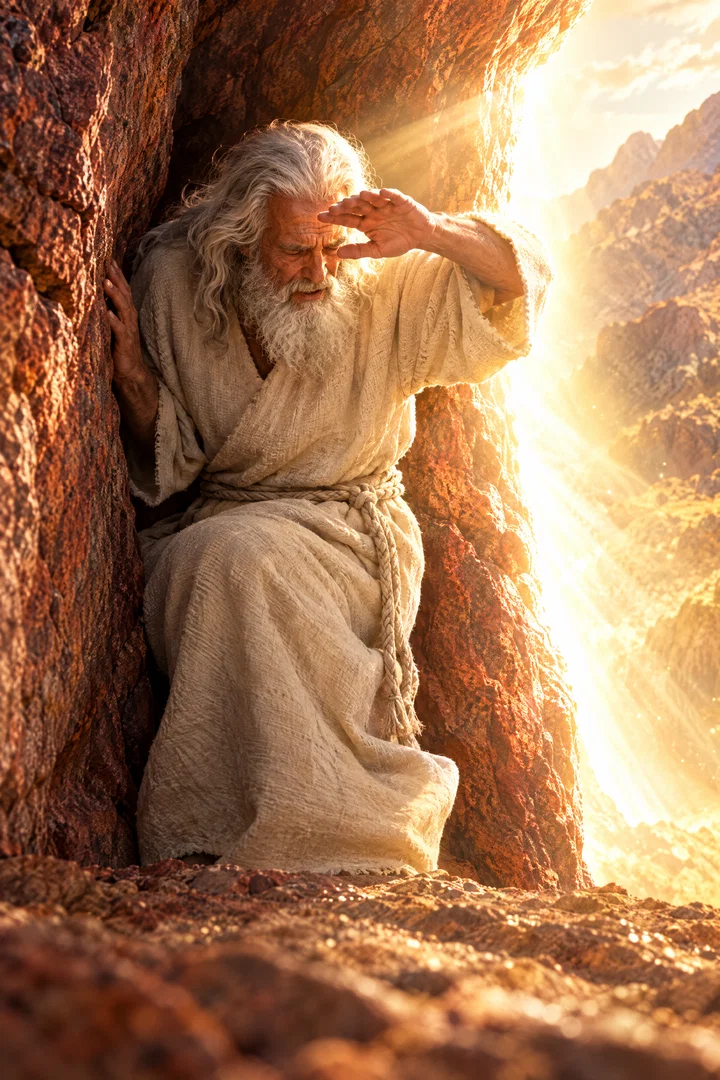
And I will take away mine hand, and thou shalt see my back parts: but my face shall not be seen.
Translations
And I will take away my hand, and you shall see my back parts: but my face shall not be seen.
And I will take away mine hand, and thou shalt see my back parts: but my face shall not be seen.
and I will take away mine hand, and thou shalt see my back parts: but my face shall not be seen.
And I will take away my hand, and thou shalt see my back parts: but my face shall not be seen.
and I will take away mine hand, and thou shalt see my back: but my face shall not be seen.
and I will take away my hand, and thou shalt see my back; but my face shall not be seen.
and I have turned aside My hands, and thou hast seen My back parts, and My face is not seen.'
And I will take away my hand, and thou shalt see me from behind; but my face shall not be seen.
Then will I take away my hand, and thou shalt see behind me, But, my face, must not be seen.
Berean Standard Bible, Majority Standard Bible
Then I will take My hand away, and you will see My back; but My face must not be seen.”
then I will take away my hand, and you will see my back; but my face shall not be seen.”
Then I will take away my hand, and you will see my back: but my face is not to be seen.
After I will take away mine hande, and thou shalt see my backe parts: but my face shall not be seene.
Douay-Rheims (Challoner revision)
And I will take away my hand, and thou shalt see my back parts: but my face thou canst not see.
Pictures



Cross-references 20 of 36
- Exodus 34:6-7
And the LORD passed by before him, and proclaimed, The LORD, The LORD God, merciful and gracious, longsuffering, and abundant in goodness and truth,
As the LORD passes by Moses, he proclaims his merciful character and justice.
- Exodus 33:11
And the LORD spake unto Moses face to face, as a man speaketh unto his friend. And he turned again into the camp: but his servant Joshua, the son of Nun, a young man, departed not out of the tabernacle.
Close conversation with God contrasts with Moses seeing only His back parts.
- Exodus 24:9-11
Then went up Moses, and Aaron, Nadab, and Abihu, and seventy of the elders of Israel:
Israel’s leaders see God, though not His face.
- Exodus 33:18
And he said, I beseech thee, shew me thy glory.
Moses asks to see God’s glory, and God answers his request.
- Exodus 34:29-30
And it came to pass, when Moses came down from mount Sinai with the two tables of testimony in Moses’ hand, when he came down from the mount, that Moses wist not that the skin of his face shone while he talked with him.
Moses’ face shines after he encounters God’s glory.
- John 5:37
And the Father himself, which hath sent me, hath borne witness of me. Ye have neither heard his voice at any time, nor seen his shape.
Jesus says no one has seen the Father’s shape.
- Exodus 33:15
And he said unto him, If thy presence go not with me, carry us not up hence.
Moses pleads for God’s presence to accompany him and the people.
- John 1:18
No man hath seen God at any time; the only begotten Son, which is in the bosom of the Father, he hath declared him.
Both state that no one has seen God; the Son makes Him known.
- Exodus 33:19
And he said, I will make all my goodness pass before thee, and I will proclaim the name of the LORD before thee; and will be gracious to whom I will be gracious, and will shew mercy on whom I will shew mercy.
God promises to make his goodness pass before Moses.
- 1 John 4:12
No man hath seen God at any time. If we love one another, God dwelleth in us, and his love is perfected in us.
It is contrasted with seeing God in a limited manifestation.
- Exodus 34:1-2
And the LORD said unto Moses, Hew thee two tables of stone like unto the first: and I will write upon these tables the words that were in the first tables, which thou brakest.
Moses is summoned back to Sinai to prepare and receive the replacement stone tablets.
- Genesis 32:30
And Jacob called the name of the place Peniel: for I have seen God face to face, and my life is preserved.
Cites a strong claim of having seen God, qualified by the limit on seeing his face.
- 1 Timothy 6:16
Who only hath immortality, dwelling in the light which no man can approach unto; whom no man hath seen, nor can see: to whom be honour and power everlasting. Amen.
It describes God as one whom no person has seen or can see.
- Revelation 22:4
And they shall see his face; and his name shall be in their foreheads.
God’s servants will see His face in the promised life to come.
- John 14:9
Jesus saith unto him, Have I been so long time with you, and yet hast thou not known me, Philip? he that hath seen me hath seen the Father; and how sayest thou then, Shew us the Father?
Jesus says that whoever has seen him has seen the Father.
- Exodus 33:14
And he said, My presence shall go with thee, and I will give thee rest.
God promises his presence, while Moses seeks assurance through seeing his glory.
- Matthew 5:8
Blessed are the pure in heart: for they shall see God.
The pure in heart are promised that they will see God.
- Numbers 12:8
With him will I speak mouth to mouth, even apparently, and not in dark speeches; and the similitude of the LORD shall he behold: wherefore then were ye not afraid to speak against my servant Moses?
God speaks with Moses face to face, while withholding the sight of his face.
- Hebrews 1:3
Who being the brightness of his glory, and the express image of his person, and upholding all things by the word of his power, when he had by himself purged our sins, sat down on the right hand of the Majesty on high;
Christ is the express image of God's person.
- Exodus 34:30-33
And when Aaron and all the children of Israel saw Moses, behold, the skin of his face shone; and they were afraid to come nigh him.
Moses’ face shines after he sees God’s glory.
Commentary
Each commentary is drawn from primary sources: the writings of Ellen G. White and Adventist pioneers and periodicals. Each commentary is separate. Its own words are not a quotation; follow the references to read the source passages.
Ellen G. White
69 sources
God set Moses in the cleft of the rock and covered him with His hand while His glory passed by, then took away His hand so Moses saw from behind after He had passed, but not His face.SG3 289.1–21SP 255.2–256.1Ms 13, 1906, par. 32–41Lt 85, 1894, par. 8–18PP 328.3–4 No one in this mortal state can look upon the unveiled glory of His face and live, so Moses was granted only a partial glimpse, as much as he could bear and endure.GW92 33.1–34.3Ms 13, 1906, par. 32–41Lt 87, 1896, par. 24–26Ms 52, 1898, par. 49–52 The glory revealed in that passing was His goodness and character proclaimed by name, merciful and gracious, longsuffering, abundant in goodness and truth, forgiving iniquity and sin yet by no means clearing the guilty.Lt 85, 1894, par. 8–18ST Sep 26, 1895STMW10 9.3 The hand that covered Moses was the hand of Christ, whose glory Moses longed to see and which was afterward veiled in the Child of Bethlehem, and to be hidden in the cleft is to be hidden in Christ and behold God's glory through Jesus, who revealed the Father as His perfect representation.ST Sep 26, 1895Ms 84b, 1897, par. 27–2821MR 62.3–4DA 52.1–3Ms 115, 1894, par. 7–8 The revelation answered Moses' importunate plea when burdened with leading Israel to the promised land, showing that earnest prayer is granted without rebuke, and it points forward to when redeemed servants made like Him in character will see His face.Lt 85, 1894, par. 8–18Ms 11, 1896, par. 1–4Lt 33, 1890, par. 18PP 328.3–4Ms 28, 1901, par. 12
Prayer and Historic Setting
The verse closes Moses' plea about God's presence while he was entrusted with leading Israel to the promised land.SG3 289.1–2Ms 117, 1909, par. 23–28 He brought his fear and burden to God rather than relying on human wisdom or seeking help from the people around him, and God strengthened his fainting heart.Ms 92, 1891, par. 6–8 He lived in close communion with God and, having obtained assurance by holding fast God's promises, grew bold to ask still greater things, pleading to see God's glory because he must know God in order to represent Him to the people in all his ministry.20MR 244.4
His advancing, importunate prayer to see God's glory was granted without rebuke or displeasure for presumption.Lt 85, 1894, par. 8–18PP 328.3–4Ms 36, 1885, par. 18–20 He was not rebuked as presumptuous after being promised that God's presence would go with him, but was promised a revelation of divine goodness.PP 328.3–4Ms 36, 1885, par. 18–20 Jesus waits to be gracious and answers earnest requests made known to God.Lt 33, 1890, par. 18
God set Moses in a place by Him upon a rock and summoned him again to the mountain summit.Lt 85, 1894, par. 8–18PP 328.3–4 He put him in the cleft of the rock and with the hand that made the world covered him while His glory passed by.Lt 85, 1894, par. 8–18PP 328.3–4 In this God brought him into sacred nearness on the mount.ST Sep 30, 1880
Moses could be given this revelation only after forty years of discipline as a shepherd in the mountain solitudes.Lt 7, 1894, par. 23–26 There he learned the character of God from nature, lost confidence in his own abilities and education, and came into a meek, humble position of trusting God alone.Lt 7, 1894, par. 23–26 The revelation was uniquely great and specially favored, granted more fully than to anyone else on earth, with a full view of God withheld.1SP 343.1SG1 40.31SP 313.1SG4 39.2SG4 58.2 Yet Moses speaking with God face to face, as a man speaks with a friend, means extraordinary closeness and directness, not sight of God's face.RH Nov 24, 19101SP 343.1SG4 58.2
Limited Sight Granted
God shielded Moses from the full sight of His glory by covering him with His hand as He passed by, then removing His hand so that Moses could see His back parts from behind after He had passed, but not His face.SG3 289.1–21SP 255.2–256.1Ms 13, 1906, par. 32–41Ms 13, 1906, par. 42–43Ms 28, 1901, par. 12 This was a gracious, limited manifestation granted to Moses as a fallen human being while he was entrusted with leading Israel to the promised land.SG3 289.1–21SP 255.2–256.1 The limit marked what Moses was permitted to see, for he could see only what God permitted and not God's face.Ms 13, 1906, par. 32–41 He was placed as a man of faith in the cleft of the rock and looked upon his Lord from behind.Ms 36, 1885, par. 18–20Ms 28, 1901, par. 12
No one in this mortal state can look upon the unveiled glory of God's face and live, for the sight would consume him and extinguish his life, so the covering protected him.GW92 33.1–34.3Lt 87, 1896, par. 24–26Ms 52, 1898, par. 49–52Ms 145, 1905, par. 16–20Ms 11, 1896, par. 1–4 Moses was therefore assured he would behold only as much of the divine glory as he could endure, sheltered by the hand that made the world while the glory of God passed before him.GW92 33.1–34.3Ms 145, 1905, par. 16–20PP 328.3–4 The revelation was limited for this reason, with God sheltering him while His glory passed by and allowing him to see only His back parts.Lt 87, 1896, par. 24–26Ms 145, 1905, par. 16–20Ms 11, 1896, par. 1–4 In contrast to this limit stands the promise that God's redeemed servants will one day see His face.Ms 11, 1896, par. 1–4
Moses beheld only as much of the divine glory as his mortal state could bear, a partial glimpse and not a full view, with a full view of God withheld even while God's presence was revealed to him in close communion.GW92 33.1–34.3SG1 40.3Ms 115, 1894, par. 7–8 He was shielded from the full sight and allowed to see only what the verse calls His back parts, seeing only what God permitted.Ms 13, 1906, par. 32–41Ms 52, 1898, par. 49–52 Being hidden in the cleft with the hand of Christ covering him was required first, so that he obtained only a partial view of His majesty.Ms 115, 1894, par. 7–8
Goodness and Character Revealed
The glory shown as God passed by was His goodness and His character portrayed and proclaimed by name as merciful and gracious, longsuffering and slow to anger, abundant in goodness and truth and loving-kindness, keeping mercy for thousands, forgiving iniquity and transgression and sin, and by no means clearing the guilty.Lt 85, 1894, par. 8–18ST Sep 26, 1895ST Aug 20, 1894ST Jul 27, 1915 Moses was sheltered in the cleft of the rock and saw from behind after God passed, receiving this protected proclamation of name and character rather than sight of the face.Lt 85, 1894, par. 8–18ST Sep 26, 1895ST Aug 20, 1894Ms 104, 1898, par. 17 Christ afterward revealed the Father's character in the same way, as the perfect representation of the Father.ST Sep 26, 1895ST Aug 20, 1894
God's passing by is represented by His character of mercy, grace, patience, goodness, truth, forgiveness, and justice.STMW10 9.3Lt 5, 1897, par. 25 The effects of His work remain in the path where He goes, with lasting influence.STMW10 9.3Lt 5, 1897, par. 25 To follow Him and know His will turns sight from self to God.STMW10 9.3
Moses was allowed to behold God's holiness, and seeking refuge in the cleft expresses the desire to behold His holy character.Ms 23, 1897, par. 8 The glory revealed to Moses then reflected upon him, so that when he returned the skin of his face shone and the people could not look upon his countenance.Ms 36, 1885, par. 18–20 He covered his face with a veil when speaking to them.Ms 36, 1885, par. 18–20
Together with the promise that the divine presence would attend him, the experience was assurance of success in the work before him.PP 328.3–4 Moses counted this of infinitely greater worth than all the learning of Egypt and all his attainments as statesman and military leader.PP 328.3–4 No earthly power or skill or learning can supply the place of God's abiding presence.PP 328.3–4
The revelation came before Moses carried out justice upon the idolaters.ST Jul 27, 1915 The Lord covered Moses so he could behold God and live and see the heavenly things revealed to him on the mount.ST Nov 21, 1892 This prepared and enabled him to direct the construction of the sanctuary according to the pattern shown him.ST Nov 21, 1892
The revelation plainly delineates what God is, to teach human weakness and inefficiency, to show that strength is alone in God, and to remove all self-exaltation.Lt 7, 1894, par. 23–26 This honor was meant to keep Moses humble despite his elevated position and childlike in faith despite his trust in God.Lt 87, 1896, par. 27 It enabled him to endure as seeing Him who is invisible.Lt 7, 1894, par. 23–26
Christ and Future Sight
The glory Moses longed to see was the glory of Christ, and that same glory was afterward veiled in the Child of Bethlehem.DA 52.1–3Ms 104, 1900, par. 8–9 As an infant He was the living revelation of that glory, yet the priest who held Him did not recognize that this child was the One whose glory Moses had asked to see.DA 52.1–3Ms 104, 1900, par. 8–9
No one could look upon the unveiled glory of the face of Christ and live, so the honor of seeing God's glory required first being hidden in the cleft of the Rock.Ms 84b, 1897, par. 27–2821MR 62.3–4Ms 115, 1894, par. 7–8 The hand that covered Moses in the cleft was the hand of Christ, His pierced hand sheltering the humble seeker while waiting reverently in bowed attitude to hear what the Lord says.Ms 84b, 1897, par. 27–2821MR 62.3–4Ms 115, 1894, par. 7–8 Covering the face expresses reverence when God draws near in majesty and in the still small voice that follows whirlwind and tempest.Ms 84b, 1897, par. 27–2821MR 62.3–4
Being hidden in the cleft of the rock is being hidden in Christ, and it is what enables beholding God's majesty and love and beholding God's glory through Jesus.ST Sep 26, 1895ST Aug 20, 1894Lt 4, 1892, par. 40–44 Moses was sheltered in the cleft and covered by God's hand and allowed to see only after the hand was removed, seeing God's back and not His face as the Lord passed by.ST Sep 26, 1895ST Aug 20, 1894Lt 4, 1892, par. 40–44 That passing revealed God as merciful, gracious, patient, and abundant in goodness and truth, and Jesus reveals the Father in the same way as the perfect representation of the Father.ST Sep 26, 1895ST Aug 20, 1894 By looking to Jesus in this way, believers are changed into His likeness.Lt 4, 1892, par. 40–44
In contrast to this mortal limit, God's redeemed servants will one day see His face.Ms 11, 1896, par. 1–4Ms 28, 1901, par. 12 Moses could not see God's face and live, so God sheltered him in the cleft, covered him with His hand, and let him see only His back parts after He passed by.Ms 11, 1896, par. 1–4Ms 28, 1901, par. 12 That encounter is joined to the declaration of His character as merciful, gracious, patient, and abundant in goodness and truth, and those who see His face must be like Him in character.Ms 11, 1896, par. 1–4Ms 28, 1901, par. 12
Shelter and Transformed Life
Hiding in the cleft of the Rock is the condition for seeing the glory of Jesus Christ, and what happened for Moses must happen for every believer.Ms 35, 1902, par. 29MR 375.2–376.1 To be hidden in the Rock is to come into close relation to Jesus with the life hid with Christ in God, where the divine is united with the human.9MR 375.2–376.1 God hid Moses in the cleft and covered him with His hand so that he could behold the revealed glory, and the humble are still called to hide in God in the same way.Lt 40, 1899, par. 27–29
Seeking to see God calls for coming near in reverence and godly fear, waiting in bowed, humble attitude to hear what the Lord says to His servants.Ms 84b, 1897, par. 27–2821MR 62.3–4 It calls for a meek and contrite spirit that trembles at His word, for those who value a holy walk with God earnestly seek this knowledge of Him.Lt 87, 1896, par. 32Lt 87, 1896, par. 33 Genuine humility belongs with the desire for His glory, and those who truly desire to see it must cherish humility.Lt 87, 1896, par. 32Lt 87, 1896, par. 33 When God draws very near in majesty and in the still small voice that follows whirlwind and tempest, all should cover their faces before Him, for covering the face expresses reverence when He draws near.Ms 84b, 1897, par. 27–2821MR 62.3–4 Jesus Christ Himself is that hiding place, and the hand that covers the seeker sheltered in Him is His pierced hand.Ms 84b, 1897, par. 27–2821MR 62.3–4
When a person comes with the whole heart, casts every idol from the soul temple, surrenders to Jesus, and rolls the whole load of his own case upon Him, God makes all His goodness pass before him while hiding him in the cleft of the Rock.Ms 24, 1891, par. 86Lt 10, 1893, par. 7 Those who put soul, body, and spirit wholly in God's hands to be moved by His will, controlled by His mind, and infused by His Spirit may likewise see heavenly things clearly and catch glimpses of the Holy One.Ms 24, 1891, par. 8619MR 258.1 Those connected with His work who make God their entire dependence, take time to pray and seek counsel, invite the heavenly Guest to possess and control them, cry after God in sincerity and soul-hunger, and wrestle with heavenly agencies until victory will have the eyes of their understanding anointed with heavenly eyesalve.Lt 10, 1893, par. 719MR 258.1
Communion with God enables His servants to see and understand more of Him through the power and light He gives, beyond what finite judgment could reach.AA 362.315MR 341.2–342.2 When men walk with God and not with self, God hides them in the cleft of the Rock and lets them see Him in the way Moses saw Him, sheltering them in times of need while shielding them from the full manifestation of His glory.Lt 396, 1907, par. 415MR 341.2–342.2 Thus hidden, they receive His presence and light to comprehend more than they deemed possible and to endure seeing Him who is invisible, though God remains invisible to ordinary sight.15MR 341.2–342.2Lt 39, 1897, par. 10–13 Walking with God lets people perceive more of Him through the presence and light He imparts.AA 362.3Lt 396, 1907, par. 4Lt 39, 1897, par. 10–13
God's goodness is seen as Christ is beheld, and looking steadfastly to Jesus in living faith beholds Him full of grace and truth.ST Feb 6, 1901Lt 10, 1893, par. 7 Beholding Him transforms the believer into His likeness, for beholding Jesus changes the beholder.ST Feb 6, 19019MR 375.2–376.1Lt 4, 1892, par. 40–44 By looking to Jesus believers are changed into His likeness, and this gives a right estimate of the character of God that produces faithful integrity in duty and keeps from careless indulgence in sin and regarding sin lightly.Lt 10, 1893, par. 7Lt 4, 1892, par. 40–44 Fitness to see God is character built after the Pattern of Christ, who in human nature met every temptation without yielding and maintained the full perfection of heaven's character, for without Christ nothing can be done.9MR 375.2–376.1 Fallen man need not remain enfeebled and degraded through sin but may become a partaker of the pure and celestial element by looking daily at the manifestation of grace in Jesus and by daily assimilation to the Saviour's character, which gives a better understanding of what heaven is like.9MR 375.2–376.1
Safety comes from God's protection and from being where God appoints a person to be, for Moses was sheltered in the cleft and covered by God's hand when God passed by.Lt 22, 1899, par. 6–7Ms 29, 1896, par. 21–22 The cleft is a place of refuge under God's protection and of safety from which to contemplate God's character.Lt 22, 1899, par. 6–7Ms 29, 1896, par. 21–222MR 236.1 Choosing a place or undertaking without a call from God leaves a person exposed to temptation.Lt 22, 1899, par. 6–7 All who know the truth are called to hide in the Rock and view God's glory in the time of trial, chastisement, and danger.4MR 107.319MR 383.3Lt 31, 1897, par. 19 The night of trial is nearly spent and Satan is bringing in his masterly power because his time is short, so the truth must not be muffled but plain, unvarnished truth must be spoken in leaflets and pamphlets scattered like the leaves of autumn.19MR 383.3 Those who refuse humility and spiritual sight will be caught unprepared when the day of God comes and in the day of their visitation.Lt 151a, 1897, par. 9Lt 151, 1897, par. 9–10Lt 141a, 1896, par. 7
God's presence is given as His goodness revealed to one who takes hold of Him by faith, as Moses was not satisfied to go without it and received what he wanted and needed when God took him as an atom of humanity, put him in the cleft, covered him, made His goodness pass before him, and then took away His hand.Ms 13, 1888, par. 72–74 That presence comes to one who goes directly to Christ the Fountain Head for strength in trouble and opposition instead of reaching to human agencies, and when God lets His goodness pass before believers they can carry that goodness to the world.Ms 13, 1888, par. 72–74 Clinging to Jesus and praying to be hidden in the cleft of the Rock while beholding His glory gives spiritual power, for trusting in the Lord with all the heart and standing fast in the faith in that hidden place enables going forward in the name of the Lord God of Israel, overcoming without doubting with eyes fixed on Jesus as helper, standing up in His strength as more than conqueror, and stopping worry over betrayal of trust.21MR 47.1–2Lt 31, 1893, par. 10 The work God gives makes His worker a target for the enemy and brings trials, and calls for meekness that never shows overmastering passion.21MR 47.1–2
Being hid in the cleft means catching distinct views and glimpses of Jesus as sin-bearer and all-sufficient sacrifice and beholding the Lamb of God who takes away the sins of the world.STE 82.1Lt 89, 1899, par. 8–10 Those who look to the Lord with undivided hearts are greatly blessed with the greatest, truest joys, earnestly seeking the living God and seeing Him who is invisible, and being quickened by His Holy Spirit.STE 82.1Lt 89, 1899, par. 8–10 The live coal of pardon is placed upon their lips and their lips are tuned to the highest themes of praise, counting the suspension of other work as no loss, with the Lord's presence distinguished and His work acknowledged and rejoicing that the salvation of God is among His people as the bright beams of the Sun of Righteousness shine into the chambers of heart and mind to draw souls in an ingathering to Jesus Christ.STE 82.1 Closeness to God and a clearer view of His character come with humility and trust, for His servant is sheltered in the cleft, hidden from view yet able to see and hear the proclamation of His character.Lt 141, 1896, par. 12–14Lt 25, 1880, par. 7 Seeing and feeling His glory belongs with successful work for Christ, yet because Moses was given very great privileges and much trust, his taking glory to himself was highly displeasing, proportionately aggravating and far more offensive than the same defects in those less favored, while also giving others who see his failure license to sin and shelter their own defective characters.Lt 141, 1896, par. 12–14Lt 25, 1880, par. 7
Sources
Pioneers and periodicals
48 sources
God placed Moses in a cleft of the rock beside Him and shielded him with His hand as His glory went past, then lifted His hand so Moses saw His back and departing form while His face stayed hidden.RH Sep 18, 1855RH Sep 20, 1870RH Jun 12, 1860RH Sep 18, 1855 No one in mortal flesh can look on His unveiled face and live, so what was granted was a veiled and partial glimpse from behind rather than the full brightness of His presence.ST Sep 26, 1895STRH Oct 20, 1874ST Oct 19, 1915ST Jun 24, 1886 The wording shows He is a real person with face and hand and back and a definite dwelling place, not a formless essence spread everywhere, and not a temporary shape assumed only for the moment.RH Sep 18, 1855RH Nov 10, 1859RH Jun 18, 1861RH Jul 10, 1856RH Apr 16, 1872 He answered the plea to see His glory by proclaiming His goodness and name as merciful and gracious, longsuffering and abundant in goodness and truth, forgiving sin yet by no means clearing the guilty.ST Jul 27, 1915RH Sep 20, 1870ST Jun 24, 1886RH Jul 7, 1910 So His working is often recognized only after He has passed by, when history reveals His hand, while in heaven the redeemed will see His open face and live, be made like Him, and share His glory and joy.RH Oct 13, 1859RH Nov 12, 1857ST Jan 8, 1880
Setting and Occasion
The verse belongs to Moses' intercession for Israel after their idolatry with the golden calf, within forty days after God spoke from Mount Sinai while the pillar of cloud by day and pillar of fire by night was still in sight.ST Jan 27, 1909 It stands within the account in Exodus 32 to 34 of God's revelation of Himself as merciful and righteous and of the renewal and confirmation of the covenant, and of the revelation of Moses' character and his plea for the people.ST Jan 27, 1909ST Jan 31, 1911 In that setting it shows for all ages that men serve God by love and not by fear or compulsion, for if the law had been received on the heart as well as on tables of stone there would have been no turning back to Egypt and no worship of the calf.ST Jan 27, 1909 God's glory in this account is reflected in Moses.ST Jan 31, 1911
The request to see God's glory was made after Moses had punished the idolaters and interceded for Israel, when God promised that His angel would go with Israel but He Himself would not go up in their midst lest He consume them.RH Dec 31, 1861 The earnest supplication was granted with the limit that God's face should not be seen, so that Moses would see only in part.RH Dec 31, 1861RH Dec 31, 1861
The verse belongs to the record of the personal descent of God upon Mount Sinai with His angels, showing that God was there in person when He gave Israel His law.RH Dec 24, 1861 The promise was fulfilled when Moses hewed two tables of stone like the first to replace those he broke and ascended Mount Sinai to behold the majesty of the infinite Law-giver.RH Dec 31, 1861 Then the Lord descended in the cloud, stood with Moses there, proclaimed the name of the Lord, and passed by before him.RH Dec 31, 1861
The asking was vast confidence in God and a mighty stretch of faith asking a large boon of the God whose presence made Sinai smoke, blaze and tremble.RH Jan 13, 1859 That confidence came by holding constant communion with God, for Moses had been forty days with Jehovah in the burning fire on the mount before he made the request, as Elijah gained like confidence by conversing with God for years.RH Jan 13, 1859 It belongs to Moses speaking with God face to face as a man speaks with a friend, and to God revealing His great glory to Moses and bringing him into sacred nearness on the mount.RH Nov 24, 1910ST Sep 30, 1880
The passing by was accompanied by God proclaiming His name as merciful and gracious, longsuffering, abundant in goodness and truth, forgiving iniquity and transgression and sin yet not clearing the guilty.ST Jul 27, 1915RH Sep 20, 1870 Before that proclaimed name and character, merciful, gracious, patient, loving and truthful, Moses bowed and worshiped.ST Jul 27, 1915RH Sep 20, 1870 This revelation was given with Moses hidden in the cleft of the rock before he carried out justice on the idolaters.ST Jul 27, 1915RH Sep 20, 1870
Shelter and Limited Sight
Moses was set on a place beside God and put in a cleft of the rock, covered with God's hand while His glory passed by, and after the passing God took away His hand so that Moses saw His back parts and departing form while His face remained unseen.RH Sep 18, 1855RH Sep 20, 1870RH Jun 12, 1860 The sheltering in the cleft and the covering with the hand came as the glory went by, and the removal of the hand came afterward to allow sight of a portion of His person from behind.RH Sep 18, 1855RH Sep 20, 1870RH Jun 12, 1860 The hand shielded Moses from looking upon the face, so that what he beheld was the radiance of the departing form and not the face itself.RH Sep 18, 1855RH Sep 20, 1870 The face was withheld because no person could see it and live.RH Sep 20, 1870RH Jun 12, 1860
The hand and covering served a literal shielding purpose against overwhelming sight and brightness, so that Moses could behold and live.ST Nov 21, 1892RH Sep 18, 1855 Without that covering he could not have endured the brightness of the face, though he could see God under that protection.RH Sep 18, 1855 The Lord so covered him that he could behold God and live and see the heavenly things revealed to him on the mount.ST Nov 21, 1892 The face could not be seen because no person in normal human condition can see it and live, since its glory would strike that person from existence.STRH Oct 20, 1874ST Oct 19, 1915 Its ineffable transcendent glory means no man has beheld God as He really is, and the seeing granted to men is seeing without His face in a very modified way.RH Oct 20, 1874ST Oct 19, 1915ST Mar 24, 1909
What was granted was a limited glimpse of glory from behind, seeing only the back and not the full unveiled glory.ST Sep 26, 1895RH Oct 20, 1874ST Jun 24, 1886RH Apr 23, 1901 It is described as back parts and as seeing only in part, a revelation given in a limited way rather than a full beholding.ST Sep 26, 1895ST Jun 24, 1886RH Apr 23, 1901 This stands among the texts where God is in a certain sense seen, in apparent contradiction to the texts saying no man has seen God, raising whether such appearances were only an angel or God manifesting Himself personally.RH Sep 20, 1870 Both speaking face to face and not seeing His face are true, for the great and dreadful God came wrapped in a cloud of glory that could be seen while His face of dazzling brightness greater than a thousand suns stayed hidden.RH Jun 18, 1861 Under that veil Moses was permitted to draw near and converse with God face to face, or mouth to mouth apparently, without seeing His shape, and even the face of the Lord's angel in heavenly glory was not visible.RH Jun 18, 1867RH Jun 18, 1861
God's Personal Bodily Form
The verse shows God has a personal form with a face and back parts and a hand and other bodily parts that can be seen, proving He is a person with body and shape and parts rather than without form or parts.RH Sep 18, 1855RH Jul 10, 1856RH Apr 16, 1872RH Jan 7, 1873ST As His glory passed by He covered Moses with His hand and then removed it so Moses could see His back after He had passed, while His face remained unseen.RH Sep 18, 1855RH Jul 10, 1856RH Apr 16, 1872 Although Moses was not permitted to see the face, portions of the body could be seen, and He is not merely intangible or unreal but a substantial being.RH Jan 7, 1873ST
Moses actually beheld the Lord with mortal eyes from his stand on the rock, being covered by the hand while glory passed and then allowed to see behind Him and some parts of His person.RH Jun 25, 1867RH Jun 8, 1869RH Sep 1, 1859 This proves God is a spiritual being with a body and parts and a substantial being, and not merely immaterial spirit or bodiless essence.RH Mar 7, 1854RH Sep 1, 1859RH Oct 8, 1903 The face was withheld and shall not be seen because seeing it would mean death, since no man can see it and live.RH Jun 25, 1867RH Sep 1, 1859ST Aug 17, 1876 The covering and the hand have a literal shielding purpose, for Moses could see God but could not endure the brightness of the face.RH Jun 25, 1867RH Sep 18, 1855
The mention of a place by God together with a face that shall not be seen and back parts that can be seen proves He has bounded presence and dwells in a definite place in heaven and is not an essence spread equally through everywhere, and the same personal reality belongs to Jesus Christ.RH Nov 10, 1859RH Jun 25, 1861 He is not bodiless but a person with bodily parts including hand and back parts.RH Nov 10, 1859ST Feb 13, 1879 The appearance was not a body temporarily assumed for the occasion with a different body from His own, for giving the idea He is a being with body and parts and then showing something that was not Himself would make Him doubly deceptive and guilty of falsehood and juggling deception toward Moses.RH Jun 18, 1861RH Sep 1, 1859RH Sep 18, 1855
God placed Moses in a cleft of the rock and covered him with His hand while His glory passed by, then removed His hand so Moses would see His back parts and form, though not His face, which teaches He has real form and personality.RH Jun 18, 1861RH Jun 12, 1860RH Mar 4, 1862 When Moses asked to see His glory God stood him on a rock and put him in the cleft and covered him while passing, then took away His hand so Moses could see behind Him, while His face was not seen because no man can see Him and live.RH Jun 12, 1860RH Mar 4, 1862 Both speaking face to face and denial of seeing His face are true because the great and dreadful God came down wrapped in a cloud of glory that could be seen, while His face of dazzling brightness greater than a thousand suns stayed hidden, and under that veil Moses was permitted to draw near and converse face to face or mouth to mouth even apparently.RH Jun 18, 1861
Glory and Character Revealed
The request to see glory was answered by a revelation of goodness in limited form, with Moses hidden in the cleft of the rock and permitted to see only the back parts and not the face, which no human being can see and live.ST Sep 26, 1895ST Jul 27, 1915ST Jun 24, 1886RH Jul 7, 1910 As He passed by He proclaimed His name and character as merciful and gracious, slow to anger, patient, abundant in loving-kindness and goodness and truth, forgiving iniquity and transgression and sin, yet just and by no means clearing the guilty.ST Sep 26, 1895ST Aug 20, 1894ST Jul 27, 1915RH Jul 7, 1910 This unveiling of mercy, grace, patience, goodness, truth, forgiveness and justice was given as Moses was sheltered before carrying out justice upon the idolaters after Israel's idolatry.ST Jul 27, 1915ST Jan 31, 1911RH Jul 7, 1910
That proclamation displayed the Father's character in the same way Christ afterward revealed it, for Jesus reveals the Father as God revealed Himself to Moses and is the perfect representation of the Father.ST Sep 26, 1895ST Aug 20, 1894 The dramatic depiction of grandeur, infinity and eternity in that revelation of divine nature provides the background that gives greater meaning and power to the gentleness and self-renunciation revealed in Christ.ST Mar 25, 1880 The One who so spoke with Moses on Sinai and passed before him was Christ, the Son of God, through whom the Father works His purposes, seen in glory though the Father's face remained unseen.ST
The glory thus shown was reflected in Moses himself upon his return after Israel's idolatry and his plea for the people.ST Jan 31, 1911 Seeing only that retreating backside turned him into a fountain of radiance glowing too intensely for his countrymen to bear unveiled.ST Jan 31, 1911RH Oct 13, 1859
Christ Sanctuary and Heaven
The covering of Moses with the divine hand enabled him to behold God and live and to see the heavenly things revealed on the mount, and that revelation prepared him to direct the construction of the sanctuary according to the pattern shown to him.ST Nov 21, 1892 On the mountain God instructed him to build a dwelling among Israel, and when the tabernacle was completed the glory of God filled it so fully that Moses could not enter.ST Jun 26, 1907 The inner walls of that sanctuary, overlaid with gold and shining brightly, represent the reflected light of the glory of God in the New Jerusalem.ST Mar 10, 1898
The back parts are the retreating, reflex, and half-eclipsed stroke of glory, in contrast to the face where all attributes and affections center and beam forth as from an unclouded sun.RH Oct 13, 1859 Moses saw only that backside and was turned into a fountain of radiance glowing too intensely for his countrymen to bear unveiled.RH Oct 13, 1859 In heaven the redeemed will no longer see only the retreating backside but the near and open face in direct vision, and will live forever, though on earth no one can see that face and live.RH Oct 13, 1859 Seeing that face will make them like Him in resemblance and vital union, pervading and flooding them with glory, refining and elevating character, and putting them in possession of divine holiness and divine nature.RH Oct 13, 1859 Then the glory and rest and joy and blessedness of God will become their own, with joy growing unspeakable and full of glory.RH Oct 13, 1859
The limited vision granted from behind stands in contrast to the Son of God becoming human and being seen, explaining why images of the Son were made while no image was made of the Father, whose divine nature cannot be represented.RH Apr 23, 1901 Pressed home upon the heart by the Holy Spirit, the glory of the law condemned Moses and shut him up in the prison-house and bondage of sin under its tormenting lordship with only one avenue of escape.ST Sep 24, 1902 That condemnation drove him to Christ, the Angel of God's presence, where he found Him then and there as Redeemer and Justifier and Saviour from sin and received pardon.ST Sep 24, 1902 The power of forgiving love then wrote the law in his heart, and his transfigured soul shone out in the glory of his face.ST Sep 24, 1902
Providence and Christian Life
The denial of a face-to-face sight of God with the granting of a glimpse after He had passed by means that God is seen from behind, after the passing of the moment.RH Nov 12, 1857ST Jan 8, 1880 His working in the wrestlings of the world is rightly understood only when the hour of conflict is over, and His hand in events is recognized only afterward.RH Nov 12, 1857ST Jan 8, 1880 Once the conflict has passed, history reveals His presence and rule, bringing the confession that God was here unrecognized and that God reigns.RH Nov 12, 1857ST Jan 8, 1880 Events as they pass away thus proclaim their divine origin. The account belongs to Exodus 32 to 34, to Israel's idolatry with the golden calf within forty days after God spoke from Mount Sinai while the pillar of cloud by day and pillar of fire by night was still in sight, giving for all ages a revelation of God and of Moses' character.ST Jan 27, 1909 It shows that men serve God by love and not by fear or compulsion, for if the law had been received on the heart as well as on tables of stone there would have been no turning back to Egypt and no worship of the golden calf.ST Jan 27, 1909
All who know the truth are now called to hide in the cleft of the Rock and view the glory of God. The call comes now, when the night of trial is nearly spent. Satan is bringing in his masterly power because he knows his time is short, and the chastisement of God is upon the world to draw those who know the truth into that hiding place. God revealed His goodness to Moses while sheltering him in the cleft of the rock, and in its application to Christ that goodness is seen as Christ is beheld.ST Feb 6, 1901 Beholding Him transforms the believer.ST Feb 6, 1901
The request to see God's glory was vast confidence in God, a mighty stretch of faith asking a large boon of the God whose presence made Mount Sinai smoke, blaze and tremble.RH Jan 13, 1859 God put Moses in the cleft of the rock and held His hand over him because it was impossible for Moses to live and see what he asked.RH Jan 13, 1859 That confidence came by holding constant communion with God, for Moses had been forty days with Jehovah in the burning fire on Mount Sinai before he made the request.RH Jan 13, 1859 Elijah gained like confidence by conversing with God for years.RH Jan 13, 1859 Holding constant fellowship with the God of Moses and Elijah gives like faith by which to mount on wings of confidence and scale the walls of heaven.RH Jan 13, 1859
Sources