Numbers 12:8
With him will I speak mouth to mouth, even apparently, and not in dark speeches; and the similitude of the LORD shall he behold: wherefore then were ye not afraid to speak against my servant Moses?
Translations
With him will I speak mouth to mouth, even apparently, and not in dark speeches; and the similitude of the LORD shall he behold: why then were you not afraid to speak against my servant Moses?
With him will I speak mouth to mouth, even apparently, and not in dark speeches; and the similitude of the LORD shall he behold: wherefore then were ye not afraid to speak against my servant Moses?
With him will I speak mouth to mouth, even apparently, and not in dark speeches; and the similitude of the Lord shall he behold: wherefore then were ye not afraid to speak against my servant Moses?
With him will I speak mouth to mouth, even apparently, and not in dark speeches; and the similitude of the LORD shall he behold: why then were ye not afraid to speak against my servant Moses?
with him will I speak mouth to mouth, even manifestly, and not in dark speeches; and the form of the LORD shall he behold: wherefore then were ye not afraid to speak against my servant, against Moses?
with him will I speak mouth to mouth, even manifestly, and not in dark speeches; and the form of Jehovah shall he behold: wherefore then were ye not afraid to speak against my servant, against Moses?
mouth unto mouth I speak with him, and [by] an appearance, and not in riddles; and the form of Jehovah he beholdeth attentively; and wherefore have ye not been afraid to speak against My servant — against Moses?'
Mouth to mouth do I speak to him openly, and not in riddles; and the form of Jehovah doth he behold. Why then were ye not afraid to speak against my servant, against Moses?
Mouth to mouth, do I speak with him And plainly—not in dark sayings, And the form of Yahweh, doth he discern,—Wherefore then, were ye not afraid to speak against my servant—against Moses?
Berean Standard Bible, Majority Standard Bible
I speak with him face to face,
clearly and not in riddles;
he sees the form of the LORD.Why then were you unafraid to speak against My servant Moses?”With him, I will speak mouth to mouth, even plainly, and not in riddles; and he shall see the LORD’s form. Why then were you not afraid to speak against my servant, against Moses?”
With him I will have talk mouth to mouth, openly and not in dark sayings; and with his eyes he will see the form of the Lord: why then had you no fear of saying evil against my servant Moses?
Vnto him will I speake mouth to mouth, and by vision, and not in darke wordes, but hee shall see the similitude of the Lord. Wherefore then were ye not afraid to speake against my seruant, euen against Moses?
Douay-Rheims (Challoner revision)
For I speak to him mouth to mouth: and plainly, and not by riddles and figures doth he see the Lord. Why then were you not afraid to speak ill of my servant Moses?
Pictures
Cross-references 20 of 34
- Exodus 33:11
And the LORD spake unto Moses face to face, as a man speaketh unto his friend. And he turned again into the camp: but his servant Joshua, the son of Nun, a young man, departed not out of the tabernacle.
Both describe the Lord speaking with Moses face to face.
- Numbers 16:1-3
Now Korah, the son of Izhar, the son of Kohath, the son of Levi, and Dathan and Abiram, the sons of Eliab, and On, the son of Peleth, sons of Reuben, took men:
Korah and his followers challenged the authority God gave Moses.
- Numbers 12:2
And they said, Hath the LORD indeed spoken only by Moses? hath he not spoken also by us? And the LORD heard it.
Miriam and Aaron challenge Moses’ authority and claim God spoke through them too.
- Exodus 33:20
And he said, Thou canst not see my face: for there shall no man see me, and live.
Moses could not see God’s face and live.
- Deuteronomy 34:10
And there arose not a prophet since in Israel like unto Moses, whom the LORD knew face to face,
Moses’ unique closeness to God is described as being known face to face.
- John 5:46-47
For had ye believed Moses, ye would have believed me: for he wrote of me.
Believing Moses’ writings leads to believing Christ, whom Moses wrote of.
- Deuteronomy 18:15-19
The LORD thy God will raise up unto thee a Prophet from the midst of thee, of thy brethren, like unto me; unto him ye shall hearken;
Moses foretells a prophet like himself who speaks God’s words and must be heeded.
- Hebrews 3:5
And Moses verily was faithful in all his house, as a servant, for a testimony of those things which were to be spoken after;
Moses was faithful in God’s house as a servant.
- Numbers 12:3
(Now the man Moses was very meek, above all the men which were upon the face of the earth.)
Moses is described as exceptionally meek.
- Exodus 24:10
And they saw the God of Israel: and there was under his feet as it were a paved work of a sapphire stone, and as it were the body of heaven in his clearness.
Israel’s elders saw God’s glory without seeing His face.
- Exodus 7:1-2
And the LORD said unto Moses, See, I have made thee a god to Pharaoh: and Aaron thy brother shall be thy prophet.
Moses and Aaron serve as God’s spokesmen.
- Numbers 12:13
And Moses cried unto the LORD, saying, Heal her now, O God, I beseech thee.
Moses prays for Miriam’s healing after the rebuke.
- John 1:18
No man hath seen God at any time; the only begotten Son, which is in the bosom of the Father, he hath declared him.
The Son directly declares the Father, whom no one has seen.
- Hebrews 1:1-2
God, who at sundry times and in divers manners spake in time past unto the fathers by the prophets,
God spoke through prophets in the past and now speaks through the Son.
- Exodus 4:15-16
And thou shalt speak unto him, and put words in his mouth: and I will be with thy mouth, and with his mouth, and will teach you what ye shall do.
God appoints Aaron to speak Moses’ words, illustrating Moses’ role as God’s spokesman.
- Numbers 12:14-15
And the LORD said unto Moses, If her father had but spit in her face, should she not be ashamed seven days? let her be shut out from the camp seven days, and after that let her be received in again.
Miriam is excluded from the camp for seven days before being received again.
- Acts 3:22-23
For Moses truly said unto the fathers, A prophet shall the Lord your God raise up unto you of your brethren, like unto me; him shall ye hear in all things whatsoever he shall say unto you.
applies Moses' true prophecy to Jesus
- Micah 6:4
For I brought thee up out of the land of Egypt, and redeemed thee out of the house of servants; and I sent before thee Moses, Aaron, and Miriam.
God sent Moses, Aaron, and Miriam to lead Israel out of Egypt.
- Exodus 33:21-23
And the LORD said, Behold, there is a place by me, and thou shalt stand upon a rock:
Both describe God as having visible form, including hands and back parts.
- Psalms 103:7
He made known his ways unto Moses, his acts unto the children of Israel.
God made known His ways to Moses by this speaking
Commentary
Each commentary is drawn from primary sources: the writings of Ellen G. White and Adventist pioneers and periodicals. Each commentary is separate. Its own words are not a quotation; follow the references to read the source passages.
Ellen G. White
21 sources
God spoke with Moses directly and openly and plainly, friend to friend, not through visions and dreams and riddles as with a prophet, and granted him to behold the divine likeness.1SP 287.2SG4 20.2Lt 7, 1894, par. 18–22Lt 88, 1894, par. 14–17 He could do this because Moses was meek above all men, faithful in all God's house, and specially chosen and entrusted as God's servant and leader.1SP 287.2SG4 20.2Lt 7, 1894, par. 18–22 The rebuke was called forth by Aaron and Miriam's jealous murmuring against Moses, when they claimed God had spoken through them also and regarded themselves as equally favored and entitled to equal authority.Lt 88, 1894, par. 14–17Ms 201, 1898, par. 1–5PP 382.4–383.1 God came down in the pillar of cloud at the tabernacle, declared Moses' standing, kindled His anger against them and struck Miriam leprous, showing that to speak against His appointed servant is disloyalty and presumptuous sin against God Himself, who hears, defends His leader, and punishes.1SP 287.2Lt 7, 1894, par. 18–22Lt 88, 1894, par. 14–17Ms 201, 1898, par. 1–5RH Aug 14, 1900 Miriam was made an example to all Israel, warning all who are tempted by jealousy and complaint never to criticize, despise, or cut away the influence of those on whom God lays the burden of His work.PP 396.3SG4 27.1–21SP 288.1Lt 28, 1859, par. 17–19Lt 14a, 1898, par. 10–13
Moses' Unique Communion with God
God speaks with Moses mouth to mouth, openly and plainly and apparently, not in dark speeches.1SP 287.2SG4 20.2Lt 7, 1894, par. 18–22Lt 88, 1894, par. 14–17PP 396.3 He makes Himself known to a prophet in a vision and speaks in a dream, but Moses is not so, for with Moses the communication is direct and clear, unlike visions and dreams and dark sayings given to other prophets.1SP 287.2SG4 20.2Lt 7, 1894, par. 18–22Lt 88, 1894, par. 14–17SG4 27.1–2 This special closeness is the ground on which Aaron and Miriam are rebuked for speaking against God's chosen servant, and the warning is laid upon the whole congregation and all Israel, not upon those two alone.PP 396.3SG4 27.1–21SP 295.1–2
Moses is granted to behold the similitude or likeness of the Lord.1SP 287.2SG4 20.2Lt 88, 1894, par. 14–17RH Aug 14, 1900ST Aug 19, 1880 Moses is very meek above all men on earth and faithful in all God's house.1SP 287.2Lt 7, 1894, par. 18–22RH Aug 14, 1900ST Aug 19, 1880 He is specially chosen as God's servant, with God's Spirit placed upon him and entrusted with a prominent burden, and appointed by God to his service and unique calling.1SP 287.2SG4 20.2Lt 7, 1894, par. 18–22Lt 88, 1894, par. 14–17ST Aug 19, 1880
His close face-to-face fellowship with God follows his humble prayer and dependence on God for spiritual understanding and guidance.ST Jul 12, 1905 That intimacy marks him as prepared to serve as a faithful shepherd and leader.ST Jul 12, 1905 He is thereby made greater than a prophet and honored to instruct Israel through direct and close communication, as friends speak.1SP 295.1–2Ms 69, 1912, par. 69–70 Unlike Moses, Joshua and later rulers of Israel after Moses seek the Lord's counsel through the high priest rather than receiving counsel directly from God.ST Jan 13, 1881
Rebuke for Speaking Against Moses
The rebuke arose when Aaron and Miriam murmured jealously against Moses, claiming that God had spoken through them as well as through him and regarding themselves as equally favored and entitled to equal authority.Lt 88, 1894, par. 14–17PP 382.4–383.1RH Aug 14, 1900 They had lost the sense that Moses was the Lord's chosen instrument to carry out His will and purposes, and were moved by envy over his Ethiopian wife and by desire for recognition.Lt 88, 1894, par. 14–17Ms 201, 1898, par. 1–5RH Aug 14, 1900 Aaron's joining Miriam in this envy and murmuring was a grievous sin that marred his otherwise noble life.PP 425.4
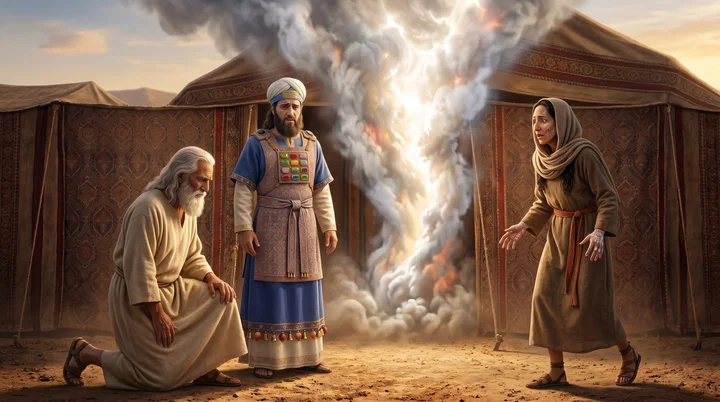
God summoned Moses, Aaron and Miriam to the tabernacle, came down in the pillar of the cloud, stood in the door and called Aaron and Miriam forward to declare Moses' standing.1SP 287.2 He explained that He makes Himself known to a prophet in a vision and speaks in a dream, but Moses was not so, for with him He speaks mouth to mouth, openly and not in dark speeches, and Moses beholds the similitude of the Lord, so they should have been afraid to speak against His servant Moses.1SP 287.2Lt 7, 1894, par. 18–22ST Aug 19, 1880 His anger was kindled against them and He departed, and Miriam became leprous white as snow.1SP 287.2RH Aug 14, 1900ST Aug 19, 1880 Aaron confessed their sin and pleaded that it not be laid upon them and that she not be as one dead, Moses cried to God to heal her, and she was shut out of the camp seven days while the people waited until she was brought in again.1SP 287.2ST Aug 19, 1880
The question why they were not afraid to speak against God's servant Moses teaches that speaking against Moses was disloyalty, irreverence and grievous presumptuous sin against God Himself.Lt 88, 1894, par. 14–17RH Aug 14, 1900PP 384.31SP 288.1 It was heard and answered by a present God who defends His appointed leader even against his own brother and sister, sees hidden motives and will expose them, and meets such speaking with kindled anger and certain punishment.Lt 88, 1894, par. 14–17Ms 201, 1898, par. 1–5RH Aug 14, 1900 God had specially chosen Moses and placed His Spirit upon him, so complaints against Moses were irreverence toward God Himself and a rebuke to jealousy and to complaining against those on whom God places the burden of His work.1SP 288.1
The warning was given not only to Aaron and Miriam but to all Israel and the whole congregation.PP 396.3SG4 27.1–21SP 295.1–2 Miriam's leprosy displayed the seriousness of speaking against God's servant, and God made Miriam an example to warn anyone tempted by jealousy, complaint or rebellion against Moses, whom He had established as Israel's leader.SG4 27.1–21SP 296.1SG4 27.3 That warning applied even while Korah's rebellion was still secret at heart and undeveloped.1SP 296.1
The same warning applies to criticizing and condemning God's messengers, looking on them with contempt, despising and disparaging their work, or cutting away the influence God appointed them to have with His people.Lt 28, 1859, par. 17–19Lt 14a, 1898, par. 10–13 It especially forbids criticizing the person God has appointed to carry a heavy responsibility when others will not share that burden.Lt 28, 1859, par. 17–19 Believers must guard one another's interests sacredly, stay out of sympathy with criticism born of evil surmising and seeking to be first, and purge the leaven of Pharisaism, criticism and accusing from the heart.Lt 14a, 1898, par. 10–13 As men judge others in little things so God will judge them for what dishonors His name, and those in positions of responsibility must be doers of His Word in little as well as large things.Lt 14a, 1898, par. 10–13
Linking relatives together to control the work molds it after the mind and judgment of the family.Ms 201, 1898, par. 1–5 In times of trouble and declension in the church those joined by relationship have less influence for the largest good on the right side.Ms 201, 1898, par. 1–5
Although Moses was so honored, with God speaking to him directly and closely as friends speak and instructing Israel through him, one transgression brought on him the penalty of death.Ms 69, 1912, par. 69–70 This shows God is impartial and was meant to put fear of breaking His law in Israel and to show that those God honors most are not excused when they turn from the right way.Ms 69, 1912, par. 69–70 Those most highly exalted by God and bearing the heaviest responsibilities must give the strictest account for words and actions, because the least deviation is watched and leads others to go further.Ms 69, 1912, par. 69–70
Sources
Pioneers and periodicals
59 sources
God spoke with Moses directly and audibly as a friend, openly and plainly and not in obscure sayings, unlike other prophets who learn His will by vision or dream or inward impression.ST May 6, 1889RH Jun 25, 1872ST May 6, 1889RH Sep 4, 1860PGGC 5.1–2 Moses beheld the likeness and glory of the Lord in visible personal form, as light veiled in cloud, without seeing the unveiled face no mortal can endure.RH Jan 14, 1873RH Jun 18, 1861RH Apr 21, 1868RH Jun 8, 1869RH Oct 8, 1903 He was thus honored above every other prophet as faithful in all God's house, yet remained the meekest man, teachable and forgiving.ST May 6, 1889RH Jan 12, 1911RH Aug 20, 1857ST Oct 6, 1887 The words were spoken to vindicate him when Aaron and Miriam spoke against him from envy at his superiority, and Miriam became leprous white as snow and was shut out seven days until Moses prayed for her healing.ST Aug 19, 1880RH Jun 12, 1913RH Dec 17, 1901ST May 23, 1911 To speak against such a servant is presumptuous sin against God Himself who gave his authority, so all are warned to fear opposing God's chosen leader, in whom direct clear speech makes Moses the type of Christ the Prophet like him.RH Aug 14, 1900RH Nov 12, 1903RH Mar 7, 1907RH Feb 19, 1861ST Sep 19, 1911
Setting and Punishment
Aaron and Miriam spoke against Moses from envy and jealousy at his superiority, for they could not bear to have anyone above them however worthy and fitted for the place, and they claimed God had also spoken by them.RH Aug 14, 1900ST Apr 29, 1913 The envy came from selfish hearts that hoped to be exalted only by bringing Moses down.ST Apr 29, 1913 The occasion included his marriage to an Ethiopian woman, and the rebuke condemns being exercised over the color line and complaining against those who respect Ethiopians.RH Aug 14, 1900RH Dec 17, 1901
The episode belongs to the wilderness murmurings of Numbers 11-14 after leaving Mount Sinai.RH Apr 17, 1879RH Apr 28, 1904 It stands among the ceremonies, wanderings and murmurings where God kept strict order among His children to teach them to learn and form systematic character.ST Mar 4, 1913 Israel, though chosen to be separate and peculiar, disobeyed by complaining because they could not live like the world and by lusting after the food eaten in Egypt, and continued to murmur until protecting care was withdrawn, so that they wandered until all but Caleb and Joshua and the children perished without entering the promised land.RH Apr 17, 1879
The Lord heard the words against Moses even when the speakers did not consider that He listened.ST Mar 31, 1909 He came down in the pillar of the cloud and called Aaron and Miriam forth to defend Moses as His servant.RH Dec 17, 1901 His anger was kindled against them, and He departed and the cloud departed from off the tabernacle.RH Dec 17, 1901
Miriam became leprous, white as snow.RH Dec 17, 1901ST Mar 31, 1909 She was shut out of the camp seven days at Hazeroth, among the swift signal punishments suffered by discontented Israel, and Israel's progress was delayed until she returned to the camp.ST Aug 19, 1880RH Jun 12, 1913ST May 23, 1911 Aaron fully shared the wrongdoing and sorrowed deeply afterward when his beloved sister was smitten, and she was healed and restored after Moses prayed for her.ST Aug 19, 1880ST Mar 31, 1909
Slander against Moses was foolish murmuring abhorrent to God.RH Feb 24, 1916 It showed that God had specially chosen Moses.RH May 20, 1873 One person's sin can hold back God's people, and rebellion and murmuring cannot be tolerated among them.RH Jun 12, 1913RH Nov 18, 1862
Speech and Vision
With him God speaks mouth to mouth, by articulate sounds in audible speech in familiar manner as a man speaks to his friend, an actual conversation with only a dim veil of cloud between them.RH Sep 4, 1860PGGC 5.1–2 This is more than a vision impressed by the Spirit and more than an inward enlightening of mind and conscience, for other prophets learned the divine will by a silent, quick and effective impression of God's mind upon the human mind with no audible voice heard.ST Dec 22, 1914 Direct speech of this kind did not require sight of God's face while speaking.RH Jan 14, 1873RH Sep 4, 1860
Apparently means openly and plainly, not in dark, obscure sayings.ST May 6, 1889RH Jun 25, 1872ST May 6, 1889ST Jan 15, 1885 God made Himself known to other prophets in vision and dream and dark speeches, but with Moses He spoke directly and clearly.ST May 6, 1889RH Sep 4, 1860RH May 26, 1863 That plain, direct revelation set Moses above the other Old Testament prophets and gave his words divine authority.ST May 6, 1889
All others with whom heavenly intercourse was held received it through a vision or in a dream, while Moses alone in the Old Testament story was brought face to face with Jehovah in counsel as one friend converses with another.ST Dec 22, 1914ST Dec 22, 1914RH Sep 21, 1916 Since the fall Moses is the only person to whom God has spoken in this manner.RH Sep 21, 1916 The example is Samuel, who was told to reject each of Jesse's older sons and to anoint David by silent impression without audible voice.ST Dec 22, 1914 Sometimes the Spirit also comes upon prophets as they open the mouth to bear God's message, and sometimes God talks with the prophet face to face, as with Moses and Jesus.ST Nov 3, 1898 God's system for speaking to and controlling the intellectual faculties is unsearchable, no less than His system for calling world elements into being, and His declaring of the divine mind upon mortal mind is as potent as over unorganized matter.ST Dec 22, 1914
The similitude of the Lord is His likeness, form and glory, the Shekinah cloud of glory enveloping the Lord of hosts.RH Jun 18, 1861RH Sep 4, 1860RH Jun 8, 1869 What Moses and Israel beheld was that glory, as one sees light radiating from the sun without seeing the sun itself.RH Sep 4, 1860 Moses beheld God's similitude but did not see God's face.RH Apr 21, 1868 He did not see the unveiled face in full glory, which mortal body could not endure and which was never unveiled to human gaze.RH Sep 4, 1860ST Apr 29, 1908
The verse therefore presents God as a person with a form and a mouth, having a visible form with mouth and face.RH Jun 18, 1861RH Jun 8, 1869RH Oct 8, 1903 The great and dreadful God came down wrapped in a cloud of glory that could be seen, but not the face that has more dazzling brightness than a thousand suns.RH Jun 18, 1861 Under that covering Moses was permitted to draw near and converse with God, which removes the difficulty between speaking face to face and not seeing His face.RH Jun 18, 1861
Moses Above Prophets
God honored Moses above every other prophet by speaking with him face to face as a man speaks with his friend and by working mighty miracles through him, setting him incomparably above every prophet, priest and king as one most highly favored of God and therefore worthy of just respect and faithfulness in service.RH Jan 12, 1911ST Oct 6, 1887RH Jul 26, 1870ST May 6, 1889 Though learned in all the wisdom of Egypt and exalted by this direct communion, he remained the meekest man upon the whole earth, teachable, unselfish, tender and forgiving, receiving counsel from Jethro, sharing his burdens and honors with the seventy, refusing to envy Eldad and Medad but desiring the Spirit for all, and praying for forgiveness for Aaron and Miriam when they spoke against him.RH Aug 20, 1857ST May 6, 1889 Called from keeping the flocks of Jethro in the plains of Midian to lead two million people through the Red Sea and through the wilderness forty years, he was permitted to behold the similitude of the Lord and the glory of God as He descended upon Mount Sinai, proving that true meekness obeys the commands of God rather than the traditions of men.RH Aug 20, 1857
He is faithful in all God's house, uniquely close and divinely illuminated within mortal limits so that he knew what he spoke and wrote, receiving direct divine revelation and illumination clearly and not in dark sayings, distinct from the visions and dreams given to other prophets.ST May 6, 1889RH Aug 20, 1857 The difference of speaking mouth to mouth and apparently and not in dark speeches is a distinction between the men, not between their Scriptures, for revelation through Moses was no more truly from God or more inspired than that through Daniel, Isaiah, Jeremiah or any other prophet, since the same God spoke through them all and the same Spirit inspired their words.ST May 6, 1889 Illumination of the prophet's mind and inspiration of his writings are two different things, for Moses was more than a channel for truth to others and his own mind was divinely illuminated so he understood the prophecies and revelations given through him, while the other prophets did not fully understand their own writings but ministered to generations to come.ST May 6, 1889
God gave Moses leading authority as chosen leader with a distinct commission to make His statutes and laws known to the people in continuing oral instruction during the patriarchal age, and his work as the Lord's messenger included more than the word prophet signifies.ST Feb 28, 1906RH Nov 1, 1906 Unlike Joshua and later rulers of Israel, who sought the Lord's counsel through the high priest, he received counsel directly from God, and because he was faithful in all the Lord's house Miriam and Aaron were not to speak against him.ST Jan 13, 1881RH Nov 1, 1906 This close communion followed his humble prayer and dependence on God for spiritual understanding and guidance, marking the intimacy of their fellowship as he was prepared to serve as a faithful shepherd and leader.ST Jul 12, 1905 God does not forsake the instrument He has chosen even in old age, for Moses was given a uniquely prominent place in direct speech with God and made accountable to God Himself, so that speaking against him was a grievous sin to be feared even though Miriam and Aaron were also prophets, bringing leprosy upon Miriam until Moses' prayer led to her restoration, and other prophets are to respect and honor the leading prophet without worshiping him.RH Aug 10, 1916RH Apr 26, 1906
Revelation and Scripture
The distinction of speaking mouth to mouth and plainly and not in obscure sayings is between the men themselves and not between their Scriptures.ST May 6, 1889 Revelation given through Moses was no more truly from God and no more inspired than that given through Daniel or Isaiah or Jeremiah or any other prophet.ST May 6, 1889 The same God spoke through them all and the same Spirit inspired all their words.ST May 6, 1889 Illumination of a prophet's mind and inspiration of his writings are two different things.ST May 6, 1889 Moses was more than a channel of truth to others, for his own mind was divinely illuminated so that he understood the prophecies and revelations given through him.ST May 6, 1889 The other prophets did not fully understand their own writings but ministered to generations to come, yet their writings were no less inspired.ST May 6, 1889
Because the Creator who made heaven and earth told him directly and made known His ways to him, Moses knew the facts of creation though no man saw creation happen.ST Mar 12, 1896 He did not get them from other men or from earlier documents or from imagination.ST Mar 12, 1896 This direct speaking is how he knew what to write, and the same speaking from God while moved by the Holy Ghost is how the entire Bible was written, for no prophecy came by the will of man.ST Mar 12, 1896 The Lord talked with Moses face to face as with no other prophet, speaking directly and openly and not merely by inward enlightening of mind and conscience.ST Nov 4, 1889 This means Moses truly heard God and told the truth when he said God spoke the law and wrote it on tables of stone and gave the Sabbath reason in the fourth commandment.ST Nov 4, 1889 To deny it makes Moses a deliberate liar and removes all reason to believe his accounts of the flood and Abraham and the manna and the giving of the law and his prophecy of the coming Prophet, and since that Prophet like Moses is Christ, it calls Christ's character into question.ST Nov 4, 1889
God also showed Moses the heavenly sanctuary and commanded him to build an earthly sanctuary as its shadow.ST Oct 25, 1905 The condition of a later visionary is the same as the condition of those to whom God gave visions in ancient times, distinct from Moses' face-to-face speech.RH Jul 29, 1873
Prophet Like Christ
Direct plain speech set Moses apart from prophets who received messages through visions or dreams, for God spoke to him mouth to mouth, openly and not in obscure sayings, and he beheld the Lord's likeness.ST Sep 19, 1911ST Jan 17, 1906 This direct and immediate intercourse made him the standard of prophetic revelation and a type of Jesus Christ, the promised Prophet like Moses.RH Feb 19, 1861ST Sep 19, 1911ST Jan 17, 1906 As that Prophet like Moses, Christ outshone him as the sun outshines all other lights in the doctrines revealed, the precepts taught, the miracles wrought, and the life and example exhibited.RH Feb 19, 1861
In Moses God placed authority and used him as His own spokesman as He used no other, so that his office carried the very authority of God and from his countenance beamed the indwelling glory of God's word received by faith.ST Aug 21, 1901 To receive his word as from God meant life, and to reject it meant death.ST Aug 21, 1901 Christ's words were received from God in the same way as those of Moses, and if Moses' words had been received as from God they would have been received not as mere law but as grace and truth.RH Feb 19, 1861ST Aug 21, 1901 Christ in this office brought grace and truth and declared God.RH Feb 19, 1861 Moses nevertheless received an exceptional place while remaining the Lord's servant, unlike Jesus, who is the Son.ST Jan 7, 1903
Warning and Example
Speaking against Moses was contemptuous speech that was grievous presumptuous sin against God Himself, done to gratify unsanctified impulses from envy and jealousy over his Ethiopian wife and from the claim that God had also spoken by Aaron and Miriam.RH Aug 14, 1900RH May 26, 1863 Moses stood in a closer relation to God than other prophets, for ordinary prophets receive visions and dreams in dark speeches, but Moses is faithful in all God's house, and God speaks with him mouth to mouth, plainly and openly, and Moses beholds the similitude of the Lord.RH Aug 14, 1900ST Sep 9, 1880RH May 26, 1863 God said this to rebuke them, and the question why they were not afraid to speak against God's servant Moses warns Miriam and Aaron and all Israel to fear opposing God's chosen servant.RH Aug 14, 1900ST Sep 9, 1880RH May 26, 1863 The words were heard and answered by a present God, kindling His anger and bringing certain punishment, and this special direct communication established his authority as Israel's appointed leader and made speaking against him a serious offense.RH Aug 14, 1900RH Nov 12, 1903ST Sep 9, 1880
Jealousy and accusations against his leadership and authority were rebellion against the Lord who gave it, for his leadership came from God and their challenge to the one He had appointed to lead Israel was treated as opposition to God.RH Nov 12, 1903RH Mar 7, 1907 His own sister and brother maligned him and weakened his influence with the people.ST Feb 15, 1905 Moses left the contention to God, continued his work, and prayed that Miriam would be healed.ST Feb 15, 1905
In this God vindicated Moses His faithful servant.ST Feb 15, 1905 The punishment that followed Miriam's sin in speaking against Moses shows the holiness of God's work and how particular God is that everything shall be performed exactly, and the sacredness of His ordinances.ST Jun 17, 1889 God is no respecter of persons, dealing in strict justice with the greatest among men and His own people even as with the lowest, with no outward provocation an excuse for sin whose root is wholly in the heart of man.ST Jun 17, 1889
This direct revelation, speaking directly and plainly and not through dark or obscure sayings, with beholding of the Lord's likeness, distinguished Moses from the other prophets of his time and set him and his words above the other Old Testament prophets with divine authority.RH Jun 23, 1903RH Feb 24, 1916 That unusually direct communication, mouth to mouth, underscores the seriousness of Aaron and Miriam speaking against God's servant, so that speaking against him was a grave offense.RH Feb 24, 1916
Sources