Exodus 4:3
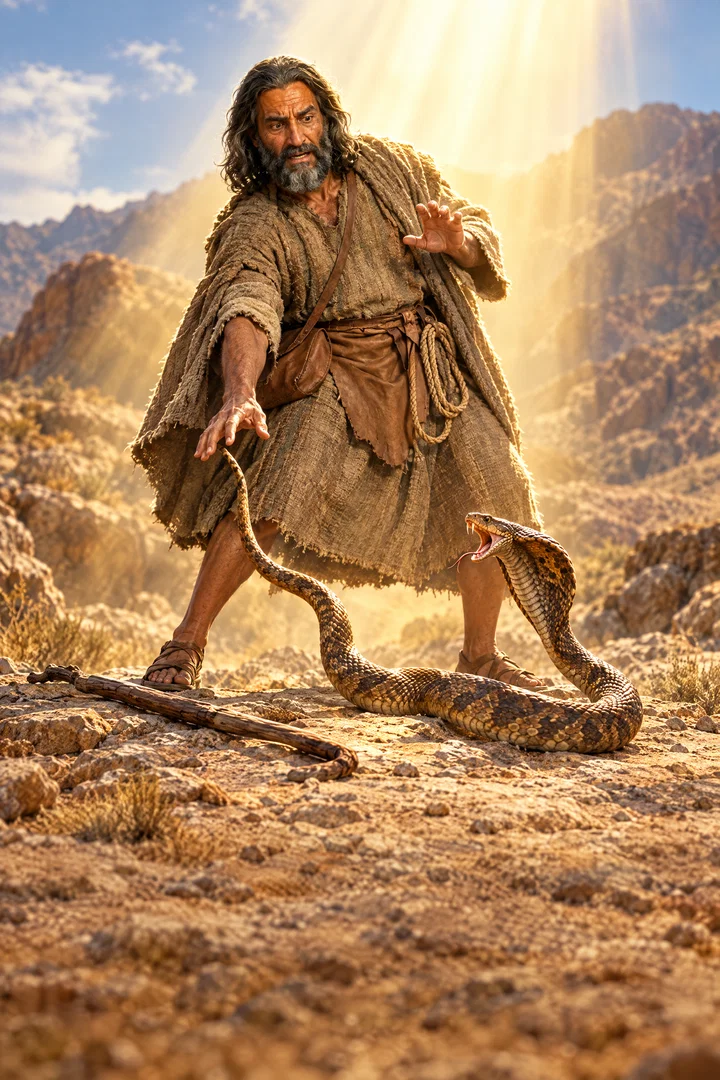
And he said, Cast it on the ground. And he cast it on the ground, and it became a serpent; and Moses fled from before it.
Translations
American King James Version, King James Version, KJV Cambridge Paragraph Bible, Revised Version, American Standard Version, Darby Translation
And he said, Cast it on the ground. And he cast it on the ground, and it became a serpent; and Moses fled from before it.
And he said, Cast it on the ground. And he cast it on the ground, and it became a serpent: and Moses fled from before it.
and He saith, 'Cast it to the earth;' and he casteth it to the earth, and it becometh a serpent — and Moses fleeth from its presence.
Then said he—Cast it to the earth. And he cast it to the earth, and it became a serpent,—and Moses fled from the face thereof.
Berean Standard Bible, Majority Standard Bible
“ Throw it on the ground,” said the LORD. So Moses threw it on the ground, and it became a snake, and he ran from it.
He said, “ Throw it on the ground.”He threw it on the ground, and it became a snake; and Moses ran away from it.
And he said, Put it down on the earth. And he put it down on the earth and it became a snake; and Moses went running from it.
Then said he, Cast it on the ground. So he cast it on the grounde, and it was turned into a serpent: and Moses fled from it.
Douay-Rheims (Challoner revision)
And the Lord said: Cast it down upon the ground. He cast it down, and it was turned into a serpent: so that Moses fled from it.
Pictures
Cross-references
- Exodus 7:10-12
And Moses and Aaron went in unto Pharaoh, and they did so as the LORD had commanded: and Aaron cast down his rod before Pharaoh, and before his servants, and it became a serpent.
Aaron’s rod becomes a serpent before Pharaoh, and Egypt’s magicians imitate the sign.
- Exodus 3:5-6
And he said, Draw not nigh hither: put off thy shoes from off thy feet, for the place whereon thou standest is holy ground.
Moses’ rod sign accompanies his commission by God at Horeb.
- Exodus 4:9
And it shall come to pass, if they will not believe also these two signs, neither hearken unto thy voice, that thou shalt take of the water of the river, and pour it upon the dry land: and the water which thou takest out of the river shall become blood upon the dry land.
Water turning to blood is a further sign if the first two signs fail.
- Exodus 7:20
And Moses and Aaron did so, as the LORD commanded; and he lifted up the rod, and smote the waters that were in the river, in the sight of Pharaoh, and in the sight of his servants; and all the waters that were in the river were turned to blood.
Moses uses the rod in a miracle, as in the sign before Pharaoh.
Commentary
Each commentary is drawn from primary sources: the writings of Ellen G. White and Adventist pioneers and periodicals. Each commentary is separate. Its own words are not a quotation; follow the references to read the source passages.
Ellen G. White
10 sources
In the land of Midian Moses pleaded for a sign confirming that his message was from heaven, in a setting like those of Gideon and Elisha where a sign confirmed a heavenly message.PK 342.2–4 The sign answered his fear that Israel would not believe God had sent him, would not listen to his voice, but would say the LORD had not appeared to him, by giving evidence appealing to his own senses.PP 253.61SP 172.2–173.2SG3 192.1–193.1 At the command he cast his rod on the ground, it became a serpent, he fled from it in fear, and when taken up it became a rod again.Ms 6, 1895, par. 8PP 253.6Lt 109, 1895, par. 13
Joined to the sign of the leprous hand, it assured him that both his own people and Pharaoh would be convinced that One mightier than the king of Egypt was at work among them.PP 253.6 It assured him that God would work by such signs and wonderful works to make Pharaoh and the Egyptians fear so they would not dare to harm him, and to convince the king and his people that One greater than Moses was manifesting power before them.1SP 172.2–173.2SG3 192.1–193.1 Even after many such miracles performed before Pharaoh in the sight of the people, they still would not let Israel go.SG3 192.1–193.1
The serpent was probably a poisonous cobra, recognized by Moses' flight and by the word nahash associated with hissing, and with its swollen neck it represented royal and divine power on Pharaoh's crown, so the change was both a portent and a pledge of victory over Egypt's king and gods.PP 757.3 Israel's deliverance was to be accomplished in a manner to pour contempt on human pride, with the deliverer going forth as a humble shepherd with only a rod in his hand, which God made the symbol of His power.PP 251.2–252.1 The simple staff shows that God can do a great work through humble, simple, or surprising means devoted to Him, so His power and choice of agencies must not be limited.Ms 6, 1895, par. 8Lt 109, 1895, par. 13
The shepherd's crook became the rod of authority for leading more than a million idolatrous, rebellious people after leaving the flock of sheep, while Moses himself was to be a willing instrument worked by Christ, depending on the invisible Leader.OEWP 11.3–13.2Lt 47, 1895, par. 26–28 Prepared in the school of shepherd work in humility, faith and trust, and united in close communion with the chief Shepherd, he became the shepherd of God's own people.OEWP 11.3–13.2 Through his firm faith and abiding trust blessings reached Israel as God worked through him for their uplifting and salvation.OEWP 11.3–13.2
Sources
Pioneers and periodicals
23 sources
After forty years in Midian tending sheep following his failed self-sent effort as deliverer, Moses was called by God himself to return to Egypt to deliver His oppressed people, and was equipped with miraculous signs for that mission.ST Jan 24, 1911ST Jan 28, 1913ST Jan 20, 1909 The rod he held was his ordinary shepherd's staff marking him as a humble shepherd, which he surrendered to receive as a rod of divine power.ST Feb 26, 1880RH Nov 12, 1903ST Jul 23, 1912 At the command he threw it to the ground and it became a living serpent from which he fled in fear he did not expect, until at God's word he took it up and it became a rod in his hand again, a real work of God's direct power and not any power or illusion of his own.ST Feb 26, 1880ST Dec 21, 1888ST Apr 15, 1913ST Jul 3, 1879RH Nov 26, 1857 It was the first sign given to answer his fear that Israel would not listen, to prove that the God of Abraham, Isaac, and Jacob had appeared to him, and to convince both Israel and Pharaoh that One mightier than Egypt's king had sent him.ST Feb 26, 1880ST Dec 21, 1888ST Jul 3, 1879RH Nov 26, 1857 It was given to strengthen Moses in his weakness and answer his excuses of unfitness, to confirm on the spot that the voice from the burning bush was God, and to furnish an instrument through which God would confound the magicians, win Israel to believe and follow, and work deliverance and supply.ST Apr 15, 1913ST Aug 7, 1901ST May 1, 1901ST Dec 30, 1889
Context and Meaning of Sign
The verse belongs to God's call to Moses at the end of forty years of schooling in the wilderness tending sheep in Midian after his flight following his failed self-sent mission as deliverer. ST Jan 24, 1911 He had felt all-sufficient in his Egyptian education and knowledge of warfare and had met utter failure, and now felt utterly insufficient, yet his God-given mission was successful. ST Jan 24, 1911 It is part of God's call equipping him with miraculous signs for his task and mission to go to Egypt to deliver the Lord's people from oppression after his years in Midian. ST Jan 28, 1913ST Jan 20, 1909
It shows part of God's direct, impressive call for Moses to leave his flock and devote the rest of his life to the Exodus. That call came not from human counsel or from Israel's suffering condition but from God himself laying hold of his conscience with an unyielding grip until he surrendered in obedience. It belongs to the deliverance of Israel with a mighty hand at the end of four hundred years servitude in fulfillment of the promise to Abraham. RH Aug 1, 1871 Their hundreds of years of slavery had unfitted them to comprehend God's great salvation and the character He required, so God gave them the sanctuary as a great, multiple object-lesson which by various forms and rites taught the great plan of salvation.
The verse belongs to the series of events in Exodus 1-14 that would not be expected to obtain direct mention in Egypt's public monuments and court histories. RH Apr 23, 1908 Only successes and triumphs were registered there, and the year of plagues and the Red Sea disaster would naturally be omitted by court historiographers and monarch. RH Apr 23, 1908 It is part of Exodus 3 and 4, which gives the account of the call of Moses that forms the background to Stephen's speech about Moses in Acts 7:17-60. That account shows Moses in Midian pleading for a sign that his message was from heaven.
The rod was Moses' ordinary shepherd's rod or crook that marked him as a humble shepherd rather than a commander with armies and armor. ST Feb 26, 1880ST Jul 23, 1912 He gave it up for a rod of power given by God, exchanging a far more peaceful and happy shepherd life for leadership of a vast, turbulent assembly which he dared not choose and could not lay down until God released him. RH Nov 12, 1903 The sign began to teach him that God could work wonders through an ordinary instrument and that its power came from God. ST Jul 23, 1912 At the command to cast it on the ground, Moses threw the rod down and it became a living serpent and he fled from it. ST Feb 26, 1880ST Dec 21, 1888ST Apr 15, 1913RH May 15, 1900RH Nov 26, 1857 At God's word he caught it and it became a rod in his hand again, through which he was to manifest God's great power. ST Dec 21, 1888ST Apr 15, 1913RH May 15, 1900
Moses did not expect the change, and his fear and flight show the sign was not produced by any power he possessed but was wrought by the direct power of God. RH Nov 26, 1857ST Jul 3, 1879RH Nov 26, 1857 The serpent was a real sign, not an illusion or merely a different phase of belief. ST Jan 28, 1903
Purpose and Application
The turning of the rod into a serpent was the first sign given in answer to Moses' fear that Israel would not believe him or listen to his voice, to prove that the Lord God of Abraham, Isaac, and Jacob had appeared to him so that the people would believe.ST Dec 21, 1888ST Jul 3, 1879 The signs were meant to convince both the Israelites and Pharaoh that God had sent Moses.ST Jul 3, 1879RH Nov 26, 1857 They assured Moses that Israel and Pharaoh would be convinced that One mightier than Egypt's king was present among them.ST Feb 26, 1880
God gave Moses this extraordinary visible sign to strengthen him in his weakness.ST Aug 7, 1901 It confirmed His word to a servant who was slow to accept it without proof.ST May 1, 1901 It was given to encourage Moses and to answer his excuses that he lacked education, speech, and fitness for bringing Israel out of Egypt, as evidence that God would sustain him in the work.ST Dec 30, 1889
The change was a demonstration of God's might, power, and authority manifested to deliver oppressed Israel in answer to their affliction and cry in Egypt.RH Dec 15, 1910 It was given to Moses together with power to bring leprosy and to heal it instantly, as living credentials that he was the royal ambassador of the living God sent with a living message that demanded heed.RH Dec 15, 1910 Through this rod Moses was to manifest the great power of God, and the sign was to be repeated before the king to manifest God's power to Pharaoh.RH May 15, 1900RH Dec 15, 1910
The casting down and its becoming a serpent was unmistakable evidence given to Moses on the spot that the voice speaking from the burning bush was God and that he was not being misled. The rod then became an instrument of deliverance through which God displayed His power and authority.ST Apr 15, 1913RH Feb 6, 1913 By it God confounded the magicians and worked miracles that led Israel to believe and follow Moses, brought deliverance, preserved the people when enemies pursued, and supplied human needs.ST Apr 15, 1913RH Feb 6, 1913
The miracle attests a special mission of leading Israel out at the end of four hundred years servitude in fulfillment of the promise made to Abraham, and it was necessary because of the circumstances of that work.RH Aug 1, 1871 It shows that special direction and assistance of the Spirit is always necessary in fulfilling such a mission, and that God works miracles when they are needed to attest it.RH Aug 1, 1871
The rod in the hand as a wonder-worker, but turned to a serpent when cast on the ground, means that knowledge and good abilities managed by grace do wonderful good, but when thrown down and used to promote earthly designs they become harmful like serpents.RH Nov 7, 1865 Moses fleeing in fright from before the serpent pictures unnecessary fears and groundless apprehensions toward each new step God bids His people take, such as church order and systematic benevolence. Blind prejudice and fearful apprehension see a thousand serpents, but every step taken in willing obedience proves a place of positive safety, for the feared thing taken up in obedience becomes a harmless rod again.
Sources