Exodus 4:2
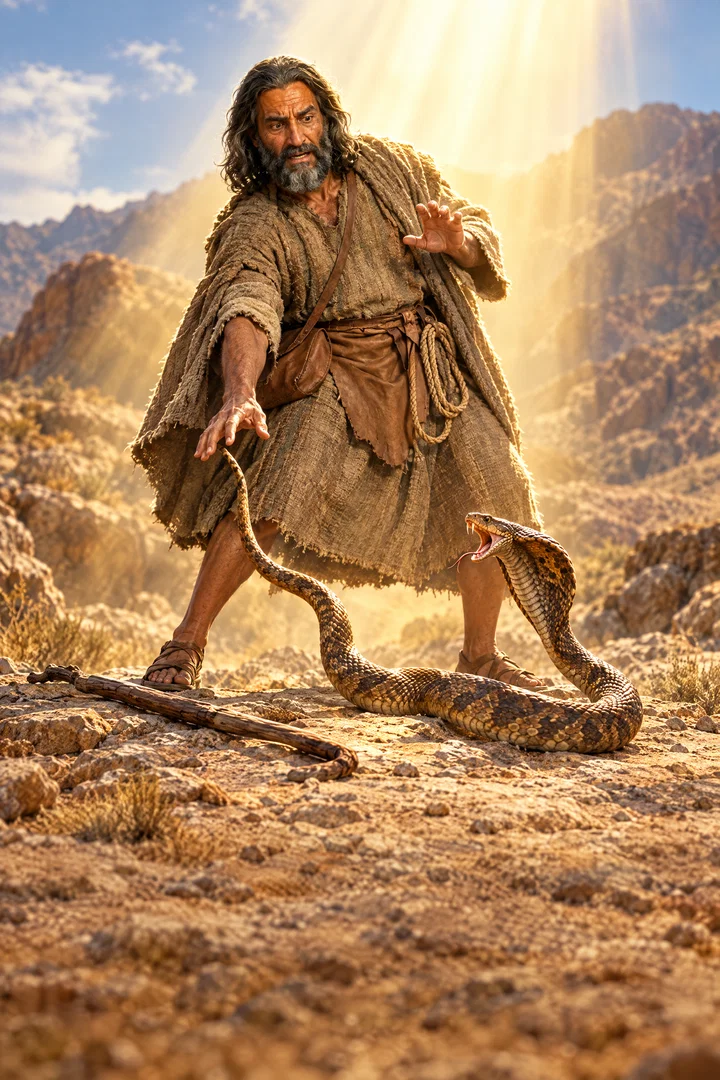
And the LORD said unto him, What is that in thine hand? And he said, A rod.
Translations
And the LORD said to him, What is that in your hand? And he said, A rod.
King James Version, Revised Version
And the LORD said unto him, What is that in thine hand? And he said, A rod.
And the Lord said unto him, What is that in thine hand? And he said, A rod.
And the LORD said to him, What is that in thy hand? And he said, A rod.
And Jehovah said unto him, What is that in thy hand? And he said, A rod.
And Jehovah saith unto him, 'What [is] this in thy hand?' and he saith, 'A rod;'
And Jehovah said to him, What is that in thy hand? And he said, A staff.
And Yahweh said unto him—What is this in thy hand? And he said—A staff.
Berean Standard Bible, Majority Standard Bible
And the LORD asked him, “ What is that in your hand?”“ A staff,” he replied.
The LORD said to him, “ What is that in your hand?”He said, “ A rod.”
And the Lord said to him, What is that in your hand? And he said, A rod.
And the Lord said vnto him, What is that in thine hande? And he answered, A rod.
Douay-Rheims (Challoner revision)
Then he said to him: What is that thou holdest in thy hand? He answered: A rod.
Pictures
Cross-references
- Exodus 7:10-12
And Moses and Aaron went in unto Pharaoh, and they did so as the LORD had commanded: and Aaron cast down his rod before Pharaoh, and before his servants, and it became a serpent.
Aaron’s rod becomes a serpent before Pharaoh, and the sorcerers imitate the sign.
- Exodus 4:6-7
And the LORD said furthermore unto him, Put now thine hand into thy bosom. And he put his hand into his bosom: and when he took it out, behold, his hand was leprous as snow.
The leprous hand is an additional sign after the rod sign.
- Exodus 4:17
And thou shalt take this rod in thine hand, wherewith thou shalt do signs.
God appoints Moses’ rod as the instrument for signs.
- Exodus 14:21
And Moses stretched out his hand over the sea; and the LORD caused the sea to go back by a strong east wind all that night, and made the sea dry land, and the waters were divided.
Moses used the rod in his hand to smite the sea.
- Exodus 3:5-6
And he said, Draw not nigh hither: put off thy shoes from off thy feet, for the place whereon thou standest is holy ground.
same Horeb commissioning of the shepherd-deliverer
- Exodus 14:16
But lift thou up thy rod, and stretch out thine hand over the sea, and divide it: and the children of Israel shall go on dry ground through the midst of the sea.
Moses stretches out his rod as God parts the sea and delivers Israel.
- Numbers 17:8
And it came to pass, that on the morrow Moses went into the tabernacle of witness; and, behold, the rod of Aaron for the house of Levi was budded, and brought forth buds, and bloomed blossoms, and yielded almonds.
Aaron’s rod buds and blossoms, displaying God’s power to make it fruitful.
- Exodus 7:20-22
And Moses and Aaron did so, as the LORD commanded; and he lifted up the rod, and smote the waters that were in the river, in the sight of Pharaoh, and in the sight of his servants; and all the waters that were in the river were turned to blood.
The rod becomes an instrument of the water-to-blood sign, which the magicians imitate.
- Exodus 17:6
Behold, I will stand before thee there upon the rock in Horeb; and thou shalt smite the rock, and there shall come water out of it, that the people may drink. And Moses did so in the sight of the elders of Israel.
Moses strikes the rock with his rod, and God provides water.
- Exodus 4:7
And he said, Put thine hand into thy bosom again. And he put his hand into his bosom again; and plucked it out of his bosom, and, behold, it was turned again as his other flesh.
hand restored as completion of sign
- Exodus 4:9
And it shall come to pass, if they will not believe also these two signs, neither hearken unto thy voice, that thou shalt take of the water of the river, and pour it upon the dry land: and the water which thou takest out of the river shall become blood upon the dry land.
A further sign is given if the first two are disbelieved.
- Exodus 8:16-19
And the LORD said unto Moses, Say unto Aaron, Stretch out thy rod, and smite the dust of the land, that it may become lice throughout all the land of Egypt.
The magicians cannot reproduce the lice and acknowledge God’s power.
- Exodus 8:5-7
And the LORD spake unto Moses, Say unto Aaron, Stretch forth thine hand with thy rod over the streams, over the rivers, and over the ponds, and cause frogs to come up upon the land of Egypt.
The magicians imitate the sign of frogs.
- Exodus 4:11
And the LORD said unto him, Who hath made man’s mouth? or who maketh the dumb, or deaf, or the seeing, or the blind? have not I the LORD?
God answers Moses’ fear by affirming his power over human abilities.
- Exodus 4:12
Now therefore go, and I will be with thy mouth, and teach thee what thou shalt say.
God promises to be with Moses’ mouth and teach him what to say.
Commentary
Each commentary is drawn from primary sources: the writings of Ellen G. White and Adventist pioneers and periodicals. Each commentary is separate. Its own words are not a quotation; follow the references to read the source passages.
Ellen G. White
9 sources
The exchange took place in Midian, where the Lord asked Moses what was in his hand and Moses answered that it was a rod.Ms 6, 1895, par. 8PK 342.2–4 The question was given to answer Moses' fear that Israel would not believe him nor listen to his voice and would say the Lord had not appeared to him.PP 253.6SG3 192.1–193.1 God met that fear by giving him evidence that appealed to his own senses, beginning by calling attention to the rod in his hand.PP 253.6SG3 192.1–193.1
When the time for Israel's deliverance had come, God purposed to accomplish it in a manner to pour contempt on human pride.PP 251.2–252.1 The deliverer went forth as a humble shepherd with only a rod in his hand, and God made that rod the symbol of His power.PP 251.2–252.1 The verse introduces the rod that God changes into a serpent as a sign to Moses.PP 757.3 That serpent was probably a cobra, the royal symbol on Pharaoh's diadem and a representation of Egypt's royal and divine power.PP 757.3
Its poisonous nature is shown by Moses fleeing from it and by the word used for it, which is associated with hissing.PP 757.3 The transformation was more than a portent, for it pledged and represented victory over Egypt's king and gods.PP 757.3 That ordinary rod became the means for signs, joined with the hand turning leprous, to convince both Israel and Pharaoh and his people that One mightier than the king of Egypt and greater than Moses was manifest among them.PP 253.6SG3 192.1–193.1 By such signs and wonderful works God would cause Pharaoh and the Egyptians to fear so they would not dare to harm him, yet even after many miracles performed before Pharaoh in the sight of the people they would not let Israel go.SG3 192.1–193.1
The rod shows that God can do great and wonderful things through a simple, ordinary object when it is devoted to His service.Ms 6, 1895, par. 8Lt 109, 1895, par. 13 His work is not limited to means people expect, so they should not limit His power.Lt 109, 1895, par. 13 The verse marks God's call for Moses to exchange his shepherd's crook for the rod of authority, to leave his flock of sheep and take leadership of more than a million idolatrous, rebellious people.OEWP 11.3–13.2 He had been prepared by shepherd work that taught humility, meekness, faith, trust, and care for the afflicted, sick, straying, unruly, young and old, and that made his life closely linked with heaven so he was ready to depend upon the invisible Leader.OEWP 11.3–13.2
Even as the rod was simply an instrument in his hand, so he himself was to be a willing instrument to be worked by the hand of Jesus Christ.OEWP 11.3–13.2Lt 47, 1895, par. 26–28 As a shepherd of God's own people he was to be an unobstructed channel through whom the riches of heaven would be poured out.OEWP 11.3–13.2 Through his firm faith and abiding trust many blessings and God's blessings reached the children of Israel.OEWP 11.3–13.2Lt 47, 1895, par. 26–28 The Midian encounter connects asking what is in the hand with asking for a sign from heaven, since God gave signs in response to a request for assurance.PK 342.2–4 It therefore serves as a precedent for Hezekiah asking for a sign that God would fulfill the promise to heal him.
Sources
Pioneers and periodicals
30 sources
At the burning bush after forty years tending sheep in Midian had emptied Moses of self-sufficiency, God called him without human counsel to lead Israel out after four hundred years of bondage and began to attest that special mission with signs.ST Jan 24, 1911RH Aug 1, 1871 The Lord asked him what was in his hand, and his ordinary shepherd's staff with no power in itself became the answer, for when cast down it became a serpent and when taken up it became a rod again to prove that the God of Abraham, Isaac, and Jacob had appeared and sent him.ST Feb 26, 1880ST Dec 21, 1888ST Jul 3, 1879ST Mar 20, 1884ST May 21, 1885 Together with the signs upon his hand and with water, that wonder was given to overcome his excuses of unfitness and to convince Israel and Pharaoh that a power mightier than Egypt's king was present, not to display any power of his own.ST May 1, 1901ST Aug 7, 1901RH May 15, 1900RH Nov 26, 1857ST Dec 30, 1889 The rod then became God's chosen instrument in his obedient hand to confound the magicians, smite Egypt, divide the waters, and deliver and preserve a humble shepherd's company without an army.ST Feb 26, 1880ST Apr 15, 1913RH Mar 2, 1916 So the question teaches that God begins with the ordinary thing already in hand and works wonders through it when yielded and obeyed, requiring everyone to consecrate whatever is possessed, however small, whether skill of hand, tongue, pen, song, or means, instead of pleading inability or waiting for extraordinary resources.RH May 15, 1900ST Jul 23, 1912RH Mar 9, 1916RH May 15, 1900ST Jul 23, 1912
Moses' Call and Sign
The question belongs to the first historical part of Exodus in chapters 1-4, which tells of Israel's oppression in Egypt and the birth and upbringing of Moses up to his call as deliverer. It belongs to the series of events in the first fourteen chapters, including a whole year of terrible plagues in Egypt and the disaster at the Red Sea, which would not be expected in Egyptian public monuments because only successes and triumphs were recorded there, which court historiographers would naturally refrain from mentioning and which the monarch would certainly not inscribe upon his edifices.RH Apr 23, 1908 It is part of God's call to Moses at the end of forty years of schooling in the wilderness tending sheep in Midian, when Moses felt utterly insufficient to be the deliverer, in contrast to the beginning of the forty years when he felt all-sufficient with Egyptian education and knowledge of warfare and his self-sent mission met utter failure and flight to Midian, while his mission after this call was successful.ST Jan 24, 1911
It presents Moses as no longer self-sufficient, with God directing him as he prepares to lead Israel out of Egypt. It belongs to a direct and impressive call to God's work that came without any suggestion or influence from men, not from the counsel of Jethro nor from the suffering condition of Israel, but from the voice of God speaking from the burning bush and laying hold on conscience with an unyielding grip until surrendered to in obedience, accompanied on the spot by unmistakable evidence that it was from God and not misleading. It shows God specially directing Moses for the special mission of leading Israel out at the end of four hundred years of servitude in fulfillment of the promise made to Abraham, with the rod and the miracles beginning there given to attest his mission because the circumstances required it, proving that special assistance of the Spirit is always necessary in fulfilling a special mission and that God works miracles when they are needed.RH Aug 1, 1871 It belongs to Israel's deliverance from bondage after hundreds of years of slavery, when God redeemed Israel with a mighty hand, and that long slavery had unfitted Israel to comprehend God's great salvation and the character He required, so God gave a great multiple object-lesson by various forms and rites comprehending in its teaching the great plan of salvation. The account of God's call of Moses in Exodus 3 and 4 gives the history behind Stephen's speech about Moses in Acts 7:17-60.
The Lord asks Moses what is in his hand as the beginning of a sign by which Israel might know that the Lord had appeared to him, and Moses answers that it is a rod, which when cast on the ground becomes a serpent and when taken by the tail becomes a rod again, to prove that the Lord God of Abraham, Isaac, and Jacob had appeared to him.ST Dec 21, 1888 The rod in his hand was an ordinary staff used to tend his flocks, with no special power in itself, though it later became associated with mighty wonders, and its ordinary nature shows the power came through its use by God and astonished the king when given to God's service.ST Mar 20, 1884ST May 21, 1885 Moses was to go as a humble shepherd with only a rod rather than leading an army, and God would make that rod powerful to deliver the Hebrews from oppression and preserve them when their enemies pursued them.ST Feb 26, 1880
The signs of the rod becoming a serpent and returning to a rod, together with the further sign changing Moses' hand to leprous and restoring it and the sign with water, assured Moses that both Israel and Pharaoh would be convinced that a power mightier than Egypt's king was present among them, to prove God had sent him and not to display power Moses possessed.ST Feb 26, 1880ST Jul 3, 1879RH Nov 26, 1857 The ordinary rod was used by God as a sign of His power and of Moses' divine commission, becoming his message of deliverance to help confound the magicians and lead Israel to believe God and follow Moses.ST Apr 15, 1913 The question about the rod begins the miracles worked before Moses as evidence that God would sustain him in bringing Israel out, given as encouragement to overcome his excuses that he had no education, could not speak well, and was not fitted for the work.ST Dec 30, 1889 It belongs to an instance in which God used a visible and extraordinary sign to prove His word to Moses, who was slow to accept it without a test, in order to support human weakness, and asking for or receiving such a sign is not necessarily skepticism.ST May 1, 1901ST Aug 7, 1901
When Moses begged to be excused from the Lord's work, God asked what was in his hand, Moses answered a rod, God told him to cast it on the ground and it became a serpent and Moses fled from it, then at the word of God he caught it and it became a rod in his hand, through which he was to manifest to Pharaoh the great power of God, and the question remains a source of constant encouragement.RH May 15, 1900 That ordinary shepherd's rod became the instrument of divine wonders, so that had Moses refused to go and stayed in Midian there would have been no leadership of Israel, no pillar of fire, no power in the rod, no wonders in the wilderness, no smiting of the sea, no meeting with God on Sinai, and no burial on Nebo by God Himself, only forty years of watching sheep in the desert.RH Mar 2, 1916 It belongs to the account of God giving signs in Midian in response to a request for assurance, serving as a precedent for Hezekiah asking for a sign that God would fulfill the promise to heal him.
The shepherd's crook in Moses' hand was exchanged for a rod of power meaning God-given authority to lead Israel rather than a position Moses chose for himself, though his shepherd life had been far more peaceful and happy than leading a vast assembly of turbulent spirits, and he dared not choose and could not lay the rod down until God released him.RH Nov 12, 1903 The account of the rod being turned into a serpent presents the rod and serpent as real and does not teach that matter is only belief or that Moses merely saw a changed phase of mortal belief.ST Jan 28, 1903
Present Use and Application
God turned Moses' attention to the ordinary rod already in his hand and chose it as the instrument for delivering Israel, teaching that He works through what is already possessed rather than through some extraordinary resource. ST Jul 23, 1912ST Jul 23, 1912 The rod itself had no power in itself, but when Moses obeyed God and used it in cooperation with Him, God worked wonders through it, showing that divine power can work through a humble instrument. ST Jul 23, 1912ST Jul 23, 1912 Everyone must therefore give to God whatever is possessed, however small and apparently insignificant, and God in His wisdom, goodness, and power will bless the owner, sanctify the instrument, bring increase from it, and honor and glorify Himself through it. ST Jul 23, 1912 Whatever duty calls, no one should say I cannot, for whatever is God's will He can do through the one who yields, and to question this limits God in His use of that person. ST Jul 23, 1912
God directed Moses to begin with the ordinary thing he already had in hand, and what seems small when used with God's blessing can bear abundant fruit for His glory. RH Aug 26, 1915 God does not excuse pleas of inability in the face of duty, for Moses pleaded that he did not know how and what to say from real humility gained through forty years dwelling in the desert with the flocks of Midian, yet he was not excused. RH Mar 9, 1916 God directed him to what he already had in his hand, and touched with heavenly power his shepherd's staff became a force that smote Egypt with plague and destruction and divided the waters. RH Mar 9, 1916 God requires faithful use of what is already in hand instead of excusing lack of other tools, which rebukes mothers who say they lack books and charts for training their children. RH Mar 9, 1916 They are charged to improve to the utmost the instruction already in the home in books and weekly papers by studying the temperance journal and emphasizing and illustrating its truths to fortify both boys and girls against the temptations and dangers of intoxicating drink. RH Mar 9, 1916
God speaks to everyone who says there is no gift and asks what skill occupies hands and heart, whether the hoe to cultivate with the Creator, the mixing bowl and bread board to prepare healthful nourishing food, the broom and duster to carry on cleansing faithfully, or a little child to train for heaven. RH May 15, 1900 Each is called to consecrate that work and self to God to become co-workers with Him and a blessing to those around, finding joy in service and in the great gathering day bringing in the sheaves to share the reward of the faithful. RH May 15, 1900 God asks each person about the individual work He has given, meaning work for God need not be going as a foreign missionary or entering the slums but learning what is in one's own hand and consecrating it to His service. RH May 15, 1900 What is in hand includes gold and silver and worldly riches to make friends for everlasting habitations, the eloquent tongue to persuade men, the gift of song to sing of Jesus' love and gather souls for the heavenly song, and the ready writer's pen to cheer many a sad heart. RH May 15, 1900
The rod in Moses' hand was a wonder-worker when held and managed by grace, picturing how knowledge and natural ability do wonderful good when guided by grace, but when cast upon the ground and employed to promote earthly designs it turns to a serpent, showing the same gifts become harmful when used for earthly ends. RH Nov 7, 1865 Moses fled in fright when his rod became a serpent and then saw it become the same harmless rod again when in obedience he put forth his hand and took it up, meaning every step the Master bids is of positive safety. What blind prejudice and fearful apprehension see as serpents becomes innocent rods through willing obedience, which applies to unnecessary fears and groundless apprehensions about church order, systematic benevolence, and other new duties, teaching not to flee from them but to obey and find them safe. God used the ordinary rod as an instrument to display power, work miracles, bring deliverance, and supply human needs, and the rod illustrates the prayer of faith as an instrument believers can use to overcome difficulties, fears, and hindrances and to receive joy and consolation, with prayer and faith going together. RH Feb 6, 1913
The Lord asks every Spirit-filled woman what she has in hand, and as a child of heaven her answer is the Bible as the sword of the Spirit, with which she has power to stop sin in every form. RH Jan 29, 1901 God wants workers and not mere triers who wield the two-edged sword until it divides soul and spirit, joints and marrow. RH Jan 29, 1901 The question meets those who in difficulty fear the Lord cannot help them and try to help themselves and shrink from crucifixion, charging them instead to submit until His will is done and let the Lord deal with them to make them perfect. RH Jan 29, 1901 Exodus 4 shows that circumcision had been enjoined on Abraham and his family four hundred years before Moses and had been retained by them, so that Moses' handling of it assumes existing knowledge on their part. RH Dec 17, 1861 This proves that to give an institution is not to newly make it but to commit an old treasure to trust, in the same way the Sabbath made for man at creation was given to the Hebrews. RH Dec 17, 1861
Sources