Exodus 9:8
And the LORD said unto Moses and unto Aaron, Take to you handfuls of ashes of the furnace, and let Moses sprinkle it toward the heaven in the sight of Pharaoh.
Translations
And the LORD said to Moses and to Aaron, Take to you handfuls of ashes of the furnace, and let Moses sprinkle it toward the heaven in the sight of Pharaoh.
King James Version, Revised Version
And the LORD said unto Moses and unto Aaron, Take to you handfuls of ashes of the furnace, and let Moses sprinkle it toward the heaven in the sight of Pharaoh.
And the Lord said unto Moses and unto Aaron, Take to you handfuls of ashes of the furnace, and let Moses sprinkle it towards the heaven in the sight of Pharaoh.
And the LORD said to Moses and to Aaron, Take to you handfuls of ashes of the furnace, and let Moses sprinkle it towards heaven in the sight of Pharaoh.
And Jehovah said unto Moses and unto Aaron, Take to you handfuls of ashes of the furnace, and let Moses sprinkle it toward heaven in the sight of Pharaoh.
And Jehovah saith unto Moses and unto Aaron, 'Take to you the fulness of your hands [of] soot of a furnace, and Moses hath sprinkled it towards the heavens, before the eyes of Pharaoh,
And Jehovah said to Moses and to Aaron, Take to yourselves handfuls of ashes of the furnace, and let Moses scatter it toward the heavens before the eyes of Pharaoh.
Then said Yahweh unto Moses and unto Aaron, Take you your hands full of the ashes of an oven,—and Moses shall scatter them towards the heavens, before the eyes of Pharaoh:
Berean Standard Bible, Majority Standard Bible
Then the LORD said to Moses and Aaron, “ Take handfuls of soot from the furnace; in the sight of Pharaoh, Moses is to toss it into the air.
The LORD said to Moses and to Aaron, “ Take handfuls of ashes of the furnace, and let Moses sprinkle it toward the sky in the sight of Pharaoh.
And the Lord said to Moses and to Aaron, Take in your hand a little dust from the fire and let Moses send it in a shower up to heaven before the eyes of Pharaoh.
And the Lord said to Moses and to Aaron, Take your handfull of ashes of the fornace, and Moses shall sprinkle them towarde the heauen in the sight of Pharaoh,
Douay-Rheims (Challoner revision)
And the Lord said to Moses and Aaron: Take to you handfuls of ashes out of the chimney, and let Moses sprinkle it in the air in the presence of Pharao.
Pictures
Cross-references
- Revelation 16:2
And the first went, and poured out his vial upon the earth; and there fell a noisome and grievous sore upon the men which had the mark of the beast, and upon them which worshipped his image.
The first vial’s grievous sores recall Egypt’s plague of boils.
- Exodus 9:12
And the LORD hardened the heart of Pharaoh, and he hearkened not unto them; as the LORD had spoken unto Moses.
After the boil plague, Pharaoh’s heart is hardened.
- Genesis 15:13-17
And he said unto Abram, Know of a surety that thy seed shall be a stranger in a land that is not theirs, and shall serve them; and they shall afflict them four hundred years;
The smoking furnace accompanies God’s foretelling of Israel’s affliction in Egypt.
- Exodus 7
And the LORD said unto Moses, See, I have made thee a god to Pharaoh: and Aaron thy brother shall be thy prophet.
The Egyptian plagues are literal judgments.
Commentary
Each commentary is drawn from primary sources: the writings of Ellen G. White and Adventist pioneers and periodicals. Each commentary is separate. Its own words are not a quotation; follow the references to read the source passages.
Ellen G. White
6 sources
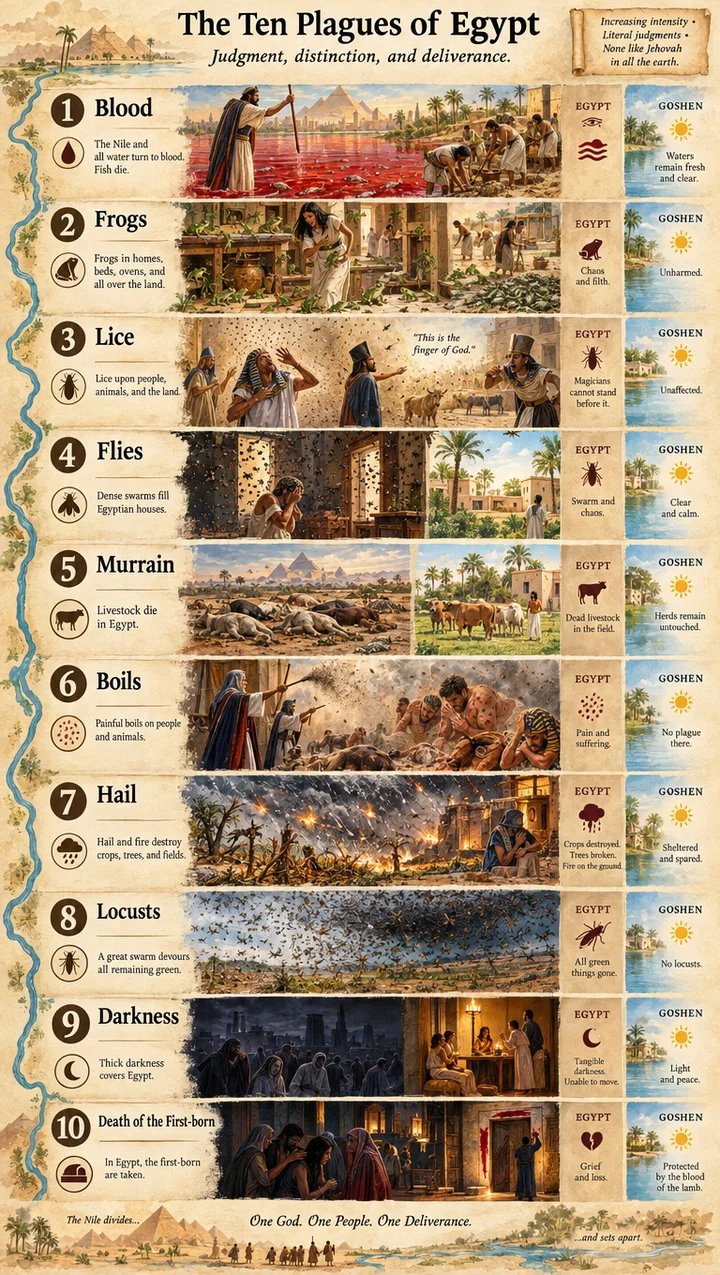
God directed Moses and Aaron to take handfuls of ashes of the furnace, and Moses was to sprinkle them toward heaven in the sight of Pharaoh.SG3 212.1–2PP 267.2–3ST Mar 18, 1880PP 758.3–760.1 As he did so the fine particles spread as dust over all the land of Egypt, and wherever it settled it became painful boils breaking forth with blains upon man and upon beast.SG3 212.1–2PP 267.2–31SP 217.1ST Mar 18, 1880PP 758.3–760.1 In the order of judgments this came after the murrain upon Egyptian cattle in which not one of the Hebrews' cattle died, and before the plague of hail mingled with fire, lightning and thunder.1SP 217.1 Like the other plagues its time was announced beforehand so it could not be dismissed as chance, proving to the Egyptians that the whole earth is under the command of the God of the Hebrews whom thunder, hail and storm obey.1SP 217.1
The furnace ashes signified that Israel's long oppression in the furnace of affliction was nearing its end and recalled the covenant promise to Abraham to judge their oppressors and bring the people out of bondage.PP 267.2–3 The ashes likely came from rites of human sacrifice to Typhon, whose priests scattered them in the belief they would ward off evil, a means the Egyptians may also have used to try to turn the plagues aside.PP 758.3–760.1 By turning a rite meant to avert harm into a judgment of boils, the act exposed the impotence of Egyptian religion, affirmed Jehovah's supremacy, and pressed the demand for Israel's deliverance.PP 758.3–760.1
As one of the signs done before Pharaoh, it attested that God had sent Moses to demand Israel's release, showing the work to be God's power rather than human ability and greater than the magicians' counterfeits.1T 291.1–292.2 The boils struck even the priests and magicians so that by none of their enchantments could they shield themselves, and they could no longer stand before Moses and Aaron because of the affliction.SG3 212.1–2PP 267.2–31T 291.1–292.21SP 217.1ST Mar 18, 1880 This let the Egyptians see the folly and uselessness of trusting in the boasted power of the magicians when it could not protect even their own persons.SG3 212.1–2PP 267.2–3ST Mar 18, 1880
Sources
Pioneers and periodicals
46 sources
The Lord told Moses and Aaron to take handfuls of ashes from the furnace and told Moses to scatter it toward the sky in Pharaoh's sight, and the ashes became fine dust over all Egypt that broke out in boils with blains on people and animals as the literal sixth plague.ST Mar 18, 1880ST Jan 25, 1910RH Jan 6, 1903ST Jan 14, 1889ST Nov 23, 1904 The act took up a familiar Egyptian priestly rite in which ashes from offerings to Typhon were thrown into the air to carry protection from evil, and turned it against itself so the trusted means of help brought disease instead.RH Jan 6, 1903RH Jan 6, 1903ST Jan 14, 1889RH Mar 11, 1915RH Jan 6, 1903 In this the one all-powerful God of Israel was arrayed against Egypt's religious system to show its gods are nothing, and the magicians who served them could not shield themselves by enchantments nor stand before Moses.ST Mar 18, 1880ST Jan 24, 1911ST Feb 4, 1913ST Jan 20, 1909 The literal boils are a type of the literal last plagues, illustrating the grievous sore of the first vial in Revelation 16:2 upon those with the mark of the beast.RH Apr 17, 1855RH Dec 2, 1862STRH Apr 5, 1870 The plague was wrought by the direct power of the Lord through His word to Moses and not by human power, and its hardening came when Pharaoh, after repeated warning and mercy rejected, was left to his own chosen hardness.ST Apr 4, 1911ST Jan 20, 1909ST May 4, 1882ST May 14, 1894ST Jul 3, 1879
Act and Plague Described
The command was given to both Moses and Aaron to take handfuls of ashes from the furnace, with Moses himself to scatter them toward the sky in Pharaoh's sight.ST Mar 18, 1880ST Jan 14, 1889ST Nov 23, 1904RH Mar 23, 1852 The fine particles spread as dust over all the land of Egypt, carried by the wind wherever it reached.ST Mar 18, 1880ST Jan 25, 1910RH Jan 6, 1903 Where the dust settled it produced boils breaking out with blains on people and animals throughout the land.ST Mar 18, 1880RH Jan 6, 1903ST Jan 14, 1889RH Apr 17, 1855
The event was the sixth plague upon Egypt.ST Jan 25, 1910ST Jan 14, 1889 It was a real and literal judgment, whatever its later antitype in Revelation 16:2.RH Apr 17, 1855ST May 31, 1910 It falls in the second group of three plagues, whose third plague came without warning.ST Jan 24, 1911 It forms the third pair with murrain, both being diseases, murrain on beasts and boils on people.ST Apr 13, 1904 Like the other plagues before darkness and death, it affected man in a material or physical way.ST Apr 13, 1904 Counted with the signs, it is the seventh of ten signs and plagues upon Egypt.ST Jul 3, 1879
The plagues on Egypt extended over about a year.RH Apr 23, 1908 Egyptian court records would be unlikely to mention such disasters, because monuments recorded royal successes and triumphs.RH Apr 23, 1908 When the ashes spread over Egypt, Goshen was spared.ST Nov 23, 1904ST Nov 23, 1904 The Hebrew word zah-rak used for sprinkle means to scatter, hence to sprinkle.ST May 6, 1880 It keeps that idea of scattering through all its occurrences despite varied English and Greek renderings, and contains no idea of dipping or immersing, so that immerse or baptizo cannot be put for sprinkle.ST May 6, 1880
Egyptian Rites and Furnace
The ashes were taken from a furnace used for sacred sacrifices, a furnace employed for a particular purpose that gives the act its significance.ST Jan 25, 1910RH Jan 6, 1903 That background points to the ashes of victims burned alive as human sacrifices to Typhon, the god or principle of evil.RH Jan 6, 1903RH Jan 6, 1903RH Mar 11, 1915 The officiating priests took those ashes and strewed them to the winds, throwing them into the air in the belief that the wind would carry protection from evil to every place it reached, so that evil would be averted wherever a particle fell.RH Jan 6, 1903RH Jan 6, 1903ST Jan 14, 1889RH Mar 11, 1915ST Jan 22, 1885
Moses casting the ashes toward the sky copied that priestly sprinkling, using Egypt's own custom of averting evil in the same manner and in sight of Pharaoh.RH Jan 6, 1903ST Jan 14, 1889RH Mar 11, 1915ST Jan 22, 1885 The priests had no doubt already used that rite to try to protect themselves from the plagues.RH Jan 6, 1903 God turned the familiar rite against its purpose, making the dust spread over all Egypt and become boils and blains upon all the people of the land, so that the very means trusted for help brought trouble instead of protection and became a curse to its practitioners.RH Jan 6, 1903RH Jan 6, 1903ST Jan 14, 1889RH Mar 11, 1915ST Jan 22, 1885
In this the supremacy of the God of the Hebrews over Typhon and the whole system of human sacrifice was vindicated, while Moses and Aaron stood among the afflicted protected and neither king nor priest escaped the affliction.RH Mar 11, 1915 The impotence of Egyptian rites and idols was exposed, and it was proved that there is no God but the God of Israel and that Jehovah is supreme over their idols.RH Jan 6, 1903ST Jan 14, 1889ST Jan 22, 1885 The plague also challenged Neit, regarded as the mother-queen of the highest heaven.ST Jan 25, 1910
It further exposed the limits of confidence in physicians, whom the Egyptians supported publicly and believed could prevent and heal disease through practices joined to astrology, leaving the land seemingly stripped of its wise men as well as its gods.RH Oct 31, 1912 The ashes signify Egypt's furnace of affliction and the bondage of God's people in Egypt, from which God would free His people.ST Nov 23, 1904ST Nov 23, 1904 When Moses scattered them before Pharaoh they were carried across Egypt and caused boils on people and animals, while Goshen was spared, though Pharaoh watched without understanding the act's meaning.ST Nov 23, 1904ST Nov 23, 1904
God's Power and Deliverance
Exodus 9:8 belongs to the miracles of Exodus 7 to 12 in which God's religious system was arrayed against the religious system of Egypt with both systems supported by miracles.RH Mar 11, 1915 The plagues opposed Egyptian idolatry and showed that the Lord is greater than Egypt's gods and that those gods are powerless, unworthy of trust, and nothing in the sight of Jehovah.ST Jan 24, 1911ST Feb 4, 1913ST Jan 20, 1909ST Nov 1, 1899 They were appropriate and merciful, teaching Egyptians who knew only many gods each with his own field and function in nature that the one God of Israel is all-embracing, all-efficient, all-powerful and all-wise, whether worshiped by king or peasant.ST Nov 1, 1899 Almost every plague was connected with Egyptian worship, and at first they were brought not against human beings but against the gods the Egyptians worshiped.ST Jan 20, 1909 The demand behind them was reasonable, Let My people go that they may serve Me, for God dealt with Pharaoh first in kindness during Moses' demand that Israel be allowed to worship in the wilderness and would have left Israel in Egypt if they had been allowed to serve Him there.ST Feb 4, 1913ST Jan 20, 1909
The plagues humbled that proud nation to the very dust and utterly annihilated the supposed power of its almost countless gods, showing that Egypt's gods could neither relieve suffering nor impart blessing amid escalating judgments following Pharaoh's repeated refusal to heed warning.ST Nov 27, 1901ST Dec 4, 1901 Together with the deliverance of the firstborn, the Red Sea, the sweetening of Marah, the bread from heaven, and water from the rock, they gave each individual abundant opportunity, such as few have realized before or since, to gain a personal knowledge of the King of kings and Lord of lords.ST Nov 27, 1901 They changed Israel's knowledge of God from the God heard of as the God of Abraham, Isaac, and Jacob, whom Moses could only describe as I AM THAT I AM, to the God known by thrilling personal experience as the Lord who brought them out of Egypt and out of bondage.ST Nov 27, 1901 By this act the supremacy of the God of the Hebrews over Typhon and the whole system of human sacrifice was vindicated.RH Mar 11, 1915
The ashes of the furnace point to the ashes of victims burned alive as human sacrifices to Typhon, the god or principle of evil, whose officiating priests took the ashes offered to propitiate him and threw or strewed them into the air and to the winds believing the wind would carry protection and averting of evil to every place a particle reached.RH Jan 6, 1903RH Mar 11, 1915 Moses casting a handful of ashes toward the sky in the same manner copied that priestly act of averting evil, which the priests had no doubt already used to try to protect themselves from the plagues.RH Jan 6, 1903RH Mar 11, 1915ST Jan 22, 1885 God made the dust spread over all Egypt and cause boils and blains on all the people, so the very means trusted for help brought trouble instead and turned a familiar rite against its purpose.RH Jan 6, 1903RH Mar 11, 1915ST Jan 22, 1885 Neither king nor priest escaped the affliction, while Moses and Aaron stood among them protected, proving there is no God but the God of Israel, exposing the impotence of Egyptian rites and idols, and affirming Jehovah's supremacy and Israel's deliverance.RH Jan 6, 1903RH Mar 11, 1915ST Jan 22, 1885
The magicians also felt this judgment of God and could not by any of their enchantments shield themselves from the grievous plague, and the boil was upon them also so that they could no longer stand before Moses and Aaron because of the affliction.ST Mar 18, 1880ST Jul 3, 1879RH Nov 26, 1857 Moses and Aaron did not wield the power themselves, for the plague was given under the Lord's immediate direction and the boils on the Egyptians, including the magicians, were no illusion.RH Nov 26, 1857 This permitted the Egyptians to see how useless it was to put trust in the boasted power of the magicians when they could not protect even their own persons.ST Mar 18, 1880 It belongs with the six later signs that the magicians did not imitate, unlike the first signs, and as the seventh of ten signs and plagues upon Egypt it settled whether Moses was a magician acting without divine authority, because the magicians could not imitate it and were themselves afflicted.ST Jul 3, 1879
Exodus 9:8 is part of God's call to the kingdoms of earth, given three and one-half millenniums ago when Egypt ruled the world as the greatest of kingdoms, acknowledged for might and power and skill and wisdom in statecraft.ST Nov 14, 1906 That kingdom deified her annually overflowing and fertilizing river as a god and worshiped the sun, from whom her kings received their title as representatives of the sun-god upon the throne of men.ST Nov 14, 1906 It belongs to the history that began when the few descendants of the nomadic patriarch Abraham sought supplies from Egypt's granaries, after Joseph, their captive-slave kinsman, had taught Pharaoh to store grain in plenteous years to become rich in time of famine.ST Nov 14, 1906 Joseph had instituted one of the best land-laws the world has known, with easy combined rental and taxes, under which while he was prime minister to Pharaoh and as long as his memory lived among the rulers of Egypt he was honored, his laws governed, the country flourished, and the people in Egypt knew no oppression.ST Nov 14, 1906
Exodus 9:8 belongs to the history part of Exodus, chapters 1 to 18, which tells the story of Israel's great deliverance from bitter bondage and oppression in Egypt.RH Jan 20, 1916 It shows how the family grown more and mightier than the Egyptians became a nation with thorough organization, efficient leadership, a complete code of laws, and an established form of worship, centering on the life of Moses as the chosen leader of Israel.RH Jan 20, 1916 That wonderful deliverance demonstrated God's wisdom, love, and power, His ability and right to rule, and Israel's obligation to obey.ST Mar 7, 1906 It stands in the story of Israel's deliverance when the whole power of Egypt was set against them, leading to Israel's song of triumph beyond the Red Sea with the host of Egypt overthrown, and shows God's mighty work in saving them, creative power shown again, greater than any work done in saving any nation.ST Jan 30, 1912
God broke the power of the Egyptian oppressor and delivered Israel by direct intervention and miraculous power through terrible plagues and judgments sent for refusing to free Israel.RH Mar 25, 1909RH Oct 1, 1861 Pharaoh had refused to let the people go to hold a feast to God and keep the Sabbath, showing that the oppression in Egypt involved the right to worship the true God and keep His commandments, particularly the Sabbath.RH Mar 25, 1909 God allowed Israel to remain for a time in a servile condition as serfs of the Egyptians, then instead of sanctioning even this modified form of slavery demanded their instant release, and on refusal struck their oppressors with judgments.RH Oct 1, 1861 He led Israel forth as an army of fugitive slaves and drowned their pursuers in the Red Sea.RH Oct 1, 1861 The ten plagues upon Egypt in Exodus 6-12 thus show God's merciful deliverance of His children and His mercy to Pharaoh and the Egyptians.ST Jan 20, 1909
After redeeming Israel from Egyptian bondage with a mighty hand, God gave them the sanctuary as a great, multiple object-lesson which by various forms and rites would teach the great plan of salvation. Those hundreds of years of slavery had unfitted Israel to comprehend God's great salvation and the character He required. Exodus 9 is cited as an example of the plagues and storms accompanying Israel's deliverance from bondage in Egypt, showing nature acting amid a divine intervention in history.ST Sep 28, 1904
Type of Final Plagues
The plagues upon Egypt were strictly literal, and they stand as a type of the last plagues, which will be strictly literal and terrible.RH Dec 2, 1862STRH Apr 5, 1870 The boils brought by the scattered furnace ashes illustrate the first vial of Revelation 16:2, whose grievous sore falls upon those who have the mark of the beast and worship his image.RH Apr 17, 1855RH Dec 2, 1862RH Apr 5, 1870 Whatever its later antitype, the Egyptian affliction was real and literal, and its future counterpart will be literal also.RH Apr 17, 1855 Its exact form is not described, but it may be similar to the boils that fell on Egypt.RH Dec 2, 1862 As God sent literal judgments upon Egypt when about to deliver Israel from bondage, so He will send literal judgments when about to give His people final deliverance and redemption.RH Dec 2, 1862
That future outpouring will be far more dreadful, being wrath poured out without mercy.RH Apr 17, 1855ST Oct 28, 1930 The ten plagues that fell on Egypt just before the deliverance of God's ancient people foreshadow seven terrible plagues that will sweep over the world, similar to the Egyptian plagues.ST Oct 28, 1930 After the seven last plagues begin, forgiveness of sin will never be granted again.ST Oct 28, 1930 The ten plagues recorded in Exodus 7 to 12 demonstrate the power of God's two witnesses, the Old and New Testaments, to smite the earth with all plagues as often as they will, proved in the past upon Egypt and to come again under the seven last plagues.ST Apr 13, 1904RH Jan 14, 1862 They are grouped in pairs, with this plague belonging to the third pair with murrain, both being diseases, murrain on beasts and boils on people, affecting man in a material or physical way like the other plagues before darkness and death.ST Apr 13, 1904
Israel remained in Egypt during the plagues upon Egypt rather than being taken away beforehand.ST Jul 18, 1878 In the same way God's people will not be removed from the earth until after six of the seven last plagues have been poured out.ST Jul 18, 1878 They must witness the fearful scenes of the time of trouble while destruction falls around them.ST Jul 18, 1878 Through it they will be protected by the seal of the living God.ST Jul 18, 1878
Miracles and Hardened Heart
The scattering of furnace ashes was done under the Lord's immediate direction, and the resulting boils on Egyptians and magicians alike were no illusion, for Moses and Aaron wielded no power of their own but acted through the Word and message God had given Moses, by which plagues including the turning of rivers to blood came upon Egypt.ST Apr 4, 1911ST Jul 3, 1879RH Nov 26, 1857 Those wonders through Moses belonged to the class of miracles wrought by God's power to convince Pharaoh and his people of their duty to obey God and receive the message He sent, and they were opposed by the magicians' enchantments.RH Dec 23, 1851ST May 4, 1882 The magicians' works were meant to deceive Pharaoh and shut his heart against that message, for magic or enchantment is the work of Satan and his angels and is always wrought to turn men away from God and His truth as in Pharaoh's day.ST May 4, 1882
The sixth plague, beginning with the command to take the ashes, settled whether Moses was a magician acting without divine authority, and it stands as the seventh of ten signs and plagues upon Egypt bringing boil or blain upon man and beast.ST Jul 3, 1879 It belonged with the six later signs that the magicians did not imitate, unlike the first signs, for they could not imitate it and were themselves afflicted by it and confessed it to be the finger of God, so that they could not stand before Moses because the boil was upon them also.ST Jul 3, 1879 This left Pharaoh without excuse, showing he had to contend not with Moses and Aaron as mortals like himself but with the living God, yet he still continued to resist, not from a sovereign controlling influence of God making repentance impossible but from covetousness in refusing to give up the profitable services of Israel.
Up to the boil plague the account does not say the Lord hardened Pharaoh's heart, for the hardening predicted comes only after Pharaoh utterly rejects every appeal and repeated opportunities to yield.ST Jan 20, 1909ST May 14, 1894 Hardening means that after Pharaoh rejected God's mercy, God's Spirit was withdrawn and Pharaoh was left to his chosen hardness when there was no hope of saving him.ST Jan 20, 1909ST May 14, 1894 The hardening connected with this plague of boils was specially occasioned by the nervous irritability produced by acute suffering, needing no direct agency from God upon the heart to explain it.RH Apr 1, 1862 God's part was only the outward event, providence and surroundings of the plague, while the hardening itself was the work of Pharaoh's own human nature.RH Apr 1, 1862
Warning and Moral Application
The plagues by which the power of the Egyptian oppressor was broken and Israel was delivered by direct intervention and miraculous power came after Pharaoh refused to let the people go to hold a feast to God and keep the Sabbath, showing that the oppression involved the right to worship the true God and keep His commandments, particularly the Sabbath.RH Mar 25, 1909 The plague of boils and blains belonged to the escalating judgments that followed Pharaoh's repeated refusal to heed warning after repeated opportunities to yield, when Egypt's gods could neither relieve suffering nor impart blessing.ST May 14, 1894ST Dec 4, 1901 Hardening means that after Pharaoh rejected mercy the Lord's Spirit was withdrawn and Pharaoh was left to his chosen hardness, and the boil plague marks the point before which the Revised Version does not say that the Lord hardened Pharaoh's heart.ST May 14, 1894
Pharaoh represents the wicked world and Israel in Egypt represents God's persecuted people, and as Christ was present with Moses to deliver Israel so He is with His people now.ST May 14, 1894 The ashes from the furnace signify Egypt's furnace of affliction from which God would free His people, and Israel's bondage is connected with repeated apostasy, presenting sin as leading to distress and bondage.ST Nov 23, 1904 Pharaoh's continued resistance after being left without excuse did not come from a sovereign controlling influence of God making repentance impossible, but from covetousness in refusing to give up the profitable services of Israel.
Every sinner with the Bible in hand who sins against light and knowledge copies that resistance, sinning against conscience, reproof, Moses and Aaron in the law, prophets, evangelists, apostles, Maker, Judge and Saviour, breaking the commandments against blasphemy, Sabbath-breaking, killing, adultery, stealing, false witness and coveting while presuming on mercy. So Pharaoh hardening his heart against ten plagues appears small beside those hardening their hearts against ten millions of mercies, though even such may still return and find mercy through the blood of the Lamb. Together with the deliverance of the firstborn, the Red Sea, the sweetening of Marah, the bread from heaven, and water from the rock, the ten plagues humbled that proud nation to the very dust and utterly annihilated the supposed power of its almost countless gods.ST Nov 27, 1901
Those events changed Israel's knowledge of God from the God heard of as the God of Abraham, Isaac, and Jacob, whom Moses could only describe as I AM THAT I AM, to the God known by thrilling personal experience as the Lord who brought them out of Egypt and out of bondage, giving each individual abundant opportunity, such as few have realized before or since, to gain a personal knowledge of and acquaintance with the King of kings and Lord of lords.ST Nov 27, 1901 The wonderful deliverance of Israel from Egypt demonstrates God's wisdom, love, and power, His ability and right to rule, and Israel's obligation to obey.ST Mar 7, 1906 God allowed Israel to remain for a time in a servile condition as serfs of the Egyptians, then instead of sanctioning even this modified form of slavery demanded their instant release, and on refusal struck the oppressors with terrible judgments, led Israel forth as an army of fugitive slaves, and drowned their pursuers in the Red Sea.RH Oct 1, 1861
Sources