Genesis 15:13
And he said unto Abram, Know of a surety that thy seed shall be a stranger in a land that is not theirs, and shall serve them; and they shall afflict them four hundred years;
Translations
And he said to Abram, Know of a surety that your seed shall be a stranger in a land that is not theirs, and shall serve them; and they shall afflict them four hundred years;
King James Version, KJV Cambridge Paragraph Bible, Revised Version
And he said unto Abram, Know of a surety that thy seed shall be a stranger in a land that is not theirs, and shall serve them; and they shall afflict them four hundred years;
And he said to Abram, Know certainly that thy seed shall be a stranger in a land that is not theirs, and shall serve them; and they shall afflict them four hundred years;
And he said unto Abram, Know of a surety that thy seed shall be sojourners in a land that is not theirs, and shall serve them; and they shall afflict them four hundred years;
and He saith to Abram, 'knowing — know that thy seed is a sojourner in a land not theirs, and they have served them, and they have afflicted them four hundred years,
And he said to Abram, Know assuredly that thy seed will be a sojourner in a land [ that is] not theirs, and they shall serve them; and they shall afflict them four hundred years.
And he said to Abram—Thou must surely know, that, sojourners, will thy seed become in a land not theirs, and shall serve them and they will humble them, four hundred years;
Berean Standard Bible, Majority Standard Bible
Then the LORD said to Abram, “ Know for certain that your descendants will be strangers in a land that is not their own, and they will be enslaved and mistreated four hundred years.
He said to Abram, “ Know for sure that your offspring will live as foreigners in a land that is not theirs, and will serve them. They will afflict them four hundred years.
And he said to Abram, Truly, your seed will be living in a land which is not theirs, as servants to a people who will be cruel to them for four hundred years;
Then he saide to Abram, Knowe for a suretie, that thy seede shalbe a stranger in a land, that is not theirs, foure hundreth yeeres, and shall serue them: and they shall intreate them euill.
Douay-Rheims (Challoner revision)
And it was said unto him: Know thou beforehand that thy seed shall be a stranger in a land not their own, and they shall bring them under bondage, and afflict them four hundred years.
Pictures
Cross-references 20 of 89
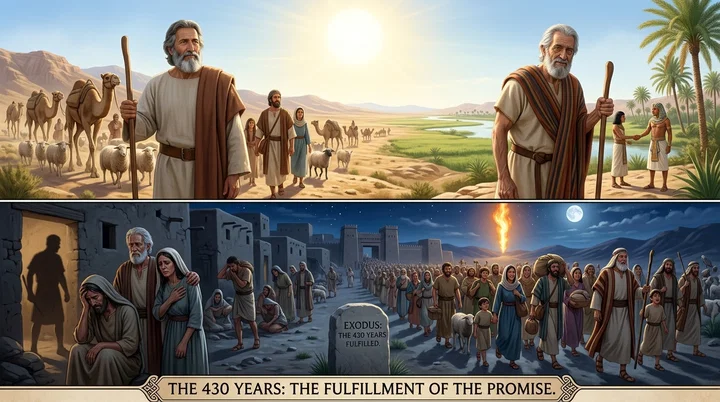
- Exodus 12:40-41
Now the sojourning of the children of Israel, who dwelt in Egypt, was four hundred and thirty years.
Dates Israel’s sojourn and departure from Egypt at the end of 430 years.
- Acts 7:6-7
And God spake on this wise, That his seed should sojourn in a strange land; and that they should bring them into bondage, and entreat them evil four hundred years.
Restates the prophecy of four hundred years of foreign oppression and God’s judgment and deliverance.
- Galatians 3:17
And this I say, that the covenant, that was confirmed before of God in Christ, the law, which was four hundred and thirty years after, cannot disannul, that it should make the promise of none effect.
Dates the 430 years from the promise to the giving of the law.
- Exodus 3:7-10
And the LORD said, I have surely seen the affliction of my people which are in Egypt, and have heard their cry by reason of their taskmasters; for I know their sorrows;
God sees Israel’s affliction and sends Moses to deliver them from Egypt.
- Acts 7:17
But when the time of the promise drew nigh, which God had sworn to Abraham, the people grew and multiplied in Egypt,
Israel multiplied in Egypt as the time of God’s promise to Abraham drew near.
- Exodus 1:13-14
And the Egyptians made the children of Israel to serve with rigour:
Israel’s harsh Egyptian bondage fulfills the foretold affliction and servitude.
- Genesis 12:1-4
Now the LORD had said unto Abram, Get thee out of thy country, and from thy kindred, and from thy father’s house, unto a land that I will shew thee:
The call and promise to Abram begin the period leading to the promised seed.
- Exodus 12:35-36
And the children of Israel did according to the word of Moses; and they borrowed of the Egyptians jewels of silver, and jewels of gold, and raiment:
Israel leaves Egypt with the great substance promised to Abraham.
- Hebrews 11:9
By faith he sojourned in the land of promise, as in a strange country, dwelling in tabernacles with Isaac and Jacob, the heirs with him of the same promise:
Abraham sojourned in the promised land as a stranger.
- Exodus 12:41
And it came to pass at the end of the four hundred and thirty years, even the selfsame day it came to pass, that all the hosts of the LORD went out from the land of Egypt.
Israel left Egypt on the appointed day when the foretold period ended.
- Genesis 22:16-18
And said, By myself have I sworn, saith the LORD, for because thou hast done this thing, and hast not withheld thy son, thine only son:
God confirms the promise to Abraham by an oath.
- Exodus 2:24
And God heard their groaning, and God remembered his covenant with Abraham, with Isaac, and with Jacob.
God remembering covenant with Abraham, Isaac, Jacob
- Genesis 17:8
And I will give unto thee, and to thy seed after thee, the land wherein thou art a stranger, all the land of Canaan, for an everlasting possession; and I will be their God.
God promises Canaan to Abraham and his descendants as an everlasting possession.
- Acts 7:5
And he gave him none inheritance in it, no, not so much as to set his foot on: yet he promised that he would give it to him for a possession, and to his seed after him, when as yet he had no child.
Abraham received no land inheritance during his lifetime, though God promised it to him and his seed.
- Joshua 21:43-44
And the LORD gave unto Israel all the land which he sware to give unto their fathers; and they possessed it, and dwelt therein.
Israel possesses the promised land and receives rest from its enemies.
- Galatians 3:16
Now to Abraham and his seed were the promises made. He saith not, And to seeds, as of many; but as of one, And to thy seed, which is Christ.
Paul identifies Abraham’s promised seed as Christ.
- Galatians 3:29
And if ye be Christ’s, then are ye Abraham’s seed, and heirs according to the promise.
Those who belong to Christ are Abraham’s seed and heirs of the promise.
- Exodus 14:21-22
And Moses stretched out his hand over the sea; and the LORD caused the sea to go back by a strong east wind all that night, and made the sea dry land, and the waters were divided.
God led Israel through the Red Sea after the departure.
- Nehemiah 9:8
And foundest his heart faithful before thee, and madest a covenant with him to give the land of the Canaanites, the Hittites, the Amorites, and the Perizzites, and the Jebusites, and the Girgashites, to give it, I say, to his seed, and hast performed thy words; for thou art righteous:
God recalls his covenant to give Canaan to Abraham’s descendants and affirms its fulfillment.
- Exodus 1:8
Now there arose up a new king over Egypt, which knew not Joseph.
A new king arose in Egypt, beginning Israel’s affliction there.
Commentary
Each commentary is drawn from primary sources: the writings of Ellen G. White and Adventist pioneers and periodicals. Each commentary is separate. Its own words are not a quotation; follow the references to read the source passages.
Ellen G. White
29 sources
God assured Abram in advance in vision amid a horror of great darkness that his descendants would be strangers in a land not theirs, serve its people and be afflicted four hundred years, and that afterward He would judge the nation they served and bring them out with great wealth and possessions.SG3 229.1PP 137.1–2ST Apr 1, 1880PP 282.1ST Dec 9, 1913 The four hundred years are years of sojourning and affliction, not four hundred years spent in Egypt, for the four hundred thirty years run from the call to leave Ur until the law at Sinai with Abraham, Isaac and Jacob also sojourning in Canaan, the affliction beginning about thirty years later and leaving only about two hundred fifteen years actually in Egypt.PP 760.2–3 It is also counted as four hundred years, or nearly four hundred years, of Egyptian servitude and grievous oppression ending with the Exodus.8T 207.1–2Ms 91, 1899, par. 22 The delay was an act of long patience toward the Amorites, who were spared while their iniquity was not yet full until after more than four hundred years their probation ended and judgment came.ST Nov 4, 1880SLP 318.1 God permitted the bondage because the descendants transgressed His law and turned toward idolatry, yet He did not forsake them but allowed distress to turn them back to Himself, to teach them patient trust in promised deliverance and to bring them out to be His peculiar treasure to obey His laws.ST Jan 22, 1880ST Apr 8, 1875ST Mar 4, 1880SG3 240.2–242.1RH Apr 29, 1875 At the appointed time He visited Egypt with fearful judgments, brought His people forth with silver, gold and clothing, and destroyed Pharaoh and his army in the Red Sea.ST Apr 1, 1880ST Dec 9, 1913PP 281.4
Promise Shown to Abraham
Know of a surety was God's sure word spoken to Abram in advance, telling him that his seed would be strangers in a land not theirs, would serve its people, and would be afflicted four hundred years.SG3 229.1PP 137.1–2PP 282.11SP 205.11SP 93.1 It was shown in vision amid a horror of great darkness, with the dark vision revealing their long, servile bondage before they were established in Canaan.ST Nov 4, 18801SP 93.1ST Mar 27, 1879 The prophecy was given about four hundred years before its fulfillment, and its fulfillment is connected with Israel's years of bondage and departure from Egypt.SG3 229.1PP 282.11SP 205.1 It meant they would suffer before settlement and would not possess the promised land immediately.PP 137.1–2ST Nov 4, 1880
The same revelation placed after the four hundred years God's judgment on the nation they served and their coming out with great substance.SG3 229.1ST Apr 1, 1880ST Dec 9, 1913 That deliverance included leaving with great wealth and possessions, with silver, gold and clothing obtained from the Egyptians.ST Apr 1, 1880PP 281.4PP 267.2–3 Despite Pharaoh's power God's word stood, and at the appointed time Israel came out of Egypt with great possessions, with Joseph's bones accompanying them as a reminder that the promise of deliverance had been fulfilled.ST Dec 9, 1913PP 281.4 The promise to judge the oppressors and bring them out with great wealth assured that the covenant was remembered and deliverance would come.PP 267.2–3
The smoking furnace pictured their affliction in Egypt, while the great darkness that fell made known the future bondage and long servile oppression in a foreign land.1SP 93.1ST Mar 27, 1879PP 267.2–3 They were to return in the fourth generation to receive Canaan when the appointed time came.ST Nov 4, 1880 The land assigned to Abraham's descendants stretched from the river of Egypt to the Euphrates.ST Nov 4, 1880
Timing and Fulfillment
The four hundred years are years of sojourning and affliction, not four hundred years spent in Egypt.PP 760.2–3 The four hundred and thirty years of sojourning run from the call to leave Ur until the giving of the law at Sinai, and Abraham, Isaac and Jacob also sojourned in Canaan as strangers.PP 760.2–3 The four hundred years of affliction begin about thirty years later, around Ishmael's persecution of Isaac, so that the actual time in Egypt could have been only about two hundred and fifteen years.PP 760.2–3
In another reckoning the prediction is fulfilled as four hundred years of Egyptian servitude, and as nearly four hundred years of grievous oppression ending with the Exodus.8T 207.1–2Ms 91, 1899, par. 22 The four hundred years are a fixed, predicted chronological period, told about four hundred years before its fulfillment.SG3 229.1GC88 323.2 It is an example of a time-specific prophecy whose events were fulfilled in accordance with its prediction.SG3 229.1GC88 323.2GC 323.2–324.2
The bondage in Egypt under Pharaoh and the departure under Moses fulfill the foretold sojourn, service and affliction.ST Apr 1, 1880PP 282.21SP 205.1 The enslavement in Egypt fulfilled the setting of oppression in a foreign land that was not theirs, and the departure after years of bondage completed the history shown to Abraham in prophetic vision.PP 282.11SP 214.1–215.11SP 215.2 That deliverance was remembered in Egypt, for the elders recalled the promise to encourage hope that God would soon break the oppressive yoke, though many seeing their suffering and the power of their oppressors doubted that God would free them.1SP 214.1–215.11SP 215.2 The fulfillment included judgment on the nation that enslaved them and coming out with great possessions, with silver, gold and clothing from the Egyptians.ST Apr 1, 1880PP 282.2
The four hundred years of bondage ended at the appointed time by God's direct action despite Pharaoh's power, for God's word stood.ST Dec 9, 1913Ms 10, 1903, par. 15 He visited Egypt with fearful judgments and freed His people through a mighty display of His power, bringing them forth and destroying Pharaoh and his pursuing army in the Red Sea.8T 207.1–2Ms 10, 1903, par. 15 They came out with great substance, wealth and possessions, and Joseph's bones went with them as a reminder that the promise of deliverance had been fulfilled.ST Apr 1, 1880ST Dec 9, 1913PP 281.4 The smoking furnace had pictured their affliction, while the promise to judge their oppressors assured that God remembered His covenant.PP 267.2–3 Yet even after that fulfillment, Israel on the border of the promised land dishonored God by giving way to unbelief.Ms 10, 1903, par. 15
Reason and Purpose
The four hundred years of strangerhood and affliction were also years of long patience toward the Amorites, whose iniquity was not yet full.ST Nov 4, 1880SLP 318.1 They were spared while receiving evidence of the true God, and Israel was to receive Canaan in the fourth generation when the appointed time came.ST Nov 4, 1880SLP 318.1 After more than four hundred years, when the Amorites had hardened themselves in evil and made war on God's people, their probation ended and judgment came.SLP 318.1 God keeps an exact record of guilt and offers mercy and calls to repentance until the fixed limit He has set is reached.SLP 318.1
The bondage itself was punishment because the descendants transgressed God's law and apostatized.ST Jan 22, 1880ST Apr 8, 1875RH Apr 29, 1875 They lost their distinct, holy character by mingling with other nations and turning toward idolatry, becoming bondmen to an idolatrous nation.ST Jan 22, 1880RH Apr 29, 1875SG3 297.1–2 Famine had driven them to Egypt to preserve their lives, and God permitted their oppression there.SG3 297.1–2 Their Egyptian bondage came because of this unfaithfulness and inclination toward idolatry.SG3 240.2–242.1SG3 297.1–2
God did not forsake them in Egypt, but allowed their distress and trials to turn them back to Himself and His righteous government.SG3 297.1–2 They were not released without trials, but had to endure suffering and learn to trust patiently in the promised deliverance.ST Mar 4, 1880 When He brought them out they were a people newly freed from slavery and ready to be taught by Christ.Lt 44, 1903, par. 16 He brought them out to take them to Himself as His peculiar treasure, so they could obey His laws and keep the Sabbath instituted at creation.ST Apr 8, 1875RH Apr 29, 1875FE 287.1
In bondage the elders recalled the promise to Abraham, together with Joseph's prophecy, to strengthen hope that God would soon break the oppressive yoke and bring them out of Egypt.1SP 214.1–215.11SP 215.2SG3 240.2–242.1 Many Israelites, seeing their suffering and the power of their Egyptian oppressors, doubted that God would free them and lost hope.1SP 214.1–215.1ST Mar 4, 1880 When the people humbled themselves, acknowledged God's dealings, and cried earnestly for deliverance from the yoke while promising to serve God and obey His law, their cries reached heaven.ST Apr 8, 1875RH Apr 29, 1875 God answered in a wonderful manner by bringing Israel out of Egypt as His peculiar treasure.ST Apr 8, 1875RH Apr 29, 1875
Sources
Pioneers and periodicals
150 sources
God told Abram in covenant vision that his descendants would live as strangers in lands not their own and be made to serve and be oppressed for four hundred years.GSAM 42.1ST Sep 26, 1911ST Mar 31, 1914ST Jun 29, 1882RH Jun 2, 1859 Those four hundred years cover the whole pilgrimage from entering Canaan to the Exodus, about one hundred eighty-five years in Canaan and neighboring lands and the remainder in Egypt, reckoned from Isaac's weaning about thirty years after the call when Ishmael mocked Isaac and the affliction began.RH Jan 2, 1913ST Aug 12, 1913ST Jun 4, 1885ST Aug 9, 1910ST Feb 4, 1889 Some reckoned the four hundred years as bondage in Egypt alone within four hundred thirty years from Jacob's entry, or as delayed to four hundred thirty years by Israel's own delay.RH Feb 17, 1874RH Nov 18, 1909ST Aug 9, 1910RH Jun 20, 1912RH Aug 16, 1870 Possession was deferred until the iniquity of the Amorites was full and until Israel grew numerous enough to possess Canaan, with Egypt as the waiting place where bondage united them, humbled them, and made them willing to leave.RH Mar 9, 1869ST May 6, 1886ST Oct 28, 1897ST Oct 9, 1879 Its exact fulfillment on time proves appointed prophetic periods will end at their appointed time, and because Abraham died without receiving the land the promised inheritance remains future to resurrection, the second advent, and the new earth for Christ the Seed and all who are His by faith.RH Dec 11, 1866RH Dec 18, 1855RH Apr 18, 1854RH Nov 18, 1909
Covenant Setting and Wording
God spoke the word to Abram in a night vision outdoors, taking him out beneath the stars before morning, and when that night conversation ended Abram at once prepared the commanded sacrifice as the token that he would inherit the land.RH Nov 2, 1869 The horror of great darkness that then fell upon him foreshadowed the iron furnace and bitter servitude to come upon his descendants, with brief prosperity followed by long and terrible oppression.ST Mar 27, 1879RH Dec 17, 1861 The smoking furnace and burning lamp seen with the promise symbolized that Egyptian bondage and affliction, and the ashes of that furnace would in due time become boils on man and beast throughout Egypt while Goshen was spared.ST Nov 23, 1904 That darkness falling immediately afterward belonged to the most blessed and comprehensive promise ever made, and it was no proof of forfeited favor but a trial for which the preceding promise and communion were given to strengthen him, for God was with him in the darkness where night shines as day. He watched the sacrifice through the whole livelong day until God granted the desired token of acceptance at the going down of the sun.RH Nov 2, 1869ST Dec 15, 1898
The saying belongs to God's covenant with Abraham concerning an heir of his own blood and a numerous seed, given before Israel became a nation, in 1913 B.C., and remembered and fulfilled over long periods, as still referred to through Jeremiah in 590 B.C., 1,323 years afterward.ST Mar 31, 1914ST Jan 29, 1894 It was spoken after the promise that all the land seen northward, southward, eastward and westward would be given to him and to his seed forever, when God was about to confirm that covenant that his seed would be strangers in a land not theirs, serve that people, and be afflicted four hundred years.RH Jun 2, 1859 The covenant was established through the death of sacrificial victims by the Hebrew method of cutting them in two and passing between the parts, with the heifer, goat, ram, dove and pigeon divided and God passing between the pieces in smoke and fire to pledge His own life.ST Mar 31, 1914RH Dec 14, 1911RH Jan 23, 1900 Both God and Abraham passed through, Abraham reverently passing between the parts in solemn vow of perpetual obedience with all his children in him, and the smoking furnace and burning lamp were the symbols of the divine presence passing between the severed victims and totally consuming them.RH Jan 23, 1900 So doubly confirmed by oath, the covenant could have nothing added to it and could not be disannulled.ST Mar 31, 1914
Abraham did his part of the covenant work by killing the sacrifice, dividing the pieces, and driving away the fowls that came to devour it, and then endured weary hours while God still did not come.ST Nov 8, 1899ST Jun 29, 1876 In that waiting he was made in figure to suffer the agonies of the Egyptian bondage that would come upon his seed, enduring that future affliction until evening with God coming only when it was dark.ST Nov 8, 1899 His watching through the day until sundown shows faithfulness in keeping what was devoted on the altar and not removing it.ST Jun 29, 1876ST Aug 21, 1879 The same faithfulness is required of those who present themselves and all they have as a living sacrifice in conversion, keeping their solemn surrender on the altar instead of robbing it piece by piece, for true faith does its part and then waits for God's time, laying hold not of appearance but of the Word.ST Nov 8, 1899ST Jun 29, 1876 Blessed are those who having done their part can so wait upon God, their waiting testing and strengthening faithfulness until the appointed sign is given.ST Nov 8, 1899ST Aug 21, 1879
The verse stands at the beginning of the subject of the two covenants in Abraham's family and must be studied with Genesis 16, Genesis 17, and Genesis 21:1-21 to understand the two covenants represented by Hagar the bondwoman and Sarah the freewoman and by their two sons.RH May 29, 1900 It belongs to the promise that the heir would be Abraham's own offspring and that all nations would be blessed through his seed, with Eliezer rejected as a supplied substitute.ST Jan 29, 1894ST Jan 20, 1898 Abraham's attempt to secure by Hagar what God had promised was human weakness and temporary lack of faith, bringing painful consequences.ST Jan 20, 1898ST Sep 23, 1913 At the same time the Lord therein repeated and enlarged His promise for the further encouragement of His chosen pioneer, sustaining a life of faith in the promise of God by one who looked for no reward in this world, as shown by indifference in the choice of pasturage with Lot.ST Sep 25, 1901 The whole passage from Genesis 12 to 15 setting forth the call of Abraham and God's covenant carries the lesson of being a blessing.RH Jan 6, 1916
Within that larger account the verse falls in the record of God's dealings with Abram showing repeated lessons in faith, providential care, and the unfolding of the promise of the Seed.ST Dec 20, 1910 It records one of the times and circumstances in which the Lord appeared to Abraham, and one of the times, places, circumstances, and ways in which the special promise to Abraham, Isaac, and Jacob was made and confirmed.ST Dec 15, 1898
Stranger Service and Affliction
The promised seed would not immediately inherit, but would live for four hundred years as strangers in a land not their own, serving its people and suffering affliction.GSAM 42.1ST Jun 29, 1882RH Oct 25, 1853ST Oct 11, 1899 They would dwell without owning the land where they lived, as pilgrims more or less subject to the peoples around them.ST Sep 26, 1911ST Oct 11, 1899 That stranger period covers both sojournings, the sojourning in Canaan where Abraham and his children dwelt as strangers and the sojourning in Egypt, with its end coming in Egypt at deliverance.GSAM 42.1ST Sep 26, 1911ST Sep 29, 1898 Abraham himself would die in peace in old age while the covenant concerning the land pointed beyond his lifetime to later fulfillment, when God would judge the merciless enslavers and bring the descendants into the promised land.ST Jun 29, 1882ST Oct 11, 1899 The whole time from the first promise to Abraham to the giving of the law at Sinai was four hundred thirty years, half spent in Canaan and half in Egypt, leaving two hundred fifteen years from Jacob's entry into Egypt to the Exodus.ST Sep 26, 1911ST Sep 29, 1898
Being afflicted for those four hundred years does not by itself mean being made slaves for four hundred years in Egyptian slavery.RH May 14, 1901 One people can afflict another in many ways without enslaving them, including mocking, jealousy and persecution.RH May 14, 1901 The four hundred years of being strangers and being afflicted are therefore dated from the mocking of Isaac by Ishmael, the son of the Egyptian woman, which is persecution.
The affliction began thirty years after the promise to Abraham, Isaac having been born twenty-five years after the promise and mocked around his weaning about five years later.ST Jun 4, 1885ST Feb 4, 1889 It began when Ishmael mocked Isaac, an act Paul identifies as persecution of Isaac's line and the true seed, with Ishmael's jealousy turning to violence at Isaac's weaning.ST Jun 4, 1885ST Feb 4, 1889ST Nov 28, 1895RH Jan 2, 1913 That persecution continued through their descendants, including the Ishmaelites who sold Joseph, and is reckoned from Ishmael's mocking to Israel's exodus from Egypt.ST Nov 28, 1895RH Jan 2, 1913 The four hundred years of affliction thus fall within the broader four hundred thirty years of sojourning from Abraham's entrance into Canaan, or from the promise, to deliverance, ending together at the Exodus.ST Jun 4, 1885ST Feb 4, 1889RH Jan 2, 1913
Timing of Four Hundred Years
The four hundred years of strangerhood, servitude and affliction are not four hundred years in Egypt alone but include the whole pilgrimage from Abraham's entrance into Canaan to the deliverance from Egyptian bondage.RH Jan 2, 1913ST Aug 12, 1913ST Aug 9, 1910ST Apr 20, 1888ST Jun 4, 1885 About one hundred eighty-five years were spent in Canaan and neighboring lands and the remainder in Egypt, covering both sojourning in Canaan where Abraham and his children dwelt as strangers and sojourning in Egypt.RH Jan 2, 1913ST Aug 12, 1913ST Apr 20, 1888 The broader sojourn lasted four hundred thirty years reckoned from Abraham's entrance into Canaan and included the time in Canaan and in Egypt.ST Aug 9, 1910ST Jun 4, 1885RH Dec 3, 1867
The four hundred years end at the Exodus from Egypt at the same time as the four hundred thirty years, counted from about Isaac's weaning in 1891 or 1890 B.C.ST Aug 12, 1913ST Jun 4, 1885ST Jan 21, 1913RH Apr 14, 1903 That beginning stood thirty years after the call in Genesis 12 in 1921 B.C. from which the four hundred thirty years are counted, and after the offering up of Isaac when the clear distinction was made between the true seed Isaac and Ishmael.ST Sep 26, 1911ST Aug 12, 1913ST Aug 25, 1898 The beginning is placed thirty years after Abraham was called from Ur of the Chaldees, when Ishmael turned against Isaac and mocked him and the seed became strangers and began to be afflicted in Canaan, with the prophecy expiring in 1491 B.C. when God brought His people out on the appointed day.ST Jan 21, 1913ST Aug 25, 1898RH Apr 14, 1903RH Apr 8, 1909
The thirty-year interval is reckoned as twenty-five years from the promise to Isaac's birth plus about five years to his weaning, when Ishmael mocked Isaac about five years old.ST Jun 4, 1885ST Apr 20, 1888ST Jun 4, 1885ST Feb 4, 1889 That mocking is identified as persecution of Isaac's line, as Paul identifies it, and as the start of the affliction.ST Jun 4, 1885ST Feb 4, 1889ST Jan 21, 1913 The four hundred years of affliction therefore began thirty years after God's promise to Abraham and ended with deliverance from Egypt.ST Jun 4, 1885ST Apr 20, 1888ST Feb 4, 1889
The broader four hundred thirty years from the promise or Abraham's arrival in Canaan to the law at Sinai is reckoned as twenty-five years to Isaac's birth, sixty years to Jacob's birth, one hundred thirty years to Jacob's entry into Egypt, and two hundred fifteen years in Egypt.ST Aug 12, 1913ST Aug 9, 1910ST Apr 20, 1888ST Jun 4, 1885ST Jan 21, 1913 This makes two hundred fifteen years in Canaan and two hundred fifteen years in Egypt, Abram being seventy-five when he left Haran, Isaac sixty at Jacob's birth, and Jacob one hundred thirty when entering Egypt.ST Aug 12, 1913ST Aug 9, 1910ST Apr 20, 1888ST Jun 4, 1885ST Jan 21, 1913 Israel entered Egypt in 1706 B.C. and left in 1491 B.C., with the Egyptian bondage itself beginning about 1706 B.C. and lasting only about two hundred fifteen years within the longer four hundred-year sojourn.ST Aug 12, 1913
In round numbers the period is given as four centuries, leaving no contradiction with the other time statements.ST Sep 26, 1911 The four hundred years are counted from the offering up of Isaac while the four hundred thirty years are counted from God's first call to Abraham.ST Sep 26, 1911 The covenant with Abraham belongs before Israel became a nation, in 1913 B.C., and God later referred to it through Jeremiah in 590 B.C., one thousand three hundred twenty-three years after it was made.ST Mar 31, 1914
A different reckoning holds that the four hundred years of bondage fall within four hundred thirty years to the day from Jacob's removal into Egypt to the departure, with thirty years from entry to the beginning of servitude when another king arose that knew not Joseph.RH Feb 17, 1874 Others state the whole four hundred years as bondage in Egypt, as more than four hundred years of affliction, or as actually four hundred thirty years covering strangers serving and afflicted in Egypt under Pharaoh.RH Nov 18, 1909RH Jun 20, 1912GSAM 43.1RH Sep 17, 1914ST Dec 17, 1912 In that accounting the foretold bondage and servitude began after Joseph's death and continued until the exodus, ending on time when God sent Moses and Aaron with deliverance.RH Jun 20, 1912RH Sep 17, 1914ST Dec 17, 1912
Another reckoning holds that when Moses was forty years old three hundred ninety years had passed so the time of the promise was nigh and Moses supposed Israel would understand deliverance by his hand, but they understood not.ST Aug 9, 1910 His early attempt brought only trouble and he fled to Midian forty years longer, so Israel delayed its own deliverance thirty years beyond the four hundred, making four hundred thirty years in all before mercy accomplished it.ST Aug 9, 1910 In the same sense fulfillment comes on God's timetable under His control of world events, not by human haste, as proved when Moses tried to bring deliverance early and failed.RH Aug 16, 1870
With the promise of return in the fourth generation, some reckon a generation in Abraham's day at one hundred years and the four hundred years as four generations.ST Sep 13, 1910ST Jan 14, 1913ST Feb 3, 1881 In the patriarchal age a generation seems to have been reckoned at one hundred years, and Genesis 15:16 is cited as an example of generation used for a definite period.ST Sep 13, 1910ST Feb 3, 1881 Others hold the verse does not establish a dependable length for a generation and using it so is vain speculation, speculative and unknowable from it.ST Jan 14, 1913ST Sep 9, 1913ST Feb 7, 1906 The verse raises an apparent discrepancy with the period in Exodus 12:40 without explaining how the two agree.ST Feb 4, 1889
Bondage and Exodus Fulfillment
The foretelling to Abraham that his seed would be strangers in a land not theirs, serve and be afflicted four hundred years, was fulfilled in Israel's descent into Egypt through Joseph sold by his brethren out of envy and hatred, followed by Jacob's family, their long enslavement under taskmasters and a Pharaoh who knew not Joseph, and their deliverance under Moses when the appointed time came despite Pharaoh's resistance and apparent impossibility.ST Dec 12, 1916RH Mar 7, 1912RH Nov 19, 1908RH Mar 9, 1869ST Oct 27, 1898 The divine plan was already developing when Joseph's brethren sold him, setting in motion the going down into Egypt, and the approaching deliverance was connected with Moses' birth.ST Oct 27, 1898ST Aug 19, 1897 God used famine and Joseph sent ahead to bring Jacob's family where they were kindly received, choosing Egypt as a waiting place while Israel grew numerous enough to possess Canaan, with later oppression making them willing to leave.RH Mar 9, 1869RH Jun 20, 1912 As the appointed time drew nigh God began preparing release, and no power could prevent His purpose.RH Mar 7, 1912
The fulfillment came in cruel affliction under taskmasters who daily increased burdens, refused necessary straw yet required the full tale of bricks, and issued decrees putting male children to death, until God declared He had seen the affliction and heard the cry by reason of the taskmasters and knew their sorrows.RH Sep 14, 1916RH Aug 11, 1863 The smoking furnace and burning lamp seen with the promise symbolized that Egyptian bondage and affliction, and when the four hundred years were fulfilled God remembered His covenant with Abraham, Isaac and Jacob and stretched forth His arm to save from the furnace, scattering furnace ashes that became boils on man and beast throughout Egypt while Goshen was spared.ST Nov 23, 1904 Their cries of anguish ascended to heaven, and God in compassion remembered His covenant and raised up Moses and Aaron and sent them to Pharaoh to ask that Israel be let go.RH Jun 20, 1912 They were not released without trials but had to endure suffering and learn patient trust, with elders recalling the promise to Abraham to encourage them though many lost hope under oppression, until God took the matter in hand with plague after plague, shielding Israel from the plagues, until the firstborn were touched and the Egyptians feared death.ST Mar 4, 1880RH Sep 14, 1916
God brought them out on time on the self-same day at the very hour due despite fierce opposition, showing the time prophecy fulfilled exactly and revealing His love, mercy and living powerful Word.RH Apr 8, 1909RH Sep 30, 1915ST Oct 6, 1909 The length of the sojourning of four hundred years was revealed far beforehand, but the precise day of termination was not made known until very shortly before fulfillment, after God's way with the flood, the cities of the plain, the departure from Egypt and the entrance into Canaan, giving reason to expect the very day of final deliverance to be made known shortly before it comes.RH Aug 27, 1857 On the night completing the period the bond people came out of deeply humbled, opulent, proud, despotic Egypt with fetters broken by Pharaoh's word, close to three millions in number and more than two million men, women and children, most on foot with flocks, herds and cattle.ST Aug 11, 1909 They set out northward toward Succoth then circled eastward and crossed the Red Sea amid unparalleled awe and marched toward Sinai, with Moses as leader under the angel of God going before the camp, leaving just after the death of Rameses with Menepta reigning as Pharaoh.ST Aug 11, 1909
They left with great substance as promised, with the Egyptians' silver, gold and clothing, fulfilling the following promise that God would judge the nation they served and bring them out with great possessions.ST Apr 1, 1880ST Feb 4, 1889RH Feb 5, 1914 The prophecy concerned bondage in Egypt, and despite Pharaoh's power God's word stood and Israel came out with great possessions at the appointed time, showing God's work has appointed times and His providence prepares deliverance.ST Dec 9, 1913RH Feb 5, 1914 The covenant had been renewed to Isaac and Jacob, and Moses understood that God would deliver His people through him, making it possible to know when deliverance was near, though failure to recognize the time is attributed to unbelief.ST Nov 28, 1895 Joseph believed the promise that God would surely visit Israel and bring them up out of Egypt to the land sworn to Abraham, Isaac and Jacob, and repeated it to his brethren as he died, charging his posterity to carry his bones to Canaan when they left at the appointed time.ST Jan 17, 1906ST Oct 30, 1901
The exodus fulfilled the promise about four hundred years later, and as the promised time drew near God shaped events through providence, called Israel out from the nations, led them by a prophet through years of wandering, and brought them into the promised land, showing all peoples that He carries out His purposes despite apostasy.RH Nov 15, 1906RH Mar 18, 1909 The prophecy was the basis of the mighty movement that gave liberty to a nation of slaves and culminated in organization of the church in the wilderness, by divine appointment the depository of God's law and teacher of salvation in the Mosaic dispensation, with Moses raised up to deliver from cruel bondage when the time of the promise drew nigh.ST Jan 17, 1906 In type the promise was fulfilled when Israel was delivered from Egypt, wandered forty years in the wilderness and entered Canaan, Abraham and several generations having died before the return and three generations remaining in bondage without seeing the land.ST Apr 28, 1914 Their shared descent from Abraham with common circumstances, work and suffering in bondage helped unite them, and liberation was a national deliverance remembered and celebrated by later generations.ST Apr 14, 1887
The related promise also specifies territory to be possessed from the river of Egypt to the Euphrates by dispossessing certain named nations stronger than the Hebrews, with fulfillment associated with possession in Solomon's time and distinct from the larger promise of inheriting the world by fixing boundaries of earthly Canaan and making clear the time of possession even to the fourth generation.ST Jul 22, 1913ST Nov 11, 1930ST Jul 22, 1913 After the appointed term of service ended God led them out through Moses toward the land promised to ancestors, to return in the fourth generation and possess the land of the nations named in the passage.ST Nov 4, 1886RH Mar 3, 1853 Israel's peaceable possession of Canaan after enemies were driven out fulfilled that promise in Joshua's time, and the faithful will possess the promised land in future fulfillment when delivered from enemies to serve God without fear.RH Mar 3, 1853 The time of return drew near at the Exodus as Acts 7:17 indicates.RH Nov 15, 1906
The verse is identified simply with the time of sojourn in Egypt and its duration of bondage, a definite local period unlike universal events such as the thousand years.RH Aug 3, 1916ST May 9, 1878ST Mar 29, 1899ST Sep 12, 1916RH Feb 18, 1902 God warned beforehand of servitude in a foreign land enslaved and afflicted there for four hundred years, fulfilled in Egyptian bondage.ST May 9, 1878ST Mar 29, 1899 The whole family was put into Egyptian bondage for many generations until they became 600,000 men besides women and children because Joseph was sold by his brothers.RH Aug 23, 1864 During that captivity Sabbath observance was apparently lost through intermingling, adopting customs and losing living connection with the God of the fathers.RH Jun 20, 1912
Going down into Egypt they became enslaved both physically and spiritually, with covenant promise to deliver them at the end of the four hundred years.ST Oct 4, 1899
Purposes for the Delay
Possession was deferred because the iniquity of the Amorites was not yet full, and God in mercy would not dispossess them while they remained on probation but waited until their cup ran over as with those before the Flood.ST Nov 4, 1880ST May 6, 1886ST Oct 9, 1879 Judgment was delayed while mercy and calls to repentance remained, for God keeps account with nations and churches as well as individuals and brings judgment only when iniquity reaches its appointed measure.ST Oct 28, 1897ST Jul 11, 1916ST Nov 17, 1914 The Amorites were both a nation and a heathen church whose religion and state were united and whose government enforced a prescribed worship without regard for individual conscience.ST Jul 11, 1916 They were spared while receiving evidence of the true God, and Israel was to receive Canaan in the fourth generation when the appointed time came, from the river of Egypt to the Euphrates.ST Nov 4, 1880 God waited four hundred years before bringing destructive war upon them, allowing their iniquity to become full before judgment fell.ST Nov 17, 1914
The four hundred years mercifully extended hope and probation to the pagan nations occupying the land before Israel, sending servants to sojourn among them to win them to the right way.ST Feb 7, 1911 Canaan had been promised to Israel hundreds of years in advance and reserved as God's heritage and the abode of His chosen people, with the bounds of the nations set according to the number of the children of Israel.RH Jan 20, 1863 The Canaanites were only tenants at will until the time of the promise came, and the deliverance from Egypt with its miracles was virtual notice to them to submit or leave territory to which Israel had prior claim.RH Jan 20, 1863 While probation lasted they gave themselves up to pagan abominations with Satan ruling through the flesh, and when they at last filled up their cup their time ended, so that blotting them from the earth became a blessing to future generations.ST Feb 7, 1911 Their refusal to receive the lesson and their determination to resist Israel and Israel's God made their overthrow severe but justly merited, showing God using faithful Israel to carry out judgment on nations with whom He had long been patient.ST Oct 28, 1897RH Jan 20, 1863
God chose Egypt as a waiting place while the Amorites' iniquity reached its full measure and Israel grew numerous enough to possess Canaan.RH Mar 9, 1869 He used famine and Joseph sent ahead to bring Jacob's family there, where for his sake they were kindly received and preserved from famine and tried, while Egypt had constantly before them representatives of God's truth.RH Mar 9, 1869RH Jun 20, 1912 He brought Jacob and his family out of their own land by extended famine after Joseph had gone ahead through his brothers' cruelty, to teach them dependence on Him and to bring the name and power and mercy of the true God before the world.ST Nov 23, 1904 There they had to work land owned by others, and that dependency sank gradually into most tyrannical slavery, with foretold bondage and servitude beginning after Joseph's death and continuing until the exodus for more than four hundred years.RH Jun 20, 1912ST Nov 23, 1904 Their later oppression made them willing to leave for the promised land, their cries ascending to heaven until God in compassion remembered His covenant with Abraham, Isaac and Jacob and raised up Moses and Aaron to ask Pharaoh to let His people go.RH Mar 9, 1869RH Jun 20, 1912
Their shared descent from Abraham with common circumstances, work and suffering in bondage helped unite them as a nation, and their liberation was a national deliverance remembered and celebrated by later generations.ST Apr 14, 1887 God deliberately kept them from inheriting at first by sending them into Egypt to become slaves and be grievously oppressed, bringing them into a condition where fulfillment looked impossible.RH Aug 16, 1870 Their darkest hour preceded deliverance, through which He displayed His power and made known that He is greater than Egypt's gods.ST Mar 18, 1889 The bondage lasted until the fullness of time came, when God wrought to steer His work through its perils and raised up agencies at the right time to defeat plans for its destruction, then brought Israel out by mighty power on His timetable rather than by human haste, as proved when Moses tried early deliverance and failed.RH Aug 16, 1870
Bondage was not God's will but came through Israel's own apostasy, transgression of God's law, intermarriage and mingling that corrupted worship and sank them toward sun-worship and idolatry in an idolatrous nation.ST Jan 22, 1880ST Apr 8, 1875ST Nov 23, 1904RH Jun 20, 1912 The smoking furnace and burning lamp seen with the promise symbolized that Egyptian bondage and affliction, showing sin in all its forms tends to distress and bondage.ST Nov 23, 1904 Such intermarriage is one reason God allowed Israel to go into Egypt and endure cruel bondage, and the mixed multitude associated with Israel in the wilderness included people who had intermarried with Egyptians and instigated major rebellion.RH Jun 4, 1867 Only long and rigorous service to heathen masters would cause them to return to the God of their fathers, so God's time waited until the erring ones humbled themselves, acknowledged His dealings, cried earnestly for help with promise to serve and obey, and became willing to be helped, with everything timed for that condition even to having a leader in readiness.ST Apr 8, 1875RH Apr 29, 1875ST Nov 27, 1901 When the four hundred years were fulfilled God remembered His covenant and stretched forth His arm to save from the furnace of affliction, scattering furnace ashes that became boils on man and beast throughout Egypt while Goshen was spared, and bringing Israel out as His peculiar treasure.RH Apr 29, 1875ST Nov 23, 1904
Affliction was foretold as part of God's plan to accomplish for His people what could not otherwise be accomplished.RH Aug 11, 1863 Its fulfillment came under cruel taskmasters who daily increased burdens, refused necessary straw yet required the full tale of bricks, and issued decrees putting male children to death, until God declared He had surely seen the affliction of His people, heard their cry by reason of their taskmasters, and knew their sorrows.RH Aug 11, 1863 Their servitude and deliverance by special providence were intended to teach them reverence for God, dependence and trusting obedience, yet they were not released without trials but had to endure suffering and learn to trust patiently, with elders recalling God's promise to encourage them though many lost hope under oppression.ST Mar 4, 1880ST Apr 15, 1875 Those redeemed had been reared amid Egyptian sun-worship as semi-heathens below God's moral standard through intermingling, adopting customs and largely losing living connection with the God of their fathers, yet when deliverance came God had to fulfill His word regardless of their moral status.ST Nov 11, 1908RH Jun 20, 1912 They could not be taken to Canaan unconditionally but had to be made acquainted with their heavenly Benefactor, so God led them, delivered them, fed them and brought them to Sinai to learn Him, the pledge being only part of a larger covenant previously made to Abraham to give his seed not only Canaan but the whole earth (Hebrews 11:3).ST Nov 11, 1908
The prediction that they would live as strangers, serve another people and suffer affliction illustrates God's rule over nations in Jeremiah's day, for as He directed the nations to serve Babylon He was still working by the same principle.ST Nov 11, 1897 It also points to the following promise that God would judge the nation Israel served.ST Nov 11, 1897
Inheritance and Doctrinal Teaching
God told Abram that he himself would die in peace and be buried in good old age without receiving the promised land, while his seed would live as strangers in a land not theirs, serve its people and be afflicted four hundred years before returning in the fourth generation.RH Dec 11, 1866RH Dec 18, 1855ST Feb 20, 1896 That delay proves the promise was not exhausted in their earthly lifetimes nor fulfilled by a temporary possession of Canaan, for Abraham died without receiving the land promised to him and his seed forever.RH Dec 18, 1855ST Feb 20, 1896ST Sep 17, 1874 The possession under Joshua, when enemies were driven out and Israel peaceably possessed Canaan, did not fully fulfill what was promised to the fathers but was the rest given through Joshua pointing to a future rest when God's people are delivered from enemies and possess the land.ST Nov 4, 1886 Paul presents that same promise as a sure hope for the heirs, extending beyond the resurrection to the new-earth state and to the heavenly city, to be realized at and after Christ's second advent when Abraham and his seed, which is Christ and all who are Christ's by faith, shall be heirs of the world and inherit the earth forever.RH Dec 11, 1866RH Dec 18, 1855ST Sep 17, 1874
Believing together that Abraham would die and that his seed would yet inherit required faith in resurrection.ST Jun 2, 1881 That faith was shown when Isaac was commanded to be offered and was received back as though raised from the dead, Abraham trusting God could raise him, and the earlier word about affliction before possession helped him understand inheritance would come only after death and resurrection.ST Jun 2, 1881 The waiting of at least four centuries therefore taught him to live as a sojourner in the promised land and to look beyond immediate possession to the resurrection of the dead and the new earth, looking for the city God would build.RH May 28, 1908 So Abraham, Isaac and Jacob died in faith without receiving the promises, yet held them in hope while God's purposes unfolded.RH May 28, 1908
The sojourn as strangers proves the promised inheritance was a distinct earthly country to be possessed later, namely the literal land of Canaan, since a foreign sojourn only makes sense with such a country in view.RH Feb 7, 1854 At the same time the promise has a deeper meaning than the literal descendants, extending through righteousness of faith to the spiritual seed, all who share Abraham's faith whether Jew or Gentile, circumcised or uncircumcised, so that circumcision did not limit it to the fleshly seed.ST Sep 9, 1889 It is God's own heavenly, everlasting covenant of promise to Abraham and to his seed, made when he had no child and confirmed in Christ, pledging by blood between the divided heifer, she-goat, ram, turtledove and pigeon that every promise would be accomplished as surely as the Lord exists.RH Jun 5, 1900 That covenant promises blessing to all families of the earth in him, gives the land of promise which is the world to come to his seed, makes his seed as the stars of heaven, which seed is Christ, and answers to the Jerusalem above for which Abraham looked.RH Dec 18, 1855RH Jun 5, 1900
The word about Egyptian bondage concerns Abraham's literal descendants and is repeated by Stephen in tracing their history when the people grew and multiplied in Egypt, distinct from the promise of the land for an everlasting possession made to Abraham, Isaac, Jacob and their seed.RH Feb 25, 1858 That covenant remembered at deliverance belongs to Abraham's seed and to heirs according to the promise, as one of the covenants gathered into the everlasting covenant in Christ whose promise is life, salvation and the kingdom.ST Feb 1, 1899ST Jan 28, 1903 Through this history knowledge of God's law was preserved from Abraham to Moses, for by the fourth generation after years of bondage Israel had largely lost knowledge of God and His requirements under idolatrous, sun-worshiping influence and turned to false worship.ST Jun 6, 1906ST Jan 16, 1912 When they humbled themselves, acknowledged His dealings and cried earnestly for deliverance, they were brought out, the Egyptian yoke was thrown off, the covenant made with the fathers was renewed to them, and the covenant of the ten commandments was given.RH Jan 3, 1856 That four-hundred-year punishment by service and affliction as strangers was followed by still more punishment for not keeping all ten commandments, a period a little short of seven times four hundred years.RH Jan 3, 1856
The covenant scene in which God and Abraham passed between the divided sacrifices made a blood relationship by which Christ became Abraham's blood-brother and, by taking human flesh and blood, mankind's nearest kin.RH Dec 25, 1900 That kinship makes Him the able Redeemer of those who have lost their inheritance and are in bondage.RH Dec 25, 1900 The sojourn, servitude and affliction of the descendants in Egypt was Satan's effort to destroy the nation of the Seed and thwart God's plan, standing with the killing of Abel to destroy the Seed and the mingling of godly men with women of the world to corrupt the Seed, while Abraham stands as the chosen progenitor of the Seed under God's providential dealing with his family.ST
Prophetic Certainty and Application
God told Abraham beforehand what would happen to his descendants, that before inheriting the promised land they would be strangers and slaves in a foreign country for four hundred years, and that they would afterward leave with great wealth.ST Nov 29, 1899ST Oct 21, 1880RH Jun 3, 1873 It is the first definite time prophecy after the Flood, a predicted event once only a matter of prophecy that was fulfilled in accordance with the prediction within its appointed time.RH Apr 18, 1854RH Mar 31, 1868RH Feb 18, 1873 It stands with other given times in Scripture as proof that God reveals important events affecting His people before they happen and reveals appointed times and fulfills them, giving truth as fast as it is due.RH Apr 18, 1854RH Jun 3, 1873 The time of the sojourn and affliction was thus made known while Abraham still lived, directing servants to do the right thing at the right time.ST Jan 17, 1906RH Mar 31, 1868
Its accurate on-time fulfillment shows the chronological portions of the Bible are profitable, written for learning and hope, and not to be passed over.RH Apr 18, 1854RH Feb 18, 1873 The definite four hundred years had to reach its fulfillment in history before the final proclamation of the gospel could be given, and its literal fulfillment shows a prophetic time period is not made uncertain by the statement that a day is with the Lord as a thousand years.RH Nov 18, 1909RH Jul 8, 1909 This gives ground to expect the prophetic periods still reaching to the coming of the Saviour to be equally certain to terminate at the appointed time in the same way.RH Apr 18, 1854RH Feb 18, 1873
As the appointed time drew near God began preparing for release, and no power could prevent His purpose.RH Mar 7, 1912RH Feb 5, 1914 His providence prepares events for deliverance, and human opposition cannot stop what He has declared.RH Feb 5, 1914RH Mar 20, 1913 When the promised time arrived He sent Moses, gave him the Spirit and miraculous power, promised to guide his speech, and through him fulfilled the promise to bring them out to the promised land.ST Jun 13, 1878ST Feb 7, 1884 That work of deliverance was certain because pledged at its appointed time, and did not depend on Moses agreeing to carry it out, because God would provide the means needed to fulfill His word.ST Mar 23, 1882
True faith does its part and then waits for God's time, laying hold not of appearance but of the Word of God, and blessed are those who having done their part can so wait upon God.ST Nov 8, 1899 Abraham himself was made to suffer in figure the agonies of the Egyptian bondage to come upon his seed, for after doing his covenant work by killing the sacrifice and dividing the pieces and driving away the fowls, God still did not come, and at evening he endured that future affliction, with God coming only when it was dark.ST Nov 8, 1899 It took as many signs to convince the Israelites that God would fulfill His promise as to convince Pharaoh to let them go, and many distrusted God all the way until their carcasses fell in the wilderness.RH Feb 17, 1874 Their lack of faith is an example to those hearing the last merciful message proclaiming final deliverance at hand, showing whether faith is present, for the Hebrews were not released without trials but had to endure suffering and learn to trust patiently, their elders recalling the promise to encourage them though many lost hope under oppression.ST Mar 4, 1880RH Feb 17, 1874 The long delay with no sign of interference seemed strange to those who thought much of God and pondered His promise, and weak faith was tempted to die and to say there is no God, or that if there is a God He has forgotten His promise and forsaken His chosen ones.RH Apr 14, 1859
Deliverance comes through divine judgment on the oppressor, fulfilled first when Israel was redeemed from Egypt with great judgments, and in like manner fulfilled again when God sets His hand the second time to recover the remnant from papal oppression by the judgment that takes away the dominion of the little horn and avenges the blood of the martyrs.RH Jan 24, 1856 The appointed period for the former recovery from Egyptian bondage is the pattern for an appointed time in the last days for the indignation to cease, the yoke to be broken off, and the remnant to be recovered from under the indignation after the manner of the Exodus.RH Jul 30, 1867 That bondage was a dark period in which worship was corrupted, the Hebrews sank morally to little above the Egyptians, held only faint ideas of the true God under the demoralizing effect of idolatry and atheism, and well-nigh lost every vestige of character as God's peculiar people.RH Dec 5, 1871 The Egyptian bondage before the earthly Canaan is a type of the bondage of modern Israel before the heavenly Canaan, the predicted twelve hundred and sixty years of papal rule when purity and simplicity of worship were corrupted by idle forms, superstitious notions, traditions and false doctrines and precious truths were hidden and almost lost.RH Dec 5, 1871
The four centuries were fulfilled accurately and on time, for when the time came to leave it looked impossible because Pharaoh refused, but Pharaoh was dealing with Jehovah's people and God's word, so God took the matter in hand with plague after plague until the firstborn were touched and the Egyptians feared death, and He would have slain every Egyptian to bring Israel out the self-same day.RH Sep 14, 1916 The same God who delivered Israel from Pharaoh lives to deliver His people now and to finish His work even when it is dark and there looks to be no prospect.RH Sep 14, 1916 Those years ended on time, and at their ending God sent Moses and Aaron with a mighty message of deliverance, which was deliverance from sin and was offered to Egypt also had Egypt accepted it, showing His pattern of sending His everlasting gospel adapted to the crisis of each generation.ST Dec 17, 1912 To Abraham that everlasting gospel tested faith by requiring hold on a special promise and local conditions unknown to Abel and Noah, yet it was the power of God unto salvation to believers who grasped it as it came, and to Israel in Egypt it based that same gospel on definite prophetic time for deliverance, demanding faith in God's word of grace and in the setting He gave it.
The sale of one brother brought generations of bondage until they became six hundred thousand men besides women and children, so a far greater punishment is deserved for wholesale buying and selling of black and white people for slavery and war.RH Aug 23, 1864 God brought Jacob and his family out of their own land into Egypt by extended famine, after Joseph had gone ahead through his brothers' cruelty, to teach dependence and to bring the name and power and mercy of the true God before the world, where they had to work land owned by others until dependency sank into most tyrannical slavery.ST Nov 23, 1904 After hundreds of years the Lord delivered these oppressed laborers not by demanding higher wages, a share of profits, or shorter hours, but by declaring their right to quit the job and go elsewhere, sustaining that right to the end at terrible cost to the employer, to go back to the land bequeathed hundreds of years before and there unite their own labor with their own capital and be free, pressing past the Red Sea without bridge or boat with government troops behind determined to break the strike and force them back and the desert threatening starvation, with the promised land beyond where labor and capital would be properly united.ST Nov 23, 1904 God's chosen people are thus proved an afflicted race, and Israel's bondage is an example of oppression preceding deliverance, even as oppressed peoples in Netherlands-India are described as prepared for a final deliverance if they accept it.RH May 1, 1866RH Oct 25, 1906 This belongs also to the Jews now scattered out of Syria with very few left there except old men come from other countries to die there, who even when he and father and grandfather and great-grandfather were all born in a country like Austria still calls himself a stranger and knows nothing of its politics because sojourning in a strange land, only in Christian England and only lately beginning to feel himself not a stranger.RH Jan 8, 1857
The prophecy foretold the bondage and made known the time of deliverance, foreshadowed bitter servitude, and consoled Abraham that affliction would end in deliverance.ST Jan 17, 1906RH Nov 29, 1853 Joseph believed it and charged his posterity to carry his bones to Canaan when they left at the appointed time, and when the time of the promise drew nigh Moses was raised up to deliver the people from cruel bondage.ST Jan 17, 1906 Abraham would die in peace before that period began, and his descendants would come out of Egypt and serve God in Canaan, their later possession fulfilling God's covenant with Abraham, not a new arrangement made at Mount Sinai.ST Mar 2, 1915 God kept His promise by redeeming them from suffering in bondage, preserving knowledge of the true God through that people, and the prophecy was thus the basis of the mighty movement that gave liberty to a nation of slaves and culminated in the organization of the church in the wilderness, which by divine appointment became the depository of God's law and teacher of salvation in the Mosaic dispensation.ST Jan 17, 1906RH Jul 27, 1916RH Oct 22, 1908 The warning that deliverance would come only after the Amorites' iniquity had reached its limit illustrates that God gives notice of coming judgments and allows time for mercy before judgment falls, letting later readers know deliverance is near.ST Aug 14, 1893
Sources